★ LATEST REVIEWS

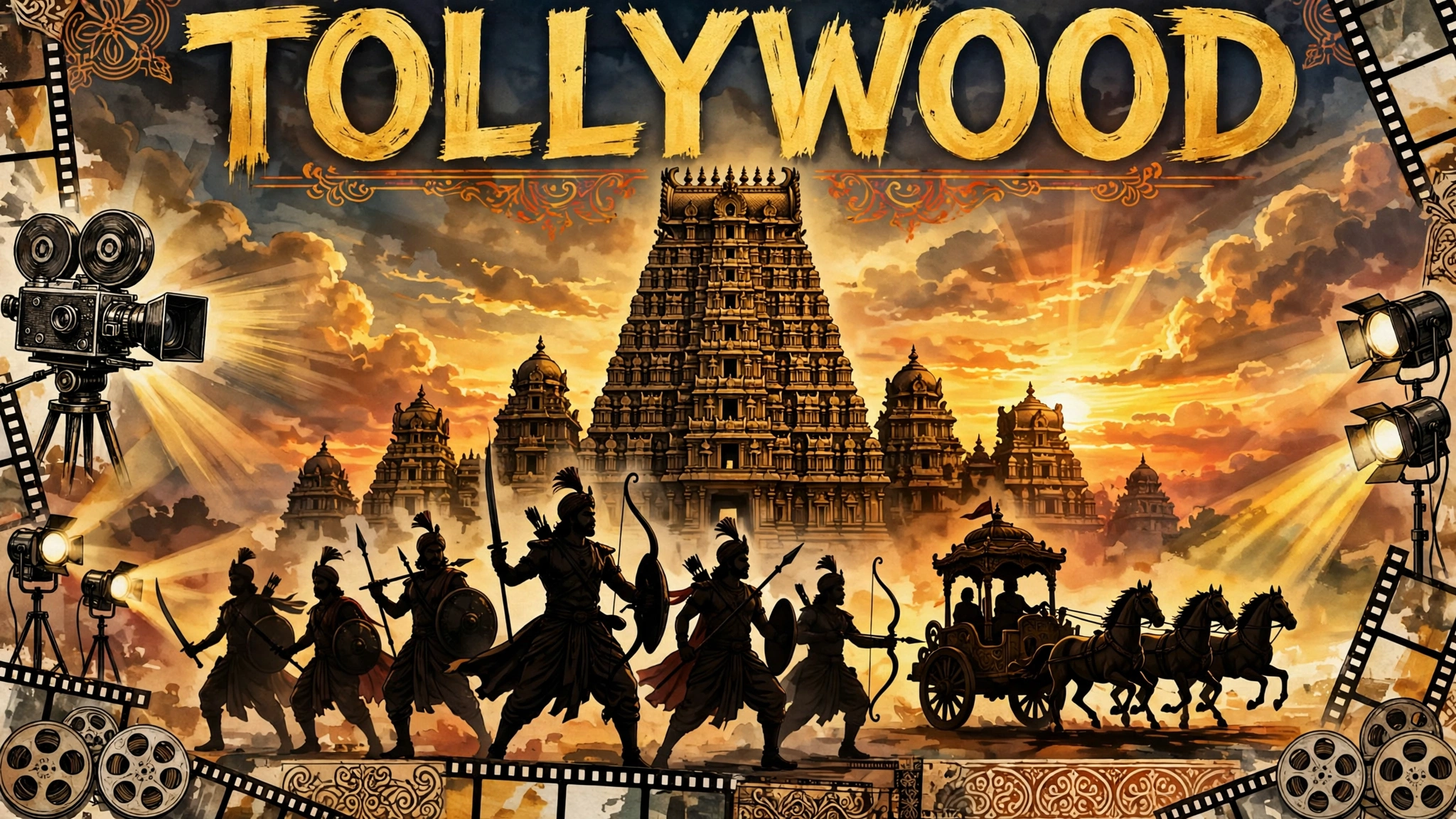
For decades, the rest of India treated Telugu cinema as a loud regional cousin — colourful, emotional, a little too fond of slow-motion hero entries. Then a prince carried a giant golden statue on his shoulders, a tribal warrior and a British-era officer danced their way to an Academy Award, and the whole world had to sit up and learn a new word: Tollywood. Today, the Telugu film industry produces some of the biggest, boldest and most technically ambitious movies anywhere on Earth, and its stars command opening weekends that most industries can only dream of.
But the spectacle did not arrive overnight. Behind the scale is a ninety-year-old storytelling culture built on mythology, music, family emotion and an almost sacred bond between stars and their fans. This guide takes you through the whole journey — where Tollywood came from, how its famous formula works, the filmmakers who changed it forever, and the films you should watch first, whatever kind of viewer you are. If you have only seen one or two Telugu blockbusters and wondered what the fuss is about, start here.
Tollywood is the nickname for the Telugu-language film industry, centred in Hyderabad, the capital of Telangana. The name blends “Telugu” with “Hollywood,” and the industry it describes is enormous: Telugu cinema serves audiences across Telangana and Andhra Pradesh, a huge diaspora around the world, and — increasingly, thanks to dubbed and pan-India releases — viewers in every Indian state and far beyond.
Its physical heart is Hyderabad’s Film Nagar and the sprawling studio floors of Ramoji Film City, one of the largest film studio complexes in the world, where entire ancient kingdoms, foreign streets and futuristic cities can be built within a single campus. But the industry’s real heart is in its theatres. A major Telugu star’s release is not treated as an ordinary film opening; it is a public festival, with giant cut-outs of the hero garlanded with flowers, fans bursting crackers at dawn shows, and tickets for the first day treated like trophies. Understanding Tollywood means understanding that devotion — because the films are made for an audience that does not merely watch its heroes. It celebrates them.
Telugu cinema began speaking in 1931 with Bhakta Prahlada, the first Telugu talkie, and it is fitting that the industry’s first sound film was a devotional story. From the very beginning, Telugu filmmakers drew their deepest material from the epics — the Ramayana, the Mahabharata and the Puranas — and those mythological films trained audiences to expect cinema on a grand, emotional scale. Gods descended, demons roared, and moral universes were settled in a single climax. The DNA of the modern Telugu spectacle was written in those early mythologicals: big feelings, clear moral stakes, and a hero whose arrival changes the weather of the story.
The golden decades that followed produced towering figures. N. T. Rama Rao became so inseparable from his screen portrayals of gods and kings that audiences genuinely revered him, and he carried that devotion all the way into public life as a chief minister. Akkineni Nageswara Rao anchored generations of family dramas and romances. Together with later greats, they established the twin pillars Tollywood still stands on: the mythic hero and the rooted family story.
Alongside the commercial mainstream, a parallel tradition of artistry flourished. Director K. Viswanath made films such as Sankarabharanam, a luminous story about classical music and a changing society that became a cultural landmark, and Sagara Sangamam, a heartbreaking portrait of a classical dancer. The illustrator-turned-director Bapu brought a painter’s eye and gentle humour to Telugu screens, while Jandhyala turned everyday middle-class life into comedy gold. This is a truth newcomers often miss: Tollywood was never only about size. It has always contained a quiet, literary, deeply human cinema inside the noisy one.
By the 1980s and 1990s, Telugu cinema had refined a commercial formula that the whole Indian industry would eventually borrow from. The ingredients became famous: a thunderous hero introduction, comedy tracks running alongside the main plot, songs shot in dream locations, family sentiment that could turn on the tears in a single scene, and action choreographed less like fighting and more like ritual celebration. Chiranjeevi, the era’s defining megastar, could dance, fight and emote with equal command, and a generation of stars — including Nandamuri Balakrishna, Nagarjuna and Venkatesh — kept the machine roaring.
It is easy to mock the formula from a distance, and Tollywood itself eventually grew tired of its weakest copies. But at its best, the masala film was a total entertainment contract with the audience: you will laugh, you will cry, you will whistle, and you will leave with your money’s worth of feeling. The interval block — the scene just before the halfway break — became a sacred craft of its own, engineered to send audiences into the lobby buzzing. When Hindi cinema later rediscovered larger-than-life heroism, it was, knowingly or not, studying lessons Telugu and Tamil filmmakers had been teaching for years.
The formula also had a darker, earthier branch: the faction drama, set against the feuds of Rayalaseema, where rival families, inherited violence and codes of honour drove stories of genuine power. That soil — rural, feudal, simmering — would later produce some of the most exciting Telugu films of the modern era.
Every industry has a before and an after. For Tollywood, the dividing line is S. S. Rajamouli. A director of obsessive discipline and mythic imagination, Rajamouli spent years making hit after hit within the Telugu system before he began bending it into something the world had never seen. His fantasy adventure Magadheera took a star vehicle and rebuilt it as a reincarnation epic spanning centuries. Then came the film that proved his imagination had no ceiling at all: Eega, in which a murdered young man is reborn as a housefly and wages war on the villain who killed him. A fly as an action hero sounds like a joke; in Rajamouli’s hands it became a masterclass in emotion-driven spectacle, and international audiences began to pay attention.
What followed redrew the map of Indian cinema. Baahubali: The Beginning ended on the most famous cliffhanger in modern Indian film — “Why did Kattappa kill Baahubali?” — and Baahubali 2: The Conclusion answered it with a mythic family saga of jealousy, duty and impossible heroism that audiences across India, in every language, embraced as their own. The Baahubali films were not just hits; they were proof that a Telugu production could be mounted at a scale, and with a craft, that matched anything in the world — and that Indian audiences would reward ambition without caring which language it arrived in.
Then came RRR, Rajamouli’s fictionalised tale of two real-life revolutionaries, Alluri Sitarama Raju and Komaram Bheem, reimagined as fire and water in a bromance for the ages. Western critics who had never reviewed a Telugu film found themselves cheering in cinemas; the song “Naatu Naatu” danced all the way to the Academy Award for Best Original Song, a universally documented first for an Indian feature film. After RRR, nobody could call Tollywood regional again. The student of world spectacle had become one of its teachers.
If Rajamouli showed what Telugu cinema could build, a younger generation of filmmakers showed what it could feel. The most thrilling development in modern Tollywood is not the size of its sets but the grain of its stories — films rooted in specific soil, dialect and memory.
The turning point for many was Sukumar’s Rangasthalam, a 1980s village drama about a hearing-impaired young man and his brother standing up to a tyrannical village president. Shot in the mud and heat of the Godavari region, it proved a superstar could disappear into a character and audiences would follow him anywhere. Sukumar later pushed rural rage even further with Pushpa: The Rise and Pushpa 2: The Rule, the saga of a red sandalwood smuggler whose swagger became a national catchphrase — proof that a rough-edged, dialect-heavy story from the Seshachalam hills could conquer the Hindi belt without sanding down a single edge.
Around them came a wave of films that trusted story over formula. Jersey told the story of a failed cricketer attempting a comeback in his late thirties, and reduced grown men across the country to tears with its father-son heart. Mahanati, a biopic of the legendary actress Savitri, was both a love letter to cinema’s golden age and a tragedy about what fame costs a woman. Sita Ramam revived the grand old-fashioned romance, all letters, longing and unspoken duty, and audiences swooned. Arjun Reddy split opinion right down the middle with its raw portrait of a self-destructive surgeon in love — a film as argued-about as it was influential, remade across India. And in Dasara, the coal country of Telangana got its own dust-and-blood epic of friendship and fury.
The lesson of this new wave is simple: Tollywood’s audiences never wanted only spectacle. They wanted belonging — stories that smell of their own earth. The industry’s smartest filmmakers now give them both.
Something fundamental changed after Baahubali. Telugu producers discovered that a film made honestly in Telugu, then dubbed with care, could open everywhere at once — and the “pan-India film” became the industry’s favourite ambition. The change had been building for years: Telugu films had long travelled through dubbed television broadcasts, and Mahesh Babu’s stylish action hit Pokiri had already been remade across languages, proof that Telugu commercial instincts translated anywhere. Director Trivikram Srinivas’s family entertainer Ala Vaikunthapurramuloo showed the warmer side of the same formula, a star vehicle built on wit, music and family feeling that travelled far beyond its home states through streaming.
The streaming era finished the job. Subtitles stopped being a barrier and became a doorway; a viewer in Delhi, Dubai or Dallas could discover a Telugu film the same weekend as a viewer in Vijayawada. Producers responded with budgets and canvas to match, mounting projects like Kalki 2898 AD, a science-fiction epic braiding the Mahabharata’s mythology with a dystopian future — the kind of swing only an industry confident of a national audience would dare to take. Not every pan-India gamble lands, and the failures can be expensive. But the direction is permanent: Tollywood no longer makes films for one audience. It makes them for everyone, in Telugu first.
A short honour roll for the newcomer. Among directors: K. Viswanath, the philosopher-poet of the classical tradition; Bapu, the painter of gentle village worlds; K. Raghavendra Rao, who industrialised the commercial hit; S. S. Rajamouli, the myth-maker who carried Telugu cinema to the world; Sukumar, the perfectionist of rural emotion; Trivikram Srinivas, the dialogue writer-director whose wit defines the family entertainer; and a restless new bench including Sandeep Reddy Vanga, Nag Ashwin and Sekhar Kammula, each pulling the industry in a different direction.
Among the stars: N. T. Rama Rao and Akkineni Nageswara Rao, the founding pillars; Chiranjeevi, the megastar who defined an era; and the modern constellation — Mahesh Babu, Allu Arjun, Ram Charan, N. T. Rama Rao Jr., Prabhas, Vijay Deverakonda, Nani and Rana Daggubati — alongside actresses from Savitri and Sridevi to Anushka Shetty, Samantha Ruth Prabhu and Keerthy Suresh, whose National Award-winning turn as Savitri in Mahanati announced a new standard for the biopic. Behind them stand the composers — from M. M. Keeravani, whose music carried both Baahubali and RRR, to Devi Sri Prasad, whose rhythms power the industry’s biggest dance floors. Tollywood is a star culture, but it has always been a crafts culture too.
Where should you begin? Here is a starter shelf, arranged as a journey rather than a ranking — every title links to our full FlickZada review.
The Spectacle Path. Begin with Baahubali: The Beginning and its conclusion, then RRR, then Eega. In four films you will understand exactly why the world changed its mind about Telugu cinema — and you will have the reference points every fan conversation assumes you know.
The Heart Path. Start with Jersey, Mahanati and Sita Ramam. These are the films to show anyone who still believes Telugu cinema is only about action. Keep tissues nearby; all three earn their tears honestly.
The Earth Path. Watch Rangasthalam, Dasara and the two Pushpa films. This is the modern, rooted Tollywood — dialect, dust, village politics and heroes who fight like the land itself is at stake. If these grip you, the whole new wave is yours to explore.
A practical word on language: watch in Telugu with subtitles whenever you can. Dubbing has improved enormously, and the big releases are genuinely well served by it, but the rhythm of Telugu dialogue — especially Sukumar’s village speech and Trivikram’s wordplay — is half the pleasure. The performances were tuned to those voices. Trust the subtitles; they will not slow you down for long.
What is the difference between Tollywood and Bollywood? Bollywood is the Hindi-language industry based in Mumbai. Tollywood is the Telugu-language industry based in Hyderabad. They have different stars, different storytelling traditions and different home audiences — though the biggest Telugu films now release across India in dubbed versions, just as major Hindi films release in the South.
Which Telugu film should a complete beginner watch first? Baahubali: The Beginning is the safest doorway: its mythology, emotion and spectacle need no cultural homework, and its sequel is even better. If you prefer emotion over scale, start with Jersey instead.
Did a Telugu song really win an Oscar? Yes. “Naatu Naatu” from RRR, composed by M. M. Keeravani, won the Academy Award for Best Original Song — a landmark moment for Indian cinema as a whole, achieved by a Telugu production.
Are Telugu films always three hours long with songs? The classic commercial format does favour generous runtimes, songs and an interval high point, and the biggest entertainers still honour it. But the modern industry is flexible: many new-wave Telugu films run closer to two hours, use songs sparingly, and play like lean thrillers or dramas. The variety is the point of this guide.
What does “pan-India film” mean? It describes a film designed from the start to release across all of India’s language markets at once, usually shot in one language and dubbed into the others (occasionally shot in two). Baahubali proved the model; Pushpa and Kalki 2898 AD confirmed it. Tollywood pioneered the modern version of the idea.
Tollywood’s story is, at heart, a story about confidence. An industry raised on gods and epics never learned to apologise for emotion, for scale, or for believing a hero’s entrance should feel like thunder. It kept that faith through decades when the rest of the country looked down its nose — and when technology, streaming and one generation of fearless filmmakers finally gave it the world’s stage, it was ready, because it had been rehearsing for the world’s stage all along.
The best news for new viewers is that the library is deep in every direction: mythologicals and masala classics behind you, Rajamouli’s epics at the centre, and a new wave of rooted, restless storytellers ahead. Wherever you enter, FlickZada’s Tollywood reviews will walk with you — honest ratings, no spoilers, and the context that turns a good film night into the start of a genuine obsession. Pick a pathway above, press play, and welcome to Hyderabad. The cut-outs are garlanded, the crackers are lit, and the show is about to begin.