★ LATEST REVIEWS

★★★★☆ Our Rating: 8.5/10
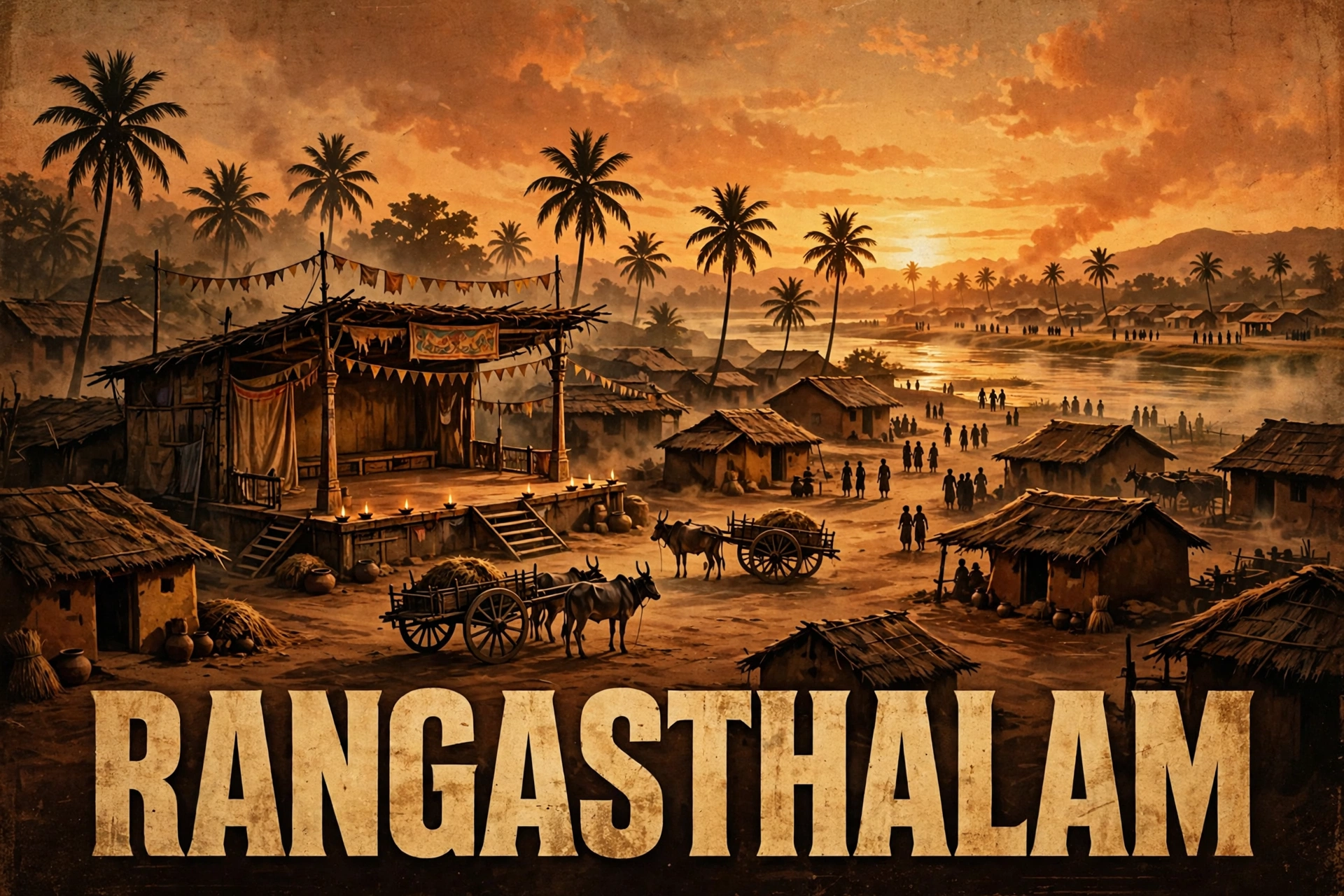
There is a version of Rangasthalam that could have been just another star vehicle in a period costume. Sukumar refused to make that film. Released on 30 March 2018, his 1980s village drama strips Ram Charan of every trace of polished star image and drops him — hearing-impaired, barefoot in the dust, heart completely on his sleeve — into a fictional village ruled by fear dressed up as tradition. What comes back is one of the most fully realised rural films in modern Telugu cinema, and a performance that permanently changed what audiences believed its lead actor could do.
An honest Rangasthalam review has to hold two truths together. The film is long, deliberately paced and, in stretches, unapologetically melodramatic; viewers raised on tighter thrillers may feel its near-three hours. It is also rich in ways most commercial films never attempt to be: every song grows out of the soil of the place, every supporting character feels lived-in rather than cast, and its portrait of how a village learns to stop being afraid builds to an emotional payoff that bigger, louder films rarely earn. The length is a real cost. What it buys is a world.
This review covers the spoiler-free story, the performances, Sukumar’s direction and the film’s remarkable technical craft, Devi Sri Prasad’s folk-rooted music, what works and what does not, the box office in flagged trade figures, and why this film’s reputation has only grown since 2018.
| Detail | Information |
|---|---|
| Release date | 30 March 2018 |
| Director | Sukumar |
| Writers | Sukumar |
| Genre | Period Action, Drama |
| Language | Telugu |
| Runtime | 174 minutes |
| Budget | ₹60 crore (reported figure — see Box Office note) |
| Lead cast | Ram Charan, Samantha Ruth Prabhu, Jagapathi Babu, Aadhi Pinisetty, Prakash Raj, Anasuya Bharadwaj |
| Our rating | 8.5/10 |
Rangasthalam, in the 1980s, is the kind of village where everyone knows the rules and nobody says them aloud. The co-operative society — and through it, credit, livelihoods and dignity — is controlled by its president, Phanindra Bhupathi, a man whose power survives because it rarely needs to raise its voice. Debts are manipulated, dissenters are ruined or worse, and the village has long ago made its peace with fear by calling it fate.
Into this stillness, the film places two brothers with opposite temperatures. Chittibabu, a boat motor mechanic and the film’s beating heart, is partially hearing-impaired, quick to laugh, quick to fight and constitutionally incapable of the careful silence the village runs on. He loves Rama Lakshmi with cheerful openness and idolises his elder brother, Kumar Babu, who has been away and returns with an education, a conscience and a dangerous idea: that Bhupathi’s machine can be challenged openly, through an election, in daylight. When Kumar Babu decides to stand against the president, the film’s real story begins — not simply good men against a bad one, but a whole community having to decide, person by person, what its silence has been costing.
Around the brothers, Sukumar builds a complete social world: the local MLA whose support everyone courts and nobody trusts, Rangamma, whose knowledge of the village runs deeper than her position suggests, and families calculating survival in every scene. There is romance, comedy, festival colour and sudden violence, but the engine is always the same question — how does fear actually rule, and what does it take, and cost, for ordinary people to withdraw their obedience? The final act answers that question with twists we will not spoil here. Suffice to say the film’s last stretch recontextualises much of what came before, and rewards the patience the first half demanded.
Ram Charan as Chittibabu gives the defining performance of his career to that point, and arguably still its benchmark. The achievement is not the hearing impairment itself, though he sustains it with impressive consistency; it is the total absence of vanity. Chittibabu is allowed to be foolish, frightened, petty and wrong, and Charan plays all of it at full size alongside the heroism, so the character feels grown rather than designed. His physicality — the turned ear, the explosive laugh, the grief he seems to carry in his shoulders — turns what could have been a gimmick into a person. He won the Filmfare Award South for Best Actor for this role, and the performance fully earns it.
Samantha Ruth Prabhu as Rama Lakshmi matches him in earthiness, which is its own kind of bravery for a leading actor of her stature at the time. Her Lakshmi is funny, sharp-tongued, superstitious and brave, and the romance works because it is played as two village people teasing and testing each other, not as a star duet in costume. Aadhi Pinisetty as Kumar Babu supplies the film’s moral spine: restrained, principled and warm, he makes idealism look like a temperament rather than a slogan, which is why the story’s turns around him land so hard. Jagapathi Babu as Phanindra Bhupathi is a study in quiet menace — a villain who whispers, smiles and lets systems do his cruelty for him; he is more frightening in a chair than most screen villains are with a weapon.
The supporting cast is unusually deep. Anasuya Bharadwaj as Rangamma won wide acclaim, including Filmfare recognition, for a performance full of knowing humour and buried pain. Prakash Raj brings his customary ambiguity to the politician Dakshina Murthy, a man whose every kindness has a price attached. Naresh, Rohini and the wider ensemble fill out a village that never feels like a backdrop — a credit to both casting and direction, because in a film this long, weak supporting work would have been fatal.
Sukumar’s direction is the film’s co-author alongside its performances. Known for psychologically intricate, urban films, he reinvented himself here as a chronicler of rural life, and the reinvention is total: dialect, costume, ritual, agriculture, debt, caste-shadowed power and village entertainment are observed with a novelist’s patience. The famous village set, built at considerable expense near Hyderabad with portions shot around Rajahmundry, gives the film a physical completeness modern productions often fake with effects. R. Rathnavelu’s cinematography — the film was among the first Indian productions shot entirely on Red Helium 8K cameras — finds beauty without prettifying poverty: dust, sweat, river light and festival colour share the same frame honestly.
The craft supports the politics. Notice how Bhupathi is framed in stillness while Chittibabu is framed in motion; how public scenes are staged so you can watch the crowd decide, face by face, whether to be brave. Naveen Nooli’s editing trusts long scenes to build, which is mostly a virtue. The reservation, honestly stated, is pace: at 174 minutes (some listings and versions run a few minutes longer), the middle stretch lingers, a couple of confrontations repeat beats the audience has already absorbed, and viewers who prefer their dramas lean will feel it. Sukumar is building a world at walking pace. We think the destination justifies the walk — but it is fair to warn you the walk is part of the ticket.
The sound design deserves its own sentence: the film won the National Film Award for Best Audiography, and Chittibabu’s partial hearing is woven into the mix itself, so the audience periodically experiences the village at his distance from it. It is the rare technical choice that is also an emotional one.
Devi Sri Prasad, Sukumar’s frequent collaborator, delivered one of the finest albums of his career by going smaller and folkier instead of bigger. The songs are sung in the voices of the place — “Yentha Sakkagunnaave” aches with rural romance, “Rangamma Mangamma” turns teasing into theatre, and “Aa Gattununtaava” carries the dust of a working song. Chandrabose’s lyrics root every number in the dialect and imagery of the village, and Sukumar stages the songs inside the life of Rangasthalam — its stage, its fields, its festivals — so they deepen the world instead of pausing it. The special appearance number, “Jigelu Rani,” functions as period village entertainment rather than a modern item-song intrusion, which is a subtle but real distinction.
DSP’s background score understands when to stay out of the way. Long dialogue passages play almost dry, folk percussion and strings gather under the election and confrontation sequences, and the emotional climaxes are scored for swell without drowning the actors. Devi Sri Prasad won Filmfare recognition for the music, and years later it is the album — as much as any single scene — that keeps the film present in Telugu popular culture.
What we loved:
What could be better:
Indian box office numbers are trade estimates rather than audited results, so we present them the honest way. The budget is consistently reported at ₹60 crore across reference listings, and we show it on that basis. Worldwide collections are most commonly cited at approximately ₹216 crore, with some trackers placing the total slightly higher, around ₹219 crore; we describe it as roughly ₹216 crore. The interpretation is not in doubt: Rangasthalam was the highest-grossing Telugu film of 2018, a blockbuster that ran strongly despite releasing without the protection of a festival weekend, and it did so on the strength of word of mouth — the most valuable currency a long, star-deglamourised village drama can earn. Its awards haul matched the money, including five Filmfare Awards South and the National Award for Best Audiography noted above.
Yes — this is essential viewing for anyone who wants to understand modern Telugu cinema beyond its loudest blockbusters. Come prepared for length and for a film that trusts scenes, faces and silences more than speed, and Rangasthalam repays that trust with one of the most emotionally complete commercial dramas of its decade. Action-first viewers may find its pleasures slower than expected; everyone else should expect to be thinking about Chittibabu, and about how fear actually works in a community, long after the credits.
Our rating: 8.5/10 — a rich, patient, beautifully acted village epic; long and melodramatic in places, and all the more powerful for how completely it commits.
Is Rangasthalam based on a real village or true events?
No. Rangasthalam is a fictional village and its story is an original creation by Sukumar. The film draws on recognisable realities of 1980s rural Andhra Pradesh — co-operative politics, debt and village power structures — but Chittibabu, Bhupathi and their story are invented.
Why is Ram Charan’s performance in Rangasthalam considered his best?
Because he abandons star glamour entirely: the dialect, the hearing impairment, the foolishness and the grief are all played without vanity. Critics and awards bodies agreed — he won the Filmfare Award South for Best Actor, and the role is still the reference point for his range as an actor.
How long is Rangasthalam, and does it feel its length?
The standard runtime is 174 minutes. The middle section is deliberately unhurried as the village world and election story build. Most viewers find the final act justifies the patience, but it is a film to watch in one committed sitting, not in fragments.
Is Rangasthalam suitable for family viewing?
Broadly yes for older children and adults: it is a period drama with episodes of violence, including a hard-hitting final act, and themes of oppression and loss. It contains no content beyond mainstream Indian commercial cinema, but its emotional intensity is real.
Where can I watch Rangasthalam?
It is widely available on major streaming platforms in Telugu, with dubbed versions in several languages released over the years. Availability varies by region, so check your local services.