★ LATEST REVIEWS

Our Rating: ★★★★★ 9/10
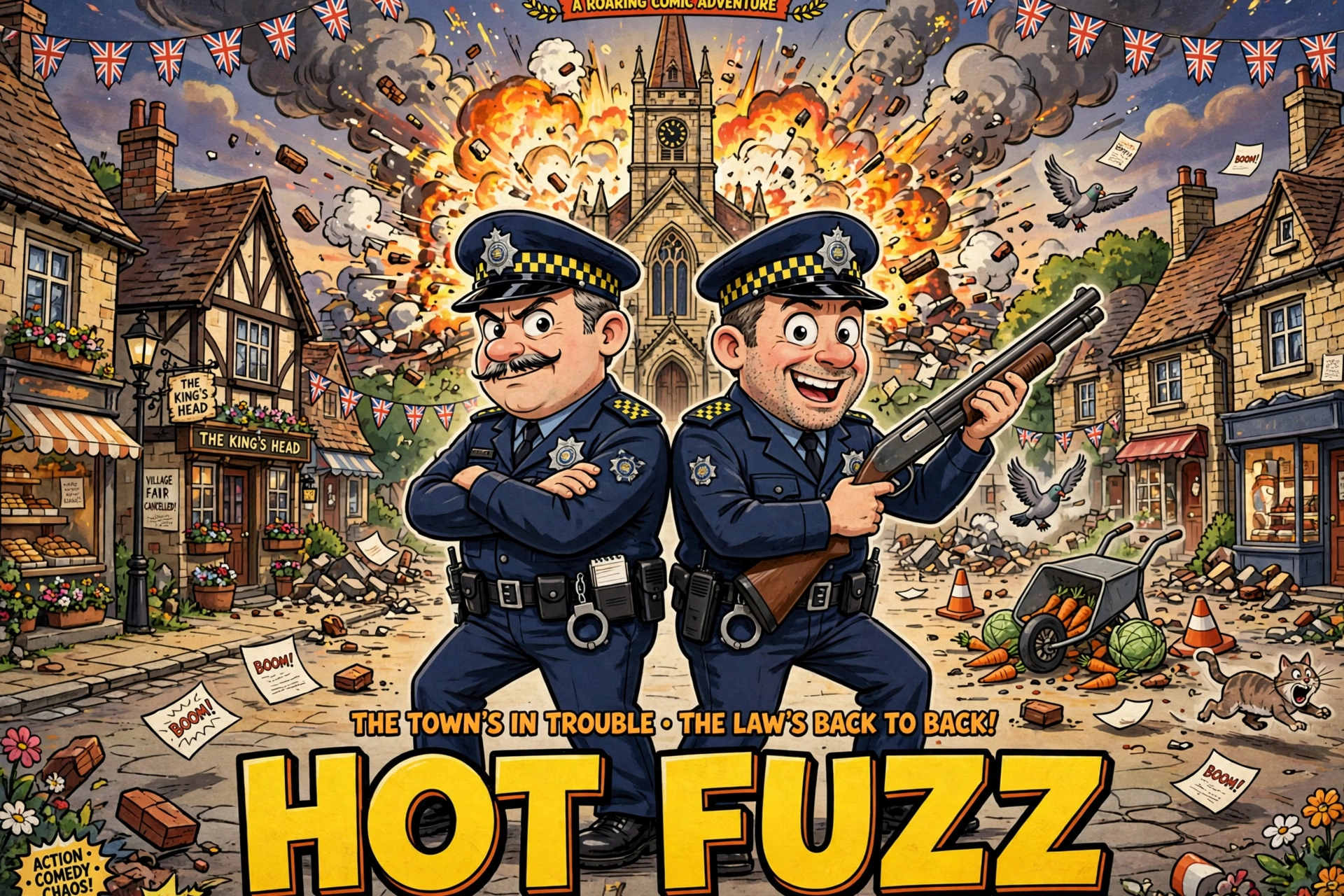
Every action film fan knows the feeling: the hero walks into a quiet town, senses something is wrong, and the film slowly reveals that the town is not quiet at all. Hot Fuzz takes that premise, sets it in the sleepiest village in England, and then does something no other action comedy has ever quite managed — it earns its explosion. For two-thirds of its runtime it is a gentle, witty comedy about a big-city policeman exiled to the countryside. Then, in its final act, it becomes a full-blooded action film, and the joke is that every silly detail from the first two acts turns out to have been a setup. It is, by common consent, one of the cleverest comedies ever made in Britain.
Directed by Edgar Wright and co-written by Wright and Simon Pegg, Hot Fuzz is the second film in the Three Flavours Cornetto trilogy after Shaun of the Dead, and its most commercially successful. It is also a film that rewards repeat viewing more than almost any other comedy: once you know what is going on, every throwaway line, every background detail and every seemingly pointless character becomes part of the machine.
| Detail | Information |
|---|---|
| Release date | 16 February 2007 (United Kingdom, theatrical; premiered 13 February 2007) |
| Director | Edgar Wright |
| Writers | Edgar Wright, Simon Pegg |
| Genre | Action, Comedy, Crime |
| Language | English |
| Runtime | 121 minutes |
| Budget | $12–16 million (sources vary) |
| Lead cast | Simon Pegg, Nick Frost, Jim Broadbent, Timothy Dalton, Paddy Considine |
| Our rating | 9/10 |
Police Constable Nicholas Angel is, by the numbers, the best policeman in London. His arrest record is so good that it makes the rest of his team look bad, so the Metropolitan Police solve the problem the way bureaucracies do: they promote him and transfer him to Sandford, a sleepy village in the West Country that has just won Village of the Year and where, officially, nothing ever happens. Angel arrives to find a police force that spends its days on pub quizzes, neighbourhood watch meetings and the annual fete, and a partner, Police Constable Danny Butterman, who is less interested in procedure than in action films — he has seen Point Break and Bad Boys II more times than he can count and quotes them constantly.
Then people in Sandford start dying. Each death looks like a gruesome accident — a car crash, a fall, a mishap with a church roof — and the village is very keen to treat them as accidents. Angel is not keen. He is a policeman who notices things, and he notices that the accidents keep happening to people who, in one way or another, threatened Sandford’s perfect record. This review will not reveal who is behind the deaths, or how Angel’s investigation ends. It is enough to say that the final act pays off nearly every joke the film has told, that the village’s secret is both funnier and darker than it first appears, and that the last twenty minutes contain some of the best-staged action in any British film.
Simon Pegg as Nicholas Angel — Pegg’s Angel is a masterpiece of comic control. He plays the character completely straight: humourless, rule-bound, incapable of relaxing, delivering lines like “Police Constable Nicholas Angel. Born and schooled in London” with the gravity of a state occasion. The comedy comes from the collision between that rigidity and a village that runs on favours, gossip and cake. As the film goes on, Pegg lets Angel loosen — partly through Danny’s influence, partly through exasperation — and the loosening is the film’s emotional arc. It is a performance that understands that the straight man is the hardest job in comedy.
Nick Frost as Danny Butterman — Frost is the film’s heart. Danny is dim, enthusiastic, kind and obsessed with action cinema, and Frost plays him without a trace of condescension: Danny’s love of films is not a joke at his expense but the film’s secret thesis — that the stories we love shape how we see the world. The Angel–Danny partnership is one of the great screen double acts, and their scenes together, from the first awkward patrol to the final shootout, are the reason the film works as a buddy movie as well as a parody.
The village — The supporting cast is a roll call of British character acting: Jim Broadbent as the avuncular Inspector Butterman, Timothy Dalton as the smooth supermarket manager Simon Skinner, Paddy Considine as the sarcastic Detective Sergeant Wainwright, and a deep bench including Bill Bailey, Edward Woodward, Billie Whitelaw, Paul Freeman, Kenneth Cranham and Rafe Spall. Almost every villager has a surname that is also a job or activity — Cooper, Porter, Turner, Shooter, Butcher, Skinner — a joke that is never explained and never needs to be. The depth of the ensemble is what makes Sandford feel like a real place rather than a backdrop, and it is why the film’s revelations land.
Edgar Wright’s direction is the film’s other star. His signature style — whip pans, crash zooms, rapid-fire montage, sound effects cut to the frame — is used here not as decoration but as storytelling. The opening sequence, which compresses Angel’s London career into a breathless montage of paperwork, arrests and commendations, tells you everything about the character in two minutes. The village sequences are shot with the same energy applied to nothing much happening, which is the joke: Wright films a man buying an ice cream with the urgency of a drugs raid.
The action, when it arrives, is genuinely superb. Wright studied more than a hundred action films while writing the script, and the final act borrows their grammar — the slow-motion walk, the gun rack, the one-liner before the shootout — while staging the violence with a clarity and invention that many straight action films lack. The geography of Sandford is always legible, the stunts are physical and funny, and the film never loses its comic timing even at its most explosive. Jess Hall’s cinematography makes the Somerset locations (the film was shot largely in Wells) look both idyllic and faintly sinister, and Chris Dickens’s editing is the engine of the whole enterprise: the film’s rhythm, its jokes-per-minute, lives in the cut.
There is also a craft lesson in the script’s construction. Wright and Pegg plant information with extraordinary discipline. Lines that sound like jokes in the first act turn out to be clues; characters who seem to exist for one gag turn out to matter. It is a screenplay built like a puzzle box, and it is why the film improves on a second viewing.
David Arnold’s score does the film’s genre work with a straight face, which is exactly right. It swells and pounds like a proper action score — and because the film treats its village stakes with blockbuster seriousness, the music never feels like a parody of itself. Around it, Wright layers a soundtrack of knowing choices: the use of Dire Straits’ “Romeo and Juliet” is both a joke and a genuine emotional beat, and the sound design — every door slam, paper rustle and gunshot exaggerated to comic-book loudness — is part of the film’s comedy. The music tells you that Sandford’s story matters as much as any city shootout, and by the end, you believe it.
What we loved:
What could be better:
Hot Fuzz premiered in the United Kingdom on 13 February 2007 and opened theatrically on 16 February, grossing about $80.7 million worldwide. That made it the most commercially successful film in the Cornetto trilogy, comfortably ahead of Shaun of the Dead. On the budget, sources differ: the most commonly cited range is $12–16 million, with some databases quoting the lower end ($12 million, roughly £8 million) and others the higher ($16 million). We give the range rather than picking a single figure, because the sources genuinely disagree. On any version of the budget, the film was a strong commercial success, earning roughly five times its cost, and it has since become one of the most quoted and rewatched British comedies of its era — Empire named it the 67th-greatest film of the 21st century in 2020.
Yes — twice, at least. Once to enjoy the ride, and once to catch everything you missed. Hot Fuzz is that rare comedy that is both a loving tribute to action cinema and a genuinely great example of it, a village mystery that is also a buddy movie, and a puzzle that is also a laugh riot. It is funny in the first scene and thrilling in the last, and the distance between those two things is the whole point.
If you have never seen it, go in knowing as little as possible. If you have seen it, you already know why you are going back.
Our rating: 9/10 — A flawlessly constructed action comedy that earns every explosion it sets off.
Is Hot Fuzz part of a trilogy?
Yes. It is the second film in the Three Flavours Cornetto trilogy, after Shaun of the Dead (2004) and before The World’s End (2013). The three films share a director, stars and themes, but each tells a standalone story.
Do I need to see Shaun of the Dead first?
No. Hot Fuzz works entirely on its own, though fans of the first film will enjoy the shared jokes and cameos.
Where was Hot Fuzz filmed?
Mostly in Wells, Somerset, in the West Country of England, which stands in for the fictional village of Sandford.
How long is Hot Fuzz?
It runs 121 minutes — just over two hours.
Where can I watch Hot Fuzz?
It is available on major streaming and digital purchase services in many regions, though availability changes by country and over time, so check your local platforms.