★ LATEST REVIEWS

Our Rating: ★★★★☆ 7.5/10
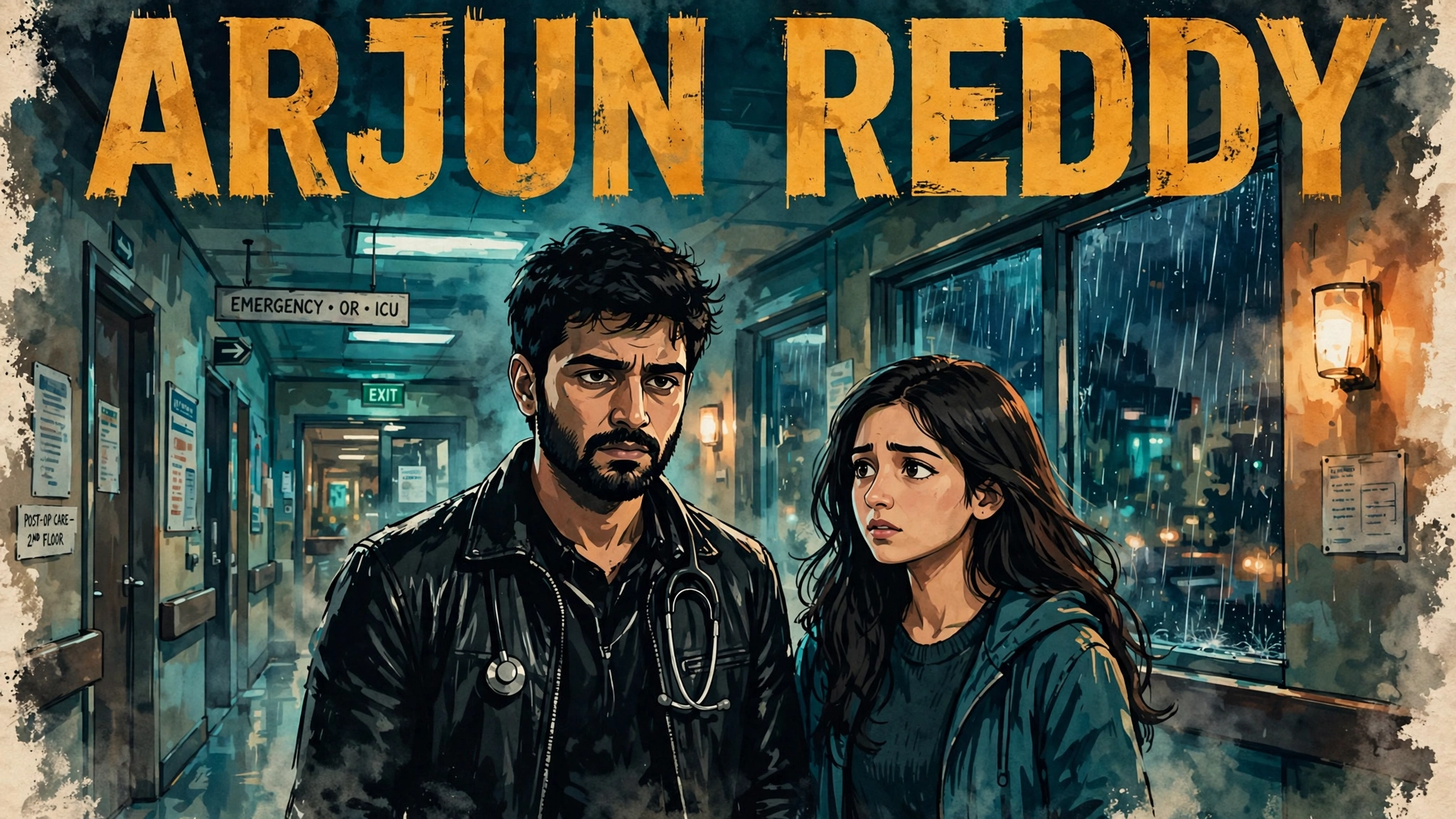
Few Indian films of the last decade have divided audiences like Arjun Reddy. To its admirers, Sandeep Reddy Vanga’s 2017 Telugu drama is a raw, fearless portrait of love, self-destruction and redemption, powered by a career-making performance from Vijay Deverakonda. To its critics, it glorifies toxic behaviour, romanticises alcoholism and treats its heroine as a possession rather than a person. Both views have truth in them, and that tension is exactly why the film is worth discussing seriously rather than dismissing or worshipping.
What cannot be disputed is its impact. Made on a tiny budget, it became a cultural phenomenon in Telugu cinema, launched Deverakonda as a star, and was remade in Hindi as Kabir Singh (2019) and in Tamil as Adithya Varma (2019). It is a film that demands a response, and this review tries to give it a fair one: admiring its craft and its lead performance while being honest about its problems.
| Detail | Information |
|---|---|
| Release date | 25 August 2017 (India) |
| Director | Sandeep Reddy Vanga |
| Writer | Sandeep Reddy Vanga |
| Genre | Romantic Drama |
| Language | Telugu |
| Runtime | 182 minutes |
| Budget | ₹5–5.15 crore |
| Lead cast | Vijay Deverakonda, Shalini Pandey, Rahul Ramakrishna, Jia Sharma, Sanjay Swaroop, Kamal Kamaraju |
| Our rating | 7.5/10 |
Arjun Reddy Deshmukh is a brilliant, arrogant medical student with anger-management problems and a genius for surgery. At college he falls in love with Preethi Shetty, a first-year student, and their relationship grows over several years despite his possessiveness and temper. When Preethi’s family arranges her marriage to someone else, Arjun’s world collapses. He becomes a house surgeon, but his grief turns into alcoholism, drug use and reckless behaviour, and his career, his friendships and his health all begin to unravel.
The film follows Arjun’s downfall and, eventually, his slow attempt to climb back. This review will not reveal how that recovery unfolds or whether Arjun and Preethi find their way back to each other, because the film’s second half works best when its turns are not known in advance. What matters is the shape: this is not a love story in the conventional sense, but a character study of a man who loves intensely, possesses fiercely and destroys himself thoroughly — and who must learn, painfully, that love is not ownership.
A content note is appropriate: the film contains heavy alcohol and drug use, strong language and scenes of toxic, controlling behaviour in a relationship. Viewers who find those subjects distressing should be aware before watching, and the film’s treatment of them is a legitimate subject of criticism, discussed below.
Vijay Deverakonda as Arjun Reddy — This is the performance that made Deverakonda a star, and it is easy to see why. He is magnetic in every register the role demands: arrogant and charming as the college senior, terrifying in his rages, broken and funny in his self-destruction, and quietly moving in his moments of clarity. Deverakonda does not soften Arjun or ask the audience to excuse him; he plays him as a man of enormous talent and enormous flaws, and that honesty is what makes the film work. He won the Filmfare Award for Best Actor (Telugu), and it was fully deserved.
Shalini Pandey as Preethi Shetty — Pandey is gentle and affecting as Preethi, and she gives the character a quiet dignity that the script does not always grant her. The honest criticism is that Preethi is underwritten: she is seen largely through Arjun’s eyes, her inner life is thinly drawn, and the film asks her to absorb behaviour that no one should have to absorb. Pandey does her best with the material, and her scenes of confusion and hurt are genuinely touching, but the film’s failure to give Preethi equal weight is a real weakness.
Rahul Ramakrishna as Shiva and the supporting cast — Ramakrishna is excellent as Shiva, Arjun’s loyal friend, providing humour, warmth and the film’s moral compass. He is the friend who stays when everyone else leaves, and his performance grounds the film’s wilder stretches. Jia Sharma, Sanjay Swaroop and Kamal Kamaraju are solid in support, and the medical-college setting feels authentic, drawn from the director’s own background as a physiotherapy student.
Sandeep Reddy Vanga’s direction is bold and uncompromising. He shoots the film with a raw, handheld energy that suits its subject: the college scenes buzz with life, the hospital scenes feel real rather than glamorous, and the self-destruction sequences are filmed without flinching. Cinematographers Raj Thota and Nagesh Banell give the film a gritty, naturalistic look, and editor Shashank Mali holds together a long, non-linear narrative that jumps between Arjun’s past and present.
The film’s length — 182 minutes — is both a strength and a weakness. The slow build of Arjun and Preethi’s relationship makes the loss feel real, but the middle stretch of self-destruction repeats itself, and some sequences could have been cut without losing anything. Vanga’s refusal to moralise is a double-edged sword: it makes the film feel honest, but it also means the film never clearly condemns behaviour that many viewers will rightly find troubling. Whether that is brave ambiguity or irresponsible glorification is the central debate about the film, and viewers will have to decide for themselves.
The songs by Radhan and the background score by Harshavardhan Rameshwar are integral to the film’s cult appeal. “Madhurame”, “Telisiney Na Nuvvey” and “Emitemitemo” capture the romance’s tenderness and ache, and the score underlines Arjun’s moods — swagger, despair, fury — without overpowering them. The music is one of the reasons the film travelled so far beyond Telugu audiences: its melodies are hummable, its emotions are direct, and its songs became anthems for a generation of young listeners. Even critics of the film’s story often praise its soundtrack.
What we loved:
What could be better:
Arjun Reddy was made on a budget reported as ₹5–5.15 crore, an extremely small sum for a film of its scale, and it grossed about ₹51 crore worldwide — roughly ten times its budget. That return, combined with its cultural impact, made it one of the most profitable Telugu films of its year and launched a franchise of remakes. It received six nominations at the Filmfare Awards South, winning Best Actor for Deverakonda. Its success also sparked a wider conversation in Indian cinema about how films portray masculinity, consent and addiction — a conversation that continues, and that the film’s defenders and critics both deserve credit for starting.
Yes — with open eyes and a critical mind. Arjun Reddy is not a comfortable film, and it should not be watched as a guide to relationships. It is a powerful, flawed, fiercely acted character study that understands self-destruction from the inside and refuses to look away. Its problems are real and serious, and they are part of why it matters: it forces a conversation about what we celebrate in our heroes. Watch it for Deverakonda’s performance, for its craft and for its music, and argue about it afterwards. That argument is part of the film’s legacy.
Our rating: 7.5/10 — A blazing, troubling, unforgettable drama that earns its cult status without earning a free pass.
Is Arjun Reddy based on a true story?
No, though director Sandeep Reddy Vanga has said it was partly inspired by his own experiences as a physiotherapy student.
Is Arjun Reddy suitable for younger viewers?
No. It is certified for adults and contains heavy alcohol and drug use, strong language and toxic relationship behaviour.
What are the remakes of Arjun Reddy?
It was remade in Hindi as Kabir Singh (2019) starring Shahid Kapoor, and in Tamil as Adithya Varma (2019) starring Dhruv Vikram.
How long is Arjun Reddy?
It runs 182 minutes, about three hours; an unreleased director’s cut is reported to be much longer.
Where can I watch Arjun Reddy?
It is available on major streaming and digital platforms in many regions, though availability changes by country and over time, so check your local services.