★ LATEST REVIEWS

Our Rating: ★★★★☆ 8.5/10
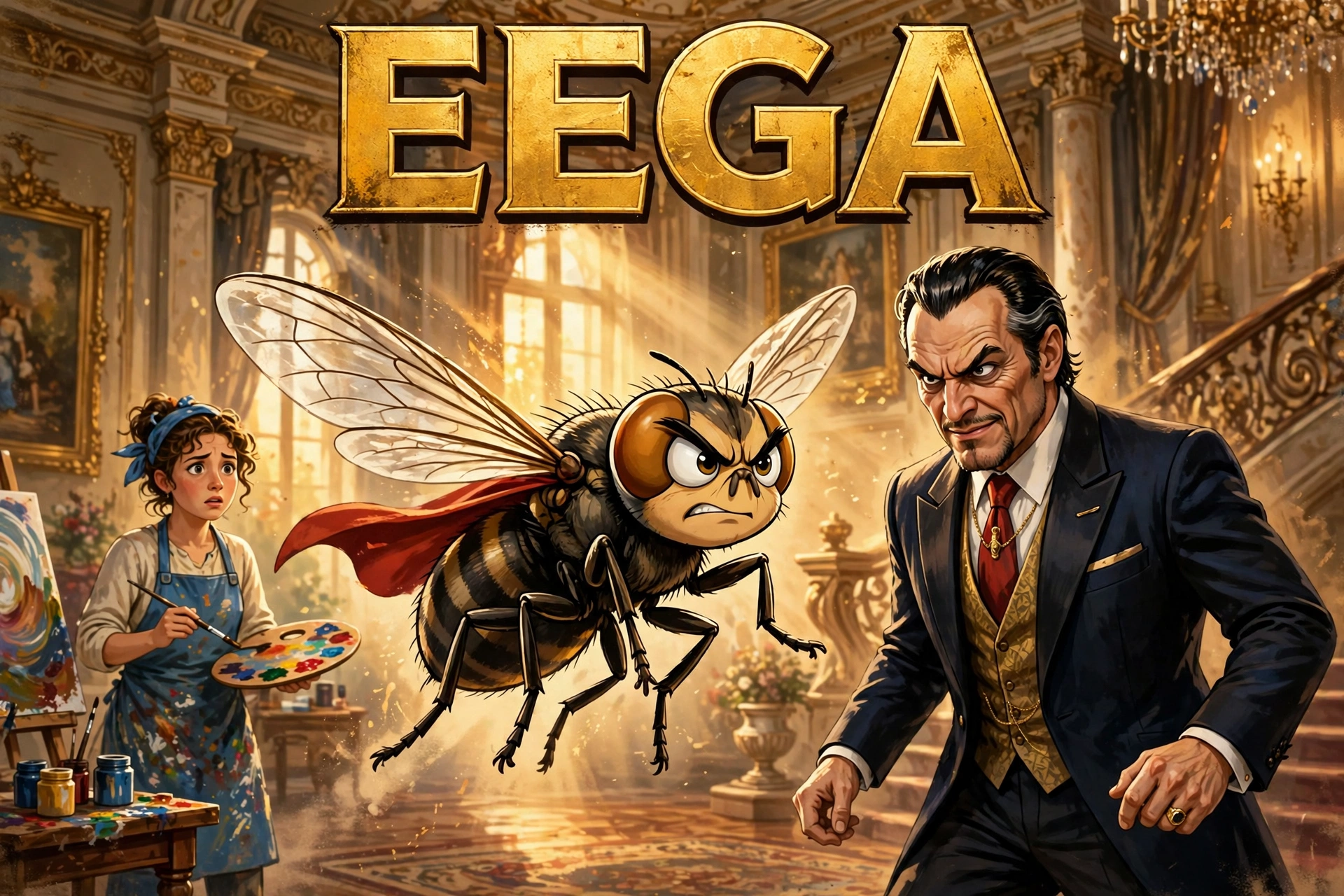
There is a moment, early in Eega, when you realise you are not watching a joke. A man has been murdered, he has been reborn as a housefly, and he is planning his revenge — and you are completely invested. That is the miracle of S. S. Rajamouli’s 2012 fantasy action film: it takes the most absurd premise in mainstream Indian cinema and plays it with total sincerity, dazzling craft and genuine emotion. The result is one of the most original and entertaining films ever made in Telugu cinema, and a calling card for the director who would go on to make Baahubali.
The film was made simultaneously in Tamil as Naan Ee, and dubbed into Malayalam as Eecha and Hindi as Makkhi. Its hero is a fly. Its villain is a multimillionaire industrialist. Its love story is between a fly and a woman who does not know he is there. On paper, it should not work. On screen, it works gloriously.
| Detail | Information |
|---|---|
| Release date | 6 July 2012 (India) |
| Director | S. S. Rajamouli |
| Writer | S. S. Rajamouli; dialogues by Janardhana Maharshi (Telugu), Crazy Mohan (Tamil) |
| Genre | Fantasy, Action, Comedy |
| Language | Telugu (also Tamil as Naan Ee) |
| Runtime | 134 minutes |
| Budget | ₹26–40 crore (sources conflict; see Box Office) |
| Lead cast | Nani, Samantha, Sudeepa, Hamsa Nandini, Devadarshini, Santhanam (Tamil version) |
| Our rating | 8.5/10 |
The film is framed as a bedtime story told by a father to his daughter, which is exactly the right frame: this is a fairy tale, and fairy tales can get away with anything if they are told well. Nani is a cheerful young man who loves his neighbour Bindu, a micro-artist who creates tiny works of art. Bindu likes him but has not yet said yes. Their happiness is shattered by Sudeep, a wealthy, ruthless industrialist who wants Bindu for himself and sees Nani as an obstacle to be removed.
Nani is murdered — and then, in the film’s great leap, he is reborn as a housefly. He retains his memories, his love for Bindu and his hatred of Sudeep, and he sets out to do what no fly has ever done: torment, outwit and ultimately defeat a powerful human being. This review will not reveal the fly’s ingenious methods or how the final confrontation unfolds, because the film’s joy lies in its inventions. It is enough to say that the story is structured like a classic revenge drama — the hero is weak, the villain is strong, and the hero must use brains rather than brawn — except that the hero is two centimetres long, and every ordinary object becomes a weapon or a trap.
Sudeepa as Sudeep — Sudeepa gives one of the great villain performances in Indian cinema. His Sudeep is charming, vain, terrifying and, as the film goes on, increasingly unhinged. The genius of the performance is that he plays it absolutely straight: he is not winking at the absurdity of being terrorised by a fly, he is genuinely, hilariously, frighteningly losing his mind. His descent from confident industrialist to paranoid wreck is the film’s comic and dramatic engine, and he won the Filmfare Award for Best Supporting Actor (Telugu) for it.
Nani as Nani, and the fly — Nani is warm and likeable in the human scenes, establishing a hero worth rooting for in a short time. After his transformation, the performance becomes a feat of animation and sound design: the fly’s personality — brave, mischievous, furious, tender — is conveyed through movement, buzzing and timing, and the audience genuinely cares about an insect. That is a testament to Rajamouli’s direction and to the visual-effects team, who gave the fly a character rather than just a shape.
Samantha as Bindu — Samantha is charming as Bindu, and her role is more than decorative: she is the reason for the revenge, the artist whose tiny creations mirror the film’s own attention to small things, and her grief and confusion drive the human side of the story. The honest criticism is that, once Nani becomes a fly, Bindu’s role narrows, and the film’s emotional centre shifts to the fly-versus-villain battle. Samantha handles what she is given with grace, and her scenes with the fly — tender, funny and strange — are among the film’s most memorable.
Rajamouli’s direction is the film’s triumph. He treats the premise with complete seriousness, which is why it works: the camera follows the fly like an action hero, the editing gives its tiny battles the rhythm of a war film, and the visual effects — supervised by Makuta VFX — are extraordinary for their time and budget. The fly is believable in every shot, its world is consistent, and the scale of its adventures (a drop of water becomes a lake, a needle becomes a sword) is realised with wit and precision.
Cinematographer K. K. Senthil Kumar shoots both the human world and the fly’s world with the same care, and editor Kotagiri Venkateswara Rao keeps the film tight at 134 minutes — the shortest film in this batch, and all the better for it. The film’s one weakness is that its human opening, before the transformation, is conventional: the romance and the villain’s introduction follow familiar patterns, and some viewers may find the first twenty minutes slow. But that conventional opening is deliberate: it establishes the stakes so that the extraordinary second half can take flight.
M. M. Keeravani’s music is a delight. The songs, including the playful “Nene Nani Ne” and the romantic “Eega Eega Eega”, are catchy and well-picturised, and Keeravani’s background score does something ingenious: it weaves the buzzing of a fly into the music, varying its intensity with the fly’s emotions. The score treats the fly’s battles as epic, and that musical seriousness is a large part of why the audience takes the fly seriously too. It is a score that understands the film’s tone perfectly: absurd, sincere and fun all at once.
What we loved:
What could be better:
Eega‘s budget is reported as a range, and the range itself tells a story: lead actor Nani estimated about ₹26 crore, director Rajamouli gave figures around ₹30–35 crore in different interviews, and a producer associated with the film estimated ₹40 crore. The fair statement is ₹26–40 crore. Its worldwide gross is similarly estimated at about ₹125–130 crore, with different trade sources favouring one end of that range or the other. On any figure, it was one of the highest-grossing Telugu films of 2012 and a major commercial success. It won two National Film Awards — Best Feature Film in Telugu and Best Special Effects — and five Filmfare Awards South, and it was later listed among the best foreign films of the decade by American outlet The Ringer. It remains Rajamouli’s most original film, and the one that proved he could make anything work.
Yes — with anyone, of any age, who loves movies. Eega is pure entertainment in the best sense: inventive, funny, emotional and technically brilliant, and it proves that originality and commercial success are not enemies. It is also a wonderful introduction to Rajamouli for viewers who know him only from Baahubali: here, before the epics, is a director with a fly, a villain and an idea, making magic out of almost nothing. If you think you have seen everything cinema can do, this film will happily prove you wrong.
Our rating: 8.5/10 — A gloriously original fantasy that turns an absurd premise into a classic.
Is Eega based on a true story?
No. It is an original fantasy story conceived by V. Vijayendra Prasad and written by S. S. Rajamouli.
What does Eega mean?
Eega means “The Fly” in Telugu. The Tamil version is titled Naan Ee, meaning “I, the Fly”.
Is Eega suitable for children?
Yes. It is a family-friendly fantasy action film, though it contains some action violence.
How long is Eega?
It runs 134 minutes, about two hours and fourteen minutes.
Where can I watch Eega?
It is available on major streaming and digital platforms in many regions, in Telugu, Tamil and dubbed versions, though availability changes by country and over time, so check your local services.