★ LATEST REVIEWS

Our Rating: ★★★★☆ 7.5/10
There are blockbusters, and then there is Wolf Warrior 2 — a film so successful in its home country that it briefly became one of the highest-grossing films in the world, despite almost nobody outside China having heard of it. Directed by and starring Wu Jing, released in China on 27 July 2017, it earned more than US$870 million, almost all of it in a single market, and it remains the highest-grossing Chinese film of all time. It is also, viewed honestly, a fascinating contradiction: a superbly made action film with a jaw-dropping opening sequence, a thunderous sense of spectacle, and a political message so blunt that it shapes every frame.
The story is simple, and that is its strength. Leng Feng, a former Chinese special forces soldier, is living quietly in Africa when civil war erupts in the country where he is staying. Rebels and Western mercenaries threaten Chinese workers, African civilians and a hospital full of patients. Leng Feng, with a doctor, a young factory worker and a retired soldier at his side, sets out to rescue them. This review will not reveal the fates of individual characters, but the film’s arc is classical Hollywood: a lone hero, a rescue mission, a ticking clock, and a climax built around a flag, a convoy and a factory under siege.
| Detail | Information |
|---|---|
| Release date | 27 July 2017 (China) |
| Director | Wu Jing |
| Writers | Wu Jing, Dong Qun, Liu Yi |
| Genre | Action, War, Adventure |
| Language | Mandarin, English |
| Runtime | 121 minutes |
| Budget | CN¥200 million (approximately US$30.1 million) |
| Box office | CN¥5.68 billion (approximately US$870–874 million) |
| Lead cast | Wu Jing, Celina Jade, Frank Grillo, Hans Zhang, Wu Gang |
| Our rating | 7.5/10 |
Leng Feng, played by Wu Jing, begins the film as a man in exile from his own army: a soldier whose temper and sense of honour have cost him his career, living by the sea in Africa and searching for the people who killed a woman he loved. When a coup erupts in the unnamed African country where he is staying, the Chinese embassy orders an evacuation, but a hospital full of Chinese and African patients — and a doctor carrying a potential cure for a deadly virus — lies outside the evacuation zone. Leng Feng goes back for them.
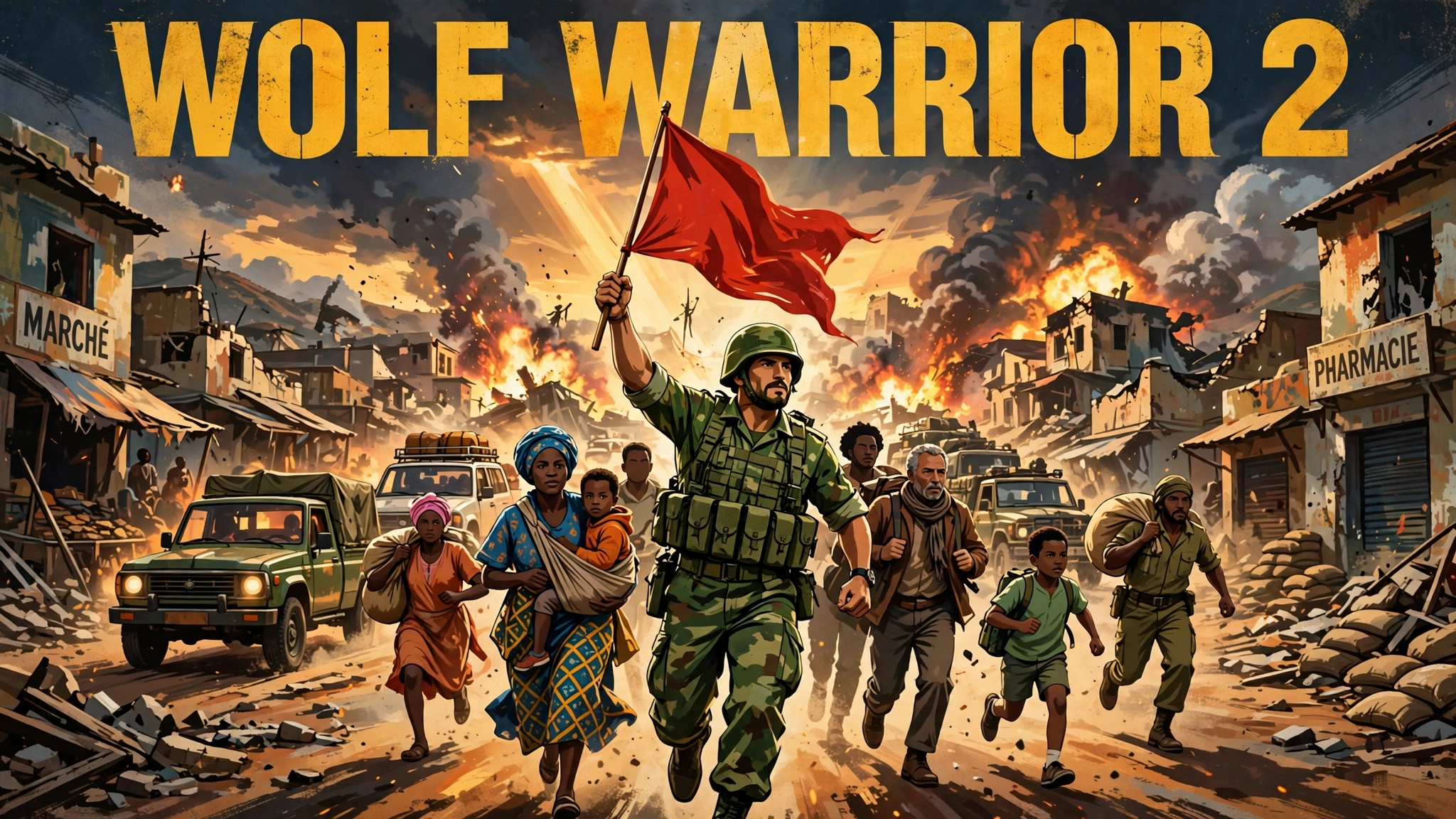
What follows is two hours of escalating action: a one-take underwater fight that opens the film, a rampage through a town under rebel attack, a rescue at the hospital, and a long, explosive climax at a Chinese-owned factory where Leng Feng and his companions hold off mercenaries and rebels with whatever they can improvise. The film’s most famous image — Leng Feng holding a Chinese flag aloft as he drives a convoy through a war zone, the fighting stopping around him — is pure, unapologetic patriotic theatre, and it is staged with total conviction.
The plot is not subtle, and it does not try to be. The villains are Western mercenaries led by a sneering American, the African characters are largely victims or sidekicks, and the Chinese characters are heroes, medics and workers. The film’s politics — that China protects its people wherever they are, and that Chinese power is benevolent — are the point, not a subtext. Viewers who can accept that as the premise of a blockbuster will have a great time; viewers who want a more complicated view of intervention will find the film’s worldview hard to swallow.
Wu Jing as Leng Feng — Wu Jing is a martial artist, a former wushu champion, and a director-star in the classic mould, and he gives the film everything he has. His Leng Feng is tough, funny, sentimental and indestructible: he fights underwater, he fights in a factory, he fights while carrying a child, and he never stops moving. Wu’s physical performance is genuinely impressive — the action scenes are built around his real athleticism, and the camera stays on him long enough for the audience to believe the punishment he takes. As an actor, he is less nuanced: Leng Feng is a hero without doubt or darkness, and Wu plays him at full volume throughout. But for this kind of film, that is exactly what is needed.
Frank Grillo as Big Daddy — Grillo, a veteran of American action films, plays the mercenary leader with a sneering, professional menace that gives the film a worthy antagonist. He is not a complex villain, but he is a credible one: a soldier of fortune who kills for money and enjoys it, and whose clashes with Leng Feng provide the film’s best hand-to-hand moments. His presence also gives the film an international gloss, and his English-language scenes help it play to non-Chinese audiences.
Celina Jade, Hans Zhang and Wu Gang — Celina Jade plays Dr. Rachel Smith, the doctor at the centre of the rescue, with warmth and competence, though the role is written more as a symbol of humanitarian virtue than as a fully developed character. Hans Zhang, as the young factory worker Zhuo Yifan, provides comic relief and a coming-of-age arc — the rich kid who learns to fight — while Wu Gang, as the retired soldier He Jianguo, brings grizzled authority to the film’s older generation. The African supporting cast, it should be said honestly, is given less to do than the Chinese leads, and the film’s portrayal of Africa as a backdrop for Chinese heroism is one of its most debated aspects.
Wu Jing’s direction is the film’s greatest achievement, and it is why the film deserves to be taken seriously as action cinema regardless of its politics. The opening underwater fight — shot in a single, continuous take, with Wu fighting a group of pirates beneath the waves — is a genuine technical marvel, and it announces the film’s ambition immediately. The action choreography throughout is of a high standard: the fights are brutal and clearly staged, the explosions are practical and large-scale, and the camera work by Peter Ngor keeps the geography of each set piece legible even in chaos.
The film’s budget of CN¥200 million, around US$30 million, is small by Hollywood blockbuster standards — a fraction of what a Marvel film costs — and the scale Wu achieves with it is remarkable. The factory climax, with its tanks, explosions and hundreds of extras, looks far more expensive than it was. The editing is propulsive, the sound design is thunderous, and Joseph Trapanese’s score does its job of pumping up the heroics. If there is a craft weakness, it is the film’s length of incident over character: at 121 minutes, it rarely pauses for breath, and the quieter scenes — Leng Feng’s grief, the doctor’s mission — are sketched rather than explored.
Joseph Trapanese’s score is functional blockbuster music: brass, drums and strings that rise for the heroics and fall for the sentiment. It does not have a memorable theme in the way the great action scores do, but it serves the film’s purpose — to make the audience feel the scale and the patriotism — effectively. The film’s sound design is more distinctive: the underwater sequence, the gunfire, the explosions and the crowd scenes are all mixed for maximum impact, and the film is best experienced loud. There are no songs of note, and the film does not need them: its music is the sound of its own spectacle.
What we loved:
What could be better:
Wolf Warrior 2‘s box-office story is, quite simply, one of the most extraordinary in film history. Made for CN¥200 million, about US$30.1 million, it earned CN¥5.68 billion in China alone, for a worldwide total reported at between US$870 million and US$874 million depending on the source — the small difference reflects exchange-rate and reporting variations, and either figure puts it among the highest-grossing films of 2017 worldwide, ahead of Wonder Woman and Thor: Ragnarok in that year’s global rankings. More than 98% of its gross came from China itself, with North America contributing only around US$2.7 million, which is why the film is both a global record-holder and, outside Asia, relatively little known.
Its success was helped by timing — it opened during China’s summer blackout period for foreign films — but timing alone does not explain a phenomenon of this scale. The film tapped into a wave of patriotic feeling, it offered spectacle that rivalled Hollywood, and it gave Chinese audiences a hero who was unmistakably theirs. It became the highest-grossing Chinese film of all time within weeks of release, overtaking Stephen Chow’s The Mermaid, and it has held that record since. For the Chinese film industry, it was a declaration: a domestic blockbuster could out-earn Hollywood on its home turf.
Yes — if you like action films, and if you can watch a patriotic blockbuster on its own terms. Wolf Warrior 2 is a superbly made, hugely entertaining action epic with some of the best set pieces in recent cinema, and its politics, while blunt, are part of what makes it interesting as a cultural document. Viewers who want a morally complicated war film should look elsewhere; viewers who want two hours of spectacular, well-crafted action, with a hero who never gives up and a climax that earns its flag-waving, will have a great time.
Our rating: 7.5/10 — Thunderous, spectacular and unapologetic: China’s biggest blockbuster is action cinema at full throttle.
Is Wolf Warrior 2 a sequel?
Yes. It follows the 2015 film Wolf Warrior, also directed by and starring Wu Jing, but it works as a standalone story — no knowledge of the first film is needed.
Is Wolf Warrior 2 based on a true story?
No. It is a fictional story, though its evacuation premise echoes real-life evacuations of Chinese nationals from conflict zones, which the film draws on for its patriotic framing.
Why did Wolf Warrior 2 earn so much money?
Almost all of its gross came from China, where it became a cultural phenomenon during the summer of 2017, helped by the blackout on foreign releases and by strong patriotic word of mouth.
How long is Wolf Warrior 2?
It runs 121 minutes, about two hours, and is in Mandarin and English.
Where can I watch Wolf Warrior 2?
Availability varies by region; it has appeared on various streaming and video-on-demand platforms, so check your local services.