★ LATEST REVIEWS

Our Rating: ★★★★★ 9/10
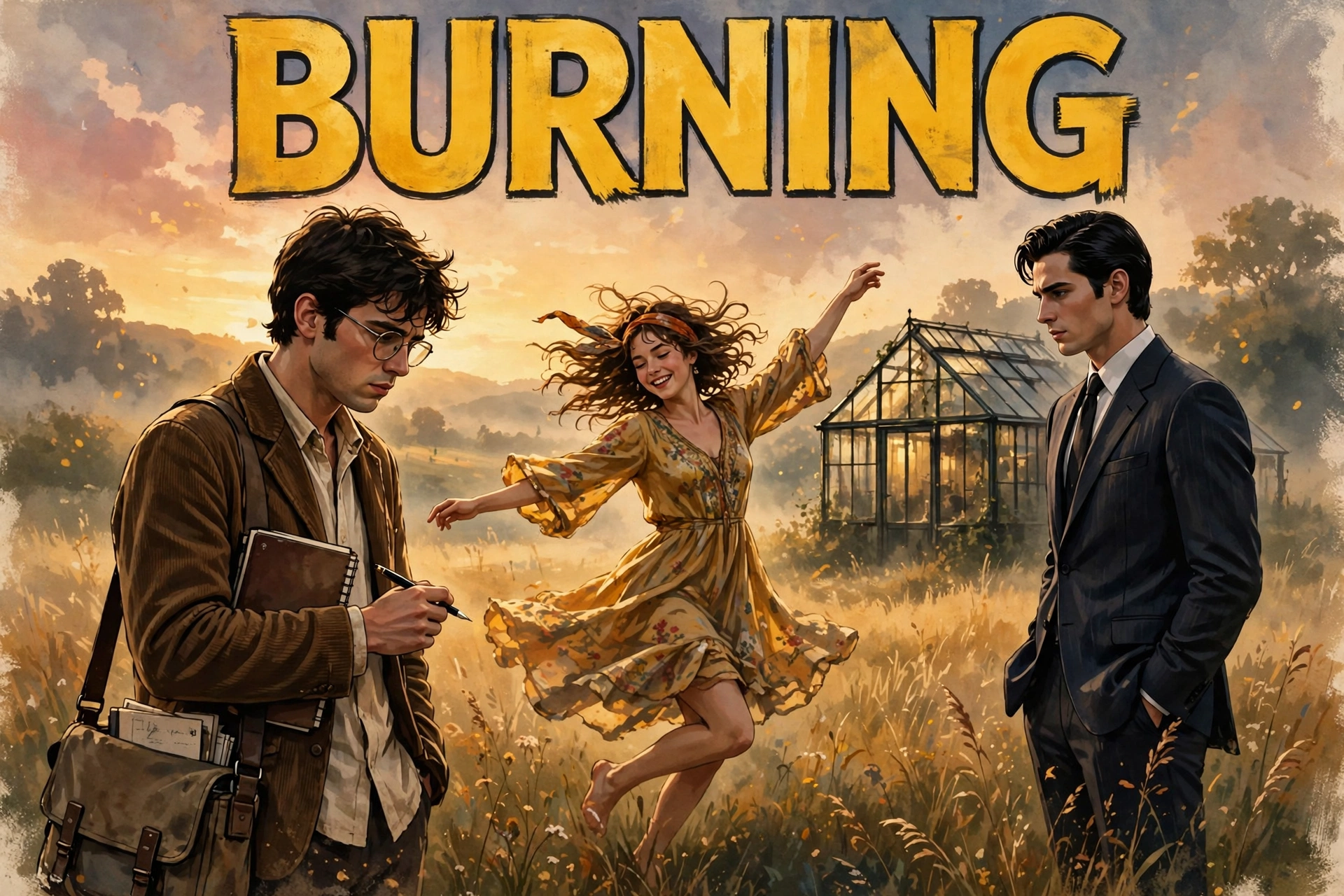
Some films give you answers. Burning gives you a match, a greenhouse, a cat that may or may not exist, and a dance at sunset that you will think about for weeks. Lee Chang-dong’s 2018 masterpiece — based loosely on Haruki Murakami’s short story “Barn Burning” — is a mystery that refuses to solve itself, a love triangle that is really about class, and a slow-burning portrait of young South Korea that is also one of the great films of the decade. It premiered in competition at Cannes, won the critics’ FIPRESCI Prize there, and divided audiences in the best possible way: some found it hypnotic, others found it maddening, and almost nobody forgot it.
The story is simple to summarise and impossible to settle. Jong-su, an aspiring writer from a poor farming family, reconnects with Hae-mi, a free-spirited young woman from his childhood village. She asks him to look after her cat while she travels to Africa. When she returns, she brings with her Ben — wealthy, charming, handsome, played by Steven Yeun — and one evening Ben confesses to Jong-su a strange hobby: he likes to burn down abandoned greenhouses. Then Hae-mi disappears. This review will not reveal what happens next, or what Jong-su does about it, because the film’s power lies in its refusal to tell you what to believe. Everything that follows is interpretation, and the film knows it.
| Detail | Information |
|---|---|
| Release date | 17 May 2018 (South Korea; Cannes premiere 16 May 2018) |
| Director | Lee Chang-dong |
| Writers | Lee Chang-dong, Oh Jung-mi |
| Based on | “Barn Burning” by Haruki Murakami |
| Genre | Mystery, Drama, Psychological Thriller |
| Language | Korean |
| Runtime | 148 minutes |
| Lead cast | Yoo Ah-in, Steven Yeun, Jeon Jong-seo |
| Our rating | 9/10 |
Jong-su, played by Yoo Ah-in, is a young man on the edge of adult life. He has left university, he works part-time as a delivery driver, and he is trying to write a novel about a world he does not yet understand. His father is facing legal trouble, his family’s farm sits near the North Korean border under loudspeaker propaganda, and his prospects are thin. When he meets Hae-mi, played by Jeon Jong-seo, she is everything he is not: spontaneous, sensual, funny, unembarrassed about her body and her dreams. She tells him she once fell down a well as a child and that he rescued her — a story he does not remember, and which may never have happened.
Hae-mi’s trip to Africa changes everything. She returns with Ben, and the film’s second half becomes a study in class as much as in desire. Ben is rich in ways Jong-su cannot imagine: a Porsche, a beautiful apartment in Gangnam, parties with beautiful people, a job he never explains. He is also, crucially, kind — or at least he performs kindness flawlessly. The three of them spend an afternoon together at Jong-su’s farm, and Ben tells Jong-su about his hobby: every couple of months, he burns down an abandoned greenhouse. It is, he says, a kind of pleasure, like a game. Jong-su begins watching the greenhouses near his home, waiting for one to burn.
And then Hae-mi is gone. The rest of the film follows Jong-su’s investigation — or obsession — and this review will not say what he finds, because the film does not say either, not definitively. It offers clues, coincidences and images that point in several directions at once, and it trusts the audience to live with the uncertainty. The mystery is not a puzzle to be solved but a mirror: what you believe Ben did says something about what you believe about wealth, power and who gets away with things in the world.
Yoo Ah-in as Jong-su — Yoo gives a performance of extraordinary interiority. Jong-su is a watcher, a listener, a young man who says little and notices everything, and Yoo plays him with a simmering, inarticulate intensity. His jealousy, his class resentment, his desire for Hae-mi and his fascination with Ben are all visible in his face before they are ever spoken. It is a performance that requires the audience to lean in, and it rewards that attention completely.
Steven Yeun as Ben — Yeun, known to international audiences from The Walking Dead, gives the performance of his career. Ben is the film’s great enigma: warm, funny, generous, and possibly monstrous, and Yeun never lets the audience settle on which. His smile is genuine and unreadable at once; his wealth is casual and absolute; his confession about the greenhouses is delivered with the lightness of a man discussing a hobby, not a crime. The performance is a masterclass in ambiguity, and it earned Yeun awards and nominations around the world, including Best Supporting Actor honours from several critics’ groups.
Jeon Jong-seo as Hae-mi — In her debut film role, Jeon is luminous. Hae-mi is the film’s free spirit and its mystery: a young woman who dances at sunset to jazz, who mimes eating an orange that is not there, who talks about hunger — the “great hunger” versus the “little hunger” — with a philosophy that is both naive and profound. Jeon’s performance is physical, sensual and heartbreaking, and the film’s second half is haunted by her absence precisely because she made her presence so vivid.
Lee Chang-dong is one of the great directors of contemporary world cinema, and Burning is his most controlled and most mysterious film. Hong Kyung-pyo’s cinematography is extraordinary: the film’s images — the farm under a huge sky, the Gangnam apartment at night, the greenhouse in the mist, the sunset dance — are composed with a painter’s patience, and the camera often holds a shot longer than the audience expects, forcing them to notice what is in the frame and what is not. The film’s sound design is equally important: the buzzing of insects, the distant propaganda loudspeakers, the jazz on a car stereo, the silence of an empty apartment. These sounds are the film’s real clues, and they reward careful listening.
The pacing is deliberate, and it is the film’s great gamble. At 148 minutes, Burning moves slowly, with long scenes of conversation, driving, waiting and watching. For viewers who need plot momentum, it will feel like a test of patience. For viewers who surrender to its rhythm, it becomes hypnotic: the slowness is the point, because it reproduces Jong-su’s own state of mind — waiting, watching, wondering. The film’s final act is shocking in a way that is both inevitable and unresolved, and it has fuelled years of debate about what, exactly, happened.
Mowg’s score — the same composer who scored I Saw the Devil — works here in a completely different register. It is spare, jazzy and atmospheric, built around piano, strings and silence rather than orchestral swell. The film’s most famous musical moment is not scored at all in the conventional sense: Hae-mi’s dance at sunset is set to jazz, and the scene’s power comes from the combination of music, light and Jeon Jong-seo’s body in motion. The score’s restraint is essential to the film’s ambiguity: it never tells the audience how to feel about Ben, about Hae-mi, or about what Jong-su does, and that refusal is what makes the film linger.
What we loved:
What could be better:
Burning was never going to be a blockbuster, and its box-office story reflects that. Sources differ slightly on the total — Wikipedia lists approximately US$8.1 million worldwide, while other databases put the figure at around US$7.6 million, with about US$719,000 of that from the United States — and the difference is a matter of which territories and re-releases are counted. Either way, the film earned a modest sum for a Cannes competition title, and its real success was critical rather than commercial: a 95% approval rating on Rotten Tomatoes, the FIPRESCI Prize at Cannes, Best Film honours at the Grand Bell Awards, and selection as South Korea’s submission for the Academy Awards, where it made the nine-film shortlist for Best Foreign Language Film before missing the final nominations.
A note on what we have omitted: no reliable, verifiable budget figure for Burning could be found in the sources consulted for this review, so the Quick Facts table carries no budget row rather than a guessed number. That omission does not change the film’s story: Burning is a film whose value was never going to be measured in grosses, and its reputation has only grown since its release, with critics and filmmakers regularly citing it among the best films of the decade.
Yes — if you are willing to meet it halfway. Burning is not a film to watch while scrolling through your phone; it is a film to watch in the dark, with patience, and then to argue about afterwards. It will not give you answers, and that is precisely why it is great: it treats its audience as adults, capable of living with uncertainty. For viewers who love slow, beautiful, mysterious cinema, it is essential. For viewers who want a thriller with a twist and a resolution, it will frustrate — and that frustration is itself part of the film’s design.
Our rating: 9/10 — Hypnotic, ambiguous and unforgettable: a mystery about class and desire that refuses to let you go.
Is Burning based on a book?
It is loosely based on Haruki Murakami’s short story “Barn Burning”, from his collection The Elephant Vanishes, with additional inspiration from William Faulkner’s story of the same name. Lee Chang-dong expanded the short story into a full-length study of class and desire.
Does Burning explain what happened to Hae-mi?
No, not definitively. The film offers clues and interpretations but deliberately leaves the central mystery open, and viewers disagree about what Jong-su discovers and what he does.
What is the greenhouse burning about?
Ben tells Jong-su that he burns down abandoned greenhouses as a hobby. Whether this is a literal confession, a metaphor, or a provocation is one of the film’s central ambiguities, and it has been interpreted in many ways.
How long is Burning?
It runs 148 minutes, about two hours and twenty-eight minutes, and is in Korean with subtitles.
Where can I watch Burning?
It is available on arthouse streaming services and video-on-demand platforms in many regions, though availability varies by country, so check your local services.