★ LATEST REVIEWS

Our Rating: ★★★★★ 9/10
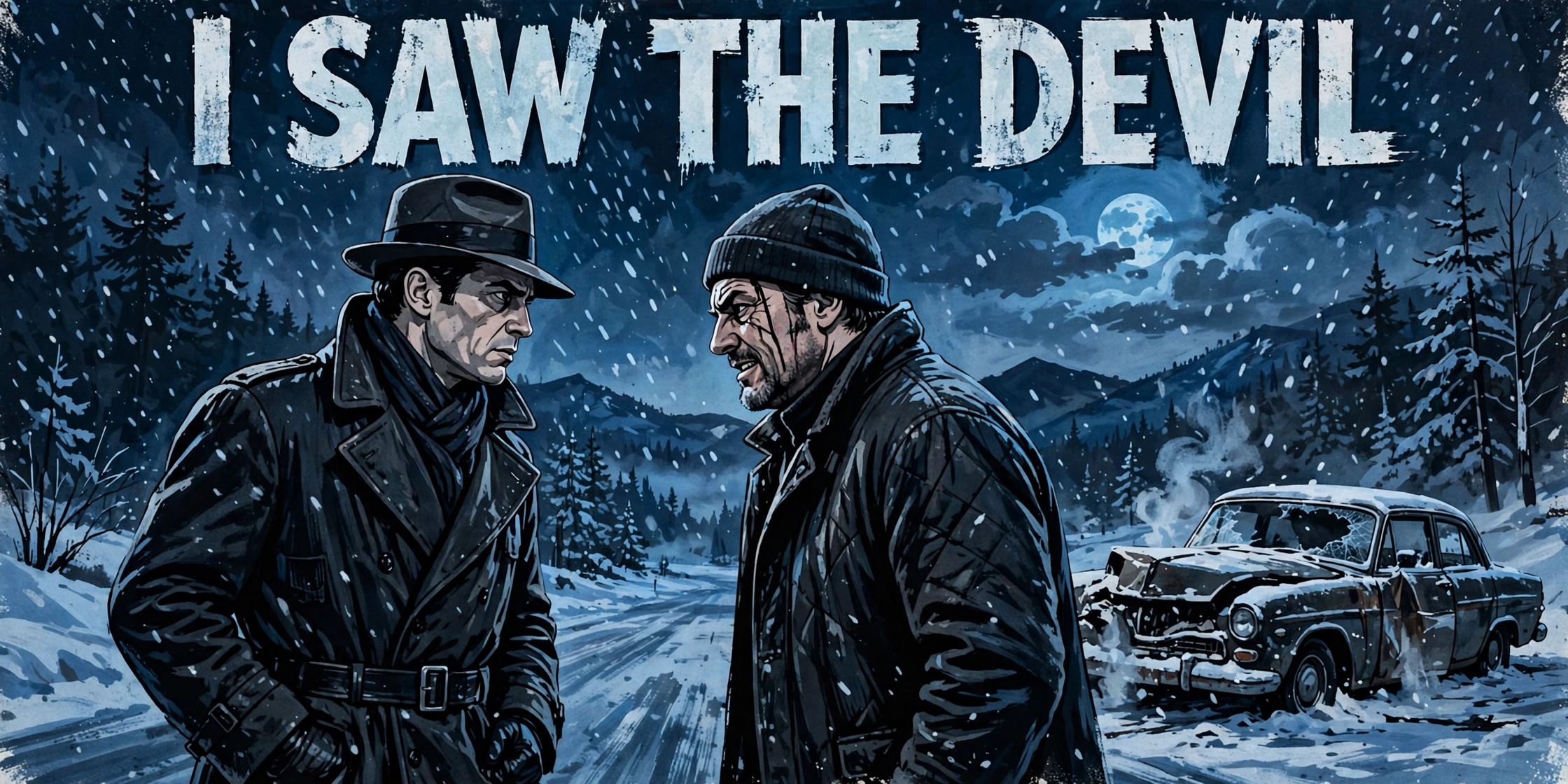
A warning first, because this review would be irresponsible without one: I Saw the Devil is one of the most violent mainstream films ever made. It contains prolonged, graphic scenes of murder, torture and cruelty, and it is absolutely not for every viewer. If you are sensitive to screen violence, do not watch it on the strength of this review. For viewers who can face it, however, it is also one of the great Korean thrillers — a film of extraordinary craft, two towering performances, and a moral question that refuses to let the audience off the hook: when a good man sets out to destroy a monster, at what point does he become one himself?
Directed by Kim Jee-woon and starring Lee Byung-hun and Choi Min-sik, the film was released in South Korea on 12 August 2010. It takes the familiar revenge-thriller template — a man hunts the killer who murdered his fiancée — and twists it into something far more disturbing. The hero does not kill the murderer. He catches him, beats him, and lets him go — again and again — so that the suffering can continue. The result is a cat-and-mouse game in which the line between hunter and hunted dissolves, and the audience is forced to ask who, exactly, the devil of the title is.
| Detail | Information |
|---|---|
| Release date | 12 August 2010 (South Korea) |
| Director | Kim Jee-woon |
| Writer | Park Hoon-jung |
| Genre | Crime Thriller, Action, Horror |
| Language | Korean |
| Runtime | 141 minutes |
| Budget | US$6 million |
| Box office | Approximately US$12.8 million worldwide |
| Lead cast | Lee Byung-hun, Choi Min-sik, Jeon Gook-hwan, Oh San-ha, Kim Yoon-seo |
| Our rating | 9/10 |
The setup is brutally simple. On a snowy night, a young woman’s car breaks down on a deserted road. A passing driver stops — not to help, but to kill. She is Joo-yeon, the fiancée of Kim Soo-hyeon, a highly trained secret agent played by Lee Byung-hun, and the daughter of a retired police chief. Her murder sets the film in motion, and this review will reveal nothing about its ending or its twists, because the film’s power depends on the audience not knowing where its game will go.
Soo-hyeon does not wait for the police. Using his training and his access, he identifies the killer: Jang Kyung-chul, played by Choi Min-sik, a school-bus driver who is, in secret, a prolific serial killer. What follows is the film’s central, horrifying idea. Soo-hyeon tracks Kyung-chul down, beats him to the edge of death — and releases him, after planting a tracking device, so that he can find him again and do it again. The killer, who has never been hunted, is now the prey. But a cornered animal is dangerous, and Kyung-chul’s response — his cunning, his cruelty, his willingness to hurt anyone connected to Soo-hyeon — escalates the game beyond anything the agent imagined.
The film’s structure is episodic and relentless: each encounter is more violent than the last, and each one costs Soo-hyeon another piece of his humanity. Kim Jee-woon’s genius is that he never lets the audience enjoy the revenge cleanly. Every beating is filmed with a queasy intimacy, every victory is shadowed by a new atrocity, and the film keeps asking, in scene after scene, whether the agent’s vengeance is justice or merely a second evil wearing a badge.
Lee Byung-hun as Kim Soo-hyeon — Lee gives one of the finest performances of his career, and one of the most physically and emotionally demanding in Korean cinema. He plays Soo-hyeon not as a righteous avenger but as a man disintegrating: his grief is quiet and total, his violence is methodical and terrifying, and his face, over the course of the film, seems to lose its humanity by degrees. The performance’s brilliance is in its restraint — Lee rarely shouts, rarely grandstands, and the horror comes from his calm. By the film’s final act, the audience is no longer sure whether they are watching a hero or a second monster, and that uncertainty is entirely Lee’s achievement.
Choi Min-sik as Jang Kyung-chul — Choi, who gave one of world cinema’s great performances in Oldboy, is equally extraordinary here, in a very different register. Kyung-chul is not a stylised villain but a banal, shambling, terrifyingly ordinary man: a bus driver who jokes with colleagues, eats noodles, and murders without a flicker of conscience. Choi plays him with a dead-eyed casualness that is far more frightening than any theatrical evil. His Kyung-chul is funny, pathetic and monstrous by turns, and the film’s most disturbing insight is that evil, in his hands, looks like boredom. It is a performance that stays with the viewer long after the credits.
The supporting cast — Jeon Gook-hwan is excellent as the retired police chief and grieving father, a man who must watch his son-in-law’s vengeance consume him, while Oh San-ha and Kim Yoon-seo play the women whose fates drive the story with a dignity that the film’s violence never quite extinguishes. The supporting players — fellow killers, policemen, victims — are all vividly drawn, and the film’s world feels populated rather than staged.
Kim Jee-woon is one of Korean cinema’s great genre stylists, and I Saw the Devil is his most technically accomplished film. Lee Mo-gae’s cinematography is beautiful in ways that make the violence harder to watch: snowy roads, rain-soaked streets, warm domestic interiors and cold, clinical torture spaces, all filmed with a painter’s eye. The contrast between the film’s visual elegance and its subject matter is deliberate and deeply unsettling — this is not a film that looks away, and it does not let the audience look away either.
The action choreography is extraordinary. The film’s set pieces — a taxi chase, a fight in a greenhouse, a confrontation in a home — are staged with a brutal, bone-crunching physicality that feels real rather than choreographed, and the editing by Nam Na-young gives each encounter a queasy rhythm, lingering just long enough for the audience to feel the damage. The film famously battled the South Korean censors, who demanded cuts for its violence, and the version most audiences see today is the director’s fuller cut. At 141 minutes, the film is long, and its relentlessness is the point — but it is also a legitimate criticism that the middle section, with its repeated cycle of capture and release, occasionally feels repetitive. The film’s violence, too, will be a moral barrier for many viewers, and no amount of craft changes that.
Mowg’s score is one of the film’s most unsettling achievements. Rather than pumping up the action with conventional thriller music, it works in a minor, mournful register — strings, piano and ambient dread — that underlines the tragedy rather than the excitement. The music tells the audience, again and again, that what they are watching is not fun: it is grief curdling into cruelty. In the quieter scenes, the score almost disappears, leaving only the sounds of rain, snow and breathing, which makes the violent passages hit harder. It is a score that refuses to let revenge feel heroic, and it is essential to the film’s moral argument.
What we loved:
What could be better:
I Saw the Devil was made for a reported US$6 million — a modest budget by international standards, and a figure on which the available sources agree. Its worldwide gross is reported at approximately US$12.8 million, with some databases listing US$12.9 million; the difference is a rounding matter, and either figure represents a solid doubling of its budget. The breakdown is instructive: the film’s North American gross was small, around US$128,000 in limited release, with the bulk of its earnings coming from South Korea and other international markets. That pattern — a modest theatrical life followed by a long, powerful afterlife on home video and streaming — is typical of cult films, and I Saw the Devil is now firmly one: it is routinely cited among the greatest Korean thrillers, it appears on best-of-decade lists, and its influence on the revenge genre is visible in films made long after it.
Only if you know what you are getting into. I Saw the Devil is a masterpiece of the revenge thriller, and it is also one of the most violent films a mainstream audience is likely to encounter. For viewers who can watch extreme screen violence as a vehicle for a serious moral argument, it is essential viewing: two great actors, a great director, and a question — what does revenge do to the avenger? — that the film answers with terrifying honesty. For viewers who cannot, or who do not wish to, sit through graphic torture and murder, no critical praise changes that calculation, and this review recommends skipping it without shame.
Our rating: 9/10 — A brutal, brilliant revenge thriller: two towering performances and a moral question that will haunt you.
Is I Saw the Devil based on a true story?
No. It is an original screenplay by Park Hoon-jung, directed by Kim Jee-woon. Its serial-killer premise is fictional, though it draws on the conventions of the crime genre.
Why is I Saw the Devil so violent?
The violence is deliberate: the film’s argument is that revenge is not clean or satisfying, and it forces the audience to experience the cost of the hero’s vengeance rather than enjoying it as spectacle.
Is there a censored version of I Saw the Devil?
Yes. The film faced censorship demands in South Korea, and a shorter, less explicit cut exists. Most streaming and home-video releases present the fuller director’s version, so check the runtime — around 141 minutes — when choosing a copy.
How long is I Saw the Devil?
The main version runs 141 minutes, about two hours and twenty-one minutes, and is in Korean with subtitles.
Where can I watch I Saw the Devil?
It is available on horror and general streaming services including Shudder and other platforms in various regions, though availability changes over time, so check your local services.