★ LATEST REVIEWS

★★★★☆ Our Rating: 8.5/10
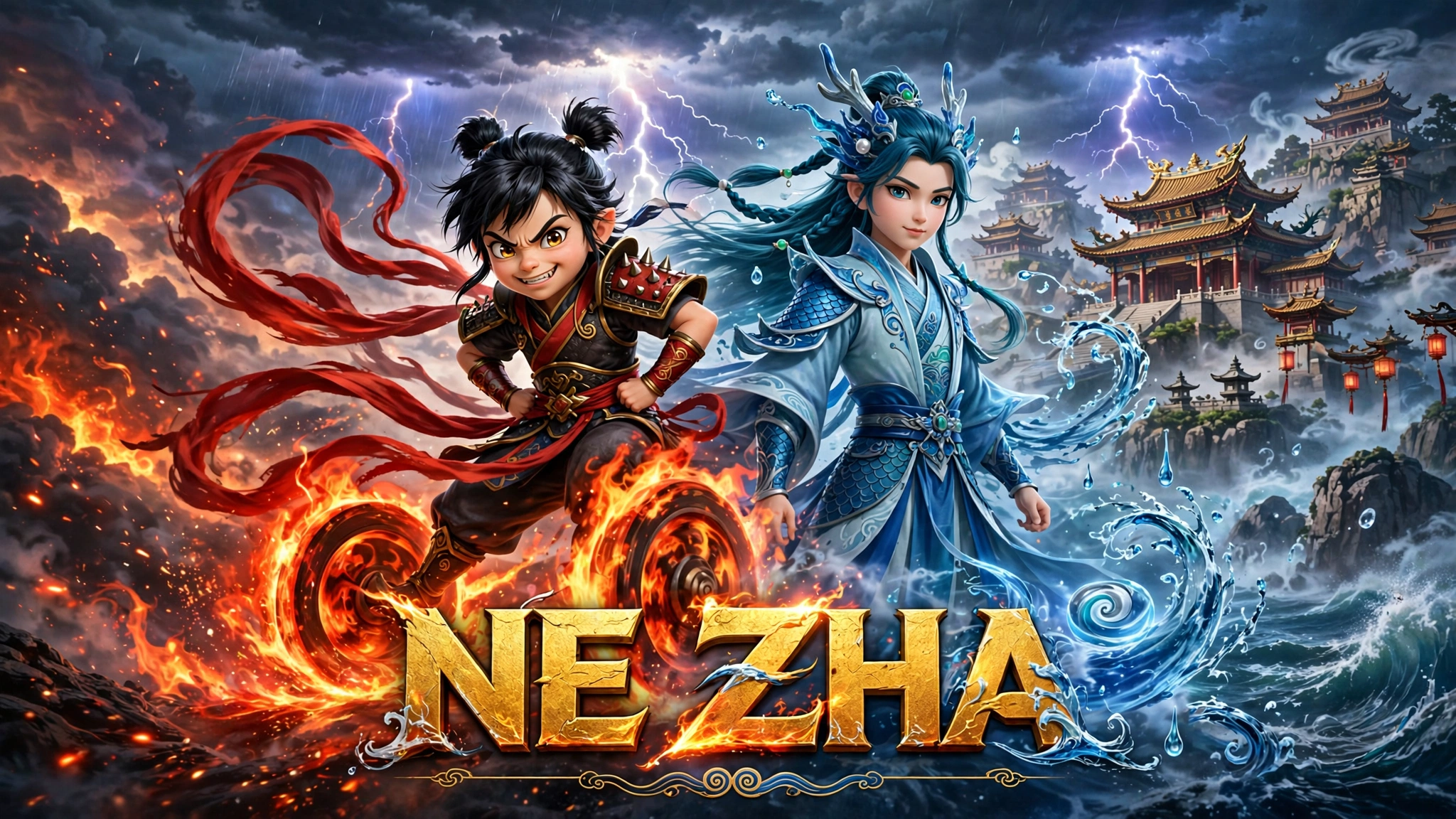
In the summer of 2019, Chinese animation stopped being a promise and became an event. Ne Zha, the debut feature of a director who calls himself Jiaozi — “Dumpling” — and of his own studio, Chengdu Coco Cartoon, took one of the most familiar heroes in Chinese mythology, made him a scowling, dark-eyed problem child hated by his own town, and rode that reinvention to roughly three-quarters of a billion dollars, records for an animated film in China, and the permanent transformation of what the country’s animation industry believed was possible. Its sequel would later go further still, but the revolution starts here, with a film that is part mythological epic, part family drama and part very loud argument with fate itself.
The argument is stated by its hero in the film’s most quoted line, in spirit if not in these words: my fate is decided by me, not by heaven. Ne Zha is born from the wrong half of a divine pearl — a demon orb instead of a spirit pearl — and is therefore expected, by gods and mortals alike, to live briefly, badly and destructively. His parents refuse the script. His teacher, a cheerfully incompetent immortal, refuses it. A friend made from the pearl’s other half complicates it. And Ne Zha himself, a toddler with the destructive power of a natural disaster and the emotional life of any unwanted child, has to decide whether the world’s verdict on him is a prophecy or merely an opinion.
This Ne Zha review covers the film spoiler-free in its story section — the broad shape of the myth is centuries old, but the film’s specific climactic choices deserve discovery — while discussing honestly where this landmark succeeds completely and where its comedy and plotting show the strain of a first-time director carrying an entire industry’s hopes at once.
| Detail | Information |
|---|---|
| Release date | 26 July 2019 (China, wide); premiered 11 July 2019 in Beijing, IMAX release 13 July 2019 |
| Director | Jiaozi (Yang Yu) |
| Writers | Jiaozi (Yang Yu); story by Yi Qiao and Wei Yunyun; loosely based on Investiture of the Gods, attributed to Xu Zhonglin |
| Genre | Animation, Fantasy, Adventure |
| Language | Mandarin |
| Runtime | 110 minutes |
| Budget | $22 million (reported) |
| Lead cast | Lü Yanting, Joseph Cao, Han Mo, Chen Hao, Lü Qi, Zhang Jiaming, Yang Wei (voices) |
| Our rating | 8.5/10 |
High in the heavens, the Primeval Lord of Heaven, Yuanshi Tianzun, refines a chaotic pearl of immense power and splits it in two: a Spirit Pearl, destined to be reborn as a hero, and a Demon Orb, cursed to be destroyed by a heavenly lightning strike in three years’ time. The immortal Taiyi Zhenren is entrusted with delivering the Spirit Pearl to its chosen family — Lord Li Jing of Chentang Pass and his wife, Lady Yin, who have waited years for a child. But Taiyi’s resentful fellow disciple Shen Gongbao, passed over and bitter, steals the Spirit Pearl and substitutes the Demon Orb at the moment of birth.
So Ne Zha arrives in the world exactly backwards: a demon child with ember-red power, born to terrified parents in a town that immediately learns to fear him. Li Jing and Lady Yin raise him behind barrier spells and loving lies, telling him he is a chosen hero while the townspeople build their lives around avoiding him. Ne Zha grows up — in the accelerated way of mythic children — lonely, mischievous and increasingly furious at a world that flinches from him, while his destructive pranks keep proving the world right. Only two relationships cut through his isolation. His parents’ love is real and, as the film slowly reveals, more sacrificial than he knows. And on the seashore he meets Ao Bing, the gentle, dutiful Dragon Prince — the child who received the stolen Spirit Pearl, heir to a dragon clan imprisoned beneath the sea and carrying his people’s entire hope of freedom on his shoulders.
The friendship between the demon boy and the dragon prince is the film’s heart and its trap, because Ao Bing’s mission and Ne Zha’s survival cannot both succeed, and Shen Gongbao is working to make sure each boy becomes the weapon his side requires. As Ne Zha’s third birthday approaches — the date fixed for the heavenly curse to destroy him — every character has to choose between the role heaven, family or resentment assigned them and the person they actually are. What each of them chooses, and what it costs, this review leaves for the film itself. Expect shuttlecocks, paintings you can walk into, a paintbrush that rearranges mountains, and a climax that scales from a birthday party to the fate of a town without losing the small story underneath: a child asking his parents why, if he is a demon, they never treated him like one.
In animation, the voice cast is the cast, and Ne Zha succeeds or fails on whether its mythic figures sound like a real family. They do.
Lü Yanting as Ne Zha carries the film. Her Ne Zha — and it matters that this bratty, swaggering boy hero is voiced by a woman, in the best tradition of animation casting — is a masterpiece of controlled obnoxiousness: hands in pockets, eyes half-lidded, reciting mocking poetry at the people who fear him, and then, in the quiet scenes, suddenly and completely a small child who wants his mother to play with him and his father to be proud. The vocal turn she makes in the final act, when mockery gives way to something rawer, is the moment the film’s blockbuster machinery becomes genuinely moving. Joseph Cao as the older, transformed Ne Zha extends the same character convincingly into heroic register without erasing the brat underneath.
Han Mo as Ao Bing provides the essential counterweight: soft-spoken, precise, kind — and quietly drowning under duty. His scenes with Lü Yanting build the film’s best relationship, two boys who recognise each other instantly as the only person in the world carrying the same impossible weight, one assigned to be evil and one assigned to be good, both assignments a kind of prison. Chen Hao as Li Jing begins as the stern archetypal father and becomes, through vocal understatement, the film’s moral centre; Lü Qi as Lady Yin is warm, funny and heartbreaking — a warrior mother juggling command duties, town politics and a son she gets too little time with, whose kickabout games with Ne Zha carry more love than most films’ speeches. Zhang Jiaming as Taiyi Zhenren supplies broad, beloved comedy in a Sichuan-flavoured performance — a drunken, vain, genuinely kind immortal whose failures set the plot in motion — while Yang Wei as Shen Gongbao, stuttering, aggrieved and dangerous, turns what could be a stock villain into a bitter study of a man destroyed by being passed over: the film’s warning of what Ne Zha might become if he lets the world’s verdict define him.
Jiaozi spent two years on the screenplay and three years in production, and reportedly reworked the film obsessively — by some production accounts, through well over a hundred drafts of key materials and with more than 1,300 special effects shots executed by over 20 Chinese effects studios and some 1,600 people. The result announced, in 2019, that a Chinese animated feature could stand beside contemporary Hollywood and Japanese work in spectacle while looking like nothing but itself. The design world fuses Ming-dynasty novel illustrations, Chinese landscape painting and modern blockbuster staging: a magical painting whose rivers and mountains can be entered and rearranged, an underwater dragon palace built from imprisoned monsters, and action sequences — Ne Zha’s fire-wheeled rampages, Ao Bing’s water-and-ice choreography — that exploit animation’s total freedom of camera and physics.
Jiaozi’s direction is strongest in rhythm: the film alternates slapstick, spectacle and family emotion in short, punchy movements, and understands that a myth lands only if the audience has laughed with its hero before being asked to weep for him. His redesign of Ne Zha himself — dark eye circles, jagged grin, slouching menace in a toddler’s body — was a genuine gamble that paid off completely, giving Chinese audiences a hero who looked like the verdict passed on him rather than a poster child. Honest criticism: the craft is not uniformly at that level. The toilet-and-bodily-function humour that peppers the first half is pitched at a very young audience and repeats past the point of charm for adults; a mid-film exposition passage delivers the pearl mythology in a lump; and some secondary character animation and crowd work visibly belongs to a production stretching its budget. None of it prevents the climax — a fire-and-ice confrontation staged above the town that hates its hero — from achieving the full-throated emotional scale the film has been promising.
The score, by a team including Zhu Yunbian and the team behind several Chinese box office hits, leans into the film’s dual nature: traditional Chinese instrumentation and operatic vocal colour for the mythic passages, and a punchy, brass-and-percussion action language for the fire-and-ice set pieces. The central theme that accompanies Ne Zha and Ao Bing’s friendship is simple enough to hum and, by the final act, to make you wince — exactly as a theme about doomed friendship should. A criticism worth noting is that the score can be very busy: the film seldom trusts silence, and the music sometimes telegraphs emotion a beat before the characters earn it. But the main themes do the essential blockbuster job — they make you feel the scale without losing the child at the centre of it.
What we loved:
What could be better:
Ne Zha did not merely succeed; it rewrote the record books for Chinese animation. Produced for a reported $22 million, it opened in China on 26 July 2019 and went on to gross roughly $742 million worldwide, with the overwhelming majority — about $725 million — in China alone, making it, at the time, the highest-grossing animated film in Chinese history and the highest-grossing non-English-language animated film ever. Its success exceeded even optimistic forecasts by several multiples, finished 2019 as China’s second-highest-grossing film of the year, and became the second-highest-grossing animated film worldwide that year behind Frozen II. More importantly than the numbers, it changed the industry’s calculus: after Ne Zha, Chinese studios and investors believed a domestic animated feature could compete at true blockbuster scale, and the Fengshen universe — and the path to the record-shattering Ne Zha 2 in 2025 — begins here.
Yes — with the honest caveat that this is a family blockbuster with a very loud first half, not a quiet art film. If you can forgive a few too many fart jokes and a clunky exposition passage, what remains is a genuinely stirring reimagining of a classic myth, a hero worth rooting for precisely because the world tells him not to bother, and a friendship — Ne Zha and Ao Bing, demon and dragon, fire and ice — that gives the spectacle its heart. It is also essential viewing for anyone who wants to understand how Chinese animation got from promising to dominant in a single summer.
Our rating: 8.5/10 — a landmark of Chinese animation: a demon child’s defiant, funny, big-hearted argument that fate is an opinion, not a prophecy.
Is Ne Zha based on a true story?
No. Ne Zha is a figure from Chinese mythology and the classic novel Investiture of the Gods, attributed to Xu Zhonglin. This film is a free, modern reimagining of that myth, not a historical account.
Do I need to know Chinese mythology to enjoy it?
No. The film explains its own world — the pearls, the curse, the dragon clan — as it goes, and its core story of an unwanted child fighting a verdict on his life works without any prior knowledge.
Is Ne Zha suitable for children?
Broadly yes, with caveats. It is a family animation with slapstick and bodily-function humour that young children enjoy, but it also contains intense action, a genuinely frightening curse, and emotional scenes about parental sacrifice that may upset very young viewers.
Is Ne Zha connected to Ne Zha 2?
Yes. Ne Zha 2 (2025) is a direct sequel continuing the story of Ne Zha and Ao Bing after the events of this film, and it became the highest-grossing animated film of all time. This film stands alone, but the sequel builds directly on it.
Where can I watch Ne Zha?
Availability varies by territory and changes over time; it has been available on major streaming platforms and for digital rental or purchase in many regions. Check your local services for current availability.