★ LATEST REVIEWS

Our Rating: ★★★★☆ 8.5/10
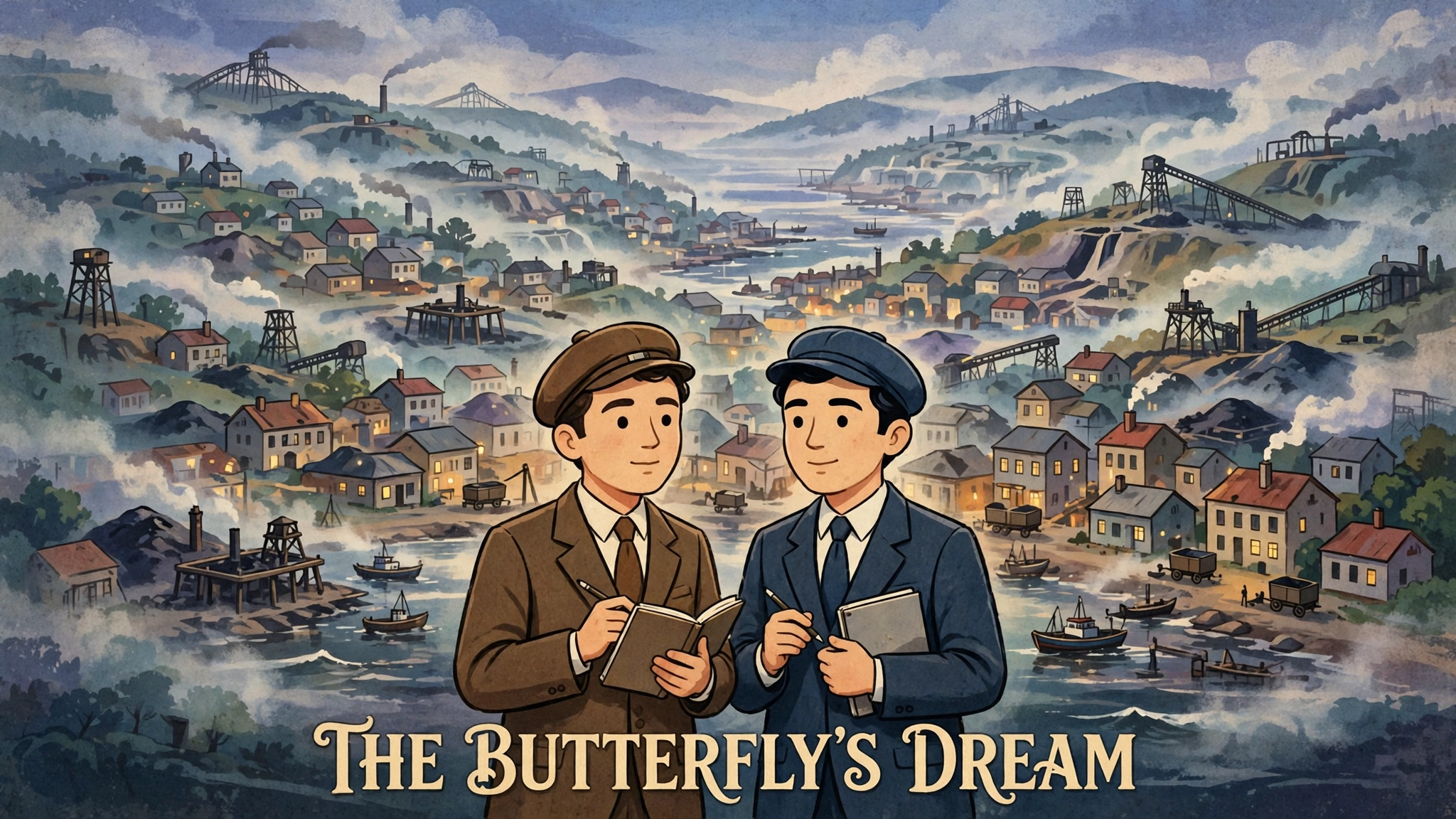
There is a particular kind of sadness that only a film about young artists can carry. It is not the sadness of a life wasted, but of a life that knew exactly what it wanted to do and was given almost no time to do it. The Butterfly’s Dream (Turkish: Kelebeğin Rüyası) is built on that feeling. Directed by Yılmaz Erdoğan, it tells the true story of two young Turkish poets, Rüştü Onur and Muzaffer Tayyip Uslu, who lived in the Black Sea mining town of Zonguldak in the early 1940s, wrote poetry while working as civil servants, fell in love, and died of tuberculosis while still in their twenties.
That premise could easily have become a stiff literary biopic, the kind of film that admires its subjects from a respectful distance. Erdoğan’s film is warmer and stranger than that. It is funny in places, romantic in others, and visually ambitious throughout. It treats poetry not as homework but as a daily habit, something these two young men practise the way other people practise a trade: on walks, at work, in arguments, and in a friendly bet over a girl they both admire. The result is one of the most accessible Turkish period dramas of its decade, even if its second half leans harder on emotion than on structure.
It is also a film about a country in transition. Turkey in 1941 was a young republic trying to modernise while war raged across Europe, and Zonguldak, with its coal mines and compulsory labour, was no place for dreamers. The film understands that tension. Its poets are not rebels in any grand political sense; they are simply young men who believe that beauty matters in a town organised around coal, wages and survival. That small, stubborn belief is the whole drama.
| Release date | 22 February 2013 (Turkey) |
| Director | Yılmaz Erdoğan |
| Writers | Yılmaz Erdoğan |
| Genre | Biography, Drama, Romance |
| Language | Turkish |
| Runtime | 138 minutes (some listings give 140 minutes) |
| Budget | Approximately US$15 million, as reported by the director |
| Lead cast | Kıvanç Tatlıtuğ, Mert Fırat, Belçim Bilgin, Farah Zeynep Abdullah, Yılmaz Erdoğan |
| Our rating | 8.5/10 |
The year is 1941. In Zonguldak, a coal town on Turkey’s Black Sea coast, two young civil servants spend their days in offices and their real lives in poetry. Muzaffer Tayyip Uslu and Rüştü Onur are in their early twenties, both already living with tuberculosis, and both determined to be taken seriously as poets. They are mentored, in the film’s telling, by the older poet Behçet Necatigil, played by Erdoğan himself, a figure of dry authority who encourages them without flattering them.
Their world changes with the arrival of Suzan, a beautiful young woman from a wealthier family, still at school and closely guarded by her ambitious father. The two friends make one of their characteristic bets: each will write a poem for her, and whichever poem she prefers will settle the matter. It is a boyish game, and the film knows it, but it also becomes the engine of the story, because affection, rivalry and artistic pride get tangled together in ways neither young man quite controls.
Meanwhile, the film keeps cutting back to the town around them: the mines, the workers, the wartime shortages, the sense of a society that has not yet made room for art. The poets try to stage a play drawn from the mining community, a project that brings them into contact with ordinary workers as well as with the town’s social hierarchies. When illness tightens its grip, the story moves between Zonguldak and the sanatorium world of Heybeliada near Istanbul, where Rüştü meets Mediha, another young patient. This review will not describe how any of these relationships resolve. It is enough to say that the film earns its tears honestly for much of its length, and that its final stretch is deliberately, unapologetically emotional.
Kıvanç Tatlıtuğ as Muzaffer Tayyip Uslu — Tatlıtuğ, then best known as a television star, gives the film its centre of gravity. His Muzaffer is confident, funny and romantic, the kind of young man who can talk his way into a room and then write a poem about it afterwards. Crucially, Tatlıtuğ does not play the illness as a constant performance of suffering. He lets it arrive in coughs, in tiredness, in moments when the charm suddenly thins, which makes those moments land harder than any single dramatic collapse would.
Mert Fırat as Rüştü Onur — Fırat is the quieter of the two leads, and that contrast is the film’s great casting success. Where Muzaffer reaches outward, Rüştü turns inward, and Fırat plays that interior life with a watchful, slightly melancholy intelligence. His scenes with Mediha have a tenderness that never tips into sentimentality, partly because both performers understand that these are two sick young people finding a brief, ordinary happiness, not symbols of doomed love.
Belçim Bilgin as Suzan and Farah Zeynep Abdullah as Mediha — Bilgin has the hardest role to make sympathetic, because Suzan is partly an object of competition in the first half. She manages it by playing Suzan as a real young woman with her own curiosity and defiance, not merely as a prize. Her scenes with her father carry a believable tension between affection and control. Abdullah, as Mediha, is luminous without being fragile in a decorative way; her illness is part of her, not the whole of her, and her growing bond with Rüştü feels earned rather than imposed by the plot.
Yılmaz Erdoğan as Behçet Necatigil — Erdoğan gives himself a supporting role and plays it with admirable restraint. His Necatigil is austere, witty and occasionally severe, the kind of teacher who improves his students by refusing to praise them too easily. It is a generous piece of directing as well as acting: by stepping back, Erdoğan lets his two young leads own the film.
Erdoğan spent years on this film, and the scale shows. The director himself described a production budget of about US$15 million, roughly five times the average Turkish film budget of the time and, by his account, the most expensive Turkish film made up to that point. Much of that money went into recreating 1940s Zonguldak, including a makeshift studio on the Black Sea coast and extensive green-screen work for period settings.
The opening is the film’s boldest visual choice: a desaturated, almost black-and-white sequence of compulsory labourers in the mines, shot in slow motion, that establishes the world of coal and compulsion before a single poem is read. Cinematographer Gökhan Tiryaki shoots the rest of the film in wide, handsome frames that make the Black Sea coast feel both beautiful and remote. The contrast is deliberate. The mines are grey and grinding; the poets’ inner lives are full of colour, light and movement, and the camera keeps insisting that both worlds are real.
Where the direction is less sure is in pacing. At 138 minutes, the film has room for its story, but its middle section sometimes drifts between episodes — a bet here, a rehearsal there, a family confrontation elsewhere — without quite building the momentum its final act needs. Some of the humour, which reportedly played very well to Turkish audiences, also loses a little in translation, since so much of it depends on wordplay, literary reference and the particular rhythms of Turkish comedy. None of this sinks the film, but it explains why some viewers admire it more than they are moved by it in every scene.
Rahman Altın’s score is one of the film’s strongest assets, and it won the Public Choice Award at the World Soundtrack Awards at Film Fest Gent. It is a romantic, orchestral score in the old-fashioned sense: it swells when the poets fall in love, quiets when they are ill, and gives the mining-town sequences a gravity that dialogue alone could not supply. Importantly, it never becomes mere background. In the play rehearsals and the sanatorium scenes, the music does much of the emotional work, carrying the audience through transitions that might otherwise feel abrupt.
The score also helps solve a problem built into the premise. Poetry on screen can feel static, and a film that simply photographed two men writing would be dull. Altın’s music gives their writing a sense of motion and aspiration, so that a poem being composed feels like an event rather than an interlude. If the film has a single element that most consistently lifts it above the ordinary period drama, it is this score.
What we loved:
What could be better:
The Butterfly’s Dream was a prestige project first and a commercial calculation second, and it should be judged in those terms. Its reported budget of about US$15 million was extraordinary for Turkish cinema at the time, and the film was positioned as a major cultural event: a long-gestated passion project from one of Turkey’s most popular filmmakers, starring its biggest television star, telling a story from the national literary past. No single, reliably documented worldwide gross figure for the film could be verified for this review, so none is quoted here rather than risk repeating an unreliable number. What is documented is the film’s festival and awards journey, including its North American premiere at the LA Turkish Film Festival and the World Soundtrack Awards recognition for its score. For a film about two poets almost nobody outside Turkey had heard of, that level of visibility was itself a kind of success, and the film did help to revive interest in Onur’s and Uslu’s poetry.
Yes, especially if you like literary biopics, Turkish cinema or romantic period dramas that are not afraid of feeling. The Butterfly’s Dream is handsome, sincere and often moving, carried by two excellent young performances and a score that deserves its award. It is not a perfect film: it wanders in the middle and it reaches for your heart rather openly at the end. But its subject is worth the reach. These were two young men who wrote as if their lives depended on it, because in a sense they did, and Erdoğan’s film honours that urgency without turning them into saints.
Our rating: 8.5/10 — A lyrical, beautifully scored tribute to two poets who ran out of time.
Is The Butterfly’s Dream based on a true story?
Yes. Rüştü Onur and Muzaffer Tayyip Uslu were real Turkish poets who lived in Zonguldak in the early 1940s and both died young of tuberculosis. The film dramatises their lives, friendships and loves, with the usual fictional shaping.
Who directed The Butterfly’s Dream?
Yılmaz Erdoğan wrote and directed it, and also appears as the poet Behçet Necatigil, the young poets’ mentor.
What language is The Butterfly’s Dream in?
Turkish, with English subtitles widely available on streaming and home-video editions.
How long is The Butterfly’s Dream?
About 138 minutes, though some listings round it to 140 minutes.
Where can I watch The Butterfly’s Dream?
It has been available on streaming services and digital platforms in various regions, though availability changes by country, so check your local platforms.