★ LATEST REVIEWS

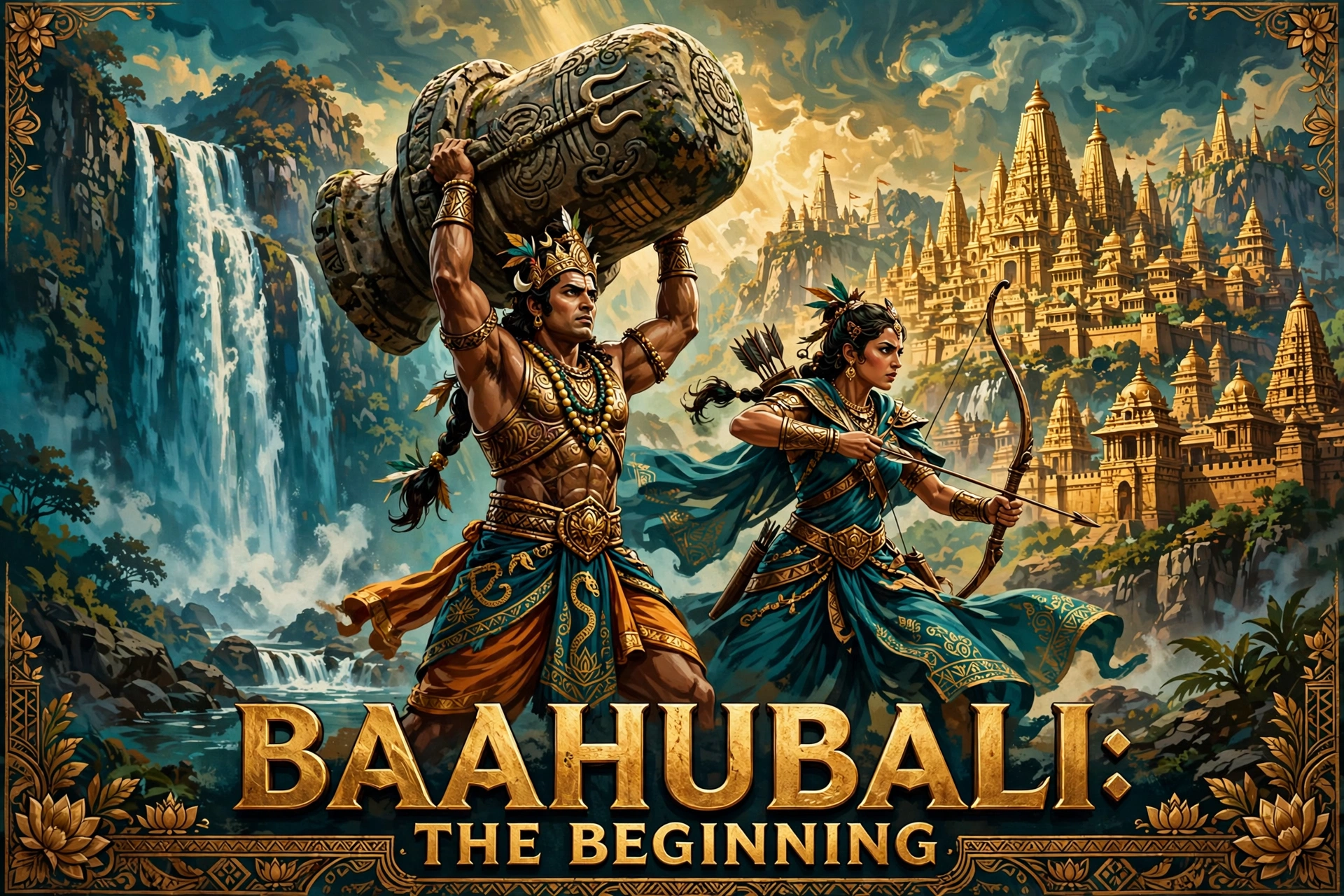
Our Rating: ★★★★☆ 8.5/10
Every national cinema has a before-and-after film — a release after which budgets, ambitions and audience expectations are quietly recalculated. For India, that film arrived on 10 July 2015. Baahubali: The Beginning, shot simultaneously in Telugu and Tamil and dubbed widely, was the most expensive Indian production of its time, and it behaved like it knew the risk: a waterfall climb staged as pure desire, a kingdom built like a myth you could walk through, and a cliffhanger question so effective that it sustained two years of public argument. When it won the National Film Award for Best Feature Film at the 63rd National Film Awards — the first Telugu film ever to do so — plus Best Special Effects, the establishment was simply confirming what audiences had already decided.
An honest Baahubali: The Beginning review must also admit what the legend sometimes smooths over. This is only half a story by design. One of its two heroines is written far thinner than the other, the romance track wobbles, and the film’s emotional peak is borrowed from a past it only begins to tell. None of that stopped it becoming a cultural event — nor should it stop you watching it. This review covers the spoiler-free story, the performances, Rajamouli’s direction and technical craft, M. M. Keeravani’s score, the box office in flagged ranges, and why Part 1 still matters even with its greater sequel standing beside it.
| Detail | Information |
|---|---|
| Release date | 10 July 2015 (India) |
| Director | S. S. Rajamouli |
| Writers | V. Vijayendra Prasad (story); S. S. Rajamouli (screenplay) |
| Genre | Epic, Action, Drama |
| Language | Telugu, Tamil |
| Runtime | 158 minutes (Telugu); 159 minutes (Tamil) |
| Budget | ₹170–180 crore (reported range — see Box Office note) |
| Lead cast | Prabhas, Rana Daggubati, Anushka Shetty, Tamannaah Bhatia, Ramya Krishna, Sathyaraj, Nassar |
| Our rating | 8.5/10 |
The film opens with an image that tells you everything about its ambitions: a woman, gravely wounded, carries a baby through a raging river beneath an enormous waterfall, determined that the child will live even if she does not. The infant is raised by a tribal community at the foot of the falls as Shivudu — a restless, impossibly strong young man who keeps trying to climb toward whatever lies above the clouds, driven by a curiosity his adoptive family cannot explain and gently fears. When an object from the world above literally falls into his hands, his obsession sharpens into purpose, and his climb becomes the film’s first great set piece: less an action scene than a love letter to wanting more than the life you were handed.
Above the waterfall sits Mahishmati, a wealthy and fearsome kingdom ruled with an iron sense of order. There Shivudu crosses paths with Avanthika, a fierce rebel fighter whose guerrilla band is dedicated to rescuing their imprisoned former queen, Devasena, who has been held in degrading captivity for twenty-five years. Through Avanthika’s mission, Shivudu is pulled into a rescue, a war and, gradually, a revelation: the kingdom’s present cruelty is rooted in a past of brotherhood, ambition and betrayal involving the legendary Amarendra Baahubali, his devoted commander Kattappa, the formidable queen mother Sivagami, and Bhallaladeva, the giant who now sits on the throne. The film’s second half opens that past like a door — and then, at the precise moment of maximum shock, closes the door in your face. Kattappa’s confession in the final minutes reframes everything you have seen and sends you out of the cinema with a single burning question, which we will absolutely not answer here. The sequel, Baahubali 2: The Conclusion (2017), exists because this film ends mid-breath on purpose.
Prabhas carries a dual burden — the boyish, wondering Shivudu and the glimpsed, godlike Amarendra Baahubali — and the contrast is the point. His Shivudu is all appetite and playfulness, which makes the flashes of Amarendra’s gravity land like prophecy. Prabhas famously devoted years of his career to this franchise, and the physical scale he brings is unmatched in Indian cinema of the period; more importantly, he never winks at the material. Rana Daggubati as Bhallaladeva matches him kilo for kilo and sneer for sneer: a mountain of a villain whose resentment the film wisely makes human before it makes him monstrous, particularly in the flashback passages where the two princes are measured against each other again and again.
Ramya Krishna as Sivagami walks away with the film’s authority. Her queen mother is terrifying, grieving and commanding in a single register, and the prologue belongs as much to her willpower as to the waterfall. Sathyaraj as Kattappa provides the emotional fault line — a warrior whose loyalty is his glory and his tragedy — and his warmth in the storytelling passages holds the flashback together. Anushka Shetty as Devasena, seen mostly in captivity and in glimpses of her former fire, makes an indelible impression with limited screen time; her full measure is deliberately saved for the sequel. The weak link is Tamannaah Bhatia as Avanthika: a fine performer given a character the script cannot decide about, introduced as a hardened insurgent and then softened, via a much-criticised romantic passage, into someone far more conventional. Nassar as Bijjaladeva, the bitter, scheming father whispering poison into his son’s ear, completes a court where every performance understands the epic register and commits to it.
S. S. Rajamouli directs like a storyteller who has waited his whole career for a canvas this size. His gift has never been subtlety; it is clarity of desire. Every major sequence is built around one legible want — climb the falls, steal the moment, free the queen, win the war — and then escalated with a showman’s patience. The great war against the Kalakeya horde in the second half remains a landmark of Indian action filmmaking: invented formations, a rolling ball of fire, battlefield tactics you can actually follow, edited by Kotagiri Venkateswara Rao for geography rather than chaos. K. K. Senthil Kumar’s cinematography gives Mahishmati a painterly, storybook solidity, while Sabu Cyril’s production design does the quiet world-building — palaces, prisons, markets and war machines that feel designed rather than rendered.
The visual effects, supervised by V. Srinivas Mohan and honoured with the National Film Award for Best Special Effects, were unprecedented for an Indian production and mostly hold up as design even where individual shots have aged. The waterfall environment, the kingdom vistas and the war’s scale shots achieve what matters most: the audience never doubts the world’s existence. Where the craft falters is pacing and proportion. The romance in the first half consumes time the rebellion plot needs, one musical passage built around Avanthika’s transformation drew justified criticism for undercutting her character, and the flashback structure means the present-day story is thin compared with the past it is excavating. But these are the flaws of a film building a cathedral in public — the scaffolding shows, and the building is still astonishing.
M. M. Keeravani, Rajamouli’s career-long collaborator and cousin, composes as if scoring a legend that must be singable by grandchildren. The songs are woven into the climb, the romance, the devotion and the war rather than parked between scenes, and the great choral-war passages helped define how Indian epics would sound for a decade. Keeravani’s real triumph, though, is the background score’s emotional engineering: a swelling heroic theme that teaches the audience how to feel about a name before the film has fully explained who bears it, and mournful string writing in the Devasena and Sivagami passages that gives the spectacle a heartbeat. The score is rarely subtle and never needs to be; in this register, restraint would read as doubt. Played loud in a good theatre, it is half the reason the cliffhanger lands like a physical blow.
What we loved:
What could be better:
As always with Indian trade figures, nothing here is audited, so ranges are the honest way to present it. The budget is most often cited in a ₹170–180 crore band: current reference listings put it at ₹170 crore, while many contemporary and reference accounts, including the film’s own widely repeated production histories, say ₹180 crore — either way, it was the most expensive Indian film made up to that point, and we show the range rather than pretending one figure is settled. Collections show the same pattern at a higher altitude: Box Office India, India Today and The Indian Express reported a worldwide total around ₹600 crore, while Firstpost and several other trackers reported approximately ₹650 crore. We therefore describe the worldwide gross as roughly ₹600–650 crore. On any version, the film was a phenomenon: the highest-grossing film in India at the time, the highest-grossing South Indian film ever to that point, and the first non-Hindi film whose dubbed Hindi version alone crossed ₹100 crore — the result that permanently changed how the Indian industry thought about pan-India releases.
Absolutely — but watch it as what it is: the magnificent first half of one great film, ideally with Baahubali 2: The Conclusion queued immediately behind it. Seen that way, its incompleteness becomes propulsion rather than frustration. New viewers should expect an old-fashioned myth told with modern muscle: big emotions worn openly, songs inside the story, action built like architecture, and a final five minutes engineered to make you press play on Part 2 before the credits finish. If you somehow start with the sequel, you will still enjoy it — but you will have robbed yourself of Indian cinema’s greatest cliffhanger.
Our rating: 8.5/10 — a flawed, towering, era-defining epic: half a story, delivered with the confidence of a complete legend.
Why did Kattappa do what the ending reveals?
That is the question the film deliberately refuses to answer — it is the engine of Baahubali 2: The Conclusion (2017), which tells the full story of Amarendra Baahubali. We keep this review spoiler-free, so watch Part 2 for the answer.
Do I need to watch Baahubali: The Beginning before The Conclusion?
Yes, absolutely. The second film assumes you know Shivudu, Kattappa, Sivagami, Devasena and Bhallaladeva, and its emotional payoff depends on the mystery this film sets up. Watch them in order, ideally close together.
Is Baahubali: The Beginning based on a real kingdom or mythology?
No. Mahishmati and its royal family are original creations by writer V. Vijayendra Prasad, though the film draws openly on the emotional grammar of Indian epics and folklore — duty, brotherhood, vows and betrayal.
Did the film really win the National Film Award for Best Feature Film?
Yes. At the 63rd National Film Awards it won Best Feature Film — the first Telugu film to win that honour — and Best Special Effects. It also won five Filmfare Awards South for its Telugu version, including Best Film and Best Director.
Where can I watch Baahubali: The Beginning?
It is widely available on major streaming platforms in Telugu, Tamil, Hindi and other dubbed versions, and on home video. Availability varies by region, so check your local services.