★ LATEST REVIEWS

★★★★★ Our Rating: 9/10
For two years, one question echoed across India: why did Kattappa kill Baahubali? The cliffhanger ending of Baahubali: The Beginning (2015) turned its sequel into perhaps the most anticipated Indian film ever made. When Baahubali 2: The Conclusion finally arrived on 28 April 2017, it did not merely answer the question — it shattered every box office record Indian cinema had, becoming the first Indian film to cross ₹1,000 crore worldwide.
Expectations that high usually crush a film. Instead, the second chapter proved bigger, more emotional and more satisfying than the first. This review revisits the conclusion of S. S. Rajamouli’s Mahishmati saga — its story, performances, craft and staggering commercial run — and asks how well it holds up beyond the hype.
| Detail | Information |
|---|---|
| Release date | 28 April 2017 |
| Director | S. S. Rajamouli |
| Writers | Story by K. V. Vijayendra Prasad; screenplay by S. S. Rajamouli |
| Genre | Epic Action, Drama |
| Language | Telugu and Tamil (shot simultaneously; dubbed in Hindi, Malayalam and more) |
| Runtime | 171 minutes (Telugu version) |
| Budget | Approx. ₹250 crore |
| Lead cast | Prabhas, Rana Daggubati, Anushka Shetty, Tamannaah Bhatia, Ramya Krishna, Sathyaraj |
| Our rating | 9/10 |
The film resumes with Shiva — who now knows his true name is Mahendra Baahubali — listening as the loyal slave-warrior Kattappa narrates the life of his father, Amarendra Baahubali. Most of The Conclusion is that flashback, and it is richer than the framing story around it.
Young Amarendra, having defeated the Kalakeya invasion in the first film, is named heir to the throne of Mahishmati, while his embittered cousin Bhallaladeva is made commander of the army — a compromise by Queen Mother Sivagami that plants the seed of everything to come. Sent on a tour of the kingdom in disguise, Amarendra visits the small kingdom of Kuntala, where he falls for its fearless warrior-princess Devasena — a woman who fights first and speaks her mind even faster, including to Mahishmati’s mighty court itself.
What follows, without spoilers, is a tragedy built from pride, wounded ego and manipulated loyalty. A marriage proposal sent with the wrong name attached, a queen mother’s pride clashing with a daughter-in-law’s dignity, a villain patiently poisoning every relationship in the palace — the film shows, step by painful step, how the noblest man in the kingdom can be isolated, stripped of his crown and finally betrayed by the people he loved most. The famous question is answered, and the answer hurts more than most viewers expected. The final movement returns to the present, where the son must decide what justice looks like a generation later.
Prabhas as Amarendra Baahubali (and Mahendra Baahubali) carries two roles and the entire weight of the franchise. His Amarendra is warmth and thunder in one body — playful in Kuntala, terrifying in battle, heartbreaking in humiliation. Prabhas devoted years of his career exclusively to these films, transformed his physique completely, and the commitment shows: it is difficult to imagine any other actor radiating this combination of innocence and physical authority.
Rana Daggubati as Bhallaladeva matches him as one of Indian cinema’s great screen villains. His Bhallaladeva is not a cackling tyrant but a man corroded by a lifetime of being second — to his cousin in love, in war and in his own mother’s esteem. Daggubati’s sheer physical presence makes the final confrontation credible, while his quiet scenes of resentment give the character a twisted logic.
Ramya Krishna as Sivagami may quietly be the film’s most complex performance. Fierce, principled and fatally proud, Sivagami is both the kingdom’s moral centre and the author of its tragedy. Anushka Shetty as Devasena is superb — regal and sharp-tongued in the flashback’s courtship, then devastating as the chained, defiant prisoner who has waited twenty-five years for justice. Sathyaraj as Kattappa gives the saga its conscience; his torment, once the truth emerges, is the emotional engine of the whole film. Tamannaah Bhatia as Avantika and Nassar as Bijjaladeva complete a cast without a weak link.
Rajamouli’s great gift is scale with clarity. The battle sequences in The Conclusion are enormous — armies, elephants, ingenious war machines — yet you always understand the geography of the fight and what is at stake emotionally inside it. The Kuntala defence sequence, where Amarendra and Devasena fight side by side, doubles as a love scene; the climax, with its flaming assault on Mahishmati, doubles as a son’s grief made literal. Action here is never decoration — it is storytelling.
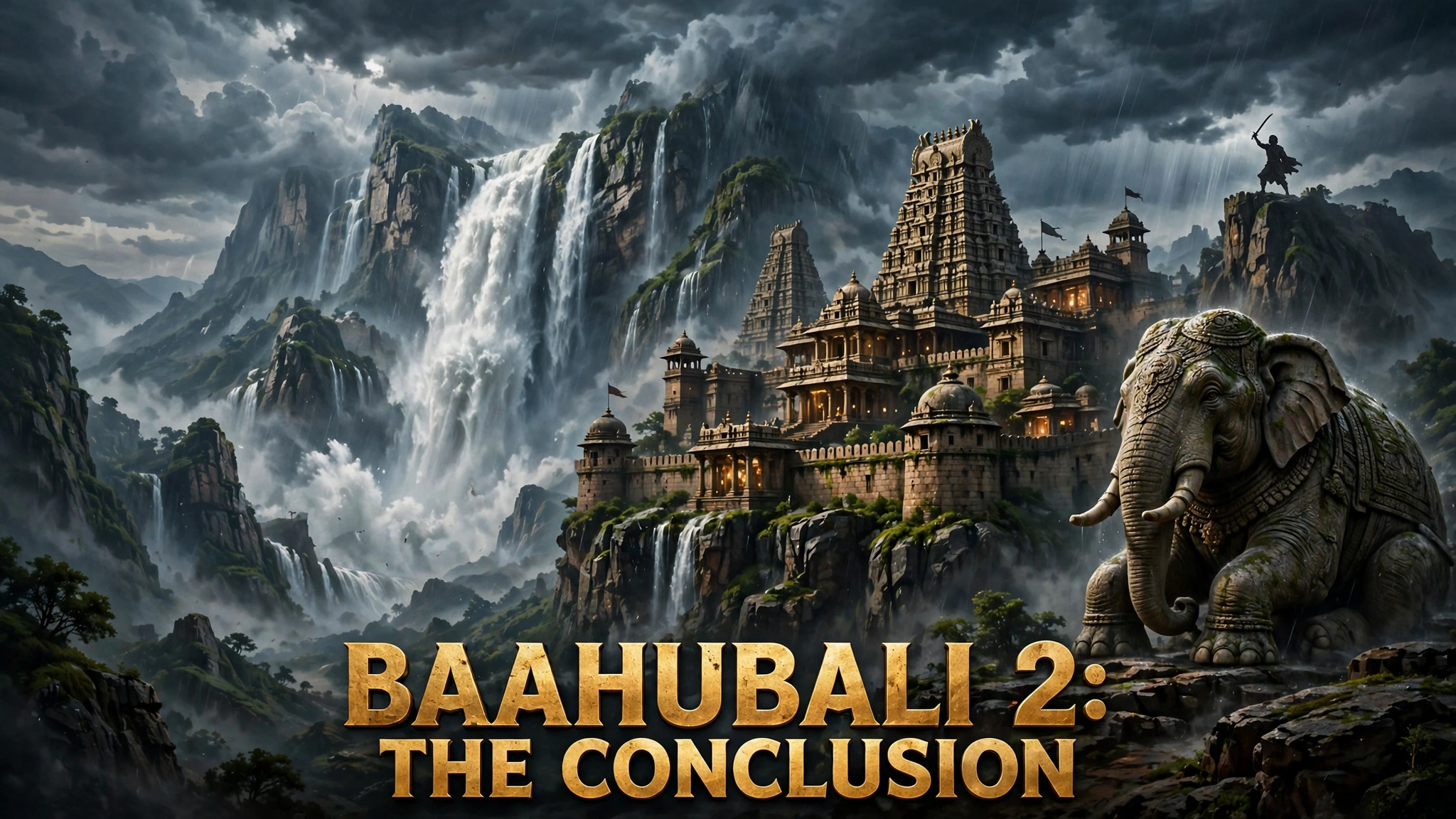
The production design by Sabu Cyril creates a kingdom that feels carved from myth: golden palaces, vast courtyards, waterfalls as defence walls. K. K. Senthil Kumar’s cinematography finds painterly frames inside the chaos. The visual effects, groundbreaking for Indian cinema at the time, mostly hold up remarkably well, though a handful of shots — particularly some animal and crowd work — look dated today. At 171 minutes the film earns its length, but the early Kuntala romance, while charming, moves at a gentler pace than everything around it, and a couple of song placements slow the momentum.
M. M. Keeravani’s music is inseparable from the Baahubali experience. The soaring theme that accompanies Amarendra’s heroics can still raise goosebumps, and the background score does heavy emotional lifting in the film’s betrayals and revelations — listen to how the music withholds triumph and leans into dread as the palace conspiracy tightens. Among the songs, the romantic “Hamsa Naava” sequence in Kuntala and the devotional grandeur of “Dandaalayyaa” stand out, the latter accompanying one of the film’s most rousing stretches of mass emotion. Few Indian scores of the decade are quoted as often, or as affectionately.
What we loved:
What could be better:
Made on a budget of around ₹250 crore — among the costliest Indian productions of its era — Baahubali 2 opened to unprecedented numbers across every Indian language market simultaneously. Remarkably, its Hindi dubbed version alone outperformed most original Hindi blockbusters of the year, proving that a well-dubbed regional film could conquer the whole country. Reported estimates place its final worldwide gross at roughly ₹1,810 crore, briefly making it the highest-grossing Indian film ever made, and it remains the highest-grossing film within India itself as well as the biggest Telugu film of all time. It sold an estimated ten crore tickets — footfalls unmatched by any Indian film in decades.
It is hard to overstate what this film changed. Before Baahubali 2, a Telugu film’s natural market was understood to be the Telugu states, with anything beyond that treated as a bonus. After it, producers across India began planning for a national audience from the first day of shooting: simultaneous multi-language releases, stars cast across industries, and budgets justified by a pan-Indian theatrical map rather than a single regional one. The wave of large-scale Indian event films that followed — for better and sometimes for worse — runs directly through Mahishmati. Just as importantly, the film proved that Indian audiences would turn out in record numbers for a story rooted in Indian mythology, design and music, without any need to imitate Hollywood grammar. Its success was not only commercial; it was a change in what the industry believed about itself.
If you have seen the first film, this is not a question — you need the answer, and the answer delivers. If you have not, watch both parts back to back and experience the most complete popular epic Indian cinema has produced. The Conclusion is melodramatic, enormous and utterly sincere, and its emotional payoffs are earned across two films in a way few franchises anywhere manage.
Our rating: 9/10 — the rare sequel that outgrows its predecessor.
Do I need to watch Baahubali: The Beginning before The Conclusion?
Yes, absolutely. The second film is a direct continuation and its emotional weight depends on knowing the characters and the famous unanswered question from part one.
Why did Kattappa kill Baahubali?
That is the central mystery of this film, and we will not spoil it here. The film answers it fully in its second half — and the reason is more about loyalty and manipulation than hatred.
Which languages was Baahubali 2 made in?
It was shot simultaneously in Telugu and Tamil, then dubbed into Hindi, Malayalam and several international languages.
Is Baahubali 2 the highest-grossing Indian film?
It was the highest-grossing Indian film worldwide at the time of its release, with reported earnings around ₹1,810 crore. It was later surpassed globally by Dangal‘s extended international run, but it remains the highest-grossing film in the domestic Indian market.
Where can I watch Baahubali 2: The Conclusion?
It is widely available on major streaming platforms in multiple languages, including the original Telugu. Availability differs by region.