
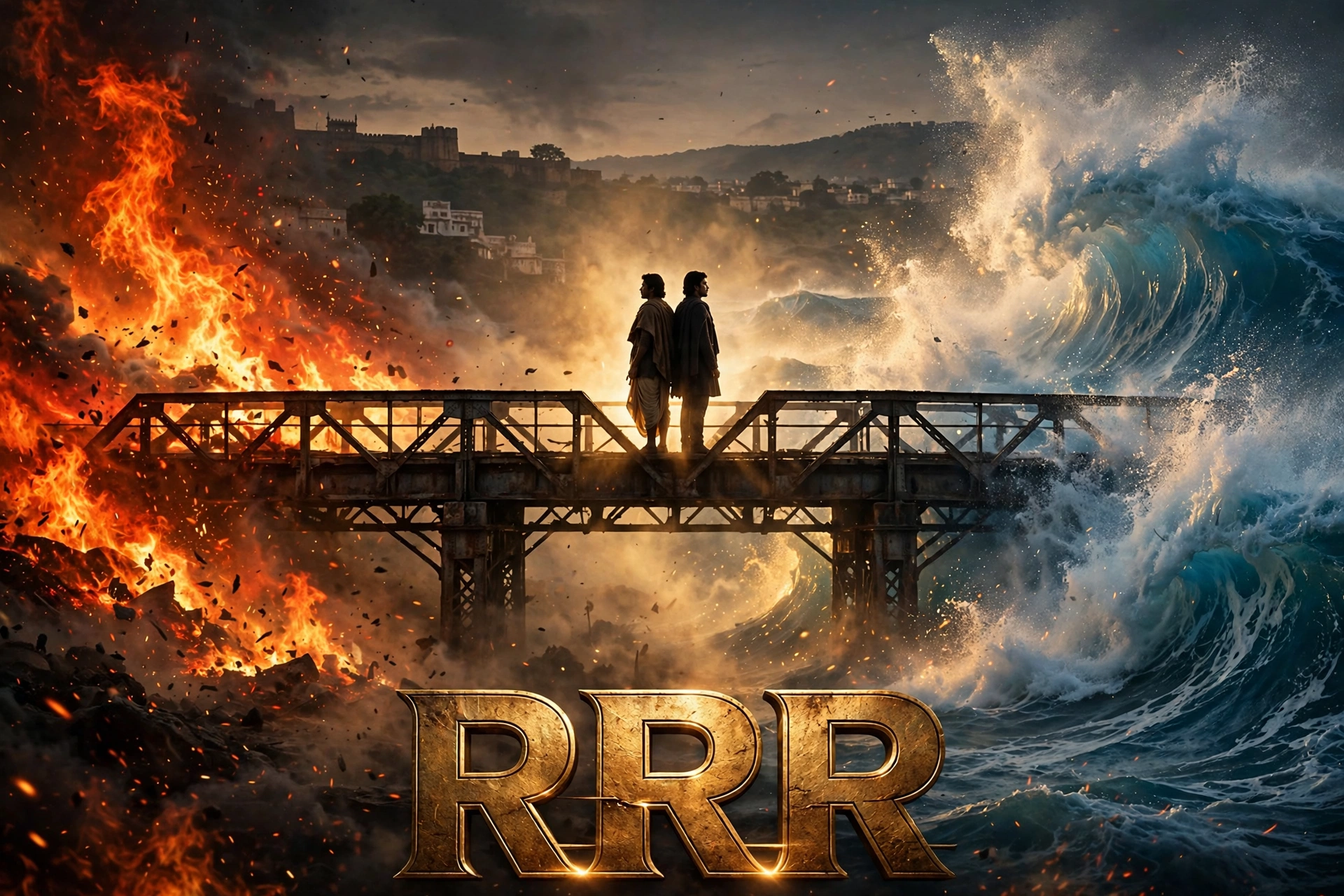

RRR (2022) Review – Fire, Water and the Loudest Bromance in Indian Cinema
Most big films try to give you value for money. RRR tries to give you value for money, then doubles it, sets it on fire, throws it off a bridge and catches it on a motorcycle. Released on 25 March 2022 after multiple pandemic delays, S. S. Rajamouli’s Telugu period action drama became a genuine global phenomenon — the rare Indian film that Western audiences discovered, celebrated and danced along to, culminating in an Academy Award for its song “Naatu Naatu.”
But strip away the records and the viral dance clips, and a fair question remains: is RRR a great film, or just a very loud one? In this review we look at the story, the performances, the craft, the music and the box office, and give you an honest answer — including the parts where this three-hour rollercoaster creaks.
Quick Facts: RRR at a Glance
| Detail | Information |
|---|---|
| Release date | 25 March 2022 |
| Director | S. S. Rajamouli |
| Writers | Story by K. V. Vijayendra Prasad; screenplay by S. S. Rajamouli |
| Genre | Period Action, Drama |
| Language | Telugu (dubbed in Hindi, Tamil, Malayalam, Kannada and more) |
| Runtime | 182 minutes |
| Budget | Approx. ₹550 crore |
| Lead cast | Ram Charan, N. T. Rama Rao Jr., Alia Bhatt, Olivia Morris, Ajay Devgn |
| Our rating | 8.5/10 |
The Story: Two Legends Who Never Met (Spoiler-Free)
RRR is openly fictional history. It takes two real revolutionaries from different corners of the freedom struggle — Alluri Sitarama Raju and Komaram Bheem — who never actually crossed paths, and imagines what might have happened if they had met in Delhi in the 1920s, under British rule.
The spark is a cruelty. A young tribal girl named Malli is taken from her village by the wife of the British Governor, more as a souvenir than a person. Her protector, Bheem (N. T. Rama Rao Jr.), a Gond tribal leader of immense physical strength and gentle heart, travels to the city to bring her home, hiding in plain sight while he searches for a way into the Governor’s fortress-like residence.
Standing in his way — though neither man knows it at first — is Rama Raju (Ram Charan), a fiercely driven Indian officer serving in the British police. Raju is hunting the very tribal rebel the administration fears, hoping a spectacular capture will earn him the promotion and the weapons access he secretly craves for his own village. When a dramatic rescue throws the two men together, they become inseparable friends, each unaware that the other is exactly the man he is looking for.
That is all you should know going in. What follows is a story about friendship tested by duty, about two different kinds of rebellion — one roaring openly, one smouldering in disguise — and about what happens when masks finally fall. The film’s second half broadens into full revolutionary drama, powered by a flashback that explains Raju’s past and his connection to a freedom fighter played by Ajay Devgn.
Performances: Two Stars, Zero Ego Problems
Ram Charan as Alluri Sitarama Raju gives the more internal performance of the two leads, and arguably the harder one. His Raju is a coiled spring — disciplined, watchful, and hiding rage behind a uniform. Charan plays long stretches almost silently, letting posture and eyes do the work, and when the character’s layers peel away in the second half, the shift is genuinely moving. His introduction sequence, taking on an entire mob alone, is staged like a superhero origin compressed into ten minutes.
N. T. Rama Rao Jr. as Komaram Bheem is the film’s beating heart. Jr NTR brings warmth, innocence and frightening physicality to the same character, sometimes within a single scene. Bheem can weep over a trapped animal one moment and wrestle a tiger the next, and the actor makes both registers believable. His public-flogging sequence — where he endures punishment rather than betray a friend — is the emotional peak of the film and rests almost entirely on his face.
Alia Bhatt as Sita does well with limited screen time, giving Raju’s story its emotional anchor, though the role is more symbolic than fleshed out. Olivia Morris as Jenny, the Governor’s kind-hearted niece, is pleasant but similarly underwritten. Ajay Devgn as Venkata Rama Raju brings gravitas to an extended cameo that carries the film’s most important flashback. On the other side, Ray Stevenson as Governor Scott and Alison Doody as Catherine play colonial villainy at full volume — effective as hate figures, though deliberately close to caricature.
Direction and Technical Brilliance
Rajamouli directs like a man who believes subtlety is a rumour. Every emotion is underlined, every action set-piece is engineered to be the biggest thing you have ever seen, and remarkably, most of them land. The interval sequence, in which Bheem storms the Governor’s residence with a truckload of wild animals, is the kind of set-piece that gets audiences out of their seats — absurd on paper, electric in execution.
The craft underneath the bombast is serious. K. K. Senthil Kumar’s cinematography gives the film a storybook richness, contrasting earthy tribal greens with the cold stone of colonial power. The visual effects are extensive — thousands of shots — and mostly convincing, though a few animal shots in the climax show their seams. The editing keeps a very long film moving; the first half in particular flies by. Where Rajamouli falters is restraint: a few emotional beats are hammered twice when once would have done, and the final act piles spectacle on spectacle until exhaustion competes with exhilaration.
Music and Background Score
M. M. Keeravani’s score is the film’s secret weapon. His themes for fire and water give the two heroes musical identities that collide and combine as their bond deepens, and the background music in the flogging sequence — built around the song “Komuram Bheemudo” — turns a brutal scene into something almost devotional.
And then there is “Naatu Naatu.” The dance number, performed with astonishing synchronisation by both leads, became a worldwide sensation and won the Academy Award for Best Original Song as well as a Golden Globe — a first for an Indian feature film song at the Oscars. It is not decoration; it is a duel, a friendship ritual and a cultural flex packed into five minutes, and it remains the single most joyful sequence in any film of 2022.
What Works and What Doesn’t
What we loved:
- Two perfectly matched lead performances with real chemistry
- Action set-pieces that keep topping themselves without losing clarity
- A simple, mythic emotional core — friendship, betrayal, sacrifice
- Keeravani’s score and the all-conquering “Naatu Naatu”
What could be better:
- At 182 minutes, the final act feels stretched and slightly repetitive
- The female characters are thinly written compared to the men
- The British villains are one-note caricatures, and the film’s history is fantasy, not fact — viewers should enjoy it as myth, not a lesson
Box Office: A Global Earthquake
Made on a reported budget of around ₹550 crore, making it one of the most expensive Indian films ever at the time, RRR opened to a record-breaking first day for an Indian film and never looked back. Reported worldwide totals vary by source — most credible estimates place the final gross in the ₹1,300–1,387 crore range — making it one of the highest-grossing Indian films of all time and the biggest Indian hit of 2022. Unusually for an Indian film, a significant share came from overseas, including a long, word-of-mouth-driven run in the United States and Japan, where special screenings continued for months.
Why RRR Travelled So Far
Part of the film’s unusual afterlife deserves its own note. In India it was a familiar kind of blockbuster, but in North America, Europe and Japan it kept finding new audiences months after release, driven by sing-along screenings, dance-along screenings and pure word of mouth. Western critics who had never programmed a Telugu film before wrote about it with genuine astonishment, and its awards-season run turned “Naatu Naatu” into a fixture far beyond diaspora audiences. That journey matters because it proved something the Indian industry had long suspected: a film does not need to soften its language, its melodrama or its scale to travel — it needs conviction, clarity of emotion and set-pieces staged well enough that no subtitle is required to understand why everyone in the theatre is cheering.
Verdict: Should You Watch It?
Yes — ideally on the biggest screen you can find. RRR is not flawless: it is long, its villains are cartoons and its emotions are dialled to maximum at all times. But its sincerity is disarming. Rajamouli believes every frame of this friendship saga, and his two leads make you believe it too. Few films anywhere in the world deliver this much spectacle with this much heart.
Our rating: 8.5/10 — a maximalist action epic that earns its excess.
Frequently Asked Questions
What does RRR stand for?
In English it was promoted as “Rise, Roar, Revolt.” In Telugu the expanded form is “Roudram Ranam Rudhiram,” with different expansions used for the Tamil, Hindi and other dubbed versions.
Is RRR based on a true story?
No. Alluri Sitarama Raju and Komaram Bheem were real freedom fighters, but they lived in different regions, fought in different periods and never met. The film is an imagined “what if” built around them.
Did RRR really win an Oscar?
Yes. “Naatu Naatu,” composed by M. M. Keeravani with lyrics by Chandrabose, won Best Original Song at the 95th Academy Awards in 2023.
Is RRR a sequel to Baahubali?
No. It is a standalone film from the same director, S. S. Rajamouli, with no story connection to the Baahubali films.
Where can I watch RRR?
The film streams on major platforms in most regions, in Telugu and dubbed versions including Hindi and English. Availability varies by country, so check your local services.