★ LATEST REVIEWS

★★★★☆ Our Rating: 7.5/10
Thirteen years is a long time to wait for a sequel, especially when the original film became the highest-grossing movie in history. In that gap, plenty of people predicted that audiences had moved on from Pandora, that the first Avatar had left too little cultural footprint to justify a return, and that James Cameron was betting too much on technology doing the persuading. Avatar: The Way of Water, released in December 2022, answered those doubts the Cameron way: bigger, longer, more technically audacious, and sincere to a fault.
Watching it in a cinema, it is easy to understand why he was so confident. The underwater world Cameron and his team have built is unlike anything else in modern blockbuster cinema — luminous, detailed, and calmly beautiful in stretches where other films would rush to the next explosion. The harder question is whether the story swimming through that world is strong enough to justify more than three hours of your time. Our honest answer is: mostly, yes, but with reservations you should know about before you sit down.
In this review, we give you an honest breakdown of the film’s story, performances, astonishing visuals, and a running time that will test even devoted fans.
| Detail | Information |
|---|---|
| Release date | December 16, 2022 (United States) |
| Director | James Cameron |
| Writers | James Cameron, Rick Jaffa, Amanda Silver (screenplay) |
| Genre | Sci-Fi, Adventure, Action |
| Language | English |
| Runtime | 192 minutes |
| Budget | $350–460 million |
| Lead cast | Sam Worthington, Zoe Saldaña, Sigourney Weaver, Stephen Lang, Kate Winslet |
| Our rating | 7.5/10 |
More than a decade has passed since the events of the first film. Jake Sully, once a human soldier, now lives permanently as a Na’vi and leads the Omatikaya clan alongside Neytiri. Together they are raising a family: sons Neteyam and Lo’ak, young daughter Tuk, adopted daughter Kiri, and Spider, a human teenager born on Pandora who has grown up among the Na’vi. For a while, their life in the forest is peaceful, shaped by hunting, family loyalty, and Jake’s strict belief that a father protects.
That peace ends when humans return to Pandora in far greater force. Earth is dying, and this time the Resources Development Administration intends nothing less than colonisation, building a fortified city and resuming its hunt for Pandora’s valuable resources. Among the returning forces is a new kind of soldier: avatars carrying the memories of dead human troops, led by a familiar enemy whose grudge against Jake is intensely personal. When that threat comes too close to his children, Jake makes a painful decision to take his family far from the forest and seek shelter with the Metkayina, a clan whose lives are built around the ocean.
The middle of the film slows down deliberately as the Sullys learn an entirely new way of living — free-diving, riding sea creatures, and earning the trust of a community that views them as outsiders with dangerous enemies. It is here that the title earns its meaning. Water connects, provides, and demands patience, and the younger Sullys grow up quickly inside that lesson. What follows when their past catches up with them is best experienced unspoiled, but be prepared for an extended, intense final act on and under the sea.
Sam Worthington as Jake Sully: Worthington plays Jake as a sterner figure than the curious outsider of the first film. Parenthood has made him protective to the point of rigidity, and that tension with his sons, particularly Lo’ak, gives the family story its friction. It is not a showy performance, but it is a consistent and believable one, delivered almost entirely through performance capture.
Zoe Saldaña as Neytiri: Saldaña remains the emotional powerhouse of this series. Neytiri’s grief, fury, and fierce love for her children come through the digital character work with startling clarity, especially in the film’s later stages. If there is a criticism, it is that the film gives her less screen time than her performance deserves, focusing more heavily on the children in the middle section.
Sigourney Weaver as Kiri: Weaver’s casting is the film’s boldest gamble — a veteran actor playing a teenage Na’vi with a mysterious connection to Pandora itself. Remarkably, it works. She captures adolescent uncertainty and wonder without caricature, and Kiri quickly becomes the most intriguing of the younger characters, with a storyline clearly built to matter in future films.
Stephen Lang as Colonel Miles Quaritch and Kate Winslet as Ronal: Lang returns as Quaritch in a new form, and the twist gives him more interesting material than a simple repeat villain would have offered, including an uneasy bond with Spider. Winslet brings authority and scepticism to Ronal, the Metkayina clan’s spiritual leader, while Cliff Curtis offers warmth as her husband, chief Tonowari. The young cast playing the Sully children acquit themselves well, with Britain Dalton as Lo’ak carrying much of the film’s coming-of-age weight.
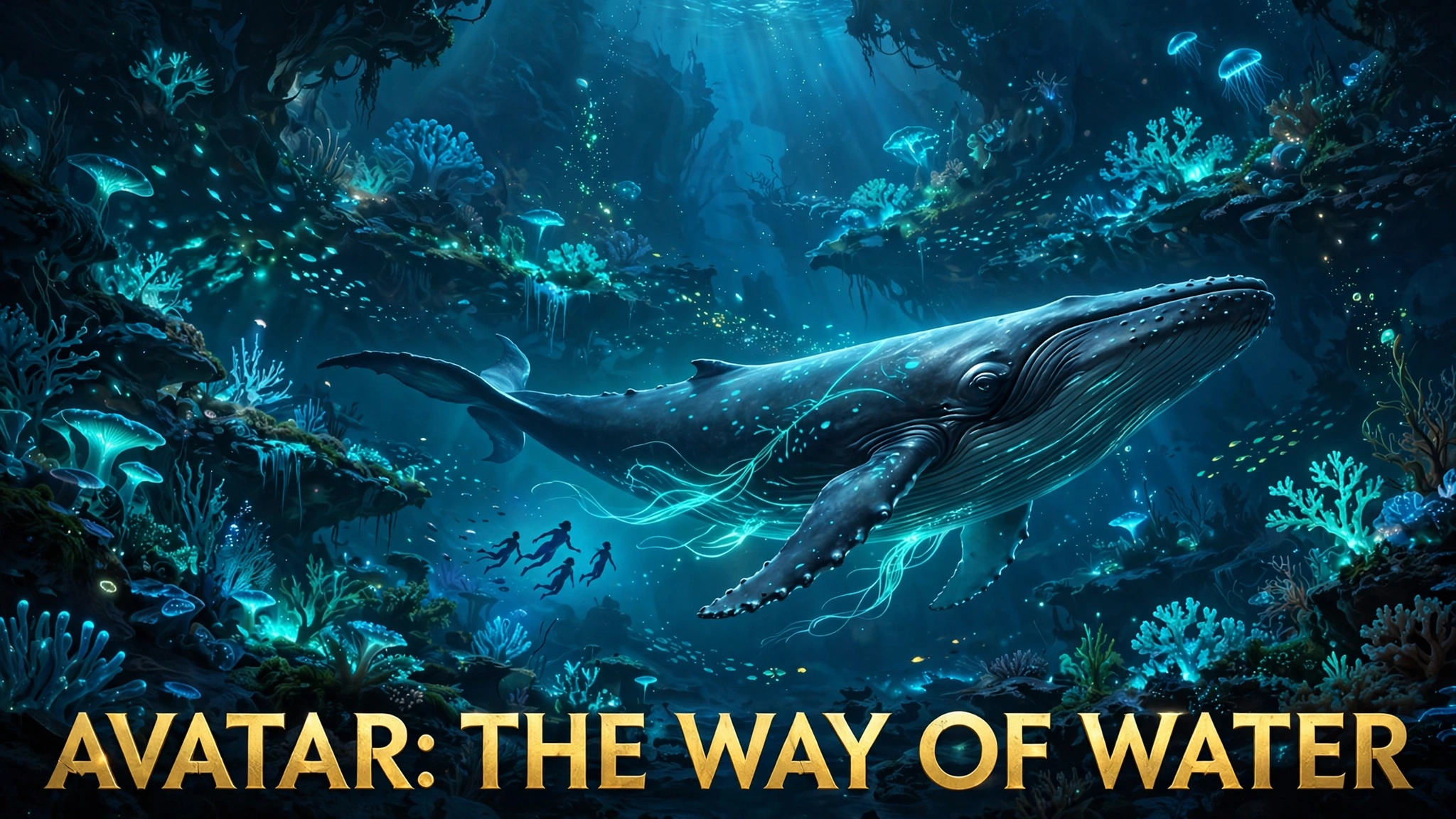
Technically, Avatar: The Way of Water is a staggering achievement, and this section could easily run longer than the rest of the review. James Cameron spent years developing new technology to capture performances underwater, and the result is a film where digital characters swim, dive, and surface with a realism that still feels ahead of the industry. The reef environments designed by the art and effects teams are dense with invented marine life, glowing plants, and believable water behaviour, lit beautifully by cinematographer Russell Carpenter.
The film’s use of 3D and, in some cinemas, a high frame rate for selected sequences divided audiences. Supporters found the images startlingly immersive, like looking through a window into Pandora. Others found the shifting frame rate distracting, with some passages resembling a video game cutscene. Our view is that the underwater scenes benefit enormously, while the variable effect takes a little adjustment on dry land. Either way, the film won the Academy Award for Best Visual Effects, and no serious viewer would argue with that decision.
Cameron’s direction of action remains masterful. The final act combines ships, aircraft, sea creatures, and family drama into a long climax that stays geographically clear and emotionally legible, a skill many blockbuster directors never master. The weakness is pacing rather than execution. The middle hour, devoted to learning the ways of the reef clan, contains the film’s most beautiful images and its least urgent storytelling. Twenty minutes could have been trimmed without losing the wonder, and a three-hour-plus film has a duty to justify every one of them.
Composer Simon Franglen, who worked closely with the late James Horner on the wider Avatar music world, had the difficult task of following Horner’s beloved score for the first film. He handles it with respect and intelligence, weaving Horner’s themes into a new score that leans on choral voices, percussion, and distinctive invented instruments to give the ocean clan its own musical identity. The underwater sequences in particular are beautifully scored, with music that suggests depth, calm, and danger in equal measure.
The Weeknd’s closing song, “Nothing Is Lost (You Give Me Strength)”, provides a contemporary counterpoint over the credits and suits the film’s themes of family endurance. Overall, the score may not contain a single theme as instantly memorable as the first film’s best-known material, but as an immersive soundscape supporting three hours of world-building, it does its job very well. Sound design, from whale-like calls of the tulkun to the groaning of ships, is equally accomplished.
What we loved:
What could be better:
Few films have ever carried financial pressure like this one. With a reported production budget of $350–460 million, Avatar: The Way of Water ranks among the most expensive films ever made, and Cameron himself noted before release that it would need to rank among history’s biggest hits simply to break even once marketing was included. It premiered in London on December 6, 2022, and opened in the United States on December 16, 2022.
It finished with $2.334 billion worldwide, becoming the highest-grossing film of 2022 and the third-highest-grossing film of all time. Audiences returned week after week, premium formats such as IMAX and 3D accounted for an unusually large share of ticket sales, and the doubters who had predicted indifference were comprehensively proven wrong. Whatever you think of its story, as a demonstration of Cameron’s ability to make event cinema that people feel they must see in a theatre, the result speaks for itself.
Yes, ideally in a cinema, in 3D if you enjoy the format, and with comfortable seating for a long sitting. Avatar: The Way of Water is not the best-written blockbuster of its year, and viewers who found the first film’s story thin will find the same simplicity here, stretched over an even longer running time. Judged purely as a story, it earns respect rather than adoration.
But films are not only stories. As an experience — a place to visit, a technical landmark, and a sincere film about parents learning that protection sometimes means letting go — it offers something no other release of 2022 could match. That combination is worth your afternoon, even if you check your watch once or twice along the way.
Our rating: 7.5/10 — Visually unmatched and genuinely heartfelt, held back by its length and familiar plot.
Do I need to watch the first Avatar before The Way of Water?
It is strongly recommended. The sequel assumes familiarity with Jake, Neytiri, Pandora, and the human conflict from the 2009 film. A brief recap will get you by, but the family story lands better if the original is fresh in your mind.
Is Avatar: The Way of Water based on a true story?
No. Pandora, the Na’vi, and the Sully family are original creations of James Cameron. The film’s environmental themes reflect real concerns about oceans and exploitation of natural resources, but the story itself is fiction.
How long is Avatar: The Way of Water and what is its age rating?
The runtime is 192 minutes, or three hours and twelve minutes, so plan an intermission-length comfort break strategy accordingly. It is rated PG-13 in the United States for sequences of strong violence and intense action, partial nudity, and some strong language.
Will there be more Avatar sequels?
Yes. Further sequels are in production, continuing the Sully family story, with the next instalment, Avatar: Fire and Ash, following this film. Release dates for later chapters have shifted before, so check official studio announcements for the latest schedule.
Where can I watch Avatar: The Way of Water?
The film is available through major streaming services, digital purchase and rental stores, and on Blu-ray and 4K disc, which offer the best home presentation of its visuals. Availability differs by country, so check the platforms in your region.