
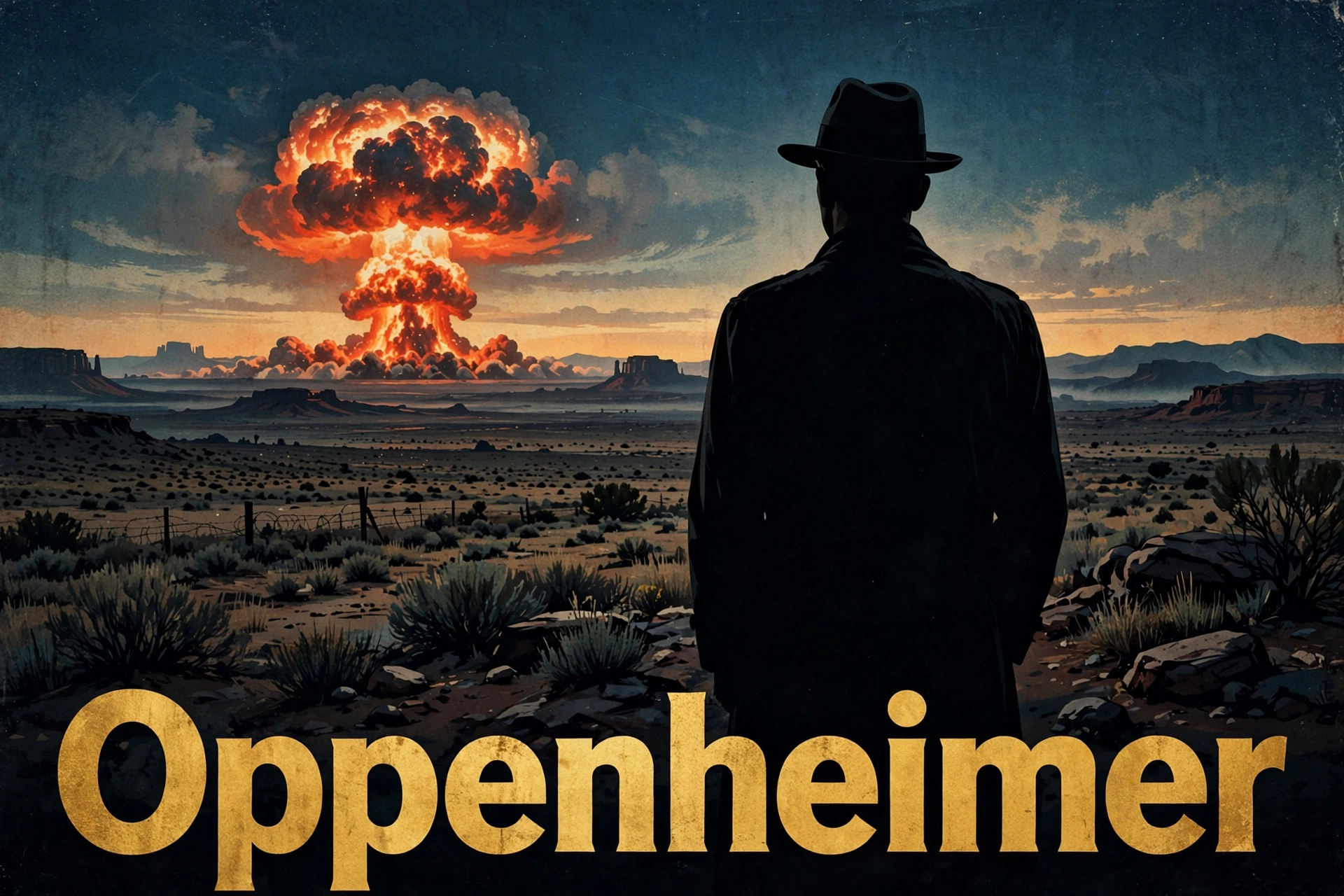

Oppenheimer (2023) Review – A Brilliant Mind, A Terrible Invention
Most biopics follow a safe formula. A gifted person struggles, succeeds, suffers a setback, and leaves the audience with a neat lesson. Oppenheimer refuses that comfort. Christopher Nolan’s three-hour portrait of J. Robert Oppenheimer, the theoretical physicist who led the Los Alamos laboratory during the Manhattan Project, is built like a thriller, a courtroom drama, and a horror story about an idea that could not be uninvented. It moves fast, talks a lot, and still finds time to sit with the silence after a test explosion in the New Mexico desert.
That pace is both its thrill and its challenge. Nolan cuts between Oppenheimer’s student years, the wartime race to build an atomic bomb, and the 1954 security hearing that stripped him of his clearance and damaged his reputation. Names, agencies, and scientific concepts arrive quickly. Viewers who prefer a slower, more conventional life story may feel they are being asked to keep up with a lecture given at sprint speed. Viewers who lean in will find one of Nolan’s most disciplined films, carried by an exceptional central performance.
This is not a film that celebrates genius without counting its cost. Nor does it turn Oppenheimer into a simple villain. It asks harder questions about ambition, responsibility, and political convenience. In this review, we give you an honest breakdown of the story, performances, craft, music, and box office, without reducing a complex life to a slogan.
Quick Facts: Oppenheimer at a Glance
| Detail | Information |
|---|---|
| Release date | 21 July 2023 (United States and United Kingdom) |
| Director | Christopher Nolan |
| Writers | Christopher Nolan, based on American Prometheus by Kai Bird and Martin J. Sherwin |
| Genre | Drama, Biography, Thriller |
| Language | English |
| Runtime | 180 minutes |
| Budget | $100 million |
| Lead cast | Cillian Murphy, Emily Blunt, Matt Damon, Robert Downey Jr., Florence Pugh |
| Our rating | 8.5/10 |
The Story: Building the Bomb, Then Facing What It Built (Spoiler-Free)
The film opens in two registers. In colour, we follow Oppenheimer’s own perspective, from an anxious young student in Europe to a charismatic teacher in America who helps bring modern physics into the classroom. In black and white, we follow the perspective of Lewis Strauss, a powerful Washington figure whose relationship with Oppenheimer becomes central to the political fight after the war.
As the Second World War intensifies, General Leslie Groves recruits Oppenheimer to direct a secret laboratory at Los Alamos, where scientists, engineers, soldiers, and families are gathered in a remote desert town built for a single purpose. The work is urgent because American leaders fear Nazi Germany may be pursuing the same weapon. Inside Los Alamos, brilliant people argue about physics, loyalty, communism, and whether a weapon this destructive should ever be used once it exists. Outside scientific circles, the film keeps returning to Oppenheimer’s complicated personal life, including his relationship with Jean Tatlock and his marriage to Kitty Oppenheimer, who sees both his gifts and his evasions more clearly than he does.
The Trinity test, the first detonation of an atomic device on 16 July 1945, forms the film’s central set piece. After that point, the story becomes less about whether the scientists can succeed and more about who controls what they have created. Political hearings, old associations, and personal rivalries move to the foreground.
This retelling stays spoiler-free about how Nolan structures the final confrontations, but it is fair to say the ending is not a courtroom victory lap. It is about reputations, guilt, and the difference between being proved right and being forgiven.
Performances: Murphy Carries the Weight
Cillian Murphy as J. Robert Oppenheimer — Murphy, a frequent Nolan collaborator finally placed at the centre, gives a performance built on intelligence and unease. His Oppenheimer is charming when he needs support, evasive when cornered, and visibly haunted when applause sounds too much like judgment. Murphy’s thin frame, sharp cheekbones, and watchful eyes do some of the work, but the real achievement is vocal and behavioural. He shows a man who can explain the universe to a room and still fail to understand his own motives until it is too late.
Emily Blunt as Kitty Oppenheimer — Blunt resists playing Kitty as merely the supportive wife. Her Kitty is sharp, frustrated, alcoholic, loyal, and politically shrewd. In the hearing scenes, Blunt turns stillness into a weapon. She understands that public respectability is a performance, and she refuses to let questioners pretend otherwise. It is a smaller role than Murphy’s, but the film lifts whenever she pushes back.
Robert Downey Jr. as Lewis Strauss — Downey gives the film’s most surprising performance. Stripped of the easy charisma of his superhero years, he plays Strauss as polished, wounded, and quietly vindictive, a man who believes history has not given him enough respect and who keeps careful accounts of every slight. The black-and-white sections depend on him, and he makes bureaucratic ambition feel dramatic without shouting.
Matt Damon as Leslie Groves — Damon brings dry humour and practical authority to Groves, the military man who must turn theory into logistics, security, and deadlines. His scenes with Murphy have a productive friction: Groves does not need Oppenheimer to be likeable, only effective, and Damon never softens that.
Florence Pugh as Jean Tatlock — Pugh has limited screen time and makes it count. Tatlock is not treated as a footnote or a scandal. She is intelligent, politically committed, and emotionally direct in a way Oppenheimer often is not. Some viewers may wish the film gave her more interior life of her own rather than viewing her mainly through his story, and that is a fair criticism. Josh Hartnett, Casey Affleck, Rami Malek, and Kenneth Branagh round out a deep ensemble, though the sheer number of faces means a few talented actors appear, deliver one strong scene, and vanish.
Direction and Technical Craft
Nolan directs a talk-heavy film as if talk itself were action. Conversations are cut with urgency, locations change rapidly, and editor Jennifer Lame keeps overlapping timelines legible without flattening them into a simple flashback structure. Hoyte van Hoytema’s cinematography, using IMAX 65mm and large-format film including specially developed black-and-white IMAX stock, gives faces the scale usually reserved for landscapes. In close-up, a hesitation can feel as large as an explosion.
The Trinity sequence is the technical highlight, and its power comes from delay and sound design as much as from imagery. Nolan famously favoured practical effects where possible, and the test is staged as light, shock, dust, and reaction rather than as a clean digital fireball. You feel scientists confronting something they understood mathematically but not emotionally. Production design recreates laboratories, hearing rooms, and desert facilities with a lived-in density, while the editing between celebration and moral recoil is where the film’s argument truly lives.
There are flaws in the craft. The sound mix, a recurring complaint with Nolan films, occasionally buries dialogue under score or ambient noise, which is a real problem in a film where a single sentence in a hearing can change the meaning of a scene. The first hour, too, introduces so many scientists and officials so quickly that even attentive viewers may lose track of who matters and who is a cameo. Subtitles at home genuinely help.
Music and Background Score
Ludwig Göransson’s score is one of the film’s great strengths. Instead of relying only on low, ominous tones, he builds pieces around violins that swirl, accelerate, and multiply, suggesting both scientific beauty and a mind spinning out of control. Strings circle like particles. Rhythms tighten during the Los Alamos build-up until the music feels like a countdown no one can pause.
Göransson also understands contrast. The score can be romantic and curious in the early academic scenes, then become almost unbearably tense as Trinity approaches. After the test, the music does not offer simple triumph. It leaves space for dread. A later scene in which Oppenheimer addresses a cheering crowd is made deeply uncomfortable by the interplay of sound, image, and Murphy’s expression, an example of score and editing working together to show a man hearing his own success as accusation.
If the score has a downside, it is that Nolan sometimes leans on it to push momentum in transitional passages that might have played better quietly. Even so, this is memorable, purposeful film music, far from generic prestige-drama piano.
What Works and What Doesn’t
What we loved:
- Cillian Murphy’s layered central performance, supported by outstanding work from Blunt and Downey Jr.
- A thriller-like structure that makes hearings, meetings, and scientific debates feel urgent
- Göransson’s inventive score and van Hoytema’s large-format cinematography
- A refusal to give easy answers about genius, guilt, and political responsibility
What could be better:
- Dialogue is occasionally hard to hear in the theatrical sound mix
- The first hour introduces characters and timelines at an exhausting pace
- Important figures in Oppenheimer’s life, especially Tatlock, get less depth than the men in hearing rooms
Box Office: A Drama That Played Like an Event Film
Made for a reported $100 million, Oppenheimer grossed about $983.1 million worldwide, an extraordinary result for a three-hour, R-rated historical drama driven by conversation rather than action set pieces. Released on 21 July 2023, the same day as Barbie, it benefited from the friendly cultural rivalry dubbed Barbenheimer, which turned a crowded opening weekend into a shared cinema event. But counter-programming alone does not explain months of strong attendance, premium-format sell-outs, and repeat viewings.
The film became the highest-grossing biographical film of its era and went on to win seven Academy Awards, including Best Picture, Best Director for Nolan, Best Actor for Murphy, and Best Supporting Actor for Downey Jr. Commercially and critically, it proved that adult drama, shot on film and marketed as a theatrical experience, could still dominate in a market often said to belong only to franchises. Its success also strengthened the case for IMAX and 70mm presentations as more than a niche interest for enthusiasts.
Verdict: Should You Watch It?
Yes, if you are prepared to give it your full attention. Oppenheimer is not casual background viewing. It is a dense, superbly acted, and morally serious film that rewards concentration and leaves you arguing with yourself afterwards. It is also, despite its subject, never dull in the way worthy historical dramas can be. Nolan keeps the pressure on, and the final hour reframes much of what came before.
Its flaws are real. The pace can overwhelm, the sound mix frustrates, and its focus stays firmly on powerful men even when women at the edge of the story deserve more room. Those faults keep it from a higher score, but they do not overturn what it achieves. This is one of the defining mainstream dramas of the 2020s, and Murphy’s performance alone justifies the time.
Our rating: 8.5/10 — An intense, brilliantly acted portrait of creation and consequence that demands, and earns, your attention.
Frequently Asked Questions
Is Oppenheimer based on a true story?
Yes. It is based on the life of J. Robert Oppenheimer and on the biography American Prometheus by Kai Bird and Martin J. Sherwin. Like all dramatisations, it compresses timelines and shapes conversations for the screen.
Is Oppenheimer a sequel or part of a series?
No. It is a standalone film. You do not need to watch any other Christopher Nolan film to follow it, though familiarity with Second World War history helps.
What language is it in, and are subtitles available?
The film is in English, with brief passages in other languages. Most home releases and streaming versions offer subtitles in many languages, and subtitles are recommended because some dialogue is quiet or rapid.
Where can I watch Oppenheimer?
Availability varies by country and changes over time. Check major streaming services, digital purchase and rental stores, and any local revival cinema listings for current options.
How long is Oppenheimer, and what is its age rating?
It runs 180 minutes and is rated R in the United States for some sexuality, nudity, and language. Younger viewers may also find the subject matter and hearing scenes heavy going, even where violence is discussed rather than shown.