★ LATEST REVIEWS

★★★★★ Our Rating: 9/10
Sequels that arrive more than three decades after the original usually come with low expectations. Top Gun: Maverick, released in 2022, thirty-six years after the first Top Gun, did the opposite of disappointing people. It reminded audiences what a big, carefully made, cinema-first blockbuster feels like, and it did so with real jets, real G-forces on actors’ faces, and a star who treats entertaining an audience as a personal responsibility.
What is most surprising is that the film works even if you have no nostalgia for the 1986 original. Yes, there are callbacks, familiar music cues, and one deeply moving reunion. But underneath them sits a clean, well-built story about a brilliant pilot who must stop flying long enough to teach, and about a younger pilot who cannot move forward until he deals with the past. The action is spectacular, yet the film never forgets that its machines are flown by people with fears, grudges, and something to prove.
This is not a subtle film, and it does not try to be. It is earnest, old-fashioned, and engineered for the biggest screen you can find. In this review, we give you an honest breakdown of why it soared, and the few places where it plays things too safe.
| Detail | Information |
|---|---|
| Release date | May 27, 2022 (United States) |
| Director | Joseph Kosinski |
| Writers | Ehren Kruger, Eric Warren Singer, Christopher McQuarrie (screenplay); Peter Craig, Justin Marks (story) |
| Genre | Action, Drama |
| Language | English |
| Runtime | 130 minutes |
| Budget | $170–177 million |
| Lead cast | Tom Cruise, Miles Teller, Jennifer Connelly, Jon Hamm, Glen Powell, Val Kilmer |
| Our rating | 9/10 |
Decades after his days as a Top Gun student, Pete “Maverick” Mitchell is still a captain in the United States Navy, a rank he has held by choice and by stubbornness. He works as a test pilot, pushing experimental aircraft and himself to their limits, while carefully avoiding the promotions that would ground him behind a desk. Maverick loves flying the way some people love breathing, and the modern Navy, increasingly interested in unmanned aircraft, is not sure it still has a place for men like him.
That question is postponed when Maverick is ordered back to the Top Gun school in California. A dangerous mission is being planned against a heavily defended facility in hostile territory, and a group of the Navy’s best young graduates must be trained to fly a route that many believe cannot be survived. Maverick’s job is not to fly the mission, a point his superiors make very clear, but to teach others how to do it — and how to come home.
Among the trainees is Lieutenant Bradley “Rooster” Bradshaw, the son of Maverick’s late best friend and radar intercept officer, Nick “Goose” Bradshaw, whose death Maverick has never stopped blaming himself for. Rooster has his own reasons for resenting Maverick, and their strained relationship becomes the emotional core of the training story. Around them is a lively group of pilots, each with a call sign, a skill, and an ego that needs managing. The film keeps its mission objective simple and its personal stakes clear, which turns out to be exactly the right approach.
Tom Cruise as Pete “Maverick” Mitchell: Cruise returns to one of his defining roles and plays Maverick not as an action figure but as a man aware that his era is ending. The confidence is still there, and so is the grin, but there is a new thoughtfulness underneath. Cruise’s commitment to practical flying sequences is well documented — the actors trained extensively and filmed in real jets — and it shows in his performance. You can see the physical strain of high-G flight on his face, and no digital effect could fake that convincingly.
Miles Teller as Bradley “Rooster” Bradshaw: Teller has the hardest job in the film, playing the son of a beloved character while building someone distinct. His Rooster is cautious where Maverick is reckless, and resentful for reasons the film reveals gradually. Teller handles the anger and the eventual trust with restraint, and a piano-bar scene that echoes the original film becomes genuinely affecting in his hands.
Val Kilmer as Tom “Iceman” Kazansky: Kilmer’s brief return is the film’s most moving element. Now a senior commander who has protected Maverick’s career for years, Iceman is living with serious illness, as Kilmer himself was following his real-life treatment for throat cancer. Their scene together is quiet, generous, and beautifully judged, giving the whole film an emotional weight that money cannot buy.
Jennifer Connelly, Jon Hamm, and Glen Powell: Connelly brings warmth and self-possession to Penny Benjamin, a bar owner and old flame who refuses to be dazzled by Maverick. Hamm is effective as the by-the-book commander who doubts Maverick’s methods, giving the film a human source of friction without becoming a villain. Powell, as the cocky pilot Hangman, channels the competitive energy the story needs and earns his moments late in the film. The wider group of young pilots is sketched quickly but likeably, in the way a good ensemble action film should manage.
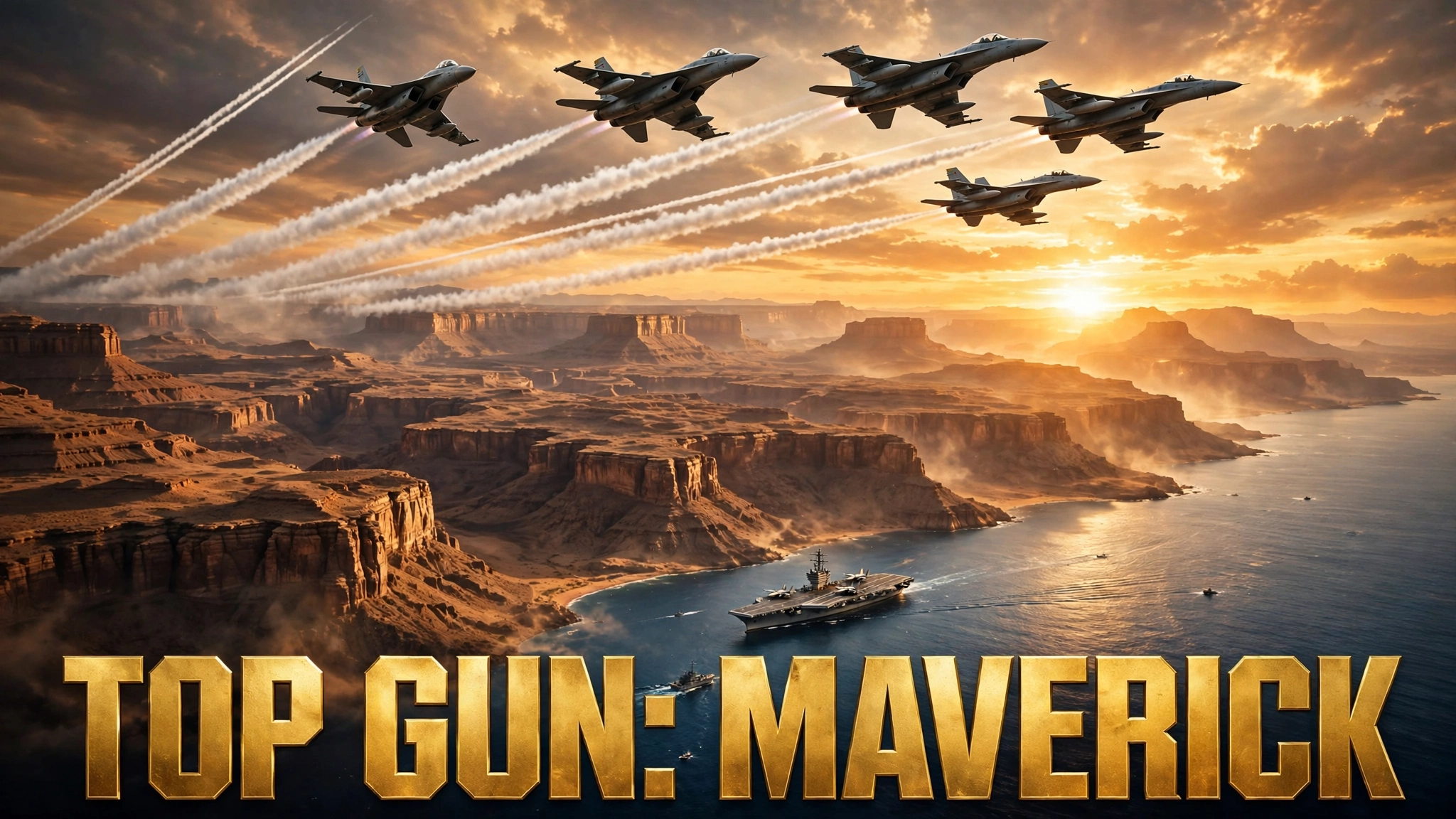
Director Joseph Kosinski, who previously worked with Cruise on Oblivion, delivers the most convincing aerial action ever put in a mainstream film. Working with cinematographer Claudio Miranda, the team placed compact IMAX-certified cameras inside real F/A-18 cockpits and trained the actors to operate them while flying with experienced naval aviators. The payoff is enormous. When a jet rolls, dives into a canyon, or pulls up under extreme pressure, you feel the speed and height rather than merely observing them.
Just as impressive is the clarity of the editing by Eddie Hamilton. Modern action films often cut so quickly that geography disappears. Here, you always know where the aircraft are, what the mission requires, and why a manoeuvre is dangerous. The training sequences build logically, teaching the audience the mission alongside the pilots, so that when the real run arrives, every turn carries weight. The sound design completes the effect, with jet noise that belongs in a cinema with a serious sound system.
The film’s few technical weaknesses are on the ground. Some dialogue scenes are functional rather than memorable, written to move the story efficiently to the next flight. The unnamed enemy nation is also a deliberate vagueness that keeps the politics simple but makes the mission feel slightly abstract. These are minor complaints in a film whose central promise — flight that feels real — is fulfilled so completely.
The music, credited to Harold Faltermeyer, Lady Gaga, and Hans Zimmer, with Lorne Balfe also contributing significantly, cleverly bridges old and new. Faltermeyer’s original Top Gun anthem returns in updated form and still raises the pulse, while the new score supports the flying sequences without competing with the jet sound effects. The balance is well judged: this is a film that knows when music should swell and when engine noise tells the story better.
Lady Gaga’s closing song “Hold My Hand” is a big, earnest power ballad that fits the film’s unembarrassed emotional style. OneRepublic’s “I Ain’t Worried”, used over a beach football scene that updates a famous sequence from the original, became a hit in its own right and gives the film a burst of pure, sunny fun between training sessions. Not every listener will love the soundtrack’s sincerity, but it is perfectly matched to a film that wears its heart openly.
What we loved:
What could be better:
The numbers tell an extraordinary story. Top Gun: Maverick premiered at CinemaCon on April 28, 2022, and opened in the United States on May 27, 2022, after several pandemic delays. Made for a reported budget of $170–177 million, it went on to gross $1.496 billion worldwide, becoming the highest-grossing film of Tom Cruise’s career and the second-highest-grossing film of 2022.
Even more telling than the total was the pattern. The film opened strongly and then kept going week after week, powered by exceptional word of mouth and repeat viewings in premium formats such as IMAX. At a time when many predicted that streaming had permanently weakened the theatrical business, Maverick became the industry’s favourite proof that audiences will still leave home for an experience that feels made for a cinema. It was nominated for six Academy Awards, including Best Picture, and won for Best Sound.
Absolutely — this is as close to a guaranteed good time as modern blockbuster filmmaking offers. Top Gun: Maverick respects its audience, its characters, and the original film without being trapped by nostalgia. Its plot may be predictable in outline, but its execution is so confident, and its central relationships so well handled, that predictability hardly matters. You will know where it is going. You will still hold your breath getting there.
If you have never seen the 1986 original, watch it first for maximum emotional effect, but do not let that stop you. This film explains everything it needs to and stands proudly on its own.
Our rating: 9/10 — A thrilling, heartfelt legacy sequel that shows how blockbusters should be made.
Do I need to watch the original Top Gun before Maverick?
It helps but is not essential. Maverick explains the key history, including Goose’s death and Maverick’s friendship with Iceman. Watching the 1986 film first will make several scenes, especially Kilmer’s return, considerably more emotional.
Is Top Gun: Maverick based on a true story?
No. The characters and mission are fictional, though the film was made with extensive United States Navy cooperation, real aircraft, and real naval aviators, which gives its flying sequences unusual authenticity.
How long is Top Gun: Maverick and what is its age rating?
The runtime is 130 minutes. It is rated PG-13 in the United States for sequences of intense action and some strong language, making it suitable for most teenagers and older children with parental guidance.
Will there be another Top Gun sequel?
A further sequel has been reported to be in development following Maverick’s success, but no completed film should be assumed until the studio confirms a release date. Check official announcements for the latest position.
Where can I watch Top Gun: Maverick?
The film is available through major streaming services, digital stores, and on Blu-ray, including high-quality 4K editions that do justice to its aerial photography. Availability varies by country, so check the services in your region.