★ LATEST REVIEWS

★★★★☆ Our Rating: 8/10
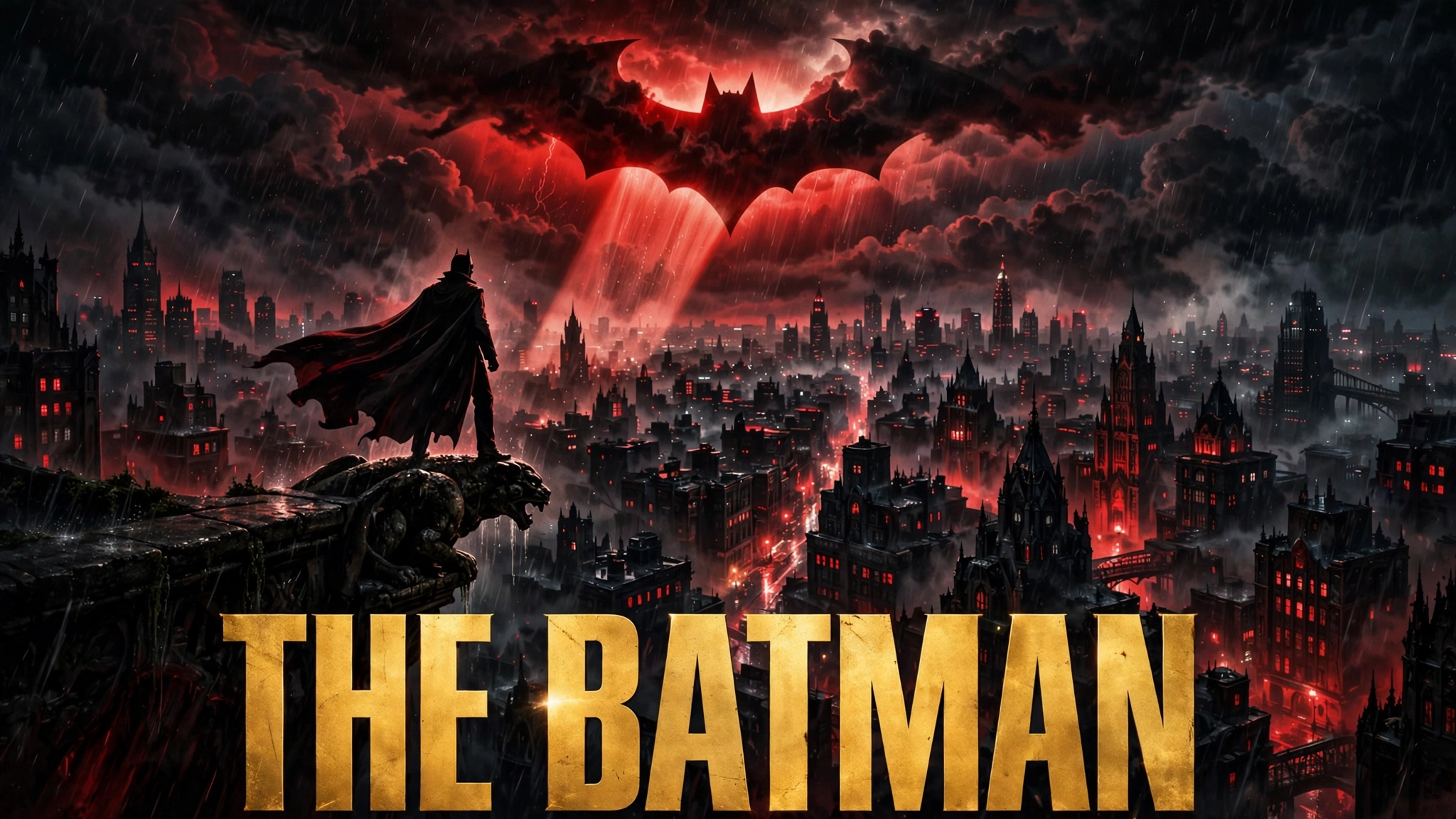
Every generation gets its own Batman, and every new version has to answer the same difficult question: what can you possibly add? When Matt Reeves’ The Batman arrived in March 2022, the character had already been played as a gothic avenger, a grounded crime-fighter, and a billionaire brawler in a shared superhero universe. Reeves’ answer was to go back to something the films had often promised but rarely delivered — Batman as a detective, working a case in a city rotting from the inside.
The result is the darkest, wettest, and most deliberately paced Batman film yet made. It runs for nearly three hours, rains for most of them, and spends more time on clues, corruption, and police procedure than on gadgets or quips. For viewers tired of superhero films that all feel the same, that commitment to a noir crime story is refreshing. For viewers who want pace and lightness, it may feel like hard work.
What is beyond doubt is the craftsmanship. This is a beautifully shot, superbly scored film with a lead performance that silenced most of the early scepticism about its casting. In this review, we give you an honest breakdown of its story, performances, technical strengths, and its very real pacing problems.
| Detail | Information |
| Release date | March 4, 2022 (United States) |
| Director | Matt Reeves |
| Writers | Matt Reeves, Peter Craig |
| Genre | Action, Crime, Mystery |
| Language | English |
| Runtime | 176 minutes |
| Budget | $185–200 million |
| Lead cast | Robert Pattinson, Zoë Kravitz, Paul Dano, Jeffrey Wright, Colin Farrell |
| Our rating | 8/10 |
The story takes place in Bruce Wayne’s second year of operating as Batman. He is not yet a symbol of hope to Gotham. He is a feared, obsessive vigilante who works alongside Lieutenant James Gordon while most of the police force distrusts him, and he has little interest in the wealthy public life his family name expects of him. His Gotham is a city where it always seems to be night, where the mayor’s office, the police, and organised crime are tangled together in ways ordinary citizens can sense but cannot prove.
On Halloween, a senior city official is murdered by a masked killer who calls himself the Riddler and who leaves a coded message addressed specifically to Batman. More attacks follow, each accompanied by puzzles aimed at exposing lies told by Gotham’s elite. Batman follows the trail with Gordon, moving through a nightclub run by mob lieutenant Oswald Cobblepot, known as the Penguin, and crossing paths with Selina Kyle, a waitress and burglar with her own reasons for wanting answers about people connected to that world.
As the investigation deepens, the case stops being only about catching a killer. It becomes about the foundations Gotham was built on, including the legacy of the Wayne family itself. Bruce is forced to ask whether his mission, driven by vengeance, is actually helping anyone, and whether the city he wants to save has been dishonest with him from the start. The film keeps its focus on that investigation rather than on origin-story retreads, which is one of its smartest decisions. Where the case leads, and what the Riddler ultimately wants, is best left for you to discover.
Robert Pattinson as Bruce Wayne / Batman: Pattinson plays Batman as a withdrawn, almost haunted young man who seems more comfortable in the cowl than out of it. His Bruce Wayne is deliberately underplayed — pale, quiet, and socially awkward — which will not please viewers who prefer Bruce as a charming playboy, but it makes psychological sense for this version of the character. In costume, Pattinson does excellent work with his eyes and voice, keeping the character intimidating without shouting. It is a thoughtful performance that proved his doubters wrong.
Zoë Kravitz as Selina Kyle / Catwoman: Kravitz is the film’s emotional spark. Her Selina is resourceful, angry, and vulnerable in believable proportions, and her chemistry with Pattinson gives the film its few moments of warmth. She is not written as a simple love interest or sidekick; she has her own investigation running parallel to Batman’s, and Kravitz makes you care about it just as much.
Paul Dano as the Riddler: Dano reinvents the Riddler as a disturbing, soft-spoken extremist rather than a giggling showman. Much of his performance is delivered through livestreams and recordings, which makes him feel chillingly modern. In his final scenes, he shifts between pride, neediness, and fury in ways that are genuinely unsettling. Some viewers may find the character’s later portrayal a touch overwrought, but the performance is memorable.
Jeffrey Wright as James Gordon and Colin Farrell as the Penguin: Wright brings weary integrity to Gordon, making the partnership with Batman feel earned and believable. Farrell, buried under remarkable prosthetic make-up, is almost unrecognisable as Cobblepot and steals several scenes with a performance that is funny, threatening, and larger than life without breaking the film’s tone. Andy Serkis also adds quiet dignity as Alfred, though he is given less screen time than the character deserves.
Matt Reeves directs The Batman as a crime film first and a superhero film second, and the discipline shows in every department. The influences are clear — 1970s thrillers, serial killer procedurals, and film noir — but Reeves shapes them into a consistent world rather than a collection of references. Gotham is filmed largely in the United Kingdom, including Liverpool and Glasgow, and it feels like a real, decaying city rather than a digital backdrop.
Greig Fraser’s cinematography is outstanding. The film is famously dark, both in tone and in literal lighting, yet the images remain rich and readable when seen on a good screen. Neon reds, sodium oranges, and deep blacks dominate, and action is often lit by a single practical source — a flare, a muzzle flash, a corridor of emergency lights — to striking effect. One car chase involving the new Batmobile, filmed in rain and firelight, is a highlight: loud, clear, and genuinely exciting without cutting the action into fragments.
Editing by William Hoy and Tyler Nelson keeps a long film coherent, though it cannot fully solve the pacing issue discussed below. Production design, costumes, and the practical Batmobile all favour texture and weight over sleekness. Everything looks used, repaired, and a little homemade, which suits a Batman who is still building his methods. The film received three Academy Award nominations, including for its sound, make-up and hairstyling, and visual effects, and each nomination feels deserved.
Michael Giacchino’s score is one of the film’s defining elements. His main Batman theme is built on a simple, heavy, repeating pattern that feels less like a heroic fanfare and more like a warning. It follows the character through the film, growing in force as the story builds, and it has quickly become one of the most recognisable Batman themes ever written. Giacchino also gives the Riddler a contrasting motif woven around “Ave Maria”, which creates an eerie link between the killer’s self-image and the city’s religious and classical trappings.
The soundtrack choices reinforce the mood. Nirvana’s “Something in the Way” opens and closes the film’s emotional arc, and its use is more than a marketing hook — its weary tone matches this Bruce Wayne unusually well. Sound design deserves special praise alongside the score. The Batmobile’s roar, the rain that seems never to stop, and the sudden quiet before violence all work together to make Gotham feel oppressive and alive.
What we loved:
What could be better:
The Batman premiered on March 1, 2022, and opened in the United States on March 4, 2022, after pandemic-related delays moved it from its original 2021 date. Against a reported production budget of $185–200 million, it grossed $772.3 million worldwide. That made it the seventh-highest-grossing film of 2022 and Warner Bros.’ most successful release of the pandemic period.
Those numbers matter because the film achieved them without being part of a shared cinematic universe event and despite its long runtime, which limits how many screenings a cinema can schedule each day. Audiences turned up for tone, character, and word of mouth. The film’s performance, together with the later success of its spin-off series The Penguin, confirmed that Reeves’ separate Gotham saga had a real future.
If you enjoy crime films, serial killer thrillers, or Batman in his detective mode, The Batman is essential viewing. It is the most visually and sonically distinctive superhero film of recent years, carried by a committed cast and a director with a clear, uncompromising vision. Go in prepared for its length and its darkness, and ideally watch it on a screen and sound system that do its craft justice.
Viewers who prefer their superhero films brisk, bright, and funny may struggle, and that is a fair response rather than a wrong one. But judged on its own terms, as a noir about corruption and obsession, it succeeds far more often than it stumbles.
Our rating: 8/10 — A moody, beautifully crafted detective epic that is slightly too long for its own good.
Is The Batman connected to Joker or the other DC films?
No. The Batman begins its own separate continuity, sometimes called the Batman Epic Crime Saga. It is not connected to Joker, the Justice League films, or other DC releases, so no homework is required before watching.
Is there a sequel to The Batman?
Yes. A sequel, The Batman Part II, is in development with Matt Reeves returning as director and Robert Pattinson returning as Batman. Its release date has been revised more than once, so check the latest studio announcements for current timing. The spin-off series The Penguin, starring Colin Farrell, was released in 2024.
How long is The Batman and what is its age rating?
The film runs 176 minutes, just under three hours. It is rated PG-13 in the United States for strong violent content, disturbing material, drug content, and some language, though its tone is darker than most PG-13 superhero films.
Is The Batman based on a specific comic?
It is not a direct adaptation of one comic. It draws inspiration from several Batman stories known for their detective and crime elements, and from the character’s long publishing history more generally, while telling an original story.
Where can I watch The Batman?
The film is available through major streaming services, digital rental and purchase stores, and on Blu-ray. Which service carries it varies by country and changes over time, so check the platforms available in your region.