★ LATEST REVIEWS

★★★★☆ Our Rating: 7.5/10
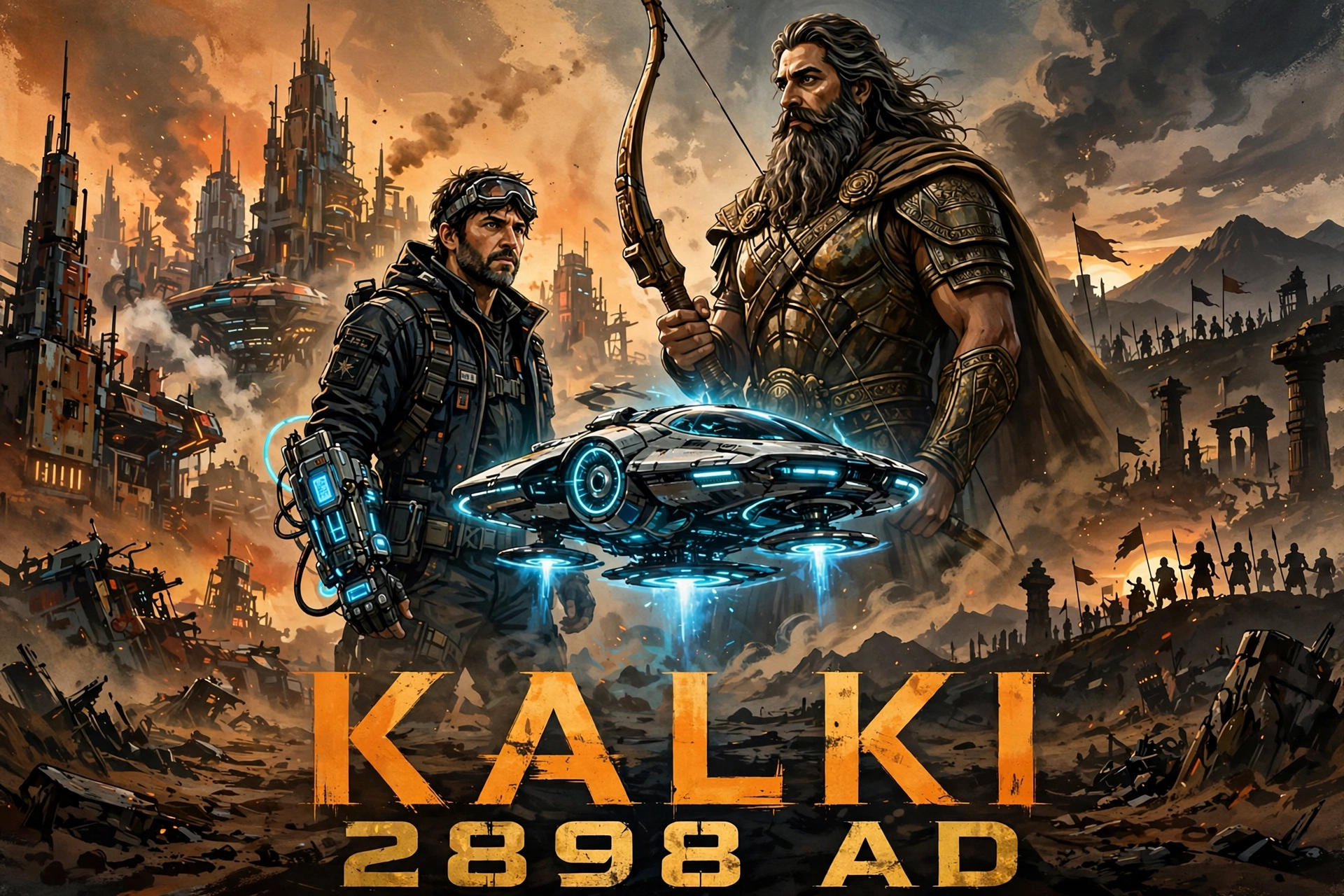
Indian cinema has attempted big science fiction before, and it has attempted the Mahabharata many times, but no mainstream film had ever tried to weld the two together at this scale. Released on 27 June 2024, Nag Ashwin’s Kalki 2898 AD imagines a ruined Earth nearly six thousand years after the Kurukshetra war, where the last city on the planet is ruled from a floating fortress and a prophesied child is the only hope left. This Kalki 2898 AD review will be honest about both halves of that gamble: the film is visually extraordinary and emotionally uneven, a slow, cluttered first movement followed by a second half so confident and moving that it almost justifies every excess that came before it.
What makes the film matter, beyond its records, is intent. Ashwin, who previously made the gentle biopic Mahanati, bet one of the largest budgets in Indian film history on an original world rather than a remake or a franchise sequel imported from elsewhere. The result is flawed in ways we will discuss plainly, but it is also the kind of flawed that moves an industry forward. When it works — and in its final hour it works beautifully — Kalki 2898 AD feels like the start of something Indian audiences have waited decades to see.
| Detail | Information |
|---|---|
| Release date | 27 June 2024 |
| Director | Nag Ashwin |
| Writers | Nag Ashwin |
| Genre | Epic Mythological Science Fiction, Action |
| Language | Telugu |
| Runtime | 181 minutes |
| Budget | Approx. ₹600 crore (reported) |
| Lead cast | Prabhas, Amitabh Bachchan, Kamal Haasan, Deepika Padukone, Disha Patani |
| Our rating | 7.5/10 |
The film opens in the aftermath of the Kurukshetra war, with the immortal warrior Ashwatthama cursed to walk the Earth until the age of Kali Yuga reaches its darkest point. We then jump to the year 2898 AD. The world is a desert of poisoned air and vanished rivers. Kashi, the last surviving city, is a pyramid of misery: the poor scramble in the streets below while the chosen live inside the Complex, an inverted structure hovering above the city, controlled by the god-like Supreme Yaskin (Kamal Haasan), who extracts resources from below and experiments on fertile women in search of something he desperately wants.
Into this world rides Bhairava (Prabhas), a cheerful, debt-ridden bounty hunter who dreams only of earning enough units to buy his way into the Complex. He travels with Bujji, a wisecracking AI vehicle voiced by Keerthy Suresh, and takes on work wherever it pays. Meanwhile, in the hidden rebel settlement of Shambhala, protectors guard a prophecy: that a child will be born who will end Yaskin’s reign. Their hopes settle on SUM-80, a lab subject who escapes the Complex and is renamed Sumati (Deepika Padukone) — a woman carrying a child that powerful forces will kill to possess. When a bounty is placed on her head, Bhairava’s greed, Ashwatthama’s ancient duty and the rebels’ faith all collide on the same dusty road.
We will not describe where that collision leads. The film’s final act draws its threads back to the Mahabharata in ways that genuinely reframe what you assumed about certain characters, and it ends by openly setting up a sequel. The journey there, however, is uneven: detours, comic passages and a romantic track slow the middle considerably before the story finds its true weight.
Amitabh Bachchan as Ashwatthama is, quite simply, the film. Playing an immortal who has carried guilt and duty across six thousand years, Bachchan brings a gravity that no amount of visual effects could manufacture. He is physically imposing — the film uses his height and stillness superbly — and his action sequences, in which Ashwatthama fights with a staff and an old warrior’s economy of movement, are the most satisfying in the film. More importantly, he gives the mythology a human face: this is a tired, sorrowful man, not a superhero cut-out, and the film’s emotional climax belongs to him.
Prabhas as Bhairava has the harder job, and the results are mixed. The character is written as a selfish rogue who must slowly discover a conscience, a classic arc, but the first half leans so heavily on broad comedy and swagger that the performance feels loose and, at times, disconnected from the stakes around him. When the writing finally asks more of him in the last act, Prabhas responds — his scenes opposite Bachchan have real charge — but the tonal whiplash is the film’s problem as much as the actor’s.
Deepika Padukone as Sumati gives the film its quiet centre. She has relatively little dialogue and must communicate fear, exhaustion and a growing protective resolve mostly through presence, which she does with dignity. Kamal Haasan as Supreme Yaskin appears briefly but memorably, frail and sinister, clearly being saved for a larger role in the sequel. Disha Patani as Roxie, Bhairava’s love interest, is given a decorative part that the film could have cut entirely, while Shobana as Mariam, the rebel leader, brings warmth and authority to her limited scenes. Pasupathy and Anna Ben add energy as rebels, and a string of star cameos — including Dulquer Salmaan and Vijay Deverakonda — are fun without being essential.
Nag Ashwin’s direction is at its best when he is building worlds and at its weakest when he is filling time between set pieces. The production design, by Nitin Zihani Choudhary, is the film’s triumph: Kashi feels lived-in and layered, its streets crowded with scavenged technology, while the Complex has the cold, clean menace of a place that has forgotten the ground exists. Serbian cinematographer Djordje Stojiljkovic gives the desert a bleached, mournful beauty and handles the Mahabharata flashbacks with painterly care — those sequences, recreating moments from the epic, are among the most beautiful images in recent Indian cinema.
The visual effects, led by major international and Indian houses, are mostly of a standard Indian productions have rarely sustained across a full film. Vehicles, creatures and large-scale action hold together convincingly, though a few sequences betray rushed compositing. Kotagiri Venkateswara Rao’s editing is where honest criticism belongs: at 181 minutes the film is long, and the first half contains material — an extended early fight, stretches of the Bhairava-Roxie track — that a stricter edit would have trimmed by fifteen minutes. Ashwin has spoken of this film as the first chapter of a larger Kalki Cinematic Universe, and chapter-one syndrome is visible: some scenes exist to seed a sequel rather than to serve this story. Yet his command of the climax, intercutting past and future with complete clarity, shows a director whose ambition is matched by genuine craft when the material tightens.
Santhosh Narayanan’s score is one of the film’s quieter successes. Rather than wall-to-wall bombast, he builds a sound that mixes electronic textures with Indian instruments and choral elements, giving the dystopia a spiritual undertow that suits a story about the end of an age. Ashwatthama’s themes carry genuine melancholy, and the score’s restraint in the flashback passages lets the images breathe. The songs are more functional than memorable: tracks such as the Bhairava anthem material and “Ta Takkara” serve energy and character introduction rather than standing alone as lasting compositions, and one song placement in the first half contributes to the pacing problem. The sound design — the growl of machines, the emptiness of the desert — deserves mention; this is a film whose world you hear as much as see.
What we loved:
What could be better:
The figures around this film are large enough that precision matters, and reports differ. The production budget was widely reported at around ₹600 crore, which made it, at release, the most expensive Indian film ever made. On the earnings side, worldwide totals are reported in a range rather than at a single agreed number: most trade and reference sources place the final worldwide gross between roughly ₹1,042 crore and ₹1,100 crore. Even at the lower end of that range, the film was a major commercial success and one of the highest-grossing Indian films of 2024, performing strongly both in the Telugu states and in its Hindi dubbed version, and doing notable business overseas. What can be said without dispute is the shape of the story: an enormous gamble on original Indian science fiction recovered its cost theatrically and turned a sequel from a hope into an expectation — the closing passages of the film itself promise that continuation directly.
Yes — preferably on the biggest screen you can still find it on, or with the patience at home to let its slow first hour pass. Viewers who know the Mahabharata will feel an extra current running under the spectacle, but the film explains enough for newcomers, and its core story — an old warrior protecting an unborn hope in a dying world — needs no prior knowledge to land. Go in forgiving the clutter; stay for Bachchan, for the world-building, and for a climax that shows what Indian blockbuster cinema can attempt next.
Our rating: 7.5/10 — an imperfect but landmark spectacle whose second half and central performance outweigh its bloated beginning.
Is Kalki 2898 AD based on the Mahabharata?
It is inspired by Hindu scripture and the Mahabharata rather than being a direct retelling. Characters such as Ashwatthama and the prophesied Kalki anchor an original science-fiction story set thousands of years in the future.
Do I need to know Indian mythology to enjoy Kalki 2898 AD?
No. The film introduces its prophecy and its immortal characters clearly. Familiarity with the Mahabharata adds resonance to the flashbacks, but the plot is designed to work for general audiences.
Is Kalki 2898 AD the first part of a series?
Yes. It is presented as the first instalment of a planned Kalki Cinematic Universe, and its ending deliberately sets up a sequel centred on the conflict it has been building towards.
How long is Kalki 2898 AD, and is it suitable for children?
The runtime is 181 minutes. It contains large-scale action and violence and dark dystopian themes, so it is best suited to older children, teens and adults rather than very young viewers.
Where can I watch Kalki 2898 AD?
The film moved to major streaming platforms after its theatrical run, with versions in Telugu, Hindi and other languages. Availability varies by region, so check your local services.