★ LATEST REVIEWS

Our Rating: ★★★★☆ 8.0/10
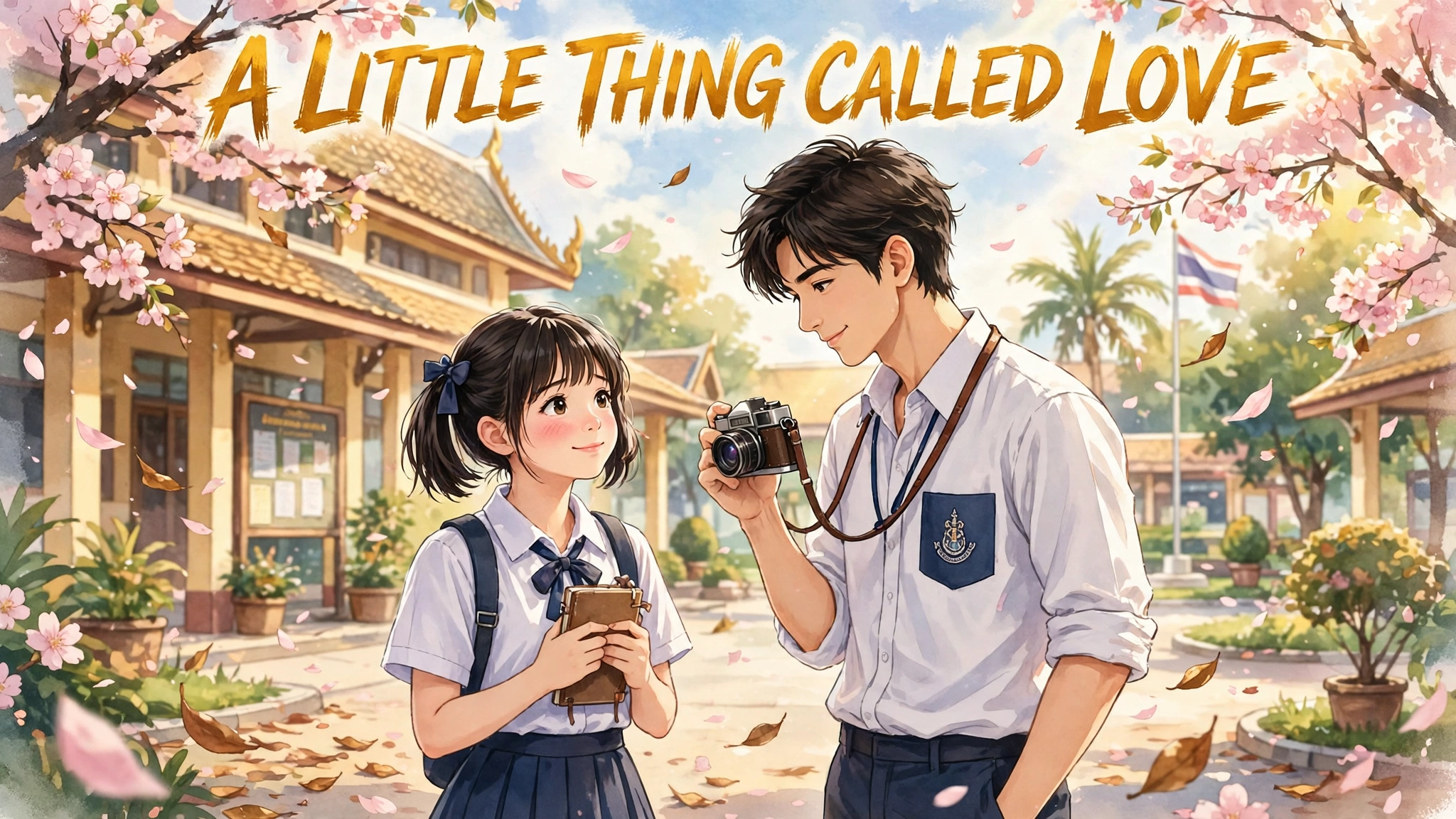
First love is embarrassing. That is the whole joke and the whole truth of A Little Thing Called Love — known in Thailand as Sing Lek Lek Tee Reak Wa… Rak and sometimes as First Love or A Crazy Little Thing Called Love. Puttipong Pormsaka Na-Sakonnakorn and Wasin Pokpong’s 2010 Thai teen romance follows Nam, a 14-year-old schoolgirl who considers herself plain, as she falls for Shone, the most popular boy in school, and sets out — with the help of her three best friends and a well-thumbed book of tips — to transform herself into someone he might notice. It is funny, sweet and, beneath the comedy, surprisingly honest about what growing up actually feels like.
The film became a phenomenon far beyond Thailand, finding huge audiences across Asia and a devoted international following that turned its two young stars into regional celebrities. Its appeal is easy to understand: it never mocks its heroine for caring too much, it treats first love as a real event rather than a rehearsal for adult romance, and it understands that the most important transformation in a coming-of-age story is not the makeover but the confidence underneath it.
It is not a flawless film. Some of its comedy is broad, its view of beauty is old-fashioned in places, and its pacing dips in the middle. But its warmth is genuine, and its heroine is impossible not to root for. In this review we look at the spoiler-free story, the performances, the direction, the music and the box-office story, and we give an honest verdict.
| Detail | Information |
|---|---|
| Release date | 12 August 2010 (Thailand) |
| Directors | Puttipong Pormsaka Na-Sakonnakorn, Wasin Pokpong |
| Writers | Puttipong Pormsaka Na-Sakonnakorn, Wasin Pokpong, Voraluk Klasukon |
| Genre | Romance, Comedy, Coming-of-age |
| Language | Thai |
| Runtime | 118 minutes (some listings give 109 or 122 minutes) |
| Lead cast | Pimchanok Luevisadpaibul, Mario Maurer, Sudarat Butrprom |
| Our rating | 8.0/10 |
Nam is fourteen, in her first year of secondary school, and convinced she is the plain one. She is funny, kind and hardworking, but in her own eyes she is invisible — especially beside Shone, a handsome tenth-grader who is good at everything, beloved by the whole school, and entirely out of her league. Encouraged by her three best friends, who form a cheerfully chaotic gang of their own, Nam embarks on a campaign of self-improvement drawn from a book about attracting a boy: study harder, look better, join the right activities, become, in short, someone worth noticing.
The comedy comes from how seriously she takes all of this, and the feeling comes from how much of it is really about something else. As Nam works her way through the book’s advice — a school play, a cheerleading contest, top marks in class — she is quietly becoming more confident, more capable and more herself. Around her, complications gather: Shone’s best friend Top takes an interest in her for his own reasons, her friends drift and reunite, and the school year moves towards its end, when Shone will graduate and leave. Without revealing how any of this resolves, it is fair to say the film’s emotional centre is not whether Nam “gets the boy” but whether the girl she becomes along the way is someone she can be proud of.
Pimchanok Luevisadpaibul as Nam — Pimchanok, credited in some sources as Baifern Pimchanok, is the film’s heart. She plays Nam’s awkwardness without caricature — the hunched shoulders, the too-eager smile, the way she lights up when she thinks no one is looking — and she makes the character’s gradual transformation feel earned rather than cosmetic. When Nam finally stands tall, the audience feels it as a personal victory, not a makeover reveal. It is a star-making performance, and it deservedly made her famous across Asia.
Mario Maurer as Shone — Maurer, already a star after Love of Siam, plays Shone with an ease that makes his popularity believable. He could have been a distant poster boy, but he gives Shone a warmth and a watchfulness — he notices more than he lets on — that makes the romance feel two-sided rather than a one-girl fantasy. His scenes with Pimchanok are gentle and unforced, and their chemistry is the film’s quiet engine.
Sudarat Butrprom as Teacher Inn — Butrprom steals scene after scene as the small, determined teacher whose own romantic misadventures mirror Nam’s. Her comic performance gives the film its funniest passages and its most touching parallel: adults, the film suggests, are not much better at love than teenagers are.
The two directors keep the tone light without making it weightless. The school is shot in bright, sunny colours, the camera stays close to Nam’s face in her moments of embarrassment and triumph, and the comedy — much of it physical, from disastrous cheerleading practice to a memorably awkward school play — is timed with affection rather than cruelty. The film understands that the difference between laughing at a teenager and laughing with her is everything, and it stays firmly on the right side of that line.
The structure follows the school year, which gives the story a natural rhythm: terms, contests, exams and farewells. The middle stretch occasionally lingers on comic set-pieces at the expense of the romance, and some of the beauty advice Nam follows has aged less gracefully than the film’s emotional core — modern viewers may wince at the idea that a girl must change her appearance to deserve attention. To the film’s credit, though, its conclusion points the other way: what Shone notices, in the end, is not a new hairstyle but a new person.
The score is light, melodic and unabashedly romantic, with songs that underline Nam’s daydreams without overwhelming them. The music’s job here is to keep the audience inside a fourteen-year-old’s head — hopeful, swooning, slightly ridiculous — and it does that job well. The soundtrack became popular across Asia alongside the film, and its gentle pop sound is now inseparable from the memory of the story for millions of viewers.
What we loved:
What could be better:
A Little Thing Called Love opened in Thailand on 12 August 2010 and became one of the year’s biggest local hits there, earning about ฿85 million in Thailand — roughly US$2.66 million in the Thai market alone according to Box Office Mojo’s Thailand figures, which do not include its substantial earnings elsewhere in Asia. Its success in the Philippines, China and across Southeast Asia, where it played in cinemas and became a television and streaming favourite, made it one of the most widely loved Thai films of its generation. Its stars toured the region to enormous receptions, and the film’s awards included Best Film honours at Thai ceremonies and the Grand Prix at the Okinawa International Movie Festival.
A note on the numbers: no reliable production budget for the film is published in English-language sources, so this review omits the budget row rather than inventing a figure. The box-office picture is also incomplete by nature — the Thai gross above is only part of a much larger regional story.
Yes — especially if you like your romances sweet, funny and sincere. A Little Thing Called Love is the rare teen film that adults can enjoy without irony, because it remembers what first love actually felt like: embarrassing, all-consuming and, in retrospect, the beginning of becoming yourself. Watch it with someone you like, and be prepared to smile at the screen like an idiot. That is the correct response.
Our rating: 8.0/10 — A sunny, funny, genuinely tender Thai teen romance with a heroine worth cheering for.
Is A Little Thing Called Love the same as First Love?
Yes. The film’s Thai title translates as “A Little Thing Called Love”; it is also known internationally as First Love and A Crazy Little Thing Called Love.
Who plays Nam and Shone?
Pimchanok Luevisadpaibul (Baifern Pimchanok) plays Nam and Mario Maurer plays Shone.
How long is A Little Thing Called Love?
Most listings give 118 minutes, though some give 109 or 122 minutes depending on the version.
Is there a sequel?
No direct sequel was made, though the film’s success led to remakes and adaptations in other countries.
Where can I watch A Little Thing Called Love?
Availability varies by country and changes over time, so check your local streaming and digital platforms.