★ LATEST REVIEWS

Our Rating: ★★★★☆ 8.5/10
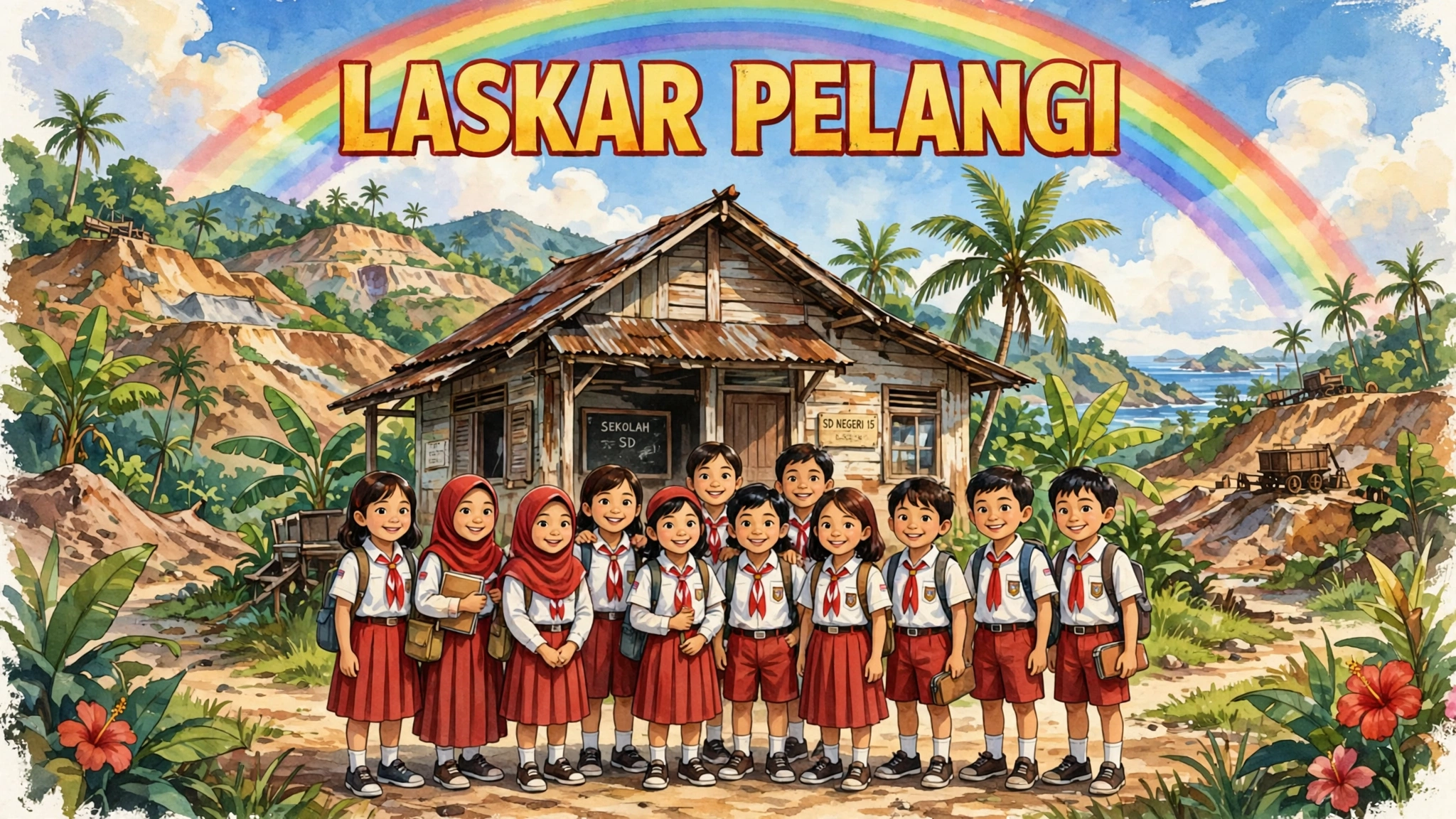
Some films win audiences with spectacle. Laskar Pelangi wins them with a leaking roof. Riri Riza’s 2008 adaptation of Andrea Hirata’s bestselling novel is set in Gantong, a village on Belitung, an island off Sumatra rich in tin yet poor in opportunity, and it follows ten children at a tiny Muhammadiyah elementary school that is one pupil short of being shut down. When the tenth child finally arrives, the school survives — and so begins one of the most warmly loved Indonesian films ever made. It is a story about poverty that refuses to be miserable, about teachers who refuse to give up, and about children who dream far beyond what their circumstances seem to allow.
The film became a phenomenon at home, one of the highest-grossing Indonesian films of its time, and it turned Belitung itself into a destination, with visitors travelling to see the school and the island that the story made famous. It is easy to see why. This is not a film that lectures about education; it makes you feel, through a group of unforgettable children, why education matters — and why hope, even in a classroom with holes in the floor, is a practical force rather than a slogan.
It is not a flawless film. Its sentiment occasionally runs ahead of its storytelling, and some of its young characters are sketched more thinly than others. But its heart is so genuine, and its sense of place so vivid, that those weaknesses feel small beside what it achieves. In this review we look at the spoiler-free story, the performances, Riza’s direction, the music and the remarkable box-office journey, and we give an honest verdict.
| Detail | Information |
|---|---|
| Release date | 25 September 2008 (Indonesia) |
| Director | Riri Riza |
| Writers | Salman Aristo, Mira Lesmana, Riri Riza |
| Based on | The novel Laskar Pelangi by Andrea Hirata |
| Genre | Drama, Family |
| Language | Indonesian, Belitung Malay |
| Runtime | 124 minutes |
| Budget | Rp 8 billion (about US$890,000) |
| Lead cast | Cut Mini, Ikranagara, Tora Sudiro, Slamet Rahardjo, Lukman Sardi, Ario Bayu |
| Our rating | 8.5/10 |
The Muhammadiyah elementary school in Gantong is in trouble before the story even begins. Its building is falling apart, its pupils come from families who can barely afford to keep them in class, and the authorities require at least ten pupils for the school to stay open. On the first day of term, only nine children have enrolled. The headmaster, Pak Harfan, and the young teacher Bu Muslimah wait anxiously — and then, at the last moment, a tenth child arrives, and the school is saved.
That tenth pupil completes the group that Bu Muslimah names the Rainbow Troops: ten children of wildly different temperaments, bound together by a classroom, a teacher’s faith in them and a shared determination not to accept the futures that poverty has mapped out for them. There is Ikal, the narrator, a bright boy whose family expects him to follow his father into the tin company. There is Lintang, a genius from a fishing family who walks miles to school and whose gift for mathematics astonishes everyone. There is Mahar, the dreamy artist, and the rest of the gang — mischievous, loyal, funny and stubborn in turn.
The film follows them through school years shaped by small triumphs and large obstacles: a contest that could put their school on the map, the lure of work that pays now against study that pays later, and the slow, painful realisation that talent alone does not defeat poverty. Without revealing how any child’s story ends, it is fair to say that the film’s emotional power comes from a tension it never resolves cheaply: these children are extraordinary, and the world they live in is arranged to waste exactly that kind of extraordinariness. The rainbow of the title is not a promise that everything will be fine. It is what you look for after the rain.
Cut Mini as Bu Muslimah — The film’s emotional centre is its young teacher, played by Cut Mini with warmth, steel and humour in equal measure. Bu Muslimah is not a saint; she is a working woman who believes, fiercely and practically, that her pupils deserve more than the island intends to give them. Cut Mini plays her without a trace of condescension, and her scenes with the children — scolding, encouraging, laughing — feel like a real classroom rather than a performance of one. It is one of the great teacher performances in Asian cinema.
Ikranagara as Pak Harfan — As the headmaster, Ikranagara gives the film its quiet dignity. Pak Harfan is a man holding a school together with faith and stubbornness, and the actor plays him with a gentleness that never tips into sentimentality. His belief in the school is the film’s spine: where Bu Muslimah supplies its heart, he supplies its patience.
The children — The young cast, many of them from Belitung itself, are the film’s great gamble and its great triumph. Producer Mira Lesmana deliberately cast local children, arguing that no one else could carry the connection to the place, and the gamble pays off in faces and rhythms that feel unperformed. The standouts are the boys playing Lintang and Mahar: the first carrying a gravity beyond his years, the second a comic, artistic energy that lights up every scene he enters. The adult versions of the characters, played by actors including Lukman Sardi and Ario Bayu, frame the story with a reflective, bittersweet quality.
Supporting cast — Tora Sudiro and Slamet Rahardjo bring authority and humour to the adult world around the school, and the parents, played with restraint, remind the audience that every child’s dream in this film is paid for by someone else’s sacrifice.
Riri Riza directs with a patience that suits the material. He shoots Belitung as both paradise and problem: Yadi Sugandi’s cinematography gives us white sand, open sea and extraordinary light, but it never lets the beauty disguise the poverty — the tin mines, the stilt houses, the school’s sagging timbers are always in frame. The island is not a postcard; it is a workplace, and the children’s dreams have to survive inside it.
The film’s structure follows the school years loosely rather than through rigid plot mechanics, and this is both its charm and its occasional weakness. Some episodes — a competition, a festival, a departure — land with real force, while others pass more gently. Riza trusts his audience to stay with the children rather than demanding a twist every ten minutes, and for most viewers that trust is repaid. The classroom scenes are directed with a documentary-like attention to detail: the chalk, the rain on the roof, the shared pencils. It is in these small, observed moments that the film earns its big emotions.
The score by Sri Aksan Sjuman and Titi Handayani Sjuman is gentle and melodic, built around themes that swell at moments of hope without ever bullying the audience into tears. Songs and choral passages give the film a communal feeling — this is a story about a group, and the music often sounds like a group singing together. It is not a soundtrack of big standalone hits so much as a warm current running beneath the story, and it works precisely because it never tries to be bigger than the children on screen.
What we loved:
What could be better:
Laskar Pelangi was made for a reported Rp 8 billion, roughly US$890,000 — a modest budget by any standard, and one that makes its success all the more remarkable. It earned about US$16.67 million worldwide, becoming one of the highest-grossing Indonesian films in history at the time, and it collected major honours including Best Film at both the Bandung Film Festival and the Indonesian Film Festival in 2009, along with international festival recognition.
Its impact went beyond ticket sales. Belitung experienced a tourism boom on the back of the film, with flights and visitors following the story’s locations, and the school at the centre of the tale became a cultural landmark. Few films can claim to have changed the fortunes of a real place; this one did, and that is part of why Indonesians still speak of it with such affection.
Yes — especially if you love stories about teachers, childhood and stubborn hope. Laskar Pelangi is not a cynical film, and it does not pretend that hope alone pays school fees. But it believes, and makes you believe, that a teacher’s faith and a child’s determination are forces that matter in the real world. Watch it with family if you can; it is that rare drama that speaks equally to children and to the adults who once were them.
Our rating: 8.5/10 — A warm, deeply felt Indonesian classic about ten children who refused to be written off.
Is Laskar Pelangi based on a true story?
It is adapted from Andrea Hirata’s novel, which is based on his own childhood experiences in Belitung. The characters and events are fictionalised, but the school, the island and the struggle are drawn from real life.
What does Laskar Pelangi mean?
It translates as “The Rainbow Troops” (sometimes “The Rainbow Warriors”) — the name the teacher Bu Muslimah gives her ten pupils.
Who are the main characters?
The teacher Bu Muslimah (Cut Mini), headmaster Pak Harfan (Ikranagara), and pupils including Ikal, the narrator, and Lintang, the mathematical genius.
How long is Laskar Pelangi?
It runs 124 minutes, just over two hours.
Where can I watch Laskar Pelangi?
Availability varies by country and changes over time, so check your local streaming and digital platforms.