★ LATEST REVIEWS

Our Rating: ★★★★★ 9.0/10
There are family dramas, and then there are films that make you feel as if you have lived inside a family for three hours and emerged exhausted, moved and slightly angry at everyone in it. Leila’s Brothers, directed by Saeed Roustayi (also spelled Saeed Roustaee), belongs firmly to the second kind. It premiered in competition at the 2022 Cannes Film Festival, where it won the FIPRESCI Prize from international critics, and it has since been recognised as one of the finest Iranian films of its decade, even though it remains banned from screening in its home country.
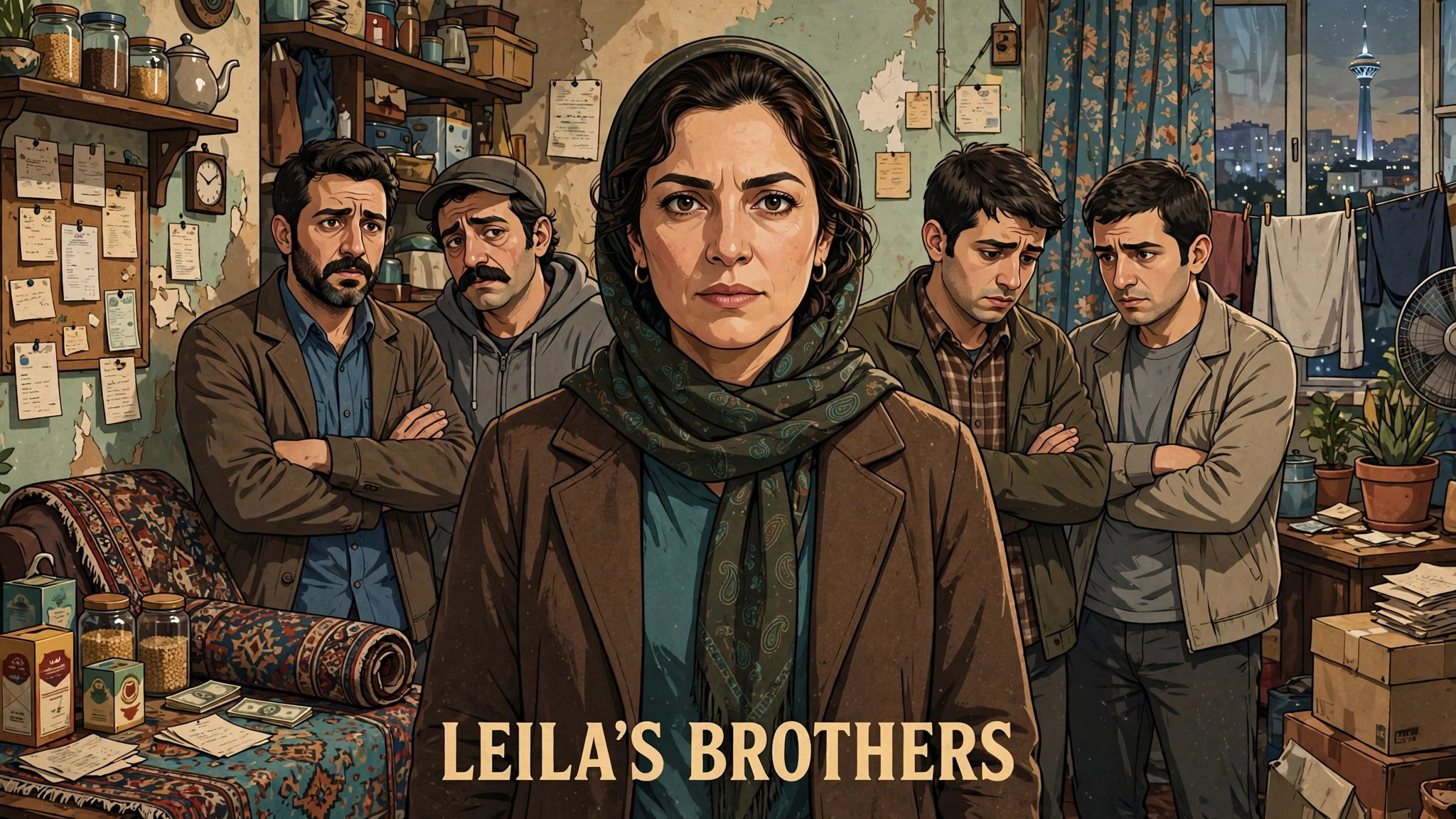
The setup is almost novelistic in its richness. Leila is forty years old, unmarried, and has spent her life looking after her parents and her four brothers in a Tehran gripped by international sanctions, debt and economic uncertainty. When she devises a plan to lift the family out of poverty — pooling their resources to open a shop in a new shopping mall — she runs into the single greatest obstacle in the house: her father, Esmail, who has secretly saved a family treasure that he intends to offer as a gift in order to become the patriarch of the extended clan.
That collision, between a daughter’s practical plan and a father’s hunger for status, drives a film that is by turns furious, funny, tender and devastating. It is long, it is loud, and it refuses to give the audience a single character to simply root for. That refusal is its greatness.
| Detail | Information |
|---|---|
| Release date | May 2022 (Cannes Film Festival premiere) |
| Director | Saeed Roustayi |
| Writers | Saeed Roustayi; story by Azad Jafarian |
| Genre | Drama, Family, Black Comedy |
| Language | Persian |
| Runtime | 169 minutes (some listings give 165 minutes; shorter cuts circulate) |
| Lead cast | Taraneh Alidoosti, Navid Mohammadzadeh, Payman Maadi, Farhad Aslani, Saeed Poursamimi |
| Our rating | 9.0/10 |
Leila lives with her parents and four brothers in a crowded Tehran apartment, and she is, in every practical sense, the head of the household, even though tradition will not call her that. Her brothers are all struggling in different ways. Parviz works as a cleaner in a shopping mall and cannot support his own wife and children on his wages. Farhad dreams of a career in wrestling. Manouchehr chases one get-rich-quick scheme after another. Alireza, the most honest of the four, has moved back into the family home after the factory where he worked closed down. Their parents are ageing, their debts are mounting, and the sanctions-era economy offers no easy way out.
Leila’s plan is simple and, in the family’s circumstances, radical: instead of each brother scrambling alone, the family should combine what little they have and buy into a shop in a new mall, creating a business that could support them all. It is the kind of plan that requires trust, discipline and a willingness to put the family’s future ahead of individual pride. The film follows the arguments, negotiations and setbacks of that plan with a novelist’s patience, letting each brother’s character emerge through conflict rather than exposition.
The crisis arrives when Leila discovers what her father has been hiding: a treasure he has saved, not for his children’s future, but for a ceremony that would crown him patriarch of the wider clan. To spend it on the shop would be, in his eyes, a betrayal of honour; to spend it on the ceremony would, in Leila’s eyes, be a betrayal of his children. This review will not describe how that conflict resolves, or what it costs each member of the family, because the film’s final hour depends on the audience not knowing who will break first. It is enough to say that Roustayi stages the family’s implosion with extraordinary control, and that the ending is both inevitable and shocking.
Taraneh Alidoosti as Leila — Alidoosti gives one of the great performances of recent Iranian cinema. Her Leila is exhausted, funny, furious and tender, often within a single scene, and Alidoosti plays her without a trace of martyrdom. Leila is not a saint; she is impatient, she makes mistakes, she loses her temper with the brothers she is trying to save. That complexity is what makes her heroic: the audience roots for her not because she is perfect, but because she is the only person in the house thinking clearly about the future. It is a magnetic, career-defining performance.
Navid Mohammadzadeh as Alireza — Mohammadzadeh, Roustayi’s regular collaborator, plays Alireza as the family’s conscience: honest, weary and loyal to Leila even when loyalty costs him. His performance is quieter than Alidoosti’s, but it provides the film’s moral anchor, and his scenes with her are among its most affecting. When Alireza finally loses patience, the moment lands precisely because Mohammadzadeh has held back for so long.
Payman Maadi as Manouchehr and Farhad Aslani as Parviz — Maadi brings sly, restless energy to Manouchehr, the brother always one scheme away from fortune, while Aslani gives Parviz a physical and emotional heaviness that makes his humiliation painfully vivid. Mohammad Ali Mohammadi completes the quartet as Farhad, the would-be wrestler whose dreams are both touching and absurd. Together, the four brothers feel like a real family: they interrupt each other, they laugh at each other, they wound each other, and they cannot quite let each other go.
Saeed Poursamimi as Esmail — Poursamimi’s Esmail is the film’s most difficult character to watch, and its most important. He is vain, stubborn and, in his own way, pitiable: an old man who has lost economic power and clings to the one status that tradition still offers him. Poursamimi never turns him into a monster, which makes his choices all the more devastating. The audience understands him, and still wants Leila to defeat him, and that contradiction is the film’s engine.
Roustayi directs Leila’s Brothers on a large canvas, and his control of it is masterly. The film is built from long, crowded scenes in apartments, courtyards and mall corridors, and Roustayi stages them like a theatre director who also understands the camera: characters enter and leave, arguments build in waves, and the camera finds the telling detail — a hand, a glance, a door left open — without ever losing the geography of the scene. Hooman Behmanesh’s cinematography gives Tehran a lived-in, slightly worn beauty, and the editing by Bahram Dehghan sustains a 169-minute film with remarkable momentum.
The film’s length is its most debated quality, and it is worth addressing honestly. At nearly three hours, Leila’s Brothers demands patience, and some viewers, including some critics at Cannes, found it unwieldy. There are passages, particularly in the middle, where the family’s arguments circle rather than advance. But that circularity is also the point: this is a family trapped in patterns it cannot break, and the film’s length makes the audience feel that entrapment. For this reviewer, the length is justified by the payoff, but viewers who prefer tight, plot-driven dramas should be warned.
Roustayi’s social critique is embedded rather than declared. The film is about sanctions, debt and patriarchy, but it never lectures: those forces appear as rent demands, failed businesses, and a father’s need for status, and the audience absorbs them through character rather than through speeches. That subtlety is part of why the film travels so well internationally, and part of why it remains banned at home, where its portrait of patriarchal power is evidently unwelcome.
The score by Ramin Kousha is restrained and effective, favouring atmosphere over melody. It does not try to compete with the film’s extraordinary ensemble scenes, and it knows when to disappear entirely, letting the sound of a crowded apartment — voices overlapping, doors slamming, a television in another room — carry the emotional weight. When music does swell, it does so at moments of genuine turning point, and its restraint makes those moments feel earned rather than imposed.
That approach suits a film whose real music is human: the rhythms of family argument, the comedy of brothers talking over each other, the sudden silences when someone says something unforgivable. Leila’s Brothers is, in that sense, a musical film without songs, and its soundscape is one of its quietest achievements.
What we loved:
What could be better:
Leila’s Brothers was never designed as a commercial proposition in the conventional sense, and no reliable production-budget or worldwide box-office figure for the film could be verified for this review, so none is quoted here. Its success was measured differently: in competition at Cannes, in the FIPRESCI Prize, in audience awards and special mentions at festivals including Munich and the Golden Rooster Awards, and in its reputation as one of the defining Iranian films of the 2020s.
That reputation comes with a paradox the film itself would appreciate. It is celebrated internationally and banned in Iran, where its portrait of a family crushed by economic pressure and patriarchal pride was evidently too close to home. For international viewers, that ban is itself a reason to watch: this is a film its own country’s authorities did not want its own people to see, and the act of watching it becomes a small act of solidarity with the filmmakers and performers who made it. Its commercial life has been in arthouse cinemas and streaming platforms abroad, where it has found the audience it deserves.
Yes, if you have the patience for a long, loud, richly human family epic. Leila’s Brothers is not an easy watch, and it is not a short one, but it is one of the finest films of its year and a towering achievement for Iranian cinema. It will make you laugh, it will make you furious, and it will leave you thinking about your own family for days afterwards. Taraneh Alidoosti’s performance alone would justify the running time; the ensemble, the writing and Roustayi’s direction make it essential.
Our rating: 9.0/10 — A sprawling, furious, deeply human family epic and a modern Iranian classic.
Is Leila’s Brothers based on a true story?
No. It is a fictional family drama, though it is grounded in the real economic pressures of sanctions-era Iran and in the patriarchal traditions it portrays.
Who directed Leila’s Brothers?
Saeed Roustayi (also spelled Roustaee), who also wrote the film.
Why is Leila’s Brothers banned in Iran?
It remains banned from screening in Iran, a fact widely reported in festival coverage, though the authorities have not offered a full public explanation; its critical portrait of patriarchal power and economic hardship is widely understood to be a factor.
How long is Leila’s Brothers?
169 minutes in its festival version, though some listings give 165 minutes and shorter cuts circulate.
Where can I watch Leila’s Brothers?
It has been available in arthouse cinemas and on streaming platforms in various regions, though availability changes over time, so check your local platforms.