★ LATEST REVIEWS

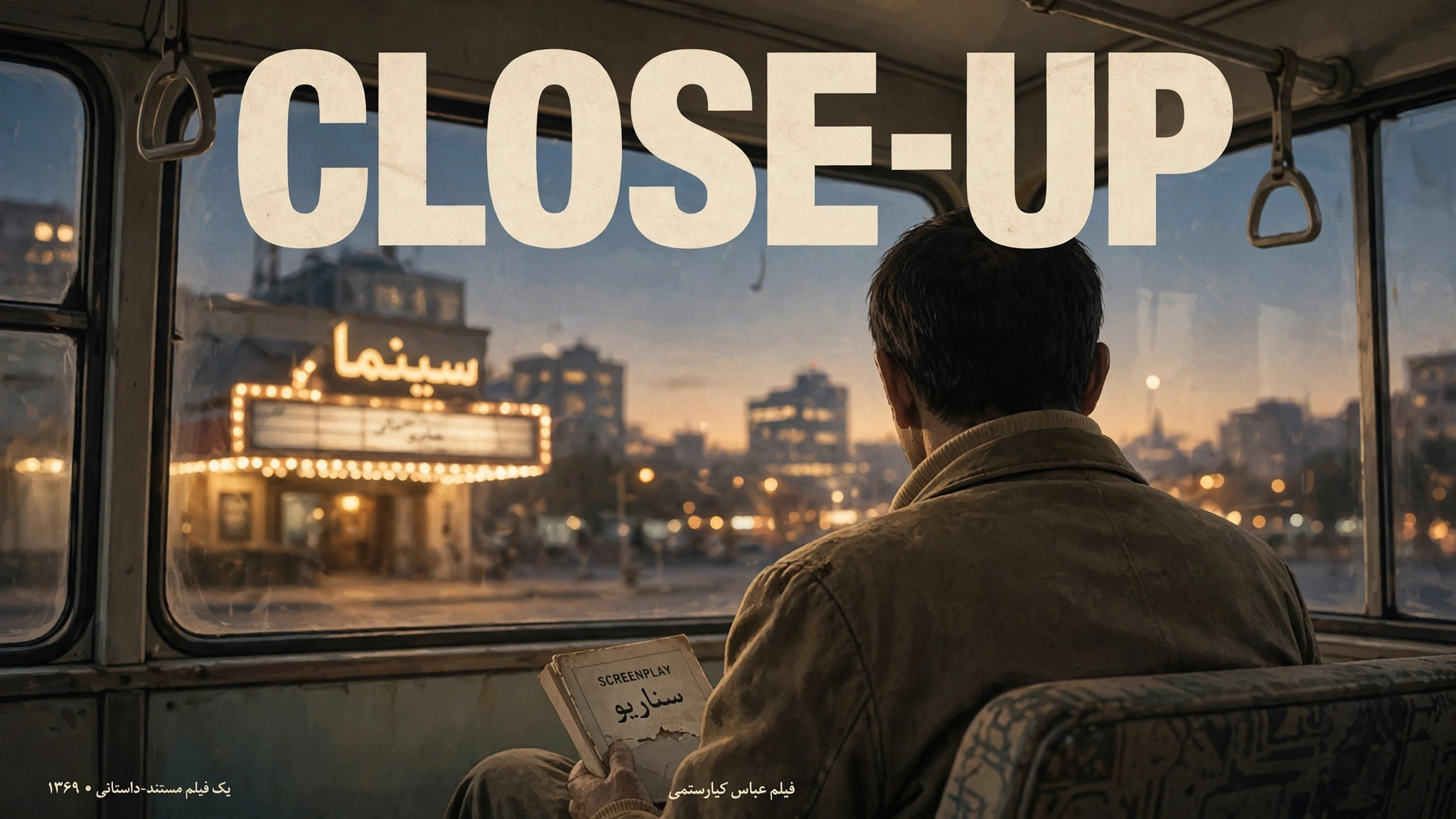
# Close-Up (1990) Review – The Impostor, the Trial, and Cinema’s Most Beautiful Blur Between Truth and Fiction**★★★★★ Our Rating: 9.5/10**In 2022, the *Sight and Sound* critics’ poll — the once-a-decade vote that functions as cinema’s closest thing to a constitution — placed *Close-Up* seventeenth among the greatest films of all time. Not seventeenth among Iranian films, or documentaries, or films of the 1990s. Seventeenth, full stop, in the company of *Citizen Kane*, *Vertigo* and *Tokyo Story*. The film that earned that place is a small, grainy, 98-minute Iranian work built from a newspaper item: a nobody, a bus ride, a borrowed name, and a court case. This Close-Up review will argue that the ranking is not critics being fashionable. It is the correct response to one of the most original films ever made.Abbas Kiarostami read the story in 1989, in the Iranian magazine *Sorush*, where journalist Hassan Farazmand had reported the strange case of Hossain Sabzian. Kiarostami was preparing another film at the time. He put it aside — accounts of the production agree he moved almost immediately — and went to find the people involved while the case was still live. What he built from it has no stable genre: part documentary, part re-enactment, part courtroom record, part confession, part essay on why human beings need cinema at all. The trade name is “docufiction,” a word that sounds clinical and does no justice to how moving the result is.A word on spoilers, because this film needs a special definition of them. Its events were real news in Iran, and its participants are public figures in their own story. But its power lies not in plot turns — it has almost none — rather in how it arranges real people, a real trial and staged repetitions of the past until the line between them dissolves. We will explain that method fully, while leaving Sabzian’s courtroom testimony, and the celebrated final movement, for you to experience in his — and its — own words.## Quick Facts: Close-Up at a Glance| Detail | Information ||—|—|| Release date | 1990 (Iran) || Director | Abbas Kiarostami || Writers | Abbas Kiarostami || Genre | Docufiction, Drama || Language | Persian || Runtime | 98 minutes || Lead cast | Hossain Sabzian (as himself), Mohsen Makhmalbaf (as himself), Abolfazl Ahankhah (as himself), Mehrdad Ahankhah (as himself), Mahrokh Ahankhah (as herself), Haj Ali Reza Ahmadi (the judge, as himself) || Our rating | 9.5/10 |There is no budget row in this table, deliberately: no reliably published production budget for *Close-Up* exists in credible sources. It was made modestly, within Iran’s Kanoon production context, but no verified figure has ever been published, and we will not invent one.## The Story: A Bus, a Famous Name, and a Family That Believed (Spoiler-Free)Here is the case, as Farazmand reported it and as the film reconstructs it. Hossain Sabzian was an unemployed print worker in Tehran — poor, divorced, devoted to cinema with the helpless completeness of a man whose real life had given him very little. Riding a bus one day with a copy of the published screenplay of *The Cyclist*, he fell into conversation with a fellow passenger, Mrs. Ahankhah, who admired the work of that film’s director, the celebrated Mohsen Makhmalbaf. On an impulse he would spend the rest of the film trying to explain — to the court, to Kiarostami, to himself — Sabzian told her that he *was* Makhmalbaf.What followed was less a confidence trick for money than an intoxication with being believed. Welcomed into the Ahankhah family’s comfortable home in northern Tehran, “Makhmalbaf” talked cinema with them, accepted their hospitality, and began — in the role — to plan a film that would be shot in their house, with their sons in it. The family, flattered and thrilled, went along; then doubts grew, a journalist was alerted, the police were involved, and Sabzian was arrested and charged with fraud. It is at this point that Kiarostami’s film truly begins. Granted permission to film inside the courtroom, he records Sabzian’s actual trial — the judge, the plaintiffs, the accused, all real, none of them actors — and then, with the agreement of everyone involved, he has those same people re-enact the earlier events: the bus, the visits, the growing suspicion, the arrest. Real and reconstructed scenes interleave, sometimes within the same storyline thread, and Kiarostami himself steps into the film as an interviewer, asking Sabzian the questions the court cannot ask: not *what did you do*, but *what were you looking for* — and whether playing Makhmalbaf, for a few days, felt more like himself than being Sabzian ever had. Where the case ends legally, and what happens when the real Makhmalbaf finally enters a story that has been conducted in his name, this review leaves to the film. They are two of the most discussed passages in all of cinema, and they earn their reputation.## Performances: People Playing Themselves, Which Is Harder Than Acting**Hossain Sabzian as himself** is the centre of the film and one of the most extraordinary “performances” ever recorded — with the quotation marks doing serious work, because the whole film asks whether what he does in the re-enactments, in the courtroom, and in conversation with Kiarostami can even be separated into acting and being. In the trial footage he is by turns evasive, witty, ashamed and startlingly eloquent, reaching for explanations of his imposture in terms of suffering, dignity and his love of cinema — particularly of Makhmalbaf’s films about the poor — that turn a petty fraud case into a man’s defence of his inner life. Kiarostami understood that Sabzian was not a criminal who happened to love films; he was a film-lover whose love had found the only expression his circumstances allowed. The camera’s patience with him is the film’s moral act.**The Ahankhah family as themselves** supply the film’s necessary counterweight, and their willingness to re-live their own gullibility on camera is its own kind of courage. Abolfazl Ahankhah, the father, emerges as proud, wounded and increasingly reflective about why his household wanted so badly to believe; his sons’ thwarted artistic ambitions — one an unemployed engineer drawn to the arts — reveal that Sabzian’s fantasy worked because it answered a longing in the house it deceived. **Mohsen Makhmalbaf as himself**, when he enters the film, brings a gentleness that reframes everything: the impersonated man refuses the role of outraged celebrity and instead treats Sabzian as something closer to a colleague in misery. And **Haj Ali Reza Ahmadi, the judge as himself**, presiding over the real proceedings, gives the film its dry procedural spine — a working court, doing ordinary justice, inside a film that keeps asking extraordinary questions.## Direction and Technical CraftThe method is the masterpiece, and it needs describing plainly. Kiarostami uses two kinds of material. First, documentary footage of the actual trial, shot with the court’s permission — by most production accounts with two cameras, one for the wider courtroom and one held close on Sabzian, which is where the film takes its title and its ethic: get nearer to the man than the charge sheet does. Second, staged reconstructions of the events before the arrest, in which the real participants play themselves, in the real locations, following the real sequence of events — but framed, timed and occasionally prompted by a director. Neither kind of footage is allowed to settle into being “the truth.” The re-enactments are visibly performed, yet emotionally exact; the trial is legally real, yet everyone in it knows a famous director’s cameras are present, which makes it, too, a kind of performance. Kiarostami edits between the registers until the viewer stops asking “is this scene real?” and starts asking the better question the film prefers: “what kind of truth does each version hold?”Around this structure everything is deliberately plain. Cinematographer Ali Reza Zarrindast shoots homes, streets and the courtroom without glamour; Kiarostami, who also edited, lets testimony run long. One famous technical decision belongs here in general terms: in a late sequence, the recorded sound famously falters and drops — an imperfection Kiarostami chose to keep and shape in the editing rather than repair, for reasons he later explained in terms of what each man in that scene knew about the camera’s presence. Even the film’s “flaws” are arguments. The initial Iranian reception, honestly recorded, was largely negative — its virtues were recognised abroad first — but the decades since have reversed that verdict completely.## Music and Background ScoreHonesty again requires brevity: *Close-Up* has almost no conventional score, and what little music it contains carries a whole essay in its credits. The film’s identified musical material is the theme from *The Traveler* (1974), Kiarostami’s own first feature, composed by Kambiz Roushanavan — a piece of music borrowed from an earlier film about another boy intoxicated by a dream, and allowed to surface where this film most needs tenderness. Beyond that borrowed theme, the soundtrack is the world: courtroom murmur, Tehran streets, room tone, silence held a beat longer than comfort allows. In a film about a man who borrowed a famous name, there is something quietly perfect about the score borrowing, too — almost nothing in *Close-Up* is allowed to be simply itself, and the music is no exception. The effect of the near-silence elsewhere is to keep every judgement with the voices: Sabzian’s testimony needs no strings to devastate, and Kiarostami knows it.## What Works and What Doesn’t**What we loved:**- Sabzian himself: a real defendant whose courtroom self-explanation becomes a defence of every nobody who ever dreamed through cinema- The method — real trial, real people re-enacting — which invents a form rather than following one- Kiarostami’s compassion as a directorial position: he prosecutes no one, and understands everyone- The Ahankhahs’ and Makhmalbaf’s participation, each adding a perspective that complicates the easy reading- An ending movement so discussed, and so earned, that it has become a reference point for filmmakers worldwide**What could be better:**- The deliberate roughness — grainy stock, uneven sound — will read as mere shabbiness to viewers who do not yet see the design in it- Long stretches of courtroom testimony demand patience and full attention; this is not background viewing- Viewers who need a firm line between documentary and fiction may find the refusal of one frustrating rather than liberating- Knowledge of Iranian cinema of the period enriches it, though the film works without it## Box Office: No Honest Total Exists — and the Canon Is the LedgerThere is no reliable worldwide box-office total for *Close-Up*, and this review will not manufacture one. Iranian theatrical data from 1990 is not available in any verifiable form, and the film’s international life was the classic arthouse pattern of its era — festival exposure, small distributors such as Zeitgeist Films in the United States, and eventual canonisation through the Criterion Collection and Janus Films — rather than any run that generated a meaningful, trackable gross. Any tidy dollar figure attached to this film in a database should be treated as a fragment of a fragment.The measurable record is the one that matters: ranked among the top fifty in the 2012 *Sight and Sound* critics’ poll, then **17th in the 2022 *Sight and Sound* critics’ poll of the greatest films of all time**; held in near-universal critical regard, with a Metacritic score in the nineties; restored, taught and programmed continuously for over three decades; and routinely cited by filmmakers worldwide as a formative work. Some films are measured in tickets. This one is measured in influence, and the influence is still compounding.## Verdict: Should You Watch It?Yes — this is not a recommendation so much as a direction to one of the essential films. Watch it if you have ever loved a film enough to wish you could live inside the life of the person who made it; Sabzian did more than wish, and Kiarostami’s genius was to see that the wish, not the fraud, was the story. Give it the conditions it asks for: one sitting, full attention, subtitles on, and patience for a Tehran courtroom in 1990. By the final movement, most viewers find the small grainy film about an impostor has quietly become a film about themselves — about every identity any of us has tried on in the hope of being treated, for once, as the person we feel we are inside.**Our rating: 9.5/10** — a form-inventing, profoundly humane masterpiece: the greatest film ever made about why people need films.## Frequently Asked Questions**Is Close-Up a documentary or a fiction film?**Deliberately, it is both — the form now called docufiction. Kiarostami filmed Hossain Sabzian’s real trial with the court’s permission, and then had Sabzian, the Ahankhah family and the other real participants re-enact the earlier events themselves, in the real locations. The film’s subject is, in part, exactly that blur.**Is the story of Close-Up true?**Yes. In late-1980s Tehran, print worker Hossain Sabzian really did impersonate director Mohsen Makhmalbaf to the Ahankhah family and was really tried for fraud. Kiarostami read journalist Hassan Farazmand’s report of the case in the magazine *Sorush* in 1989 and set aside another project to film it while the case was still unfolding.**Why did Sabzian impersonate Makhmalbaf?**Not, the film makes clear, for serious money. In his own testimony Sabzian speaks of poverty, humiliation and a consuming love of cinema — above all of Makhmalbaf’s films about the poor — and of the intoxicating experience of being listened to, respected and believed. The film treats his explanations seriously without ever pretending they make the deception harmless.**Why is Close-Up considered one of the greatest films ever made?**Because it invented a way of filming reality that dozens of later filmmakers have followed, and because its small story opens onto the largest questions: identity, class, dignity, forgiveness and the power of art over ordinary lives. The *Sight and Sound* critics’ poll ranked it 17th of all time in 2022.**Where can I watch Close-Up?**It is available through the Criterion Collection on disc and, in many regions, on arthouse streaming services carrying the Janus Films catalogue, often paired with Kiarostami’s first feature *The Traveler*. Availability varies by region, so check your local services.