★ LATEST REVIEWS

★★★★★ Our Rating: 9/10
Few films divide audiences as cleanly — or as permanently — as Taste of Cherry. Premiered at the Cannes Film Festival on 16 May 1997, Abbas Kiarostami’s minimalist drama won the Palme d’Or, shared with Shohei Imamura’s The Eel, becoming the first Iranian film ever to take Cannes’ highest honour. It was also called boring, empty and fraudulent by prominent critics who saw the same cut in the same year. Both responses are understandable, and this review will engage honestly with each. What is no longer in doubt, nearly three decades on, is the film’s stature: it sits near the top of critics’ polls of the greatest films ever made, and its final minutes remain among the most argued-over in cinema.
A necessary word before anything else: this is a film about a man who intends to end his life, and this review discusses that premise directly, because there is no honest way to write about the film without it. It handles the subject the way Kiarostami does — gravely, without spectacle, and ultimately on the side of life. This Taste of Cherry review keeps its story section free of the ending’s details, reserving the famous final sequence for a clearly marked FAQ, where it belongs: it is the one part of the film the whole world already talks about.
| Release date | 16 May 1997 (Cannes Film Festival); Iranian release 30 April 1999 |
| Director | Abbas Kiarostami |
| Writers | Abbas Kiarostami |
| Genre | Minimalist Drama, Road Film |
| Language | Persian |
| Runtime | 99 minutes (some prints and listings give 95 minutes) |
| Lead cast | Homayoun Ershadi, Abdolrahman Bagheri, Afshin Khorshid Bakhtiari, Safar Ali Moradi, Mir Hossein Noori |
| Our rating | 9/10 |
There is no budget row in this table, deliberately: no reliably published production budget for Taste of Cherry exists in credible sources, and rather than repeat an unsourced figure from a low-quality database, we omit it and say so.
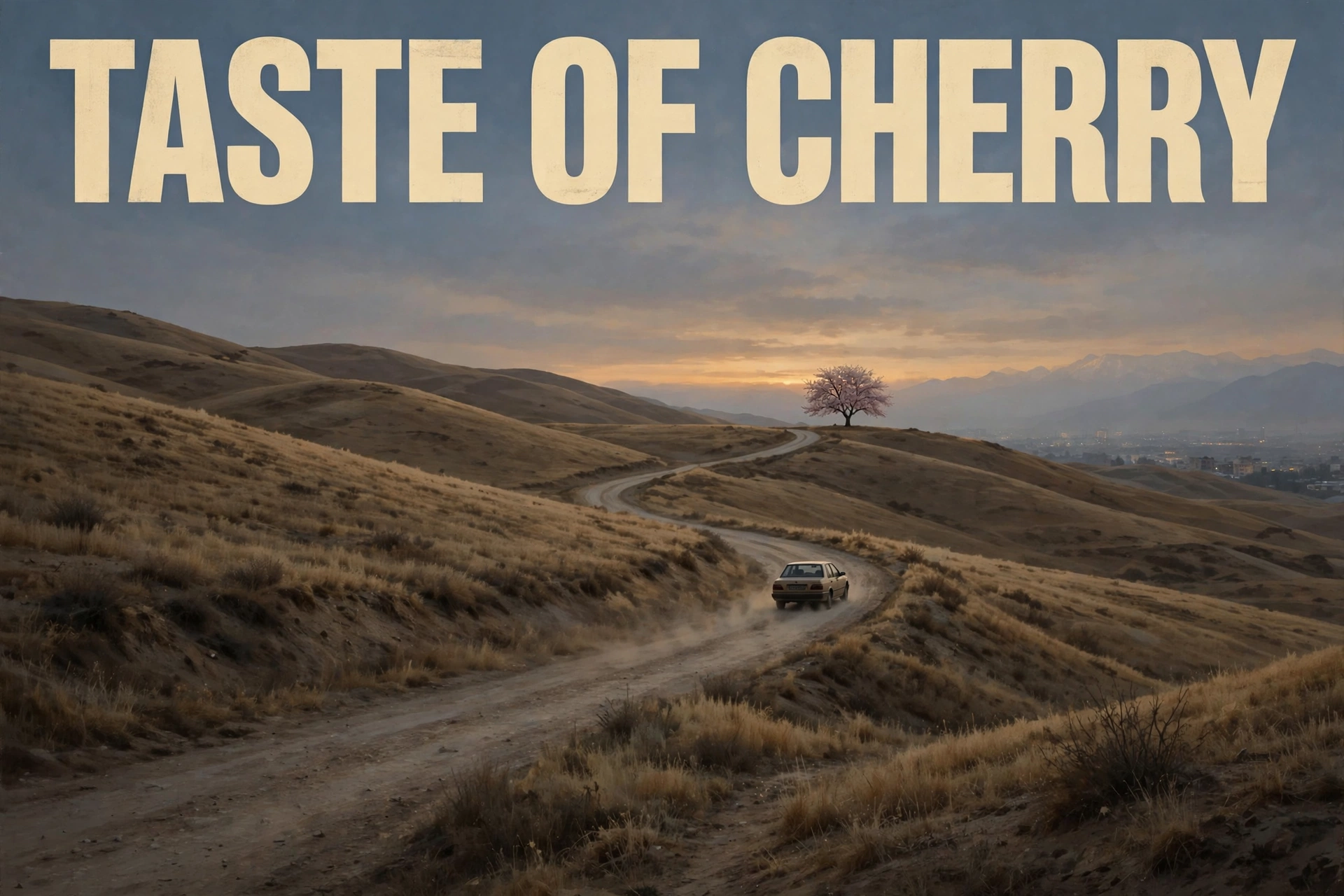
Mr. Badii (Homayoun Ershadi), a middle-aged man of evident means, spends the film driving. His Range Rover circles the construction-scarred, dusty outskirts of Tehran — past labourers hoping for work, past quarries and half-built developments, along unpaved roads that wind through hills the colour of dry earth. He is looking for someone. Slowly, through refused offers and wary conversations, the audience understands the errand: Badii has decided to die, has already chosen and prepared the place, and needs one thing he cannot do for himself — a person willing to come at dawn, call his name into the stillness, and, if there is no answer, complete the burial he has arranged. For this he offers a great deal of money.
The film is built as a series of encounters, three of which form its spine. A young Kurdish soldier, picked up on the road, listens in growing alarm. An Afghan seminarian, studying religion far from home, answers with theology and gentle refusal. And an older man, Mr. Bagheri (Abdolrahman Bagheri), a Turkish-speaking taxidermist at a natural history museum, responds in a way neither of the others does — with experience. Badii’s reasons are never given. Kiarostami withholds them absolutely: no trauma is revealed, no diagnosis offered, no backstory supplied. Whether that refusal is the film’s genius or its cheat is the argument audiences have been having since 1997 — but it is a deliberate, principled refusal, and the film’s whole meaning is built on it. What becomes of Badii’s plan is not discussed here. It is discussed, with warning, in the FAQ below.
Homayoun Ershadi as Badii was not a professional actor — Kiarostami famously cast him, an architect by profession, after spotting him in Tehran traffic — and the film turns that fact into its greatest asset. Badii must carry nearly every frame while revealing almost nothing, and Ershadi’s quality of withheld interiority is extraordinary: a polite, controlled, quietly exhausted man whose courtesy never cracks even as his request horrifies everyone he makes it to. You watch his face the way his passengers do, searching for the reason, and the film’s refusal to provide one makes that search the experience. When, late in the film, something like fear finally crosses his composure, the moment lands with the force of an action climax.
Abdolrahman Bagheri as Mr. Bagheri, also a non-professional, gives the film its soul. The taxidermist’s long conversation with Badii — delivered with warmth, humour and the authority of a man speaking from his own darkest chapter — contains the film’s title and its thesis: a simple, sensory argument for living, built from mulberries, cherries, sunsets and the ordinary evidence of the senses. It is one of the great monologues in cinema, and Bagheri’s unpolished delivery is exactly what makes it believable; a trained actor would have performed it, and Bagheri simply testifies. The younger passengers — Safar Ali Moradi as the soldier and Mir Hossein Noori as the seminarian, with Afshin Khorshid Bakhtiari also appearing among the young men Badii approaches — play their refusals with an authenticity that keeps the film’s fable-like structure grounded in recognisable human reaction: fear, doctrine, and finally, experience.
Kiarostami shoots the film in long takes, largely from within or beside the car, and the form is the philosophy. Cinematographer Homayun Payvar’s frames hold Tehran’s periphery as a landscape of earth and construction — a city literally digging and filling holes — while Badii’s vehicle becomes a confessional on wheels: men sit side by side, facing forward, and say things to a stranger’s profile that they could not say to a face. The dialogue scenes were famously shot with an audacious method — Kiarostami himself often riding in the car, playing the off-screen partner in alternating setups — so that each man is, in effect, alone with the camera and with us. It gives the conversations their strange, direct intimacy.
The austerity is real, and honest reviewing requires naming its cost. The pace is not slow by accident or by arthouse fashion; it is slow as an ethic — the film insists that you sit inside Badii’s time, his circling, his emptiness. Some viewers, including some great critics, have found that insistence empty rather than profound, and their frustration is not philistinism: the film genuinely offers no conventional rewards — no revelation, no catharsis on schedule, no explanation. What it offers instead is accumulation. Small things recur and deepen: earth, dust, a cherry tree, the sound of machinery, a sunset Bagheri urges Badii to actually look at. By the final movement, the film has quietly rebuilt the viewer’s own attention — and that rebuilt attention is the argument. Very few directors in history have trusted an audience this much, and the Palme d’Or jury, at least, decided the trust was honoured.
Taste of Cherry has, for practical purposes, no conventional score at all — and discussing its “music” honestly means discussing silence. The film’s soundtrack is the world: engine noise, wind, distant construction, birdsong, the crunch of earth. Kiarostami’s sound design makes the landscape itself the accompaniment to Badii’s despair, and its plainness is devastating — this is what the world he wants to leave actually sounds like, indifferent and continuing. The single famous exception arrives only at the very end, when a piece of recorded music — an old jazz standard, Louis Armstrong’s recording of “St. James Infirmary Blues” — enters the film like weather from another life. Why it arrives where it does, and what it means, belongs to the ending discussion in the FAQ; here it is enough to say that Kiarostami makes you wait ninety-five minutes for music, and then makes that wait itself meaningful. Few films have ever spent a soundtrack budget — or its absence — so eloquently.
What we loved:
What could be better:
Iranian box-office reporting of the 1990s is fragmentary, and Taste of Cherry is the clearest case in this entire review bank for refusing to invent a number: no reliable worldwide gross for this film exists in credible sources. The small tracked figure sometimes attached to it in databases — a few thousand dollars from a limited American engagement — represents a sliver of a specialty release, not the film’s commercial life, and quoting it as a “box office total” would be false precision. The film was a festival and arthouse phenomenon, distributed internationally by companies such as Zeitgeist Films in the United States and Artificial Eye in the United Kingdom, and its returns were measured in influence rather than grosses.
That influence is fully documented. It won the Palme d’Or at Cannes in 1997, shared with Shohei Imamura’s The Eel — the first Palme d’Or for an Iranian film — and went on to win Best Foreign Language Film honours from the National Society of Film Critics and the Boston Society of Film Critics in the United States, among other critics’ prizes. In the years since, it has placed high in the Sight and Sound critics’ polls of the greatest films ever made and anchored retrospectives of Kiarostami’s work worldwide. Some films earn money. This one earned a permanent place in the canon, which for a 99-minute film about a man driving in circles is the more interesting transaction.
Yes — if you are ready for it, and on its terms. Watch it in one sitting, in the dark, phone away, and let its patience work on you; it is one of the essential films of the 1990s and the defining work of one of cinema’s great directors. Go in honestly warned, though: viewers who need explanation, momentum or resolution delivered in conventional form may leave angry, as some distinguished critics did in 1997 — and the film would say that anger, too, is a response worth examining. A final note, offered plainly: if the subject of this film is close to your own life right now, treat it with the same seriousness Kiarostami does, and perhaps watch it with someone. The film’s own answer, delivered by a taxidermist over the taste of fruit, is that the world is worth staying for.
Our rating: 9/10 — a Palme d’Or masterpiece of restraint: austere, demanding and quietly life-affirming, with an ending cinema will argue about forever.
Because Kiarostami refuses to show you Badii’s fate — and then does something stranger. After the story reaches its darkest, most suspended moment, the film breaks its own fiction: the image shifts to grainy video footage of the production itself — the crew, the location in daylight and spring growth, and Ershadi alive and relaxed among them, with Kiarostami directing. Supporters read it as a deliberate release: the director pulls the audience back from the grave’s edge, reminds us the despair was a constructed meditation rather than a real death, and ends on life, work and blossoming trees instead. Detractors — Roger Ebert most famously, who called such devices tired distancing strategies — read it as a betrayal of the story’s contract. Kiarostami himself suggested the coda tells viewers the film was an argument to think with, not a fate to witness. Nearly thirty years later, no consensus exists, which is rather the point.
Yes. At the 1997 Cannes Film Festival it shared the Palme d’Or with Shohei Imamura’s The Eel, becoming the first Iranian film to win the award.
The film never says, and the omission is deliberate. Kiarostami maintained that Badii’s reasons were his own, and that the film is not about the cause of despair but about what can be said — and tasted, and seen — in answer to it.
Its subject is grave, but its effect, for most viewers who stay with it, is the opposite of depressing: Bagheri’s testimony and the film’s final turn make it one of cinema’s most cited arguments for choosing to live. It is contemplative rather than harrowing, with no graphic content.
It is available through the Criterion Collection on disc and, in many regions, on arthouse streaming services carrying the Janus Films catalogue. Availability varies by region, so check your local services.