★ LATEST REVIEWS

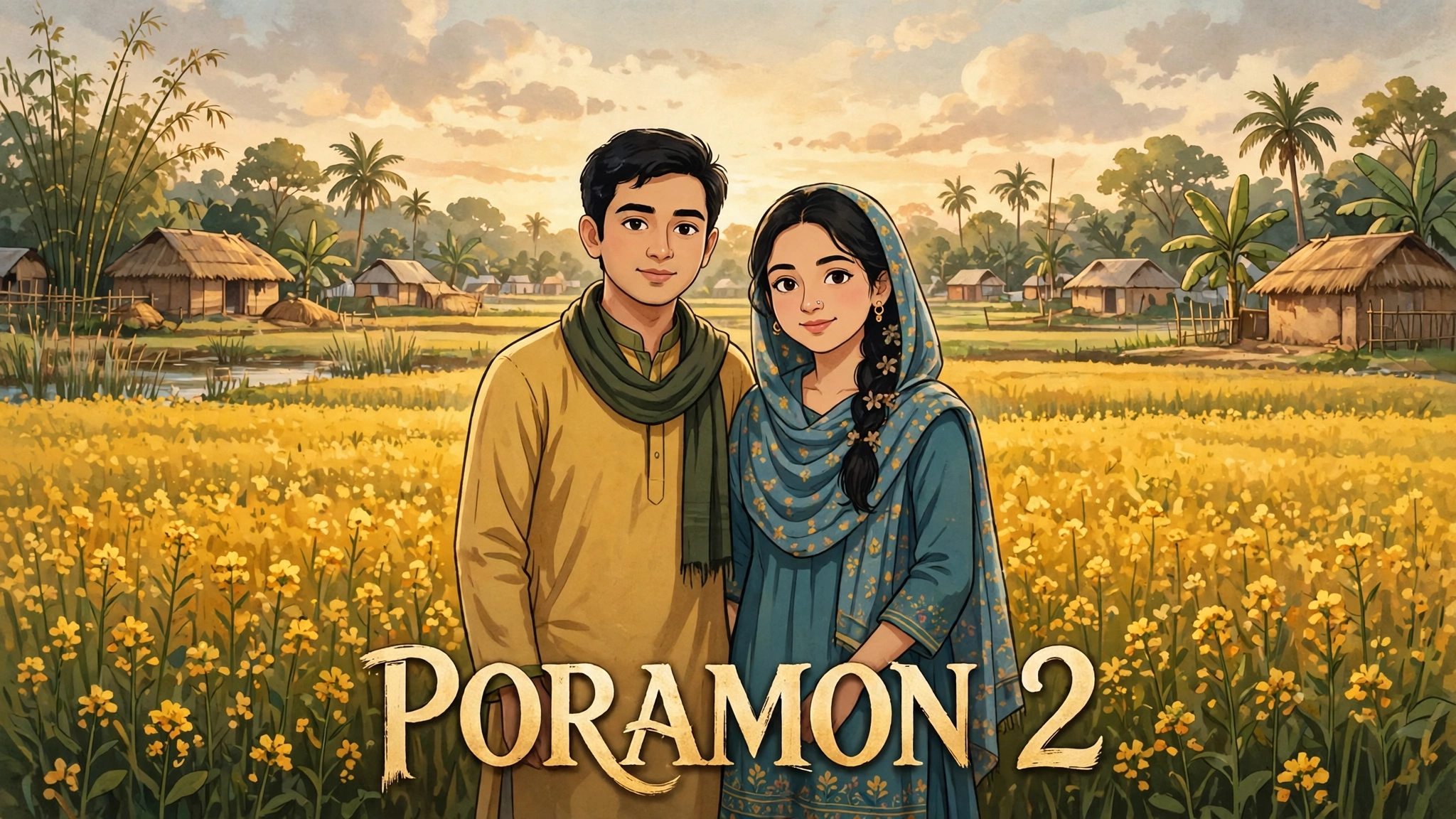
Our Rating: ★★★★☆ 7.5/10
Bangladeshi commercial cinema has produced many village romances, but few with the patience of Poramon 2. Directed by Raihan Rafi and released on Eid al-Fitr in 2018, it is the sequel to the 2013 hit Poramon, though it tells a self-contained story that needs no knowledge of the original. It stars Siam Ahmed and Puja Cherry Roy in their breakthrough film roles, and it became a genuine commercial success, expanding from a modest opening to dozens of cinemas across Bangladesh and then to audiences abroad.
The film’s premise is deceptively simple: a daring village boy and a poor schoolgirl fall in love, and their love runs up against family pride, village power and the rigid expectations placed on young people in rural Bangladesh. What distinguishes Poramon 2 is not the originality of that outline, which will be familiar to anyone who has seen a village romance, but the tenderness with which Rafi films it. The camera lingers on the countryside, the performances are unhurried, and the film gives its young lovers time to simply be together before the world closes in.
It is not a great film. Its story borrows heavily from an earlier Tamil classic, its second half is more melodramatic than its first, and some of its supporting characters are drawn in broad strokes. But it is a genuinely affecting one, and for many Bangladeshi viewers it remains the film that announced two new stars.
| Detail | Information |
|---|---|
| Release date | 16 June 2018 (Bangladesh, Eid al-Fitr) |
| Director | Raihan Rafi |
| Writer | Delowar Hossain Dil |
| Genre | Romance, Drama |
| Language | Bengali |
| Runtime | 146 minutes |
| Lead cast | Siam Ahmed, Puja Cherry Roy, Fazlur Rahman Babu, Bapparaj, Anwara Begum |
| Our rating | 7.5/10 |
The film is framed by grief. In a village called Shwapnopuri, a day labourer named Kafil Mia is mourning his only daughter, and the film slowly reveals the story behind that mourning through the romance that preceded it. At its centre are Sujon, a daring, restless village boy, and Pori, a poor schoolgirl whose life is defined by modesty, family duty and the narrow path laid out for girls in her world.
Their love grows the way village loves often do in films and in life: through friendship first, through glances and small kindnesses, through the gradual discovery that another person understands you better than your own family does. Siam Ahmed’s Sujon is all forward motion — brave, impulsive, unwilling to accept that his background should limit him — while Puja Cherry Roy’s Pori is quieter, more watchful, and no less determined in her own way. The film takes its time with their courtship, and that patience is its greatest strength: by the time outside forces begin to press on them, the audience has invested in the relationship itself, not just in the idea of it.
Those outside forces are familiar but potent. There is family opposition, village hierarchy, and the influence of powerful local men who believe they have the right to decide who marries whom. The film also touches, in its framing story, on questions of faith, burial and community judgement that give it a moral weight unusual for a commercial romance. This review will not describe how the lovers’ story ends, because the film’s reputation rests partly on the shock and sadness of its final stretch, and new viewers deserve to meet it unprepared.
Siam Ahmed as Sujon — This was Siam Ahmed’s first big-screen role, and it is a remarkably assured debut. His Sujon is physical, funny and reckless, a village boy who treats every obstacle as a dare, and Ahmed plays that energy without turning it into mere showing off. In the film’s quieter scenes, he shows a vulnerability that would become his trademark in later work: Sujon is brave, but he is also young, and Ahmed never lets the audience forget it.
Puja Cherry Roy as Pori — Roy, also making her breakthrough, is the film’s emotional centre. Her Pori is not a passive heroine waiting to be rescued; she is observant, principled and quietly stubborn, and Roy gives her a stillness that contrasts beautifully with Ahmed’s restlessness. Their chemistry is the film’s engine, and it works because both performers seem to be listening to each other rather than performing at each other.
Fazlur Rahman Babu as Kafil and Bapparaj in support — Babu, one of Bangladesh’s most respected character actors, carries the framing story with heartbreaking restraint. His Kafil is a man broken by loss but not by bitterness, and his scenes give the romance its retrospective ache: the audience knows, even before the story unfolds, that this love had a cost. Bapparaj, a veteran star, brings authority and menace to a supporting role, while Anwara Begum adds warmth as an older family figure. The supporting cast is uneven — a few village figures are sketched rather than developed — but the central trio holds the film together.
Rafi’s direction is the film’s quiet surprise. He was a young director making only his second feature, and he directs with a confidence that belies that inexperience. The cinematography by Saiful Shahin is genuinely beautiful: rural Bangladesh is filmed in golden light, wide fields, riverbanks and village lanes that feel both specific and idyllic, and contemporary commentators praised the film for showing the beauty of the Bangladeshi countryside after a long run of films that had neglected it.
That beauty is not merely decorative. Rafi uses the landscape to mark the lovers’ freedom: when Sujon and Pori are together in open country, the film breathes; when they are in village compounds and courtyards, it tightens. The contrast gives the romance a visual logic that the script alone does not always supply. The film’s one significant craft weakness is its length and its second-half pacing. At 146 minutes, it has room for its story, but the final stretch leans into melodrama more heavily than the first half earns, and a few confrontations are staged with a broadness that undercuts the tenderness that preceded them.
It is also honest to note the film’s debt to earlier cinema. Poramon 2 is widely described as an unofficial remake of the acclaimed Tamil film Paruthiveeran (2007), directed by Ameer Sultan. Rafi does not hide the resemblance, and his film finds its own identity in its Bangladeshi setting, its performances and its framing story, but viewers who know Paruthiveeran will recognise the shape of the story throughout.
The music of Poramon 2, by Emon Saha, Akassh and Raja Narayan Deb, is one of its most popular elements, and for good reason. The songs are melodic, romantic and rooted in Bengali folk and film traditions, and they are placed to mark the stages of the lovers’ relationship rather than to interrupt it. The film also features a special song paying tribute to the late Bangladeshi superstar Salman Shah, a gesture that resonated deeply with local audiences and that situates the film within a lineage of Bangladeshi screen romance.
The background score is less distinctive than the songs, but it serves the film well, swelling at the right moments and, crucially, knowing when to fall silent. In the framing scenes with Kafil, the absence of music is more powerful than any theme could have been, and Rafi deserves credit for that restraint.
What we loved:
What could be better:
Poramon 2 was a commercial success by the standards of Bangladeshi cinema in 2018. It opened on Eid al-Fitr in a modest number of cinemas — reports put its initial release at around 22 halls — and expanded as word of mouth grew, eventually playing in 87 cinemas across Bangladesh. Its box office is estimated at around ৳1 crore, a figure that should be treated as an estimate, since Bangladeshi box-office reporting of the period was less systematic than in larger industries, and some sources present the figure with that explicit caveat.
No reliable production-budget figure for the film could be verified for this review, so no budget number is quoted here; a single aggregator’s dollar estimate circulates online, but it is not supported by the kind of reporting that would justify repeating it as fact. What is documented is the film’s afterlife: it was selected for the Marché du Film section at Cannes, and it went on to release in Singapore, Australia, France, Canada and the United States in the months after its Bangladeshi run. For a film starring two newcomers, that international footprint was a significant achievement, and it helped establish both Rafi and his leads as names to watch in Dhallywood.
Yes, particularly if you enjoy romantic dramas or want to understand modern Bangladeshi cinema. Poramon 2 is not original, and its second half overreaches, but its central romance is played with such sincerity, and filmed with such beauty, that its flaws matter less than they might. It is the kind of film that works best when you let it wash over you: a village, two young people, and a love that the world around them cannot accommodate. Bring tissues.
Our rating: 7.5/10 — A tender, beautifully shot village romance that launched two stars.
Is Poramon 2 a sequel?
Yes, it follows the 2013 film Poramon, but it tells a self-contained story with new lead characters, so it can be watched on its own.
Who stars in Poramon 2?
Siam Ahmed as Sujon and Puja Cherry Roy as Pori, with Fazlur Rahman Babu as Kafil and Bapparaj in support.
Is Poramon 2 based on another film?
It is widely described as an unofficial remake of the Tamil film Paruthiveeran (2007), adapted to a Bangladeshi village setting.
How long is Poramon 2?
146 minutes, just under two and a half hours.
Where can I watch Poramon 2?
It has been available on streaming and digital platforms in various regions, though availability changes over time, so check your local platforms.