★ LATEST REVIEWS

★★★★★ Our Rating: 9.5/10
Some films represent their country. Matir Moina — known in English as The Clay Bird — quietly redefined what its country could be in cinema. When it opened the Directors’ Fortnight at the Cannes Film Festival on 15 May 2002 and won the FIPRESCI International Critics’ Prize, it became the first Bangladeshi feature ever selected for Cannes. It then became Bangladesh’s first ever submission for the Academy Award for Best Foreign Language Film. And in one of the bitter ironies that cling to this gentle film, it was initially banned at home by the Bangladesh Film Censor Board, which judged its treatment of religion too sensitive — a ban overturned on appeal, allowing the film to be shown in the country it so tenderly describes.
More than two decades on, the honours have settled into consensus: Tareque Masud’s debut feature is regularly placed among the greatest Bangladeshi films ever made, and it remains the essential starting point for anyone discovering the cinema of Bangladesh. This Matir Moina review looks at why a slow, small film about a boy at a religious school, built from folk songs, river light and family friction, carries such historical and emotional weight — and where its deliberate simplicity may test modern viewers. The story section below is spoiler-free in the way that matters: we describe the film’s world and conflicts, not the fates that history has in store for its characters.
| Detail | Information |
|---|---|
| Release date | 15 May 2002 (Cannes Film Festival, Directors’ Fortnight) |
| Director | Tareque Masud |
| Writers | Tareque Masud (story); Tareque Masud, Catherine Masud (screenplay) |
| Genre | War Drama, Coming-of-Age, Historical Drama |
| Language | Bengali |
| Runtime | 98 minutes |
| Lead cast | Nurul Islam Bablu, Russell Farazi, Jayanta Chattopadhyay, Rokeya Prachy, Soaeb Islam, Lameesa R. Reemjheem |
| Our rating | 9.5/10 |
There is no budget row in this table, deliberately. A figure of around US$300,000 circulates in reference listings for Matir Moina, but it is repeated without a verifiable primary production source, and the film’s financing — early support from French sources within a Franco-Bangladeshi co-production structure involving MK2 and Audiovision — was never published as an audited budget. Rather than present an unsourced number as fact, we omit it and say so.
The film is set in rural East Pakistan in the late 1960s, in the charged years of the 1969 mass uprising and the approach of the Liberation War — events the film keeps at the edge of the frame, arriving as radio news, arguments and rumours, exactly as they would arrive in a village boy’s life. Anu (Nurul Islam Bablu) is a shy, observant child whose father, Kazi (Jayanta Chattopadhyay), has hardened over the years into a strict, austere Islam. Believing the village world too loose and too mixed for his son, Kazi sends Anu away to a madrasa, an Islamic boarding school, where discipline is rigid, comfort is scarce and the boy’s homesickness is treated as a weakness to be outgrown.
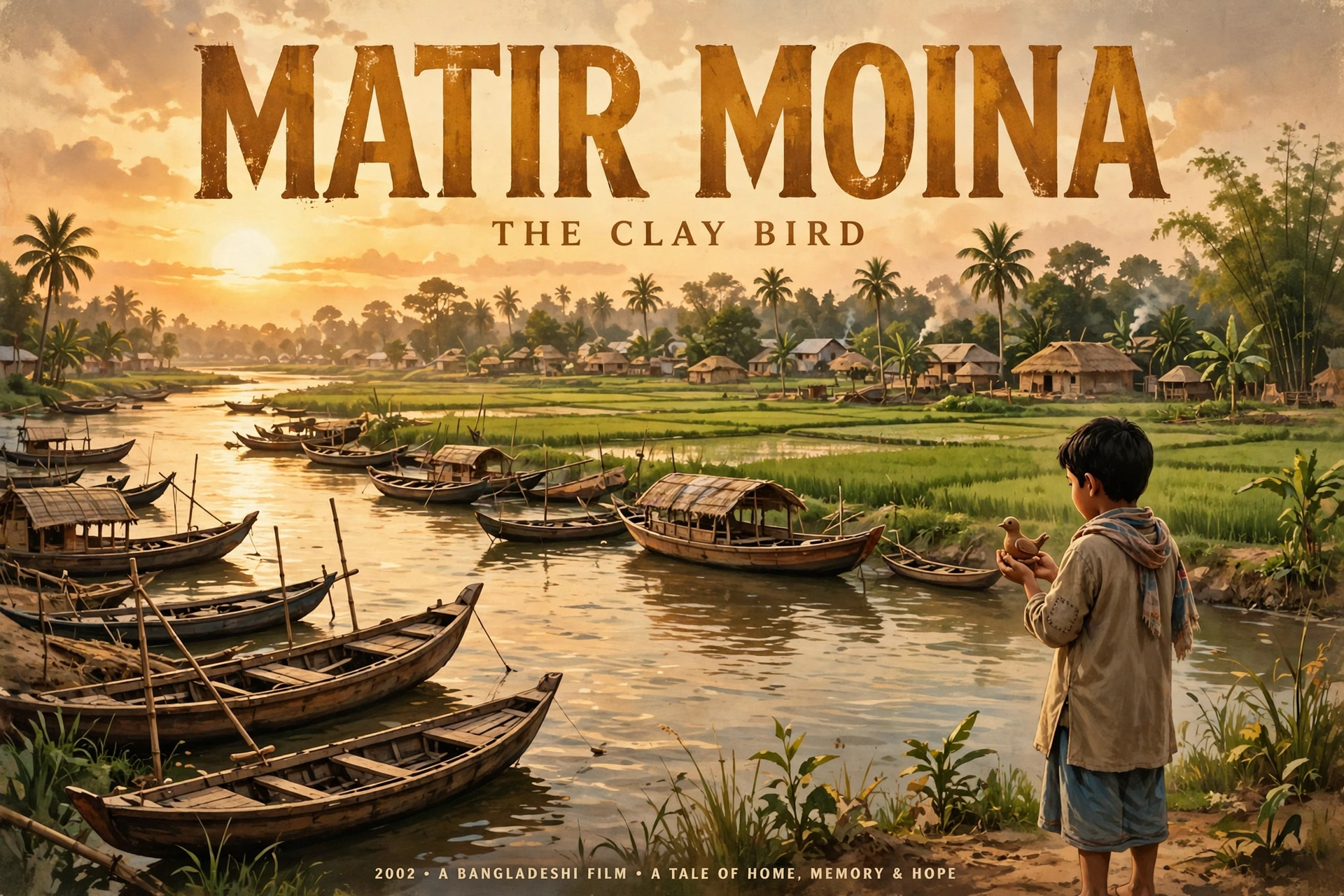
At the school Anu finds one lifeline: Rokon (Russell Farazi), an imaginative, questioning friend whose inner world does not fit the institution’s rules, and through whom Anu begins to see that faith and curiosity are not enemies. Back in the village, the other half of the film unfolds in counterpoint. Anu’s mother Ayesha (Rokeya Prachy) — married young, confined by her husband’s severity, alive with a spirit the household keeps asking her to suppress — holds the family together while it quietly strains. Anu’s uncle Milon (Soaeb Islam), a politically engaged young man moving towards the independence cause, argues with Kazi across a widening generational and ideological divide. And flowing through everything, literally and spiritually, is the river culture of Bengal: boatmen, Baul singers, Hindu festivals and folk performances that present a different, older, syncretic Bengal — one that Kazi’s imported strictness is trying, and failing, to wish away. The clay bird of the title belongs to this world: a fragile, handmade thing, shaped from the earth of home. What history does to this family, this review will not say. The film’s power is that by the end, the national story and the family story have become the same story.
Nurul Islam Bablu as Anu carries the film the way a child actually experiences the world: mostly by watching. Masud, drawing on his own childhood in a madrasa, cast largely non-professionals and shot in real locations, and Bablu’s unpolished openness is the film’s greatest asset. He does not “perform” loneliness, curiosity or fear in the adult sense; he simply has them, on camera, in sequence, and the audience does the rest. It is one of the great child performances in South Asian cinema precisely because it never reaches for effect — and the industry recognised it, with Bangladesh’s National Film Awards honouring the film’s child artistry among its wins.
Jayanta Chattopadhyay as Kazi faces the film’s most dangerous role. In a lesser film, the strict father would be a villain with a beard. Chattopadhyay and the script instead build a man whose severity is a form of fear — of poverty, of disorder, of a changing country, of his own failures — and whose certainties keep colliding with consequences he did not intend. He is wrong, often and consequentially, but he is never a caricature, and the film’s refusal to hate him is central to its humanism. Rokeya Prachy as Ayesha gives the film its quiet rebellion: a performance of compressed life, in which glances, withheld words and one or two moments of released joy sketch an entire marriage and an entire social order. Russell Farazi as Rokon brings the necessary strangeness and sparkle — the friend as artist-in-embryo, constitutionally unable to be flattened by the institution — while Soaeb Islam as Milon supplies the political future entering the family home, arguing the case for a Bangladesh that does not yet exist.
Tareque Masud arrived at this debut feature after years of documentary work, including the celebrated Muktir Gaan, and the documentary eye is everywhere: real villages, real seasons, real festivals, real faces, and a patience with ordinary duration that commercial cinema rarely permits itself. Working with cinematographer Sudheer Palsane, Masud organises the film around the rhythms of rural Bengal — rivers, fields, courtyards, the schoolroom’s bare geometry — and around the contrast between two visual worlds: the madrasa, all discipline and enclosure, and the village, all water, music and mixture. Catherine Masud’s editing gives the film its dual structure, alternating school and home so that each comments on the other without a line of dialogue ever stating the comparison.
The film’s most famous formal quality is its fairness. Masud criticises religious rigidity, and the criticism has real teeth — the ban the film received at home is proof the teeth were felt — but he distributes blame and sympathy across every position: the orthodox father, the political uncle, the folk mystics, the school authorities each get their argument and their limitation. For a first feature made with modest means, the control is remarkable; its flaws are those of its virtues. The pacing is genuinely slow, the narrative deliberately loose, and viewers raised on plot-driven cinema may find the middle stretches drifting where the film intends them to accumulate. That is a real cost, honestly recorded — but accumulation is the method, and by the final movement the weight of all that observed life is exactly what gives the ending its force.
Music in Matir Moina is not decoration or underscore in the commercial sense; it is one of the film’s arguments. Moushumi Bhowmik served as music director, and the film’s soundscape is built from the living folk culture of Bengal — Baul songs, devotional and river music, festival performance — presented diegetically, as things the characters themselves hear, sing and gather around. The mystic boatman figure and the folk singers are not local colour: they articulate the film’s counter-theology, a Bengal Islam and a Bengal culture grown from local soil, set against imported austerity. Where the madrasa sequences are defined by recitation and silence, the village sequences breathe with melody, and the contrast does more storytelling than pages of dialogue could.
There is little conventional background score in the dramatic sense, and the film is stronger for the restraint: emotional scenes are allowed to sit in natural sound — water, birds, crowds, weather — rather than being instructed by strings. If you come to Bangladeshi cinema through its famous playback-song tradition, this will feel different, even austere. But as an integrated use of a region’s actual music to carry a film’s themes, Matir Moina remains a model that South Asian filmmakers still study.
What we loved:
What could be better:
This section exists to refuse a number, and to explain why. Listings attached to Matir Moina sometimes show a worldwide gross of roughly US$47,000–49,000. That figure represents only a small tracked portion of the film’s limited international arthouse release — it does not include the film’s Bangladeshi life, its festival circulation, or the home-video release that reached Bangladeshi audiences in April 2005 after the ban was overturned, and quoting it as the film’s “box office” would be false precision of exactly the kind this site avoids. No reliable, complete worldwide gross for this film exists in credible sources.
What is documented, and what actually measures this film’s success, is its trajectory: opening film of Cannes Directors’ Fortnight 2002 and winner of the FIPRESCI Prize there; Best Screenplay at Marrakech; National Film Awards in Bangladesh including Best Screenplay and Best Child Artist; five categories at the Bachsas Awards; Bangladesh’s first-ever Academy Award submission; and a second life as a fixture of retrospectives, syllabi and “greatest Bangladeshi films” lists ever since. Tareque Masud died in a road accident in 2011, and Matir Moina is the cornerstone of a legacy Bangladeshi cinema is still building on. Some films are hits. This one is a foundation.
Yes — and if you watch only one Bangladeshi film from before the streaming era, this is the strongest candidate. Come to it as you would come to a classic: in one sitting, without your phone, willing to let a slow film about a boy, a river and a divided household gather its weight. Viewers who need pace and plot mechanics may find it demanding; viewers who meet it halfway tend to carry it for years. Its final achievement is balance — it loves the culture it criticises, and criticises the rigidity it understands — and that balance is precisely why a film once banned at home is now taught as national heritage.
Our rating: 9.5/10 — a humane, quietly devastating debut: the film that carried Bangladesh to Cannes, and still the benchmark for Bangladeshi art cinema.
Why was Matir Moina banned in Bangladesh?
The Bangladesh Film Censor Board initially refused the film on the grounds that its treatment of religion — a strict madrasa education and a father’s austere faith — was too sensitive. The Masuds appealed, the decision was reversed, and the film was shown in Bangladesh in late 2002; a DVD release followed on 16–17 April 2005.
Is Matir Moina based on a true story?
It is semi-autobiographical. Tareque Masud drew directly on his own childhood experience of studying at a madrasa in rural East Pakistan during the turbulent late 1960s, though Anu’s family and the specific events are shaped as fiction rather than presented as documentary fact.
What does the title Matir Moina mean?
Matir Moina translates as “the clay bird” — a handmade bird of earth, a traditional rural toy and, in the film, an image of something fragile, local and lovingly shaped: childhood, home and Bengal’s folk culture itself, all of which the coming storm threatens.
What awards did Matir Moina win?
Most notably the FIPRESCI International Critics’ Prize in the Directors’ Fortnight at Cannes 2002 — as the first Bangladeshi film selected for the festival — plus Best Screenplay at Marrakech and Bangladeshi National Film Awards for Best Screenplay and Best Child Artist, among other honours. It was also Bangladesh’s first submission for the Best Foreign Language Film Oscar.
Where can I watch Matir Moina (The Clay Bird)?
The film has been distributed internationally by companies including MK2 and Milestone and appears periodically on arthouse streaming services and in retrospectives, as well as on home video. Availability varies by region, so check your local services.