★ LATEST REVIEWS

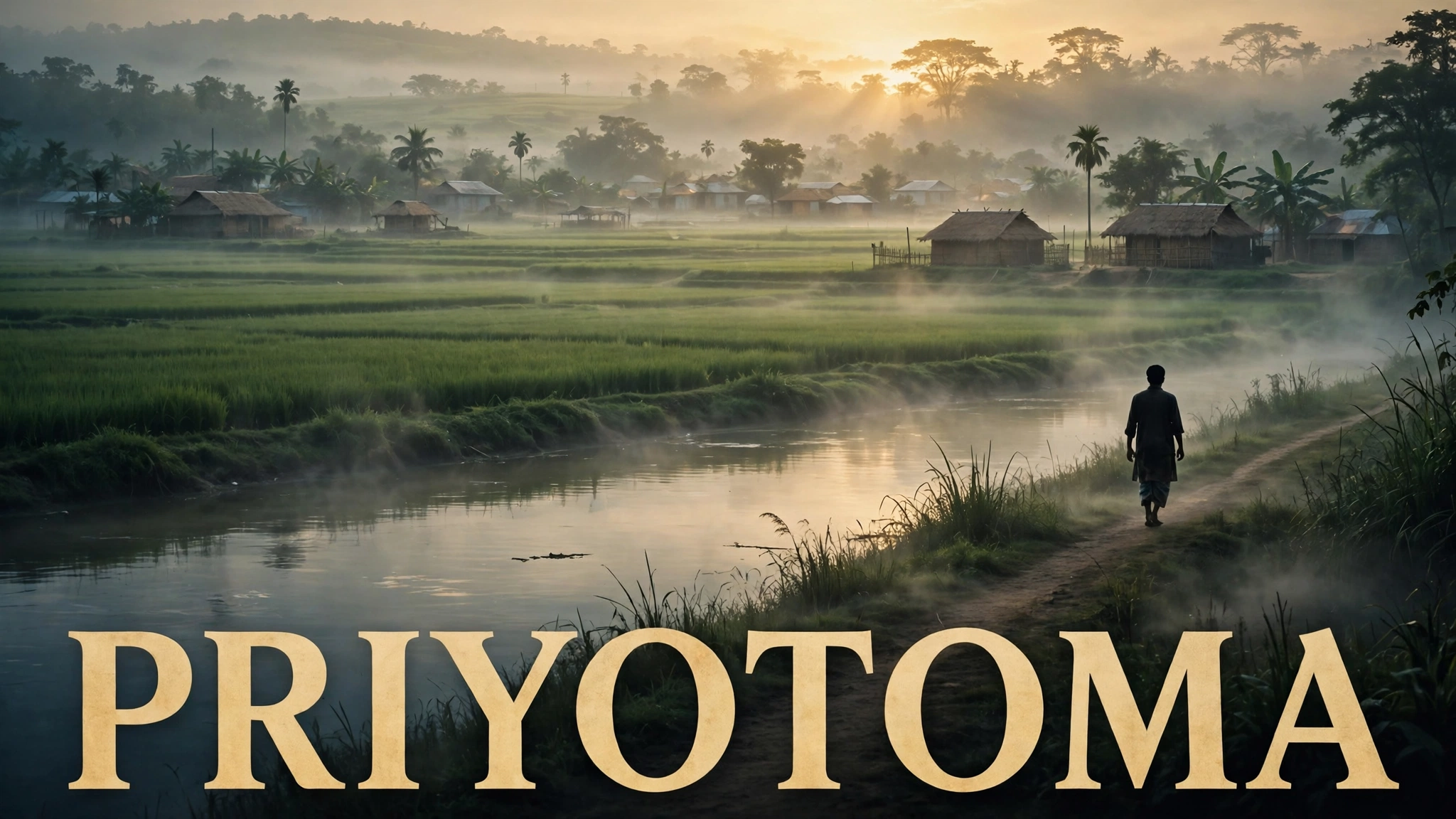
★★★★☆ Our Rating: 7/10
Some films succeed because they are flawless. Priyotoma succeeded because it understood exactly what its audience had been starved of. Released for Eid-ul-Adha on 29 June 2023, at a moment when Bangladeshi cinemas were closing, screens were shrinking and the industry was leaning heavily on one star to survive, Himel Ashraf’s tragic romance did something nobody quite predicted: it filled halls again. Families who had stopped going to the cinema went back. Shows sold out. And a modestly made love story, carried almost entirely by feeling, music and one enormous star performance, climbed past a record that had stood for more than three decades.
None of that means Priyotoma is a perfect film, and this review will not pretend otherwise. Its plot is familiar, its comedy is weak, and stretches of its craft are ordinary. But honesty cuts both ways: a film does not become the biggest earner in its industry’s history, on the strength of repeat family audiences, by accident. Something in it connects — deeply, and across generations. This Priyotoma review looks at what that something is, where the film genuinely earns its success, and where it falls short, without spoiling its celebrated final stretch.
| Detail | Information |
| Release date | 29 June 2023 (Bangladesh, Eid-ul-Adha) |
| Director | Himel Ashraf |
| Writers | Faruk Hossain (story); Himel Ashraf, Faruk Hossain (screenplay) |
| Genre | Romantic Drama, Tragedy, Action |
| Language | Bengali |
| Runtime | 142 minutes (some listings give 140 minutes) |
| Budget | est. ৳2.5 crore (reported estimate — see Box Office note) |
| Lead cast | Shakib Khan, Idhika Paul, Shahiduzzaman Selim, Lutfur Rahman George, Kazi Hayat |
| Our rating | 7/10 |
A note on that budget line: ৳2.5 crore is the figure consistently reported by Bangladeshi trade and press coverage, including The Business Standard, but Bangladeshi film budgets are not independently audited, so it should be read as a widely reported estimate, not a certified production account.
Sumon (Shakib Khan) is a man carrying a fresh wound. His elder brother is dead, and with the death comes an unfinished obligation: money owed to the family sits with a business associate in a distant city, and Sumon must travel to retrieve it. It is an errand born of grief and duty, undertaken by a man in no emotional state to begin anything new.
The journey changes his life anyway. In the city, Sumon’s path crosses with Iti (Idhika Paul), the free-spirited daughter of an influential local political figure — a young woman raised with every comfort Sumon has never had, and with a lightness he has forgotten how to feel. What begins in friction softens, gradually and believably, into affection. The film takes its time here, and that patience is one of its better instincts: this is a romance built from small encounters rather than instant declarations.
But Priyotoma announces itself, honestly and from the start, as a tragedy. The love story unfolds under a shadow the audience can feel even when the characters cannot, and the world around the couple — family pride, political power, money and the obligations Sumon left home carrying — keeps tightening around them. To say more would be to steal the film’s most praised passage: its final half hour, and a transformation in Sumon that the film’s own publicity turned into its biggest talking point. This review will only say that the ending recontextualises everything before it, and that audiences who found the middle of the film familiar stayed in their seats, and then stayed talking about it, because of where it lands.
Shakib Khan as Sumon is the film, and the film knows it. Bangladesh’s biggest star for the better part of two decades, Khan has often been accused — fairly, at times — of coasting on charisma through weak scripts. Priyotoma asks far more of him, especially late, and he delivers what many local critics called a career-best performance. The early Sumon is all suppressed grief and working-class dignity; the romantic middle lets him be warm without turning soft; and the closing stretch requires a physical and emotional transformation that could easily have tipped into melodrama or even unintentional comedy. In Khan’s hands it lands as devastation. It is the rare star performance that reminds you the star became one for a reason.
Idhika Paul as Iti, in her feature debut, has the harder job than it looks. Iti is written, frankly, as an archetype — the bubbly, privileged girl whose love redeems a wounded man — and a lesser newcomer would have been swallowed by both the archetype and her co-star’s fame. Paul brings a genuine freshness to the role: her Iti is playful without being silly, and her chemistry with Khan, widely praised on release, develops at a pace the audience can actually follow. She is not asked to carry the film’s heaviest scenes, and the film is wise not to ask — but within her register, she is completely convincing, and her arrival from Kolkata’s industry to headline Dhallywood’s biggest hit is a story in itself.
The supporting cast does solid, unshowy work. Shahiduzzaman Selim lends authority and menace in equal measure, Lutfur Rahman George is effective as the local chairman whose world Iti belongs to, and veteran Kazi Hayat brings quiet weight to the role of Sumon’s father — a small part that anchors the film’s family-values core. Nobody in the ensemble embarrasses themselves; equally, nobody except the two leads is given material that lets them truly shine.
Himel Ashraf, directing only his second feature, makes a clear-eyed commercial decision: he directs for emotion first and elegance second. The storytelling is classical to the point of old-fashioned — clearly marked beats, songs placed where the audience expects them, sentiment underlined rather than suggested. Purists may call that dated. But there is a real skill in calibrating a film this precisely to a mass audience, and Ashraf’s control of tone in the final act, where the film shifts from romance into something much darker without losing the audience, is the work of a director who understands his viewers.
The film was shot largely in Dhaka, Sylhet and Sunamganj, with additional schedules in Cox’s Bazar and Bandarban, and cinematographer Saiful Shaheen makes good use of the contrast between Sumon’s rural world and the city that changes him. The photography is handsome rather than inventive — which, to be fair, describes much of the craft here. Simit Ray Antor’s editing keeps a 142-minute film moving, though the middle section, where the romance settles into a comfortable rhythm, could have lost ten minutes without losing anything that matters. The action passages, choreographed in the mainstream Dhallywood style, are functional rather than memorable; this was never going to be an action film first, whatever the posters suggested, and the film is at its best when it stops pretending otherwise.
The honest craft verdict: Priyotoma is not a technical leap forward for Bangladeshi cinema in the way some of its art-house contemporaries are. It is, instead, a mainstream film made with unusual care about the two things its audience values most — its star and its feelings.
If one element besides Khan explains this film’s phenomenon, it is the music, composed by Akassh, Prince Mahmud and Sajid Sarker. The title song, “O Priyotoma,” sung by Balam and Somnur Monir Konal, became a genuine cultural event: it crossed 100 million views on YouTube within roughly three months of release, reported as the fastest Bengali-language film song to reach that milestone, and it trended across platforms for weeks. Songs in South Asian popular cinema are often marketing first and storytelling second; here, the title track does both — it is the film’s emotional thesis set to melody, and audiences arrived at cinemas already knowing it by heart.
Prince Mahmud’s “Ishwar,” a song of devotion and surrender, supplies the film’s spiritual register and was singled out for top honours in Bangladeshi awards coverage of the film’s music. Akassh’s “Qurbani Qurbani,” released just before Eid, gave the film its festive calling card and racked up enormous first-day views. The background score is more conventional — it tells you what to feel, loudly, in the mainstream manner — and in the long romantic middle it occasionally oversells scenes the actors were already carrying. But as an album, this is one of the strongest Bengali film soundtracks of its decade, and the rare one where the songs genuinely extend the film’s life far beyond its theatrical run.
What we loved:
What could be better:
This section needs a warning label, and the film deserves it stated plainly: Bangladeshi box-office figures are press- and trade-reported, compiled from producer, distributor and exhibitor claims, and are not independently audited. Treat every number below as a reported claim, not a certified fact — and Priyotoma is the extreme case, because its reported totals vary wildly between sources.
What is consistent across sources: the film opened on 29 June 2023 in 107 cinemas with hundreds of shows a day, took a reported ৳10.3 crore in its first week, and after about four weeks had overtaken Beder Meye Josna (1989) — the record holder for 34 years — in reported grosses, becoming at that moment the highest-grossing Bangladeshi film ever released. Later reported totals diverge sharply: industry reporting such as The Business Standard put the eventual take at around ৳42 crore; the commonly maintained highest-grossing list settles on ৳44 crore; a more conservative academic case study suggested around ৳37 crore. The honest summary is a reported range of roughly ৳37–44 crore against a reported production cost of about ৳2.5 crore — a phenomenal return by any version of the arithmetic. In the years since, newer Shakib Khan vehicles, Toofan (2024) and Borbaad (2025), have been reported above it, which tells its own story about the wave Priyotoma started. The film also travelled: a North American release across dozens of screens followed in July 2023, with further releases reported in other markets — rare reach for a Bengali-language tragedy.
Whatever the exact crore count, the qualitative fact is not in dispute: this was the hit that broke Dhallywood’s long commercial slumber, and it did so with a love story, not a franchise or a spectacle budget.
Watch it if you want to understand modern Bangladeshi popular cinema — what it values, what its biggest star can do when a film finally asks enough of him, and why a simple story, honestly told and beautifully sung, can outrun films with ten times its budget. Go in knowing it is a melodrama and proud of it: if your taste runs only to understatement and novelty, the familiar plot and broad comedy will test you. But stay for the last half hour. There is a reason audiences left cinemas in tears and then bought tickets again.
Our rating: 7/10 — an imperfect, entirely sincere star vehicle whose music, climax and central performance turned a modest tragedy into Dhallywood history.
Is Priyotoma based on a true story? No. It is an original fictional story written by the late Faruk Hossain, who also co-wrote the screenplay with director Himel Ashraf. Its themes — grief, duty, class difference and lost love — are universal rather than biographical.
Why did Priyotoma become such a huge hit? A combination that rarely aligns: Shakib Khan’s star power and career-best performance, an Eid-ul-Adha release, a soundtrack led by the record-breaking title song “O Priyotoma,” an emotional climax that generated powerful word of mouth, and family audiences returning to cinemas for a clean, sentiment-driven story.
How much did Priyotoma really earn at the box office? Nobody can say with audit-level certainty. Reported totals range from roughly ৳37 crore to ৳44 crore depending on the source, and Bangladeshi figures are not independently verified. What is well established is that it passed the long-standing record of Beder Meye Josna (1989) during its run and was the highest-grossing Bangladeshi film of its time.
Is Priyotoma suitable for family viewing? Broadly, yes — it was embraced by family audiences in Bangladesh, with romance and emotion rather than explicit content. It does deal with death, grief and violence in its later passages and is an intense tragedy, so very young children may find the closing stretch upsetting.
Where can I watch Priyotoma? It was released on the Bioscope streaming platform after its theatrical run, alongside cinema releases in Bangladesh and selected international markets. Availability varies by region, so check your local services.