★ LATEST REVIEWS

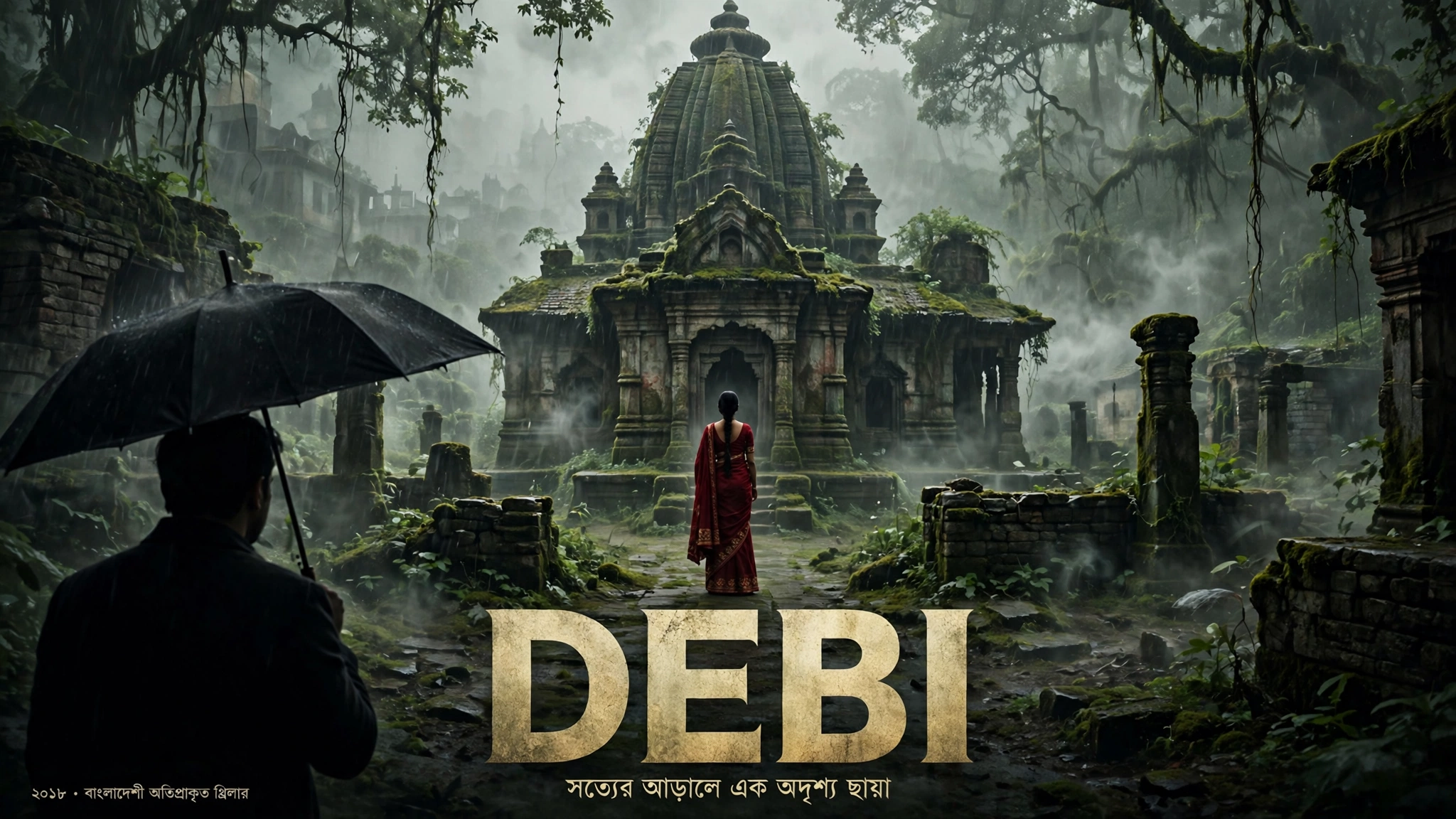
★★★★☆ Our Rating: 8/10
For Bangladeshi readers, Misir Ali is not just a character. He is a habit of mind. Humayun Ahmed’s quiet, logic-obsessed, endlessly curious investigator — a teacher of psychology who collects other people’s mysteries the way other men collect stamps — anchored one of the most loved book series in modern Bengali literature. Yet for decades, while other Humayun Ahmed creations reached the screen again and again, Misir Ali stayed on the page. Debi: Misir Ali Prothombar, released on 19 October 2018, was the first film ever built around him, and it carried the weight that “first” always carries: a beloved novel, a legendary author who was no longer alive to approve the adaptation, and an audience ready to be unforgiving.
The film, directed by Anam Biswas and produced by its star Jaya Ahsan as the first production of her company C for Cinema, with support from a Government of Bangladesh film grant, largely earned that audience’s trust. It was received warmly by critics, became a clear box-office hit by Bangladeshi standards, travelled to cinemas across the United States, and proved that a literary, atmosphere-driven thriller could sell tickets in an industry then dominated by action and romance formulas. It is not a flawless adaptation — readers of the novel will feel some of its edges soften and its ending remains debated — but as this Debi review will argue, its two central performances and its patient, unsettled mood make it a genuine landmark for Dhallywood.
A note on spoilers: Debi is a mystery whose pleasure lies in not knowing whether what you are watching is supernatural or psychological. This review protects that question completely. We will not tell you what Misir Ali concludes, what Ranu truly is, or how the film ends.
| Detail | Information |
|---|---|
| Release date | 19 October 2018 (Bangladesh) |
| Director | Anam Biswas |
| Writers | Humayun Ahmed (novel); Anam Biswas (screenplay) |
| Genre | Supernatural Thriller, Mystery, Drama |
| Language | Bengali |
| Runtime | 106 minutes |
| Lead cast | Chanchal Chowdhury, Jaya Ahsan, Animesh Aich, Iresh Zaker, Sabnam Faria |
| Our rating | 8/10 |
There is no budget row in this table, deliberately. Debi was partly financed through a Government of Bangladesh film grant, which is well documented, but no reliably published, independently verified production budget exists, and the unsourced figures circulating on low-quality databases are not worth repeating as fact.
Ranu (Jaya Ahsan) is a young Dhaka housewife with a problem nobody around her can name. She appears to know things she has no ordinary way of knowing — premonitions, intuitions and dark certainties that arrive uninvited and are too often proved right. Is she gifted, ill, haunted, or protected by something that has stood beside her since childhood? Her husband Anis (Animesh Aich) is, pointedly, a psychiatrist and part-time university teacher: a professional man of science, married to a mystery his science cannot file away. Out of love, worry and professional pride, he does what the plot requires — he takes his wife’s case to the one man in Dhaka famous for refusing easy answers, a former colleague and teacher named Misir Ali (Chanchal Chowdhury).
Misir Ali approaches Ranu the way he approaches everything: by listening longer than anyone else would, asking the questions others are too polite or too frightened to ask, and following the trail of her memories back towards the village and the childhood she has half-buried. Running alongside this investigation is a second, quieter thread that gives the film its contemporary chill. Nilu (Sabnam Faria), a young woman connected to Misir Ali’s household, has struck up an intense online friendship with a stranger calling himself Ahmad Sabet (Iresh Zaker) — a charming, elusive presence who is always available, never quite visible, and increasingly hard to place in the ordinary world. Whether the two threads belong to the same darkness is the film’s central engine, and this review will leave it exactly there. What can be said safely is that Debi — the title means “goddess” — is finally about the ways women in this story are worshipped, feared, used and misunderstood, often by the same people, sometimes in the same scene.
Jaya Ahsan as Ranu is the film’s still centre, and it is one of the finest performances of her decorated career. Ranu could so easily have been played as a collection of spooky tics — the stare, the whisper, the sudden trance. Ahsan refuses all of it. Her Ranu is gentle, domestic, funny in small moments and visibly tired of being extraordinary; the strangeness seems to exhaust her more than it frightens anyone else. That ordinariness is what makes the uncanny scenes work: when this believable woman says something impossible in the tone of someone discussing the weather, the film’s temperature drops several degrees. That Ahsan also produced the film, championed the adaptation for years and then gave its most exposed performance is a combination Bangladeshi cinema rarely sees from one person on a single project.
Chanchal Chowdhury as Misir Ali had the harder assignment: playing a character millions of readers had already cast in their imaginations. His solution is understatement. Chowdhury’s Misir Ali is rumpled, soft-spoken and stubbornly unimpressed — a man whose authority comes from attention rather than theatrics. He does not play “the great detective”; he plays a tired, kind, slightly lonely teacher who happens to be very good at noticing what a story leaves out. It is a performance built on reaction shots and pauses, and it holds the film together precisely because it never competes with Ahsan’s mystery. Together they make the interview scenes — two people in a room, talking — the most gripping sequences in the film.
The support is strong in smaller doses. Animesh Aich gives Anis a credible professional brittleness: a psychiatrist who can diagnose everyone except his own wife, and whose decency and helplessness coexist uncomfortably. Iresh Zaker is ideally cast as Ahmad Sabet, all charm and wrongness in proportions that keep shifting — the performance understands that the most frightening screen presences are usually the pleasant ones. And Sabnam Faria, in her feature film debut as Nilu, brings a fresh, modern naturalness to the online-romance thread; her scenes carry the film’s most contemporary warning, delivered without a single line of lecturing.
Anam Biswas, directing his feature debut, makes the correct foundational decision: he treats Debi as a slow-burning psychological drama that occasionally behaves like a horror film, rather than a horror film with dramatic padding. The scares, when they come, are built from withholding — a figure held a second too long in frame, a room that feels occupied, a conversation that ends one sentence early. Cinematographer Kamrul Hasan Khosru gives Dhaka a damp, green-grey, monsoon-washed palette and reserves warmer tones for the remembered village world, so the film’s two realities are distinguishable before a word is spoken. Sazal Alok’s editing keeps the parallel threads clean and resists the temptation, common in mainstream Bangladeshi thrillers of the period, to underline every revelation with a musical sting and a zoom.
The craft is not uniformly at that level. The film’s final movement moves considerably faster than the patient build that precedes it, and viewers are asked to accept a great deal of resolution in a short stretch; readers of the novel, in particular, have debated whether the film explains things Humayun Ahmed deliberately left suspended, and whether that explanation is a clarification or a reduction. The balance between the Ranu investigation and the Nilu thread is also imperfect — the second story, though thematically essential, occasionally feels like it is waiting politely for the first one to finish. But the overall achievement should not be undersold: a government-grant literary adaptation, made without a big action budget, that sustains tension for most of its 106 minutes through performance, framing and sound is a craft statement in itself, and it visibly raised the bar for what a Bangladeshi “thriller” was expected to look and sound like afterwards.
The music, by Pritom Hasan and Anupam Roy, became a genuine part of the film’s public life rather than mere decoration. Pritom Hasan’s “Doyel Pakhi Konna Re,” written by Rakib Hasan Rahul and sung with earthy power by folk legend Momtaz, was released ahead of the film and spread widely — a folk voice carrying the story’s village roots and its goddess imagery into the marketing itself. Anupam Roy, making his Bangladeshi film debut, contributed “Du Mutho Bikel,” a gentle, melancholic song that plays over Ranu and Anis’s married life and supplies the film’s most purely tender passage: for a few minutes, Debi is simply about a husband and wife in Dhaka, and the film is better for the pause.
The background score works in the opposite register — sparse, low and textural, favouring unease over melody, and generally trusting silence in the interview scenes where a lesser production would have pushed strings. The one consistent criticism is that the score occasionally announces the uncanny a beat before the image earns it. But as an overall sound-world — folk song, soft urban ballad and held-breath underscore — the music of Debi is unusually well matched to a story that lives between the village and the city, the goddess and the diagnosis.
What we loved:
What could be better:
Bangladeshi box-office numbers are press- and trade-reported rather than independently audited, and Debi should be read with that warning attached. With that said, the reported figure most consistently attached to the film is around ৳6 crore, and the qualitative story behind the number is well documented and more informative than the number itself. The film opened on 19 October 2018 in a modest number of halls — contemporary reports put the first release at under thirty cinemas — and then did the thing hits do: it grew. Reports from the time describe the screen count climbing week by week as exhibitors responded to demand, and within weeks the film had crossed into an unusually wide international run for a Bangladeshi title, opening across some twenty cities in the United States. For a literary supernatural thriller with no conventional action hero and a female lead-producer at its centre, that trajectory was itself the news: Debi demonstrated a paying urban and diaspora audience for exactly the kind of film the industry kept claiming could not sell.
Yes — especially if you believe horror works best when it is sad, patient and unresolved. Watch it for Jaya Ahsan, who produces the film and then quietly walks away with it; watch it as the historic first screen outing of Misir Ali, handled with more respect than sceptical readers feared; and watch it as evidence of what Dhallywood can do when it trusts literature, atmosphere and acting over formula. Go in warned that the ending divides people and that the film’s pace is a slow burn rather than a rollercoaster. That, for this story, is the right shape.
Our rating: 8/10 — a beautifully acted, genuinely atmospheric supernatural thriller whose rushed, over-explaining finish keeps it from greatness, but whose two leads make it essential modern Bangladeshi cinema.
Is Debi the first Misir Ali film?
Yes. Despite the enormous popularity of Humayun Ahmed’s book series, Debi (2018), released with the subtitle Misir Ali Prothombar — “Misir Ali for the first time” — was the character’s first appearance as the centre of a feature film, with Chanchal Chowdhury in the role.
Do I need to read Humayun Ahmed’s novel before watching Debi?
No. The film tells a complete, self-contained story and explains Misir Ali clearly for newcomers. Readers will notice changes, compression and a more definite resolution than the book offers, and many enjoy comparing the two — but the novel is an enrichment, not a prerequisite.
Is Debi a horror film or a psychological thriller?
It is best described as a supernatural thriller with a psychological core. It contains unsettling and frightening passages, but its tension comes from mystery, performance and atmosphere rather than gore or jump scares, and its central question — supernatural or psychological — is deliberately kept open for most of the film.
Is Debi suitable for family viewing?
Mostly, for older children and above. There is no explicit content, but the themes are adult and disturbing in implication — including menace around a child in the backstory and intense psychological distress — so it is not a film for young children despite its clean surface.
Where can I watch Debi?
The film has circulated on Bangladeshi streaming services and official online channels at different times since its theatrical and international cinema run. Availability changes by region and period, so check your local platforms for the current listing.