★ LATEST REVIEWS

Our Rating: ★★★★☆ 8.0/10
Before The Figurine, the phrase “New Nollywood” was more aspiration than description. The Nigerian film industry was enormously productive, but most of its output was shot quickly for video, with little time for scripting, cinematography or sound design. Kunle Afolayan’s 2009 supernatural thriller, full title The Figurine: Araromire, helped change that calculation. It took five years to develop, three months to shoot, and it arrived in cinemas with a polish that Nigerian audiences had rarely seen from a homegrown film. It won five awards from ten nominations at the Africa Movie Academy Awards, including Best Picture, and it set a new standard for what a Nigerian theatrical film could look like.
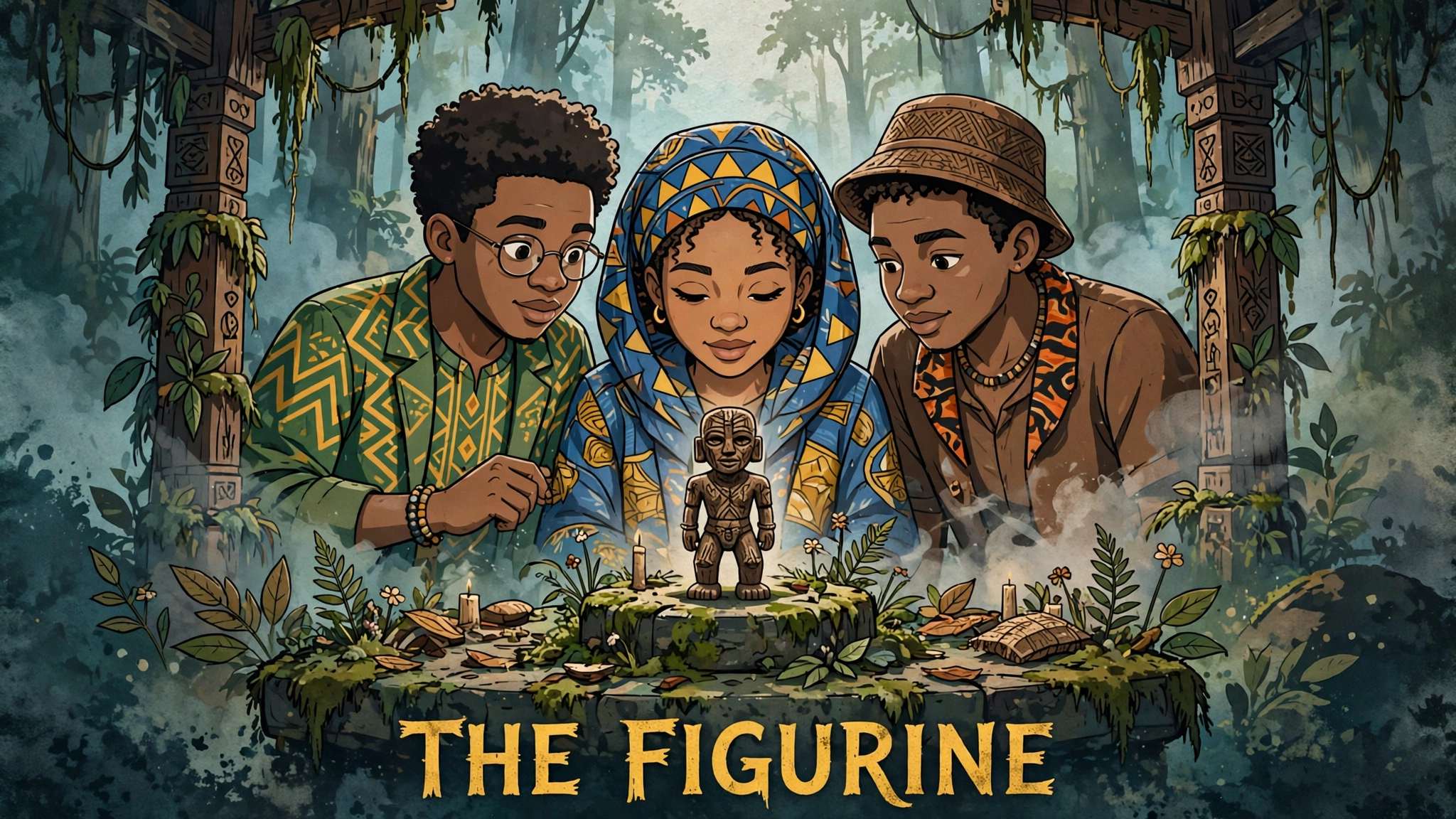
The premise is folklore made flesh. Two friends on National Youth Service discover a carved figurine in an abandoned shrine in the forest. The sculpture belongs to Araromire, a goddess who grants seven years of good fortune to anyone who encounters her, followed by seven years of bad fortune. One of the friends takes the figurine home. What follows is not a horror film in the conventional sense, but a slow, psychological thriller about success, jealousy and the price of a bargain nobody fully understood.
The Figurine is not flawless. Its second half is less disciplined than its first, and some of its twists depend on the audience accepting a great deal about its characters’ choices. But as a landmark film and as a thriller, it still holds up remarkably well, and its influence on the generation of Nigerian filmmakers who followed it is impossible to overstate.
| Detail | Information |
|---|---|
| Release date | 2009 (premiered at the Rotterdam International Film Festival; Nigerian theatrical release 2 October 2009) |
| Director | Kunle Afolayan |
| Writers | Kemi Adesoye; story by Kunle Afolayan and Giovanni Durojaiye (Jovi Babs) |
| Genre | Supernatural, Thriller, Drama |
| Language | English, Yoruba |
| Runtime | 122 minutes (some listings give 120 minutes) |
| Budget | ₦50–70 million (sources conflict; see Box Office section) |
| Lead cast | Ramsey Nouah, Kunle Afolayan, Omoni Oboli, Funlola Aofiyebi |
| Our rating | 8.0/10 |
Femi and Shola are friends serving in the National Youth Service Corps, posted to a camp near a village with a long and uneasy history. On an endurance trek through the forest, they stumble on an abandoned shrine and, inside it, a carved figurine of striking, unsettling beauty. Against his friend’s better judgement, Shola takes it home.
The film then follows the two men across years rather than days. Their lives improve dramatically: careers take off, money arrives, and success that once seemed distant becomes routine. At the centre of their story is Mona, a woman both men care about in very different ways, and the film is as much a love triangle as it is a supernatural tale. Femi watches, quietly and obsessively, as Shola builds the life Femi believes should have been his. Mona, meanwhile, is no passive prize: she makes choices, keeps secrets and pushes back, and Omoni Oboli’s performance makes sure the audience never forgets it.
The bargain, of course, has a second half. Seven good years are followed by seven bad ones, and the film’s tension comes from watching two men who have built everything on borrowed luck begin to sense the ground shifting beneath them. This review will not reveal how the reckoning arrives, or who understands it first. The pleasure of The Figurine is in its slow dread, and its final act should be experienced without foreknowledge.
Ramsey Nouah as Femi — Nouah gives the film’s most quietly disturbing performance. His Femi is charming and controlled on the surface, but the film keeps showing the audience the calculation underneath: the long silences, the looks that last a fraction too long, the politeness that never quite warms. It is a portrait of obsession that never shouts, and it is all the more unsettling for it. Nouah won the Africa Movie Academy Award for Best Actor for this role, and the award was deserved.
Kunle Afolayan as Shola — Afolayan, directing himself, plays Shola as an ordinary man who mistakes luck for talent. He is likeable, impulsive and blind to the forces around him, and Afolayan’s performance is deliberately less showy than Nouah’s, which is exactly right: Shola is the man who does not see the trap because he is too busy enjoying the bait. That Afolayan could direct a film of this polish while carrying one of its lead roles is itself a remarkable achievement.
Omoni Oboli as Mona — Oboli’s Mona is the film’s revelation for many viewers, and the role changed her career. She plays Mona as intelligent, sensual and morally complicated, a woman who knows she is desired and refuses to be reduced to that fact. Her scenes with both men crackle, and the film is at its best when it lets her drive a scene rather than merely react to one. It is easy to see why this performance made her one of Nollywood’s most sought-after actors.
Funlola Aofiyebi and the supporting cast — Aofiyebi provides the film’s comic relief, and contemporary reviews singled her out for a performance that is funny without ever breaking the film’s tension. The supporting cast, including Femi Adebayo and Wale Ojo, gives the world around the triangle texture and credibility, from village elders to Lagos business circles.
The most important thing to understand about The Figurine is how deliberately it was made. Afolayan and his scriptwriter spent nine months finalising the script after a five-year development process, and the film was shot over three months in Lagos and Osun states, an unusually long schedule for Nollywood at the time. That patience shows in every department. Yinka Edward’s cinematography won the Africa Movie Academy Award, and it deserves to have done so: the forest sequences are genuinely eerie, the Lagos scenes are sleek without being glossy, and the film’s colour palette darkens almost imperceptibly as the good years curdle.
The visual effects, which also won at the Africa Movie Academy Awards, are modest by Hollywood standards but ambitious for their context, and they are used sparingly. Afolayan understands that a figurine is frightening not because of what it does on screen, but because of what the characters believe it can do. The sound design, too, is more careful than the video-film norm of the era, with silence and ambient forest sound doing much of the work that a louder score would have done crudely.
The film’s weakness is structural. The first half, with its folklore setup and slow build, is superb. The second half, which must juggle the love triangle, the supernatural reckoning and a series of revelations, occasionally loses its grip, and at least one major turn depends on a character behaving in a way that feels driven by the plot rather than by psychology. At 122 minutes, the film also has a few passages that could have been tightened. These are real flaws, but they do not undo the achievement.
The Figurine does not rely on a hit soundtrack in the way many Nollywood films of the period did, and that restraint is a strength. Its score is atmospheric rather than melodic: low drones, forest sounds, and music that swells only when the supernatural pressure becomes undeniable. The bilingual texture of the film — Yoruba spoken in private, English in formal settings — is itself a kind of music, and contemporary critics praised it for realism: this is how many Nigerians actually move between languages in daily life.
Where songs do appear, they are placed to mark the passage of time and the rise of the characters’ fortunes, so that prosperity itself begins to sound slightly hollow. It is a subtle piece of scoring, and it supports the film’s central idea: that good fortune, when it arrives too easily, starts to feel like something borrowed.
What we loved:
What could be better:
The Figurine arrived at a moment when Nigeria had only a handful of functioning cinemas, mostly in Lagos, which makes its commercial performance more impressive than its raw numbers might suggest. It grossed approximately ₦30 million domestically, a figure reported consistently across sources, and at the time that made it the highest-grossing Nollywood film in cinemas. The film also recouped further money through international screenings, rented-hall showings in Nigerian cities and schools, and festival exposure.
Its budget is where sources conflict, and honesty requires saying so. Contemporary reporting put the budget at ₦50 million, while later reference sources give a range of ₦50–70 million, and one retrospective account converts the budget to roughly US$330,000. Those figures are broadly consistent in scale — a large budget by Nollywood standards of 2009 — but they do not agree precisely, so this review quotes the ₦50–70 million range rather than pretending to a certainty the sources do not support. Against a domestic gross of about ₦30 million, the film’s importance was never purely in its theatrical profit: it proved that a Nigerian film made to international technical standards could command critical respect, festival attention and a theatrical audience, and that proof changed what investors and filmmakers attempted next.
Yes, especially if you want to understand modern Nollywood. The Figurine is not just a good thriller; it is a hinge in an industry’s history, the film that showed Nigerian cinema could be patient, polished and psychologically ambitious. Its flaws are real, but they are the flaws of a film reaching beyond what its industry had previously attempted. Watch it for Nouah’s performance, for Oboli’s breakthrough, and for the slow, queasy feeling of watching good luck turn.
Our rating: 8.0/10 — The supernatural thriller that helped reinvent Nollywood.
What is The Figurine about?
Two friends find a figurine of the goddess Araromire in a forest shrine. It brings seven years of good fortune, followed by seven years of bad fortune, and the film follows their success, rivalry and reckoning.
Who directed The Figurine?
Kunle Afolayan produced and directed it, and also stars as Shola, opposite Ramsey Nouah as Femi and Omoni Oboli as Mona.
What does Araromire mean?
Araromire is the name of the goddess to whom the figurine belongs in the film’s folklore, a figure associated with the cycle of fortune and misfortune.
Did The Figurine win awards?
Yes. It received ten nominations at the 6th Africa Movie Academy Awards and won five, including Best Picture, Best Nigerian Film, Best Cinematography and Best Visual Effects.
Where can I watch The Figurine?
It has been available on streaming and digital platforms in various regions, though availability changes over time, so check your local platforms.