★ LATEST REVIEWS

★★★☆☆ Our Rating: 6.5/10
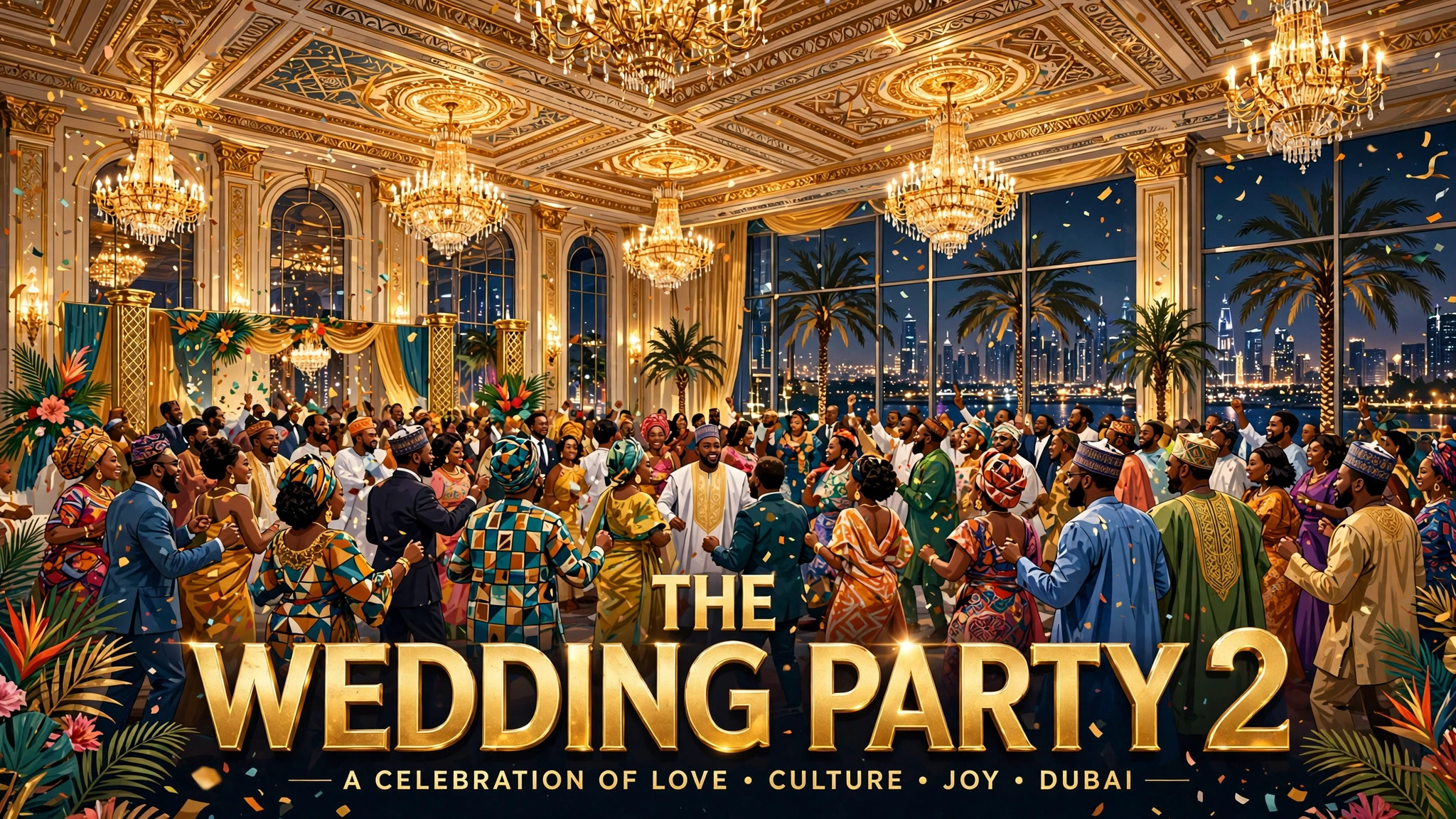
In December 2016, The Wedding Party changed what Nollywood believed about itself. Kemi Adetiba’s romantic comedy about one chaotic Lagos wedding day became the first Nigerian film to pass ₦400 million at the domestic box office, and a sequel stopped being a possibility and became an obligation. One year later, almost to the week, the ELFIKE collective — EbonyLife Films, FilmOne, Inkblot Productions and Koga Studios — delivered The Wedding Party 2: Destination Dubai, directed this time by Niyi Akinmolayan, written by Naz Onuzo, and built on a simple, expensive idea: take everything audiences loved, and fly it to Dubai.
The gamble worked commercially beyond argument. The sequel opened on 15 December 2017 with a reported ₦73 million in its first three days — at the time the biggest opening weekend in Nigerian box-office history, Nollywood or Hollywood — and went on to become, briefly, the highest-grossing Nigerian film ever made. Whether it deserved to is a harder question, and this review will ask it honestly. The short version: the party is still fun, the cast is still a joy, and the gloss is unmatched in Nigerian cinema of its era. But the freshness of the first film — one day, one venue, one escalating disaster — has been traded for scale, and scale, it turns out, was never really the point.
A word on numbers before the Quick Facts, because this film needs it. Every figure attached to The Wedding Party 2 — its ₦300 million production cost, its box-office totals — comes from producers and Nigerian trade and press reporting. Nigerian box-office data of this period was not independently audited. We report the figures as they were reported, flag the places where they conflict, and treat the record-breaking shape of the run, which no source disputes, as the reliable fact.
| Detail | Information |
|---|---|
| Release date | 15 December 2017 (Nigeria) |
| Director | Niyi Akinmolayan |
| Writers | Naz Onuzo (screenplay) |
| Genre | Romantic Comedy, Drama |
| Language | English, Yoruba, Igbo |
| Runtime | 97 minutes (some listings give longer figures) |
| Budget | ₦300 million (producer-reported, excluding publicity — see box-office section) |
| Lead cast | Enyinna Nwigwe, Daniella Down, Adesua Etomi, Banky Wellington, Sola Sobowale, Alibaba Akpobome, Richard Mofe-Damijo, Iretiola Doyle, Somkele Iyamah-Idhalama, Patience Ozokwor |
| Our rating | 6.5/10 |
The first film married Dunni Coker (Adesua Etomi) to Dozie Onwuka (Banky Wellington) amid glorious chaos. The sequel promotes the supporting couple. Dozie’s elder brother Nonso (Enyinna Nwigwe) has continued his romance with Deirdre Winston (Daniella Down), Dunni’s bridesmaid from London, and on a dinner date in Dubai he proposes — by accident, fumbling a ring meant for someone else’s moment into a proposal Deirdre joyfully accepts before he can explain. It is the film in miniature: charming, contrived, and powered entirely by nobody saying the sensible thing at the sensible time.
Neither family is pleased. Deirdre’s upper-class British parents regard a Nigerian son-in-law with barely veiled horror, while parts of the Onwuka clan — led by Nonso’s formidable aunt Ada (Patience Ozokwor) — return the prejudice with interest. A traditional engagement ceremony in Lagos goes so badly that relocation becomes diplomacy: both families reluctantly agree the wedding itself will happen in Dubai, neutral, glittering and very far from home. What follows is the expected and largely enjoyable machinery — culture clashes, meddling relatives, exes and opportunists, a best man and maid of honour (Somkele Iyamah-Idhalama’s Yemisi and Ikechukwu’s Sola) generating their own sparks, and two matriarchs, Sola Sobowale’s Tinuade Coker and Iretiola Doyle’s Lady Obianuju Onwuka, holding their families together by force of personality.
We will not spoil the wedding-day complications or the ending, though anyone who has seen the first film can guess the destination; the pleasure here is entirely in the route. It should be said plainly, though, that the route is thinner this time. The first film’s single-day pressure cooker turned every subplot into rising steam. Spread across two countries and many days, the sequel’s episodes sit side by side rather than building, and the film must keep inventing fresh friction — a lost ring here, a relative there — because its premise generates less of its own.
Enyinna Nwigwe as Nonso steps up from support to lead with ease — handsome, flustered, decent to a fault — and he and Daniella Down as Deirdre make an appealing couple, even if the script gives Deirdre determination as a substitute for depth. Their romance is sweet; it is rarely, as Dunni and Dozie’s was, funny in itself, and the film knows it, surrounding them with louder people whenever the energy dips.
The louder people deliver. Sola Sobowale as Tinuade Coker remains this franchise’s MVP: a full-body performance of maternal ambition, wounded pride and sudden, floor-filling dance joy, capable of turning a line of dialogue into a national catchphrase. Iretiola Doyle as Lady Obianuju answers her with patrician ice, and their rivalry continues to be the most reliably entertaining relationship in the series. Patience Ozokwor as Aunt Ada imports her legendary screen menace into comedy — her disapproval is a weather event — while Richard Mofe-Damijo and Alibaba Akpobome as the two fathers supply warmth and dry exasperation in roughly inverse proportions.
Adesua Etomi and Banky Wellington, now married in the film and — in a publicity gift no marketer could buy — married in real life just weeks before the sequel’s release, are charming in reduced roles, though the film underuses the chemistry that powered the original. The cameo bench is deep to a fault: Chigul, Seyi Law, Afeez Oyetoro and Chiwetalu Agu all swing by, some landing real laughs, others arriving as celebrity sightings rather than characters. It is a cast that could carry a better film, and frequently carries this one.
Niyi Akinmolayan, one of Nollywood’s most technically reliable directors, takes over from Kemi Adetiba and makes a shinier, more mobile film. Cinematographer Malcolm McLean shoots Dubai the way Dubai pays to be shot — marina, desert, five-star marble — and Lagos with matching gloss, so the sequel genuinely looks like the most expensive Nigerian production of its moment. The traditional engagement sequence, all colour, costume and choreography, is the film’s visual peak and a small landmark of Nigerian production design on screen.
What Akinmolayan cannot fully solve is structure. Editor Victoria Akujobi keeps individual scenes brisk, but the film’s middle is a necklace of incidents rather than a tightening chain, and the ending, when it comes, resolves threads the audience had stopped worrying about an hour earlier. Contemporary Nigerian reviewers noted continuity wobbles and a finale that felt anticlimactic, and those criticisms stand. There is also a tonal choice worth naming: the culture-clash comedy between the Winstons and the Onwukas brushes against real prejudice — on both sides — and the film repeatedly reaches for the laugh where the first film, for all its lightness, occasionally reached for the feeling. Nothing here is sour or mean-spirited; it is simply safer, and safety is a strange quality for a record-breaking blockbuster to be remembered for.
Music is credited to Dr. Bayo Adepetun, and the soundtrack continues the franchise’s formula: contemporary Nigerian pop woven through the parties, ceremonies and travel montages, with score cues keeping the romantic machinery warm underneath. As in the first film, the music’s real function is celebration — the traditional engagement and wedding sequences are staged almost as music videos, and they are the scenes audiences carried out of the cinema. The song selection was singled out for praise even by several of the film’s tougher reviewers, and fairly so: if you want a two-hour advertisement for the Nigerian wedding-industrial complex at its most joyful, this soundtrack is the showroom. Original score, as a dramatic instrument, matters less here than curation — which suits a film whose best moments are parties.
What we loved:
What could be better:
Here is what was reported, and by whom. Producer Mo Abudu announced an opening weekend of over ₦73 million in three days from 15 December 2017 — reported at the time by Vanguard and the News Agency of Nigeria as the highest opening weekend ever at the Nigerian box office for any film, doubling the ₦36 million the first film had opened with. In January 2018, Vanguard reported the producers’ figures for the full run: a production cost of ₦300 million excluding publicity, and a gross of over ₦500 million within six weeks, which made it, on those figures, the highest-grossing Nollywood film of all time to that date — overtaking its own predecessor.
The asterisk, stated plainly: other widely used listings of highest-grossing Nigerian films put the film’s total at about ₦433 million rather than ₦500 million-plus. The two figures cannot both be exact; they likely reflect different snapshots, different treatment of the run’s tail, or producer-versus-exhibitor accounting. Nigerian box-office figures of this era are press- and trade-reported, not independently audited, and we present the ₦433–500 million range rather than pretend to a precision the sources do not support. What is not in dispute is the shape of the achievement: the biggest opening in Nigerian history at the time, a run at or near the top of the all-time domestic chart, and proof — for the second December in a row — that a glossy Nigerian romantic comedy, released for the holidays and marketed like an event, could out-draw Hollywood on home soil. Later films, Omo Ghetto: The Saga and beyond, have since pushed the ceiling far higher, which is itself part of this film’s legacy: it helped build the ceiling they broke.
Yes, with expectations set correctly. Watch The Wedding Party 2 as a celebration rather than a story: for the matriarchs, the engagement sequence, the clothes, the music and the sight of Nollywood operating at full blockbuster confidence. Do not watch it expecting the first film’s freshness or focus — this is a victory lap, beautifully dressed, that runs about fifteen minutes longer than its plot. As a document of the moment Nigerian cinema learned to think in franchises and nine figures, it is essential. As a romantic comedy, it is a pleasant, glossy, slightly padded evening.
Our rating: 6.5/10 — the party is still worth attending; the sequel simply proves the first invitation was the special one.
Do I need to watch The Wedding Party (2016) before this sequel?
Strongly recommended. The sequel assumes you know Dunni and Dozie, both families and the Nonso–Deirdre spark, which was set up in the first film. It is also, frankly, the better movie — watch it first and enjoy this one as a reunion.
Is The Wedding Party 2 really the highest-grossing Nollywood film ever?
It was reported as such in early 2018, on producer-reported figures of over ₦500 million; other listings put its total nearer ₦433 million. Either way it held the all-time domestic record for a time. It has since been overtaken several times over as the Nigerian box office has grown.
Why do the box-office figures for this film differ between websites?
Because Nigerian box-office reporting of the period relied on producer and distributor announcements and trade compilations rather than a single audited source. We therefore give the ₦433–500 million reported range and flag its sources, rather than choosing one number and pretending it is exact.
Is The Wedding Party 2 suitable for family viewing?
Yes — it is a mainstream romantic comedy built around family, ceremony and celebration, with mild innuendo and no content likely to trouble a general audience. It is designed, deliberately, as a film the whole extended family can attend together, which was part of its box-office strategy.
Where can I watch The Wedding Party 2: Destination Dubai?
The film has circulated on streaming platforms carrying EbonyLife and Nollywood catalogue titles, and on disc and television in Nigeria and the diaspora. Availability changes by country, so check your local services.