★ LATEST REVIEWS

Our Rating: ★★★★★ 9.0/10
The title is a piece of grim arithmetic. In Iran, the film’s final accounting suggests, the number of drug addicts rose from one million to 6.5 million despite decades of arrests, raids and executions. Law of Tehran, known in Iran as Just 6.5 (Persian: Metri Shesh-o Nim, literally “six and a half metres”), takes that statistic as both its title and its argument: a drug war fought with maximum force and minimum effect, told through a detective, a kingpin and a system that consumes everyone who touches it.
Written and directed by Saeed Roustayi, the film premiered at the Fajr Film Festival in early 2019, opened the Zurich Film Festival, played in the Horizons section at Venice, and became one of the biggest Iranian box-office hits of its era, breaking records for a non-comedy film. It is a crime thriller of extraordinary intensity, a procedural that follows a narcotics investigation from street raids to interrogation rooms to courtrooms, and a work of social criticism that never needs to raise its voice to be heard.
If Leila’s Brothers is Roustayi’s family epic, Law of Tehran is his genre masterpiece: faster, harder and more propulsive, but no less serious. It is one of the finest crime films of the last decade, from any country.
| Detail | Information |
|---|---|
| Release date | 2019 (Fajr Film Festival premiere; Iranian theatrical release March 2019) |
| Director | Saeed Roustayi |
| Writers | Saeed Roustayi |
| Genre | Crime, Thriller, Drama |
| Language | Persian |
| Runtime | 131 minutes (some listings give 134–135 minutes) |
| Lead cast | Payman Maadi, Navid Mohammadzadeh, Parinaz Izadyar, Farhad Aslani, Houman Kiai |
| Our rating | 9.0/10 |
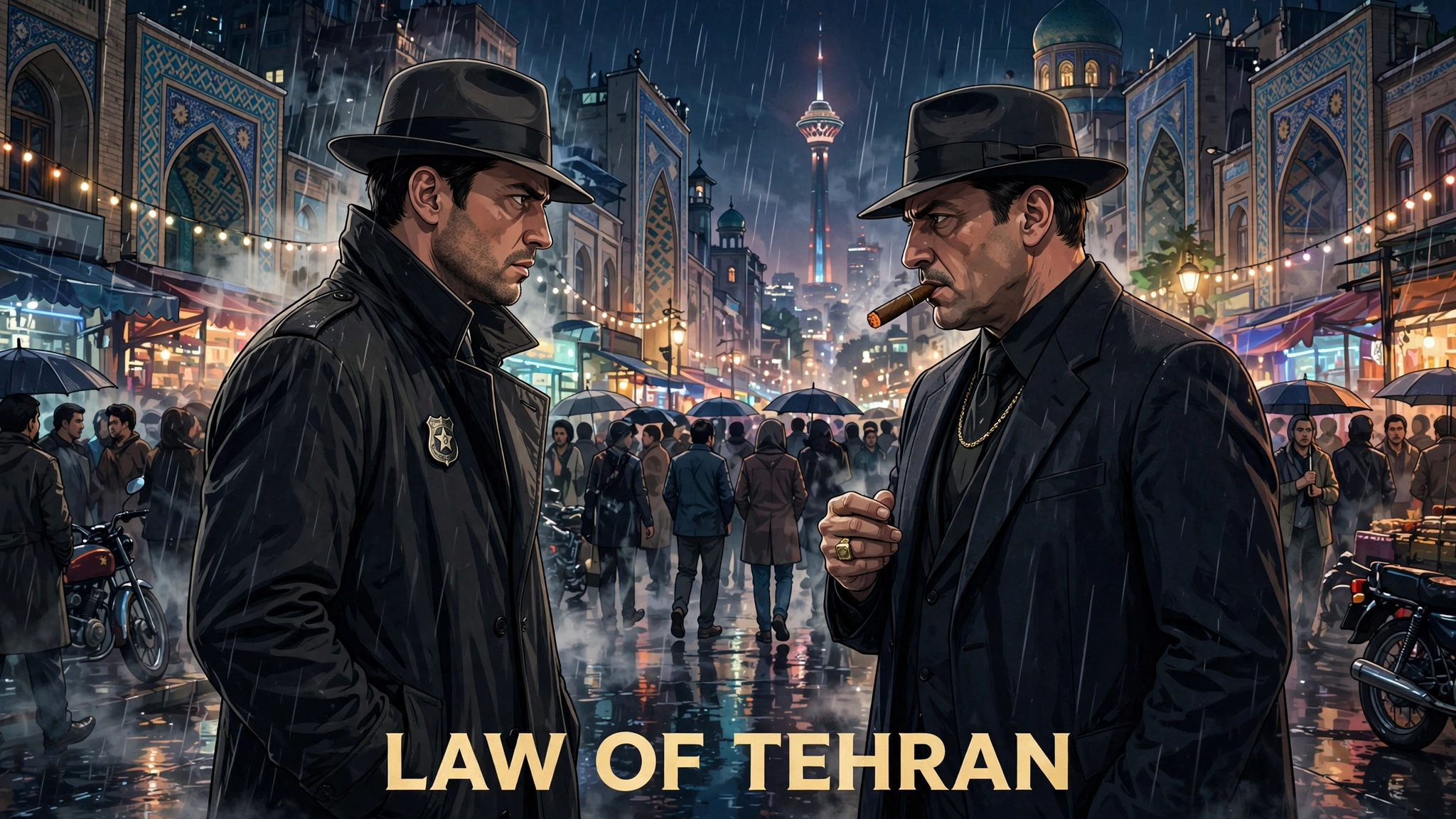
Tehran, as Roustayi films it, is a city brimming with drug users, many of them homeless, many of them young, all of them caught in a trade that the state has spent decades trying to crush. At the centre of the enforcement effort is Samad, a narcotics detective played by Payman Maadi: tough, sarcastic, relentless, and convinced that the only way to win a drug war is to arrest everyone in sight. After a series of operations that go wrong in different ways, Samad becomes obsessed with tracking down Nasser Khakzad, a shadowy drug kingpin played by Navid Mohammadzadeh, whose network seems to touch every corner of the city.
The film follows Samad’s investigation as a procedural in the fullest sense. There are street raids that descend into chaos, mass arrests that fill prisons beyond capacity, interrogations in which Samad uses charm, sarcasm and intimidation in equal measure, and a slow climb up the chain from low-level dealers toward the man at the top. Along the way, the film introduces the people caught between cop and kingpin: dealers’ families, girlfriends, addicts, prison guards, and a judge who must decide what justice means in a system built on punishment.
This review will not reveal whether Samad catches Khakzad, or what happens when the two men finally confront each other, because the film’s second half turns on that confrontation and on the moral questions it raises. It is enough to say that Roustayi does not give the audience a simple hero and villain. Samad and Khakzad are both products of the same broken system, and the film’s power lies in watching each man discover that uncomfortable truth.
Payman Maadi as Samad — Maadi, known internationally from A Separation, gives a towering performance as a detective who is both compelling and appalling. His Samad is funny, in a dark and sarcastic way, and he is also terrifying: a man who terrorises suspects, bends rules without hesitation, and believes his own brutality is justified by results. Maadi never asks the audience to like Samad, but he makes him impossible to look away from, and the film’s moral complexity depends entirely on that balance. As Samad’s certainty begins to crack, Maadi lets the cracks show in small, devastating ways: a pause, a look, a joke that does not quite land.
Navid Mohammadzadeh as Nasser Khakzad — Mohammadzadeh is Samad’s equal and opposite: charismatic, intelligent and, in his own way, as trapped as the detective hunting him. His Khakzad is not a cartoon kingpin but a young man who built an empire out of a broken society’s failures, and Mohammadzadeh plays him with a mixture of arrogance and vulnerability that makes the audience understand, without ever condoning, how he got there. The scenes between Maadi and Mohammadzadeh are the film’s high points: two superb actors playing two men who recognise something of themselves in each other.
Parinaz Izadyar as Elham and the ensemble — Izadyar, as a woman connected to Khakzad’s world, gives a performance of quiet dignity in a film dominated by male aggression, and her scenes provide some of its most human moments. Farhad Aslani, as a judge, brings moral weight to the courtroom sequences, while Houman Kiai, as Samad’s deputy Hamid, gives the detective’s team a human face and a personal stake in the investigation. The vast supporting cast of prisoners, dealers and addicts is directed with documentary-like attention, so that the film’s crowd scenes feel like a real city rather than a collection of extras.
Roustayi’s direction is propulsive without ever being merely frenetic. The opening raid sequence is one of the great set pieces of recent crime cinema: a handheld, breathless descent into a Tehran neighbourhood, with police and suspects colliding in narrow passages, stairwells and courtyards, shot by cinematographer Hooman Behmanesh in natural light that makes every barrier, gate and wall feel like part of the trap. From there, the film settles into a procedural rhythm — raids, interrogations, prison scenes, courtrooms — that never loses momentum, even as it accumulates moral weight.
The prison sequences deserve particular mention. Roustayi films overcrowded cells with a claustrophobic intensity that makes the audience feel the system’s logic: arrest everyone, sort it out later, and watch the problem grow anyway. The editing by Bahram Dehghan sustains a film of more than two hours without a wasted scene, and the sound design — shouting, doors, crowds, silence — gives Tehran a sonic texture that is as important as its visual one.
The film’s one weakness, if it can be called that, is that its moral argument occasionally outruns its thriller mechanics. A few scenes in the second half pause the investigation to make a point about the drug war’s futility, and while those points are valid and powerfully made, they briefly slow the propulsive energy that makes the first half so gripping. It is a minor complaint about a film that otherwise balances genre excitement and social criticism as well as any crime film in recent memory.
The score by Peyman Yazdanian is tense, minimal and effective, favouring low drones and percussive tension over melody. It does not try to make the raids exciting in a Hollywood sense; instead, it makes them feel relentless, which is closer to the truth of the film’s argument. In the interrogation and courtroom scenes, the music often drops away entirely, leaving only voices, silence and the sound of a room, and that restraint gives the dialogue — sharp, funny and brutal by turns — room to do its work.
Like Leila’s Brothers, this is a film whose real score is human: the overlapping shouts of a raid, the murmur of a prison, the sarcasm of a detective who has heard every lie before. Yazdanian’s music supports that soundscape without competing with it, and the result is a thriller that feels grounded rather than scored.
What we loved:
What could be better:
Law of Tehran was a phenomenon in Iran. Contemporary reporting recorded that it earned around 250 billion rials during its theatrical run, making it, at the time, the best-selling non-comedy film in the history of Iranian cinema. That figure should be read with the usual caution about Iranian box-office reporting and about currency values in a period of high inflation, but the scale and the record are consistently reported, and the film’s status as a domestic blockbuster is not in doubt.
No reliable production-budget figure for the film could be verified for this review, so no budget number is quoted here. What matters more than the budget is what the box office proved: that a serious, politically sharp crime thriller could outdraw comedies and become a national talking point. The film’s festival journey — Fajr, where it won the Crystal Simorgh for Audience Choice of Best Film, Venice, Zurich, Tokyo and Stockholm — confirmed that its appeal was not only domestic. It remains one of the most successful Iranian films ever made, commercially and critically, and its later release under the title Law of Tehran on digital platforms in the UK, US and Canada introduced it to a new international audience.
Yes, without reservation. Law of Tehran is a great crime thriller and a great work of social criticism, and it manages to be both at the same time without compromising either. It is intense, it is funny in dark places, and it will leave you thinking about drug policy, punishment and the systems that claim to protect us long after the credits. If you liked A Separation, if you like crime procedurals, or if you simply want to see what Iranian cinema can do at its most ambitious, this is essential viewing.
Our rating: 9.0/10 — A blistering crime epic that asks whether a drug war can ever be won, and answers with devastating clarity.
Is Law of Tehran the same film as Just 6.5?
Yes. Just 6.5 (Persian: Metri Shesh-o Nim) is the original title; Law of Tehran is the title used for its English-language digital release.
Who directed Law of Tehran?
Saeed Roustayi, who also wrote the film.
Who stars in Law of Tehran?
Payman Maadi as detective Samad and Navid Mohammadzadeh as drug kingpin Nasser Khakzad, with Parinaz Izadyar, Farhad Aslani and Houman Kiai in support.
How long is Law of Tehran?
131 minutes according to most listings, though some give 134–135 minutes, reflecting different versions and listings.
Where can I watch Law of Tehran?
It has been available on digital purchase and rental platforms in the UK, US and Canada, and on streaming services in various regions, though availability changes over time, so check your local platforms.