★ LATEST REVIEWS

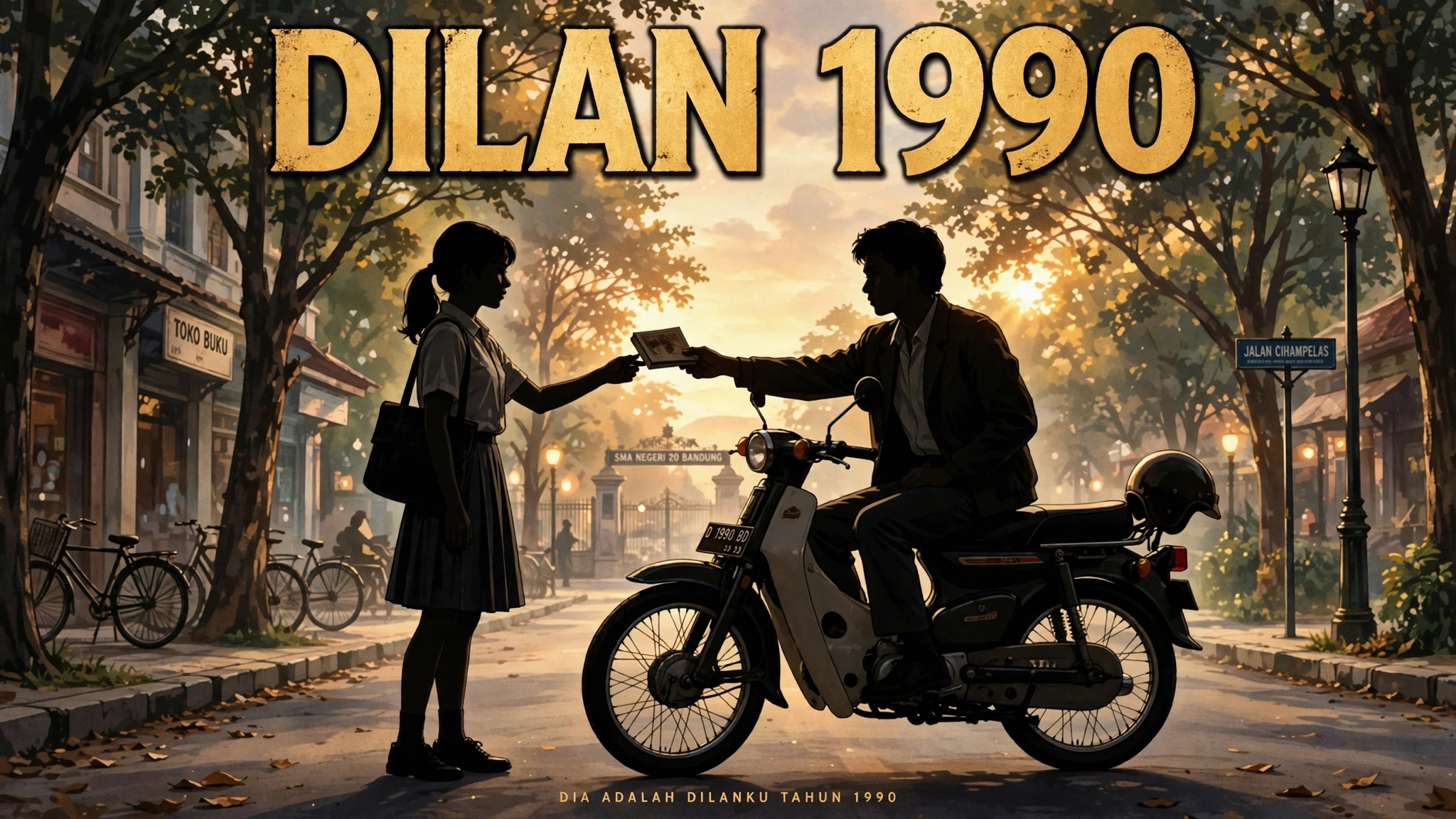
# Dilan 1990 (2018) Review – The Bandung Love Letter a Generation Memorised**★★★★☆ Our Rating: 7.5/10**There is a particular kind of film whose plot you could summarise on a postcard, and whose effect on its audience you could not explain in a book. *Dilan 1990* is that film. A new girl arrives at a Bandung high school. The school’s most notorious boy — bright, poetic, and the so-called war chief of a motorbike gang — tells her, on first meeting, that she will one day ride home with him as his girlfriend. She laughs him off. He spends the rest of the film, patiently and with outrageous confidence, being right. That is almost the whole story, and in early 2018 it became the story Indonesia could not stop quoting.This Dilan 1990 review tries to judge both halves of that equation honestly: the phenomenon, which is real and remarkable, and the film itself, which is charming, beautifully cast and considerably slimmer than its reputation. Adapted from Pidi Baiq’s bestselling 2014 novel *Dilan: Dia adalah Dilanku Tahun 1990* — itself drawn from the author’s much-retold memories — the film arrived carrying a readership that already knew Dilan’s lines by heart. What directors Fajar Bustomi and Pidi Baiq, the author himself, had to deliver was not surprise. It was recognition: Bandung in 1990, exactly as a generation remembered or wished it had been.Our assessment, up front: as a piece of storytelling, this is a gentle, episodic courtship with a wobbly gang subplot and very little conventional conflict. As a cultural time capsule and a star-making romance, it is close to perfect for its audience — and the chemistry between its two young leads is strong enough that most viewers, Indonesian or not, will understand exactly why 6.3 million people bought a ticket.## Quick Facts: Dilan 1990 at a Glance| Detail | Information ||—|—|| Release date | 25 January 2018 (Indonesia) || Director | Fajar Bustomi, Pidi Baiq || Writers | Pidi Baiq, Titien Wattimena (based on the novel by Pidi Baiq) || Genre | Romance, Coming-of-Age Drama || Language | Indonesian || Runtime | 110 minutes || Budget | Rp 11 billion (reported figure, approx. US$0.78 million) || Lead cast | Iqbaal Ramadhan, Vanesha Prescilla, Sissy Priscillia (narrator), Debo Andryos, Giulio Parengkuan, Omara Esteghlal, Brandon Salim || Our rating | 7.5/10 |## The Story: A Prediction, a Motorbike and a Long Courtship (Spoiler-Free)The film is framed as memory. An adult Milea (voiced and narrated by Sissy Priscillia) looks back on 1990, the year her family moved from Jakarta to Bandung and she started at a new school as a bright, self-possessed sixteen-year-old. Walking to school on her first morning, she is intercepted by Dilan (Iqbaal Ramadhan), a classmate she has never spoken to, who greets her by name, tells her where she lives, and calmly predicts their future together. Most screen heroes would be reported to a teacher. Dilan, somehow, gets away with it — partly because he is funny, and partly because the film is honest that Milea is intrigued from the first minute, however hard she pretends otherwise.What follows is less a plot than a campaign. Dilan courts Milea with the tools of 1990: landline phone calls that tie up the family line, small gifts, crossword puzzles, poems, and appearances at her gate on his motorbike. Complications exist at the edges. Milea still has a boyfriend in Jakarta, Benni (Brandon Salim), whose phone manner curdles from possessive to ugly. Dilan’s life has a second compartment Milea only gradually sees: he is a senior figure — a “panglima tempur,” a battle commander — in a motorbike gang, in a city and era where rival school gangs fought real, sometimes dangerous street battles. Her private tutor, Kang Adi (Refal Hady), quietly hopes to become something more than a tutor. And Milea’s father, an army colonel (Farhan), watches the motorbike at his gate with entirely reasonable suspicion.The film resolves these threads in its own unhurried way, and we will not map the final stretch here. It is enough to say the ending delivers the emotional confirmation the whole film has been promising, while leaving the gang question — the one genuinely adult problem in Dilan’s life — only partly settled, which is precisely what the sequel, *Dilan 1991*, was made to argue about.## Performances: Two Star-Making Turns**Iqbaal Ramadhan as Dilan** carries the film, and knows it. A former child star from the boy band Coboy Junior, Iqbaal was a risky piece of casting on paper — Dilan needed to be dangerous enough to lead a gang and gentle enough to write poems — and the gamble is the film’s masterstroke. He plays Dilan’s famous confidence as softness rather than swagger: the lines that became national catchphrases work because he delivers them quietly, smiling, as if stating the weather. Crucially, he never begs for the audience’s approval. When the script asks Dilan to be unreasonable — jealous, reckless, proud — Iqbaal lets him be those things, and the character stays human instead of hardening into a poster.**Vanesha Prescilla as Milea** had the harder, less showy job, and in her feature debut she is quietly excellent. Milea is our narrator and our eyes; the entire film is her memory, and Prescilla plays the younger Milea with a scepticism that slowly, visibly thaws. Her best scenes are reactions — listening down a phone line, trying not to smile, deciding to be angry and failing — and the film trusts her face with long stretches of its story. The chemistry between the leads is the real special effect here: unforced, funny and tender in a way Indonesian teen romance rarely permitted itself to be.Around them, **Debo Andryos as Nandan**, Milea’s loyal friend, and **Giulio Parengkuan as Anhar**, the gang member whose volatility causes the story’s sharpest rupture, do strong work in small spaces. **Brandon Salim as Benni** is effective in a deliberately thankless role. The adult world is warmly cast: **Ira Wibowo** as Dilan’s mother brings the film several of its best scenes — her easy, teasing acceptance of Milea tells you everything about where Dilan learned his confidence — while **Happy Salma** and **Farhan** give Milea’s parents a believable mix of strictness and love. A famous cameo from Ridwan Kamil, then the actual Mayor of Bandung, as a teacher is the kind of stunt that should break the spell; in context, it plays as the city itself winking at its own legend.## Direction and Technical CraftCo-directing with the novel’s author is usually a warning sign, and the division of labour here is visible: Pidi Baiq guards the text and the tone, while Fajar Bustomi, an experienced commercial director, supplies the craft. The result is a film that looks considerably more expensive and more considered than its modest budget suggests. Bandung is photographed by Dimas Imam Subhono in warm, slightly hazy light — old streets, schoolyards, modest houses, the famous Asia-Afrika thoroughfare — and the production design performs the film’s central magic trick: a 1990 with no mobile phones, no social media, and courtship conducted at the speed of a shared telephone line. For Indonesian viewers who lived it, this is documentary. For everyone else, it is a handsome period piece.The craft weaknesses are structural rather than visual. The film is episodic to a fault — a chain of charming courtship scenes whose order could often be shuffled without loss — and the gang material, which should supply real stakes, is handled oddly weightlessly until it suddenly isn’t. Fights are hinted at more than dramatised, Dilan’s authority within the gang is asserted rather than shown, and a late confrontation arrives with an abruptness the gentle film around it hasn’t prepared for. Viewers who came for the romance will not mind. Viewers who came for a drama about a boy divided between love and the street will find that film only in outline.## Music and Background ScoreMusic is not decoration in the Dilan universe; it is load-bearing. Andhika Triyadi’s score keeps the period romance afloat with soft, guitar-led warmth, while the songs come largely from The Panasdalam Bank, Pidi Baiq’s own band — a piece of authorial control that pays off, because the music sounds like it was written inside the story rather than licensed onto it. The signature number, “Dulu Kita Masih Remaja” (“Back When We Were Still Teenagers”), became a hit in its own right, and Iqbaal Ramadhan’s own “Rindu Sendiri” gave the star a chart presence alongside the film. Heard today, the soundtrack is inseparable from the film’s nostalgia effect: these are the songs a generation of Indonesian teenagers slow-danced their first love to, and the film knows exactly when to let a track carry a scene instead of dialogue.## What Works and What Doesn’t**What we loved:**- Iqbaal Ramadhan’s Dilan — quiet confidence, real comic timing, and no vanity- Vanesha Prescilla’s debut: the film’s emotional camera, scene after scene- A lovingly recreated 1990 Bandung where courtship runs on landlines and patience- Dialogue lifted from a beloved novel that an entire audience could — and did — quote back- The Panasdalam Bank songs, which turn nostalgia into something you can hum**What could be better:**- The plot is thin and episodic; long stretches are courtship vignettes without escalation- The motorbike-gang world is asserted more than dramatised, so its dangers feel weightless until very late- Benni and Kang Adi are functions more than characters- Readers of the novel will feel the compressions; newcomers may wonder what the fuss is about in the slow middle- The ending defers its hardest question — Dilan versus the gang — to the sequel## Box Office: 6.3 Million Admissions Is the Number That MattersIndonesian box office is tracked honestly in admissions — tickets sold, called *penonton* — and not in officially published grosses, so admissions are the anchor here and dollar figures must be handled with care. On that reliable measure, *Dilan 1990* was a phenomenon: approximately 6.3 million admissions, making it the best-selling Indonesian film of 2018 and, at the time, the second best-selling Indonesian film of all time, behind only *Warkop DKI Reborn: Jangkrik Boss! Part 1* at about 6.8 million. It passed three million admissions within roughly its first week, a speed that announced this was not a normal hit. A worldwide gross of around US$17.6 million is listed by international trackers, but that figure is an estimate built from admissions and ticket-price assumptions rather than an officially reported Indonesian gross, and we present it as such. The reported production budget of Rp 11 billion (roughly US$0.78 million) comes from the film’s standard production listings; against 6.3 million tickets, the conclusion needs no estimate at all — this was one of the most profitable Indonesian films ever made, and it launched a franchise: *Dilan 1991* followed in 2019, with further sequels and spin-offs after it.## Verdict: Should You Watch It?Yes — as long as you know which film you are sitting down to. *Dilan 1990* is not a sweeping drama and does not pretend to be; it is a memory of first love, told at walking pace, in a city and a year its audience wanted to live in again. Judged on sweep, it is slight. Judged on charm, casting, dialogue and sheer cultural electricity, it is one of the defining Indonesian films of its decade — the rare adaptation that made its source novel more famous, its unknown leads into stars, and its hero’s pick-up lines into a national language. Foreign viewers will miss some of the charge that shared memory provides, but the two performances at its centre travel perfectly well.**Our rating: 7.5/10** — a thin story carried by two star-making performances and the most quotable courtship in modern Indonesian cinema.## Frequently Asked Questions**Is Dilan 1990 based on a true story?**It is based on Pidi Baiq’s 2014 novel *Dilan: Dia adalah Dilanku Tahun 1990*, which the author has presented as drawn from real memories and a real Milea from his youth in Bandung. The film follows the novel’s version of events; how literally every scene happened is part of the legend the books and films have built together, rather than a documented record.**Do I need to read the novel before watching Dilan 1990?**No. The film stands alone clearly, and its narration fills in what you need. Readers get an extra layer of pleasure — many of Dilan’s most famous lines are carried over from the book — but newcomers follow the story without any homework.**Is Dilan 1990 suitable for family viewing?**Broadly, yes. It is a chaste, gentle teen romance by design — its period setting and Milea’s narration keep it firmly in sweet rather than steamy territory. Parents should know there are references to school-gang fights and one brief scene of a boy striking a girl, which the film treats as a serious wrong, not a joke.**What should I watch after Dilan 1990?**The direct sequel is *Dilan 1991* (2019), which continues Dilan and Milea’s relationship into its harder chapter, followed by *Milea: Suara dari Dilan* (2020), which retells the story from Dilan’s side. The wider franchise later moves forward in time with new characters and new Dilans.**Why was Dilan 1990 such a huge hit in Indonesia?**A bestselling novel with a devoted readership, dialogue audiences already loved, two perfectly cast young leads, a nostalgic 1990 Bandung setting that older viewers remembered and younger viewers romanticised, and songs that became hits in their own right. Word of mouth turned a modest romance into the best-selling Indonesian film of its year.