★ LATEST REVIEWS

★★★★☆ Our Rating: 8/10
The title translates, roughly, as “a little bit different” — and in an Indonesian market flooded with horror films, Agak Laen understood the assignment literally. Indonesian horror reliably sells tickets, so producer Ernest Prakasa and his young studio Imajinari asked a mischievous question: what if the horror film was also the funniest comedy of the year? The result, released on 1 February 2024, took a premise from the popular Agak Laen podcast — whose four hosts, Bene Dion, Oki Rengga, Indra Jegel and Boris Bokir, play versions of themselves — and turned it into a haunted-house farce with a dead body at its centre and a surprising amount of heart beating underneath the jokes.
The gamble worked beyond anyone’s stated ambitions. The podcasters had once joked about reaching one million viewers. The film passed that in four days, and kept going until more than nine million Indonesians had seen it. This Agak Laen review looks at why: a script that treats its four leads’ real chemistry as its main special effect, a premise that keeps escalating like a good sitcom episode stretched to feature length, and emotional stakes — a dying mother, a wedding, debts, a friend’s last chance — that give the laughter something to hold on to. It is not a flawless film. But it may be the most purely enjoyable Indonesian crowd-pleaser of its decade.
| Release date | 1 February 2024 (Indonesia) |
| Director | Muhadkly Acho |
| Writers | Muhadkly Acho |
| Genre | Horror Comedy |
| Language | Indonesian |
| Runtime | 119 minutes |
| Lead cast | Bene Dion, Oki Rengga, Indra Jegel, Boris Bokir, Tissa Biani, Indah Permatasari, Arie Kriting, Mamat Alkatiri |
| Our rating | 8/10 |
A note on the missing budget row: no production budget for Agak Laen has ever been reliably published. Producer Ernest Prakasa has said it was Imajinari’s most expensive production up to that point, but no figure was given, and we do not print numbers we cannot verify — so the row is omitted rather than guessed.
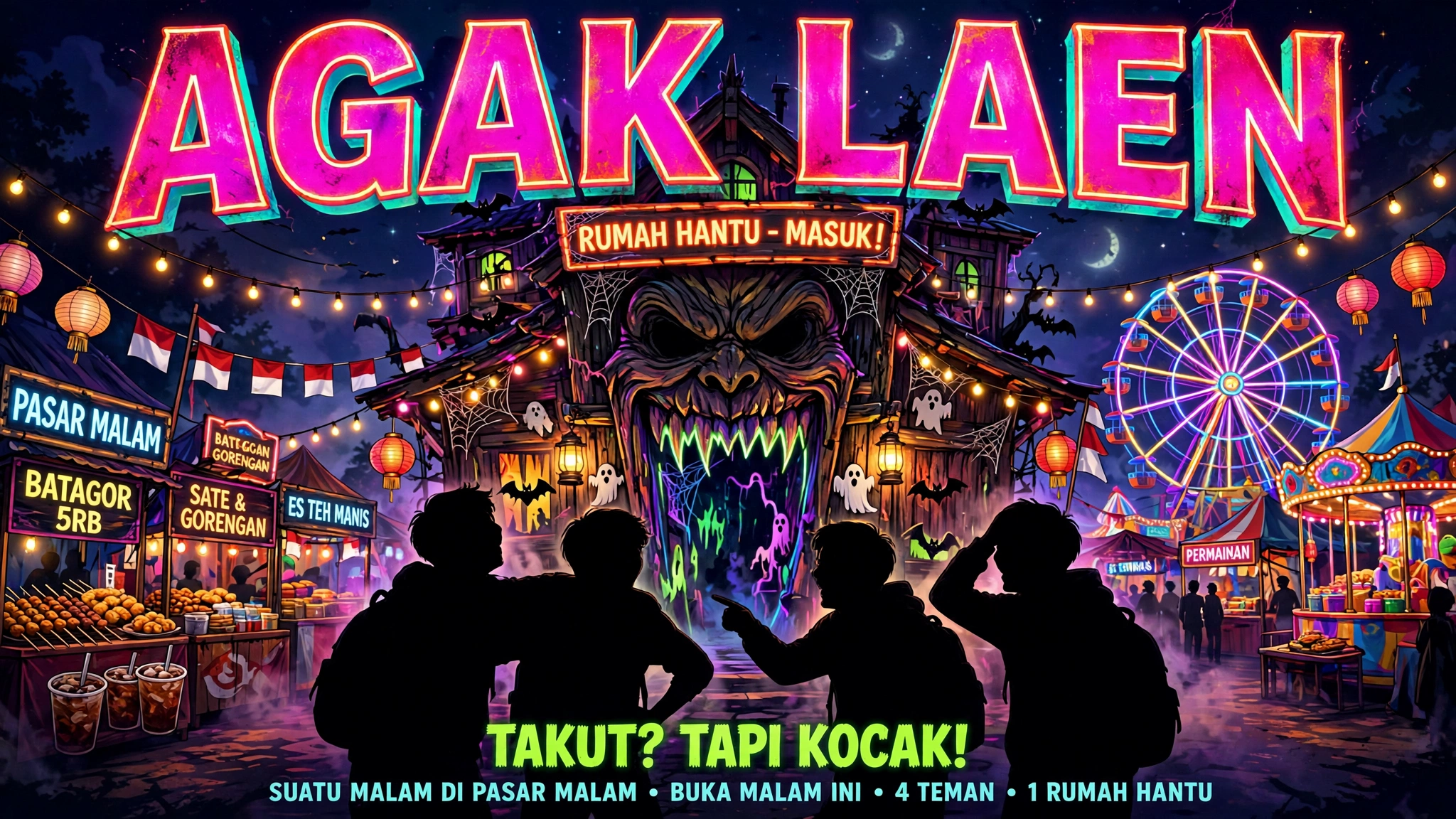
At a struggling night market in West Java, four friends scrape a living running a haunted-house attraction that is failing at the one job it has: nobody is scared. Each of them needs money for reasons that are funny on the surface and quietly sad underneath — Oki, fresh out of prison, is trying to secure medicine and a burial plot for his terminally ill mother; Boris needs the fee to enlist in the army; Bene is saving for his wedding; Jegel is drowning in gambling debts. Their friend Marlina helps keep the ramshackle operation running while their boss Jongki keeps the pressure on.
Then, on the attraction’s desperate relaunch night, the scares finally work — too well. A visitor sneaking through the haunted house to hide an affair suffers a fatal heart attack inside it. Panicked, broke and terrified of the police, the four friends make the worst decision available to them: they bury the body inside the attraction and carry on. What follows is the film’s delicious central joke. The haunted house suddenly becomes genuinely haunted — effects trigger themselves, visitors are terrified, videos go viral, and the attraction the friends could not give away becomes a sensation built, literally, on a secret they have to protect. Police interest, a suspicious widow, a witness who cannot speak and their own spiralling lies tighten the net, while the ghost they accidentally acquired keeps doing their jobs better than they ever could. To say more would spoil a chain of escalations the film has carefully built; the pleasure is watching four idiots dig, in every sense, deeper.
The central quartet — Bene Dion as Bene, Oki Rengga as Oki, Indra Jegel as Jegel and Boris Bokir as Boris — are not, strictly speaking, acting. They are doing on screen what they had already done for years on their podcast: interrupting, insulting and rescuing each other with the rhythm of men who have finished each other’s sentences a thousand times. Director Muhadkly Acho, himself a stand-up comedian, wisely built the screenplay around their established personas rather than against them, in the tradition of Indonesia’s beloved Warkop DKI comedies, whose stars also played named versions of themselves. The result is that rare thing in ensemble comedy: not one of the four is the “funny one.” The comedy lives between them.
Individually, Oki Rengga carries the film’s emotional spine as the ex-convict racing his mother’s illness, and his scenes away from the group reveal a dramatic register the podcast never required. Bene Dion plays the group’s anxious planner with a hangdog decency that makes his wedding subplot land. Indra Jegel is the chaos agent, gifted the film’s broadest physical comedy — including an extended, helpless turn stuck in a pocong costume — and Boris Bokir supplies the bluster and the wounded pride, particularly in his determination to prove himself soldier material.
Around them, Tissa Biani as Marlina (in her second film in this part of our catalogue, after leading KKN di Desa Penari) is the operation’s competent centre, Arie Kriting as Jongki makes the exploitative boss funnier than he has any right to be, and Indah Permatasari as Intan and Arief Didu as Basuki, the ill-fated visitor, handle roles that could have been mere plot devices with real comic timing. Sadana Agung’s nearly wordless turn as Obet, the janitor who saw too much, is a small masterclass in reaction comedy.
Acho directs like a comedian who understands that the camera’s job is to be in the right place before the joke happens. The night-market setting — built from scratch on open land in Depok and shot through the night — gives the film a colourful, slightly unreal world of neon, painted plywood and fairground noise that suits its tone perfectly; cinematographer Arfian leans into the carnival palette rather than draining it for horror. Inside the haunted house, the film plays fair with its scares: the same corridors are funny when the friends run them and genuinely unnerving once the haunting turns real, and the shift is achieved mostly through timing, sound and Jegel’s face.
The craft is not beyond criticism. At 119 minutes the film runs long for a farce, and a mid-section stretch of police-procedural plotting slows the laugh rate before the finale recovers it. Some gags are clearly improvised podcast riffs that play better to the group’s existing fans than to newcomers, and the film’s Indonesia-specific humour — regional stereotypes, slang, election-season jokes — will inevitably lose a layer in subtitles. Acho’s staging of the biggest set pieces can also feel televisual, favouring coverage of faces over visual invention. But his instinct for when to stop joking is the film’s secret weapon: he lets the mother’s story play straight, and the audience’s affection, carefully earned, does the rest.
Ofel Obaja Setiawan’s score has the double job of selling scares it knows are mostly fake and emotion it knows is real, and it manages the balancing act with a light touch — fairground brightness outside the haunted house, creeping strings inside it, and a willingness to drop out entirely for the film’s quietest scene. The film also carries the group’s own theme song, “Agak Laen,” released by the four members in 2021, which functions less as a soundtrack single than as a signature: by the time it plays, the audience feels like part of the gang. Sound design does heavy comic lifting throughout — the haunted house’s creaks, shrieks and malfunctioning effects are practically a fifth lead performer, and the viral-video sequence understands exactly how a haunting would sound through a phone speaker.
What we loved:
What could be better:
As with all Indonesian releases, the honest numbers are admissions, not grosses — Indonesian box-office revenue is not publicly reported, a point trade coverage of this film has made explicitly. On that reliable measure, Agak Laen was a phenomenon. It passed one million admissions in four days, two million in a week and three million in ten days. After 24 days it passed seven million and overtook Warkop DKI Reborn: Jangkrik Boss! Part 1 (6,858,616 admissions) to become the highest-grossing Indonesian comedy of all time, standing second only to KKN di Desa Penari among all Indonesian films. Its theatrical run lasted 98 days and closed at 9,125,188 admissions in the commonly cited final tally — one secondary all-time table lists 9,126,607, a trivial difference of about 1,400 tickets that we flag rather than hide; either way, the figure rounds to just over 9.1 million. It was the highest-grossing film of 2024 in Indonesia, and at the close of its run the second-highest-grossing Indonesian film ever made; the animated Jumbo has since pushed it down the all-time list, and its own 2025 sequel has also passed it — which changes nothing about what the original achieved as only the third production from a studio founded in 2022. Overseas, it opened in Malaysia and Brunei, in Singapore, and in thirteen cinemas in the United States, before reaching Netflix in May 2024.
Yes — especially if your image of Indonesian cinema begins and ends with solemn horror. Agak Laen shows the other Indonesia: loud, warm, regional, broke and laughing at itself, in a film engineered with real craft around four performers audiences already loved like friends. Horror fans should know the scares are seasoning, not the meal; comedy fans should know the meal is excellent, and that the film earns its unexpectedly moving final stretch honestly, one joke at a time. If subtitles cost it a little of its local fizz, what survives translation is universal: four friends, one terrible decision, and a haunted house that finally, fatally, works.
Our rating: 8/10 — a big-hearted horror-comedy whose chemistry, escalation and heart fully justify its nine million admissions.
It is Indonesian slang, roughly “a little bit different” or “kind of unusual” — the name of the four leads’ podcast before it was a film, and a fair description of both.
Primarily funny. It is structured as a comedy with a horror premise and contains some effective scares once the haunting turns real, but audiences should come expecting laughter first. It was classified 13+ in Indonesia.
No. The four leads play versions of themselves and fans will catch extra riffs, but the story, characters and stakes are fully established inside the film.
Just over 9.1 million admissions in Indonesia across a 98-day run (final tallies vary slightly between trackers: 9,125,188 and 9,126,607 are both published) — the biggest Indonesian comedy of all time and the highest-grossing Indonesian film of 2024. Indonesian gross revenue is not publicly reported, so admissions are the reliable measure.
Yes. A sequel with an entirely new, standalone story, Agak Laen: Menyala Pantiku!, was released on 27 November 2025, reuniting the four leads and director Muhadkly Acho — and it has gone on to out-gross the original.