★ LATEST REVIEWS

★★★★☆ Our Rating: 7.5/10
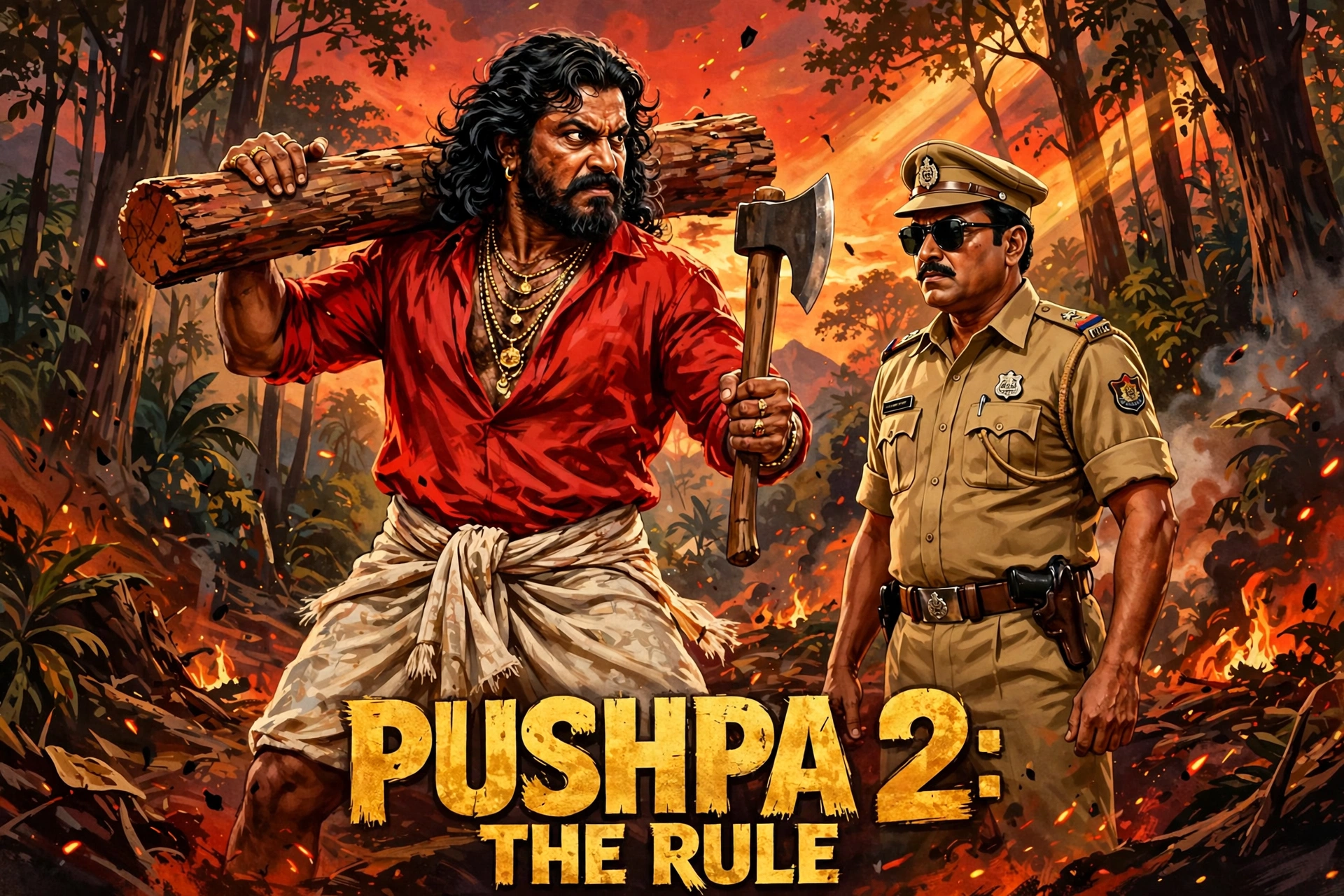
Few sequels arrive carrying expectations like this one. Pushpa: The Rise (2021) turned a red sandalwood smuggler into a national catchphrase, and its follow-up, released on 5 December 2024, was built to be an event rather than merely a film. This Pushpa 2 The Rule review gives Sukumar’s sequel its due where it earns it: as a star vehicle and a piece of mass-cinema engineering it is frequently electrifying, anchored by a lead performance of total commitment and one festival sequence that will be talked about for years. But honesty also requires saying that at 200 minutes, with a story that often circles the same confrontations, the film’s rule is longer than its material — a spectacle that overwhelms more often than it develops.
None of that stopped audiences. The film opened to record-breaking numbers and became one of the biggest Indian hits in history, which makes a clear-eyed assessment more useful, not less. Pushpa 2 is best understood as a film of peaks: individual sequences engineered to detonate in a theatre, strung along a plot that exists mainly to move Pushpa Raj from one show of dominance to the next. If you accept that contract, the peaks are very high indeed.
| Detail | Information |
|---|---|
| Release date | 5 December 2024 |
| Director | Sukumar |
| Writers | Sukumar |
| Genre | Action, Drama |
| Language | Telugu |
| Runtime | 200 minutes |
| Budget | Approx. ₹400–500 crore (reported range) |
| Lead cast | Allu Arjun, Rashmika Mandanna, Fahadh Faasil, Jagapathi Babu, Sunil, Rao Ramesh |
| Our rating | 7.5/10 |
The film opens far from the Seshachalam forests, with a consignment of red sandalwood reaching a Japanese port and a startling discovery inside one of the containers — a framing device that tells you immediately how far Pushpa Raj’s operation has travelled since he was a daily-wage labourer carrying logs on his shoulder. Pushpa (Allu Arjun) now runs an international syndicate. He has money, machinery and political reach. What he does not have, and what the film correctly identifies as his true hunger, is respect: the social acceptance that his birth and his trade keep denying him.
That hunger drives the plot’s main threads. A humiliation involving a powerful politician pushes Pushpa to demonstrate his power in increasingly public ways. At home, his wife Srivalli (Rashmika Mandanna) anchors his private world and presses him on the family honour that money cannot buy. And hanging over everything is the unfinished business of the first film: SP Bhanwar Singh Shekhawat (Fahadh Faasil), the eccentric, brutal officer whom Pushpa humiliated, returns with his pride in ruins and vengeance as his only remaining project. Their cat-and-mouse war — each man obsessed less with winning than with making the other bow — gives the sequel its spine.
Around that spine, Sukumar arranges business rivalries, a new political antagonist in Central Minister Kogatam Veera Pratap Reddy (Jagapathi Babu), episodes within Pushpa’s extended family, and the celebrated Gangamma Jathara festival sequence at the film’s centre. We will not spoil how the ego war concludes, except to say the film ends by deliberately opening the door to a third chapter, already announced under the title Pushpa 3: The Rampage. Whether the story told here needed 200 minutes is a fair question, and we return to it below.
Allu Arjun as Pushpa Raj delivers the kind of all-in star performance that a film like this cannot survive without. The physical transformation of the first film remains — the sloped shoulder, the beard, the Chittoor-inflected delivery — but what impresses more this time is range within the swagger. He plays wounded pride, marital tenderness, comic timing and pure menace, sometimes within a single scene. The Jathara sequence, in which Pushpa, dressed in a saree as part of the Gangamma Thalli ritual, moves from devotional trance to ferocious combat, is a career highlight: few stars of his stature would commit so completely to so unusual a set piece, and he makes it the film’s defining image. If the film holds together, it is because he never lets the character become a poster.
Fahadh Faasil as Bhanwar Singh Shekhawat is the performance connoisseurs will argue about. Shekhawat is written broader here — more comic, more unhinged — than in his chilling introduction in the first film, and some viewers reasonably felt the character was diluted and underused in stretches of the second half. Yet Faasil’s instincts remain razor-sharp: he finds the humiliation rotting inside the clowning, and his scenes with Arjun crackle precisely because his unpredictability plays against Arjun’s control. The tragedy is that the film keeps interrupting their duel for lesser subplots.
Rashmika Mandanna as Srivalli is given more to do than in the first film, and she takes it. Srivalli is no longer only a love interest; she is Pushpa’s emotional compass and, in a couple of strong scenes, the voice that names what his empire is costing. Her chemistry with Arjun remains easy and lived-in. Among the supporting cast, Jagapathi Babu brings oily authority to the minister, Rao Ramesh as Siddappa continues to give the political passages weight, and Sunil and Anasuya Bharadwaj reprise their roles effectively. Jagadeesh Prathap Bandari as Kesava, Pushpa’s loyal friend, once again supplies the film’s most human reactions amid the myth-making.
Sukumar is one of Indian cinema’s genuine perfectionists, and his strengths and his indulgence are both on full display. His world-building remains superb: the smuggling logistics, the syndicate’s rituals of loyalty, the texture of the Chittoor region all feel researched and specific rather than generic. He also directs actors for subtext — a glance from Pushpa often carries the scene’s real meaning. And his staging of mass moments is masterful: the Jathara episode, shot by Polish cinematographer Mirosław Kuba Brożek in firelight and festival colour, is twenty-odd minutes of sustained, escalating cinema that justifies the big screen by itself.
The craft problems are structural. Editor Naveen Nooli cannot fully disguise that several episodes repeat the same beat — Pushpa is slighted, Pushpa responds with a demonstration, onlookers gasp — and the second half’s melodrama, involving family honour and a rescue thread, stretches thin material across a long runtime. A later, longer “Reloaded” version even added footage, when the theatrical cut arguably needed subtraction. Some CGI in the larger action passages looks rushed beside the film’s otherwise rich production design. None of this is fatal, because Sukumar’s highs are so high, but a leaner film would have been a greater one.
Devi Sri Prasad returns, and his background score does heavy lifting throughout: the Pushpa theme material still raises a theatre’s pulse, and the score for the Jathara sequence — building from devotional rhythm to battle fury — is among his finest work. The songs are a more mixed account. Tracks such as “Peelings” and the special number “Kissik”, featuring Sreeleela, are staged with energy, but the album has been widely felt to fall short of the first film’s phenomenon-level soundtrack, whose songs became national events in themselves. That comparison is perhaps unfair — few albums repeat such a strike rate — yet in a 200-minute film, songs that merely work, rather than soar, contribute to the sense of length. The sound design in action scenes, all timber, chains and crowd roar, is excellent.
What we loved:
What could be better:
Precision is difficult with this film because trade sources do not agree on a single final number, so we give the range honestly: worldwide grosses for Pushpa 2: The Rule are reported between roughly ₹1,642 crore and ₹1,800 crore, against a production budget itself reported in a range of about ₹400–500 crore. On any figure within those ranges, the film stands among the highest-grossing Indian films of all time and was the biggest Indian release of 2024. Its opening day set an all-time Indian record, reported at around ₹294 crore worldwide, and its Hindi dubbed version performed at a level that permanently changed how Telugu mass films are released in the north. The commercial conclusion is not in doubt; only the final digit is. A third film has been announced, and after numbers like these, its arrival is a matter of scheduling, not speculation.
If you enjoyed The Rise, this is essential viewing — bigger, louder and, at its best, better, with a central performance that fully justifies the phenomenon. Newcomers should watch the first film first; the sequel assumes your allegiance from its opening minutes. Go for Arjun, for Faasil, and for the Jathara sequence, and forgive the longueurs of a director who loves his world too much to leave any of it out. Seen in a packed theatre, its flaws shrink and its peaks become memories.
Our rating: 7.5/10 — a thunderous star spectacle whose greatest sequences outrun its overlong, repetitive storytelling.
Do I need to watch Pushpa: The Rise before Pushpa 2?
Yes, strongly recommended. The sequel continues Pushpa’s rise and his feud with Shekhawat directly, and its emotional beats assume knowledge of the first film’s events and characters.
How long is Pushpa 2: The Rule?
The theatrical runtime is 200 minutes — three hours and twenty minutes. An extended “Reloaded” version with additional footage was also presented in some markets.
What is the Jathara sequence everyone talks about?
It is a centrepiece set during the Gangamma Jathara festival, in which Pushpa, dressed in ritual attire honouring the goddess, performs a devotional dance that erupts into a major action episode. It has been widely praised as the film’s highlight.
Will there be a Pushpa 3?
Yes. A third instalment, titled Pushpa 3: The Rampage, has been announced and is set up by this film’s ending, though release timing should be treated as unconfirmed until the makers announce it.
Where can I watch Pushpa 2: The Rule?
After its theatrical run the film moved to streaming in multiple languages including Telugu and Hindi. Availability differs by region, so check your local platforms.