★ LATEST REVIEWS

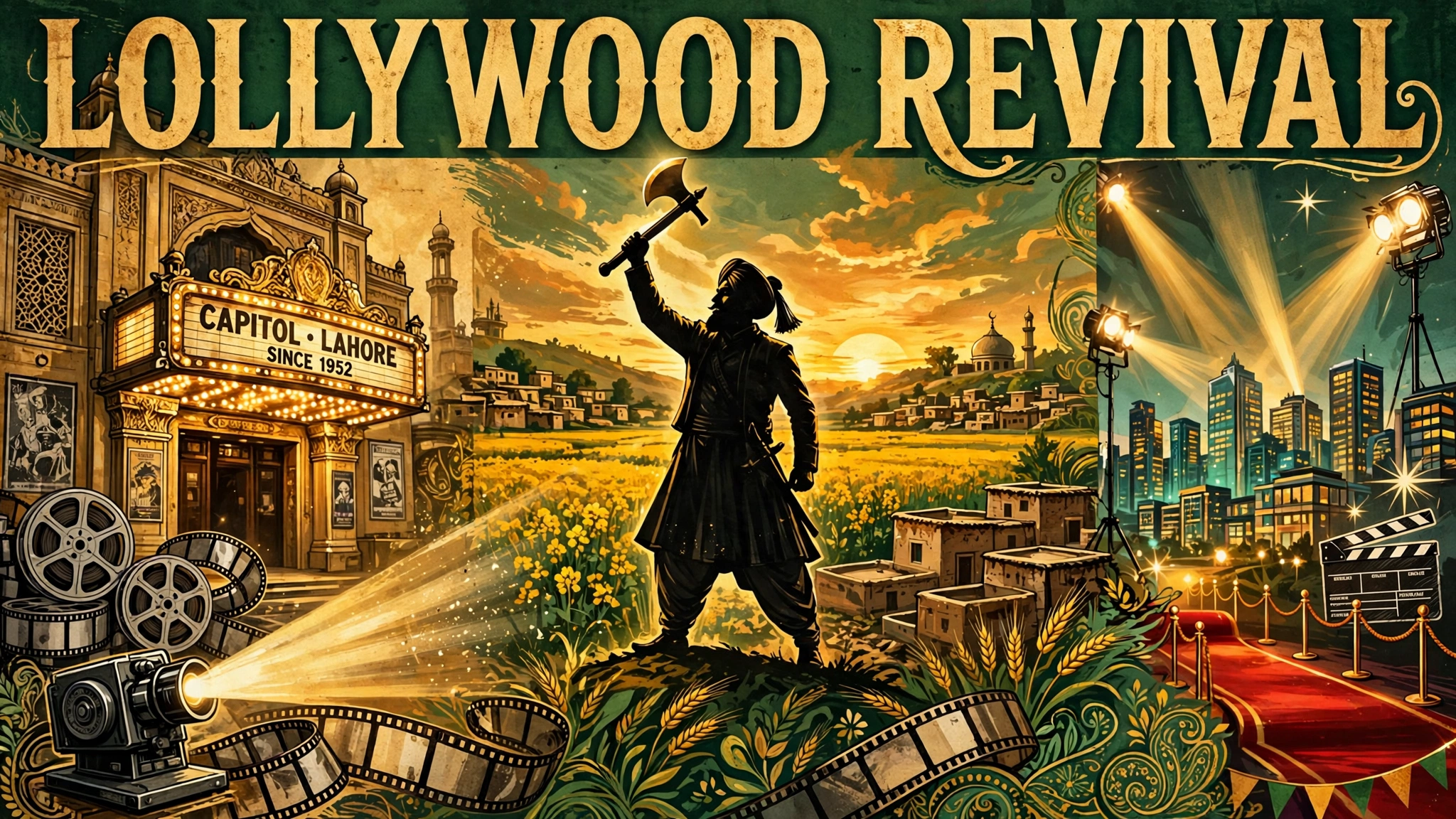
Every film industry has a comeback story, but very few have one as dramatic as Pakistan’s. Within a single lifetime, Lollywood has been a glamorous hit factory, a ghost town of shuttered cinemas and formula films, and then — almost when nobody was watching — the source of some of the most exciting cinema in South Asia. This is the industry that gave the world Waheed Murad’s effortless charm in the 1960s, lost its way for three long decades, and then produced a Punjabi folk epic so powerful that it out-earned every Pakistani film ever made. Our review of The Legend of Maula Jatt calls it a phenomenon, and for once that word is not hype: it is the peak of a revival that had been quietly building for fifteen years.
This guide walks you through the whole arc — the golden age, the decline, the brave films that restarted the engine, and the new generation now carrying Pakistani cinema to Cannes, to global streaming and back into packed multiplexes at home. Whether you grew up on these films, discovered them through television dramas, or are arriving completely fresh, consider this your map. Along the way we will point you to the essential films, explain why they matter, and help you build a watchlist that covers seventy years of storytelling in a handful of unforgettable titles.
Pakistani cinema was born with the country itself. When Pakistan came into being in 1947, Lahore already had studios, technicians and performers from the pre-partition industry, and the city quickly became the heart of a new national cinema. Through the 1950s the industry found its feet, and by the 1960s it was flying. This was the era of the great studios, of films shot in black and white and glowing early colour, and of a star system that could fill a cinema on a name alone.
No name shone brighter than Waheed Murad. Dubbed the “chocolate hero,” he had a softness and modernity that changed what a South Asian leading man could be — romantic without being loud, stylish without trying. Opposite him and alongside him stood performers like Shamim Ara, Zeba, Mohammad Ali and Nadeem, the last of whom became perhaps the most durable leading man in the country’s history, anchoring hit after hit across decades. Behind them, the playback singers — above all Noor Jehan, whose voice became woven into the nation’s memory — gave these films a musical soul that audiences carried home with them.
The milestones came thick and fast. Armaan (1966), starring Waheed Murad, is remembered as a landmark of the era and one of the first Pakistani films to achieve a platinum jubilee run. Aina (1977) became a phenomenon of longevity, running in cinemas for years and embedding its songs into the culture permanently. Punjabi cinema, meanwhile, developed its own mighty tradition: earthy, musical, larger than life. Its defining moment arrived with Maula Jatt (1979), in which Sultan Rahi’s thunderous folk hero and Mustafa Qureshi’s immortal villain Noori Natt turned a rural feud story into the most quoted film in Pakistani history. The gandasa — the hero’s axe-like weapon — became a national symbol, and dialogue from the film is still exchanged like currency today.
It is hard, from the present day, to grasp how complete this world was: hundreds of films, grand studios, premieres that shut down streets, songs on every radio. Lollywood was not a smaller copy of someone else’s cinema. It was its own universe — romantic, musical, moral and unmistakably Pakistani.
The fall, when it came, was slow and then sudden. From the late 1970s onward, a tightening political and cultural climate squeezed the industry: heavy taxes, censorship pressures and a state that treated cinema as a problem rather than an asset. Studios aged, investment dried up, and the audience’s habits changed underneath everyone’s feet. The arrival of the VCR in the 1980s let families watch pirated films at home for free, and cinema after cinema — once the pride of every town — closed its doors or fell into ruin.
What remained on screen narrowed into formula. Punjabi action films, built around the gandasa-wielding hero in the Maula Jatt mould, dominated production, but imitation without imagination turned a proud genre into a parody of itself: the same plots, the same shouted dialogue, the same violence, made cheaper every year. Urdu films retreated into tired melodrama. Talented actors, writers and directors migrated to television, where Pakistani drama was entering its own golden age and offering the quality, respect and salaries that film no longer could.
By the 1990s and early 2000s, the industry that had once released films by the hundred was producing a trickle, and much of it was unwatchable. A generation of Pakistanis grew up barely aware their country had a film industry at all. The multiplexes had not yet arrived, the single screens were dying, and it genuinely seemed possible that Lollywood — the whole idea of it — would simply end, surviving only in old songs and older memories.
Revival, when it finally came, did not arrive with a blockbuster. It arrived with a question. In 2007, Shoaib Mansoor — a giant of Pakistani television making his feature debut — released Khuda Kay Liye (“In the Name of God”), a drama that dared to examine faith, extremism and the choices of ordinary Pakistanis caught between worlds. It was serious, questioning and beautifully made, and audiences who had abandoned local cinema came back to argue about it. It travelled internationally and became the first Pakistani film in decades to receive a release in India. Our Khuda Kay Liye review explains why it remains the revival’s founding document: it proved, after decades, that a Pakistani film could be an event because of what it said, not just who danced in it.
Mansoor struck again with Bol (2011), a Lahore-set family drama about a household crushed by patriarchy and poverty, carried by a remarkable ensemble and a script that trusted silence as much as speech. Bol became one of the biggest Pakistani successes of its era and carried its message across borders. Read our Bol review and you will see the pattern the revival would follow: strong writing first, social honesty always, and a faith that Pakistani audiences were far smarter than the old formula had assumed.
Just as importantly, the ground itself was changing. Multiplexes began opening in Karachi, Lahore and Islamabad, giving well-made local films clean screens and paying audiences. Digital cameras slashed the cost of shooting. A new generation — trained on world cinema, television drama and sheer stubbornness — started picking up cameras. The spark had landed on dry wood.
The revival’s second phase proved it could entertain as confidently as it could preach. In 2013, a young director named Bilal Lashari released Waar, a sleek military action thriller with international scale and a pounding sense of occasion. It became the biggest Pakistani hit of its time and announced that local films could look and sound world-class. Our Waar review looks at how it reset expectations for production values almost overnight.
Comedy and crime followed. Na Maloom Afraad (2014) turned a Karachi heist story into a sharp, funny portrait of a city and its strivers — our Na Maloom Afraad review rates it among the revival’s most enjoyable rides. Jawani Phir Nahi Ani (2015) showed that a big, glossy ensemble comedy could pack multiplexes for weeks; see our Jawani Phir Nahi Ani review for why it became a template so many later comedies chased. Actor in Law (2016) paired Fahad Mustafa with the legendary Om Puri in a courtroom comedy-drama with a real social spine — our Actor in Law review argues it is one of the era’s smartest mainstream films. And Load Wedding (2018) wrapped its entertainment around the cruelty of dowry culture, smuggling a serious argument into the middle of a wedding film.
Notice what unites these films: they are commercial to their bones, yet each one is about something. The new Lollywood had learned the golden age’s real lesson — that Pakistani audiences turn up for stars and songs, but they stay, and they return, for stories that respect them.
Every revival has a coronation moment, and Lollywood’s came in October 2022. Bilal Lashari returned with The Legend of Maula Jatt, a ground-up reimagining of the 1979 classic — not a remake but a myth retold: Fawad Khan as the brooding Maula, Hamza Ali Abbasi as a Noori Natt of genuine menace, and a Punjab of mud, blood and honour rendered with a visual ambition Pakistani cinema had never attempted. It became the highest-grossing Pakistani film of all time by an enormous margin, ran for months, and played to cheering audiences from London to Toronto — including many who had never watched a Pakistani film in a cinema before.
Its importance goes beyond money. The Legend of Maula Jatt proved that a film rooted entirely in local language, folklore and landscape could compete with any spectacle on earth without imitating anyone. It gave the industry its confidence back at industrial scale: bigger budgets, international releases and Punjabi-language pride all became thinkable because one film had done it first. It is the single most important Pakistani film of the modern era, and the standard every Lollywood blockbuster is now measured against.
While the mainstream was rebuilding, a parallel Lollywood was quietly conquering the festivals. It began in earnest with Cake (2018), Asim Abbasi’s Karachi family drama — funny, fractured and heartbreakingly true — which suggested that the most radical thing a Pakistani film could do was simply observe a family honestly. Our Cake review makes the case for it as the revival’s most perfectly acted film.
Sarmad Khoosat’s Kamli (2022) carried that artistry into a dreamscape: a woman, a stranger, a marriage suspended in waiting, and imagery of a beauty rarely seen in South Asian cinema. Our Kamli review explores how it turns folklore and longing into pure visual poetry. And then came Joyland (2022), Saim Sadiq’s Lahore-set story of a gentle son, a dance theatre and desires that fit nowhere — the first Pakistani film ever selected for the Cannes Film Festival, where it won major prizes, and later Pakistan’s first-ever entry to reach the Academy Awards shortlist. Our Joyland review was written in something close to awe.
These films stand on earlier shoulders: Dukhtar (2014), a mother’s flight across the mountains with her daughter, showed the road-movie art film was possible here — see our Dukhtar review. Together they give Pakistani cinema a dual identity few industries manage: blockbusters that fill multiplexes and art films that fill festival programmes, each making the other stronger.
The revival’s deepest sign of health is that it no longer depends on three or four names. A generation of directors, writers and performers — many of them women, many of them working far from the old studio system — is now telling every kind of story. Karachi’s crime cinema produced the stylish, brooding Laal Kabootar (2019); our Laal Kabootar review shows a city film with noir in its veins. Punjabi popular cinema, meanwhile, has rediscovered its swagger in crowd-pleasers like Mango Jutt — our Mango Jutt review celebrates a commercial entertainer that knows exactly what its audience came for and delivers it with both hands.
Television drama, once the industry’s rival, has become its academy: the actors, writers and directors trained by Pakistan’s extraordinary TV serials now move between the two mediums, raising the craft of both. Streaming has given smaller films a second life and the diaspora a front-row seat. Challenges remain real — financing is fragile, censorship is unpredictable, and too many single-screen towns still have no cinema at all. But the direction of travel is unmistakable, and it is upward.
No history of Pakistani cinema is complete without its music. In the golden age, the playback system produced songs that outlived the films themselves — melodies by composers and voices like Noor Jehan and Mehdi Hassan that became part of weddings, radios and collective memory across the country. A film’s album could decide its fate before a single review appeared, and the greatest stars were often loved as much for the songs filmed on them as for their acting.
The decline years starved that tradition too, but the revival restored it with interest. Modern Lollywood soundtracks blend qawwali, folk, Sufi rock and pop, and the industry’s musicians now move easily between film, television and the streaming charts. The big romances understand this inheritance best: Punjab Nahi Jaungi (2017), one of the defining mainstream hits of the revival, weds its love story to music in the grand old manner — our Punjab Nahi Jaungi review shows how completely it won its audience. When a new Pakistani film’s songs start travelling ahead of the film itself, every producer in Lahore knows what that means: the oldest magic in Lollywood is working again.
New to Lollywood? Do not start at random. This path takes you through the revival in the order that makes it sing:
After that, wander freely: the comedies, the crime films, the romances and the festival titles in our Lollywood section are all reviewed and rated the FlickZada way — honestly, and without spoilers.
Lollywood is the nickname for Pakistan’s film industry, a blend of “Lahore” and “Hollywood,” after the city that has been its historic home. The name covers both Urdu-language cinema and the parallel Punjabi film tradition, which together make up the core of Pakistani filmmaking.
Most historians of the industry point to Shoaib Mansoor’s Khuda Kay Liye (2007) as the spark: a serious, successful, internationally noticed drama that proved Pakistani audiences would return to cinemas for well-made local films. Multiplex construction, digital production and Bol (2011) built the momentum, and Waar (2013) confirmed it commercially.
The Legend of Maula Jatt (2022) is the highest-grossing Pakistani film ever released, by a wide margin. Its success at home and across the global diaspora made it the defining blockbuster of the revival era and a landmark for Punjabi-language cinema worldwide.
A combination of heavy taxation and censorship pressure, the collapse of the cinema network, home-video piracy in the 1980s, and an industry that narrowed into cheap formula productions while its best talent migrated to television drama. The decline lasted roughly three decades before the revival took hold.
Major revival titles play in cinemas across Pakistan and in diaspora markets, and many are available on international streaming platforms and official YouTube channels after their theatrical runs. Availability varies by country, so check your local services — and start with the reviews linked throughout this guide to choose well.
The loveliest thing about the Lollywood revival is that it is unfinished. New directors are arriving every season, romances like the gentle Pehla Pyaar Doosri Baar are finding their audiences, and the industry’s centre of gravity keeps widening — more cities, more languages, more kinds of story. From Waheed Murad’s smile to a gandasa raised over a burning Punjab skyline, Pakistani cinema has travelled an extraordinary road. FlickZada’s Lollywood section will keep reviewing every step of it — the triumphs, the stumbles and the surprises — and we would love you to travel with us.