★ LATEST REVIEWS

★★★★☆ Our Rating: 8/10
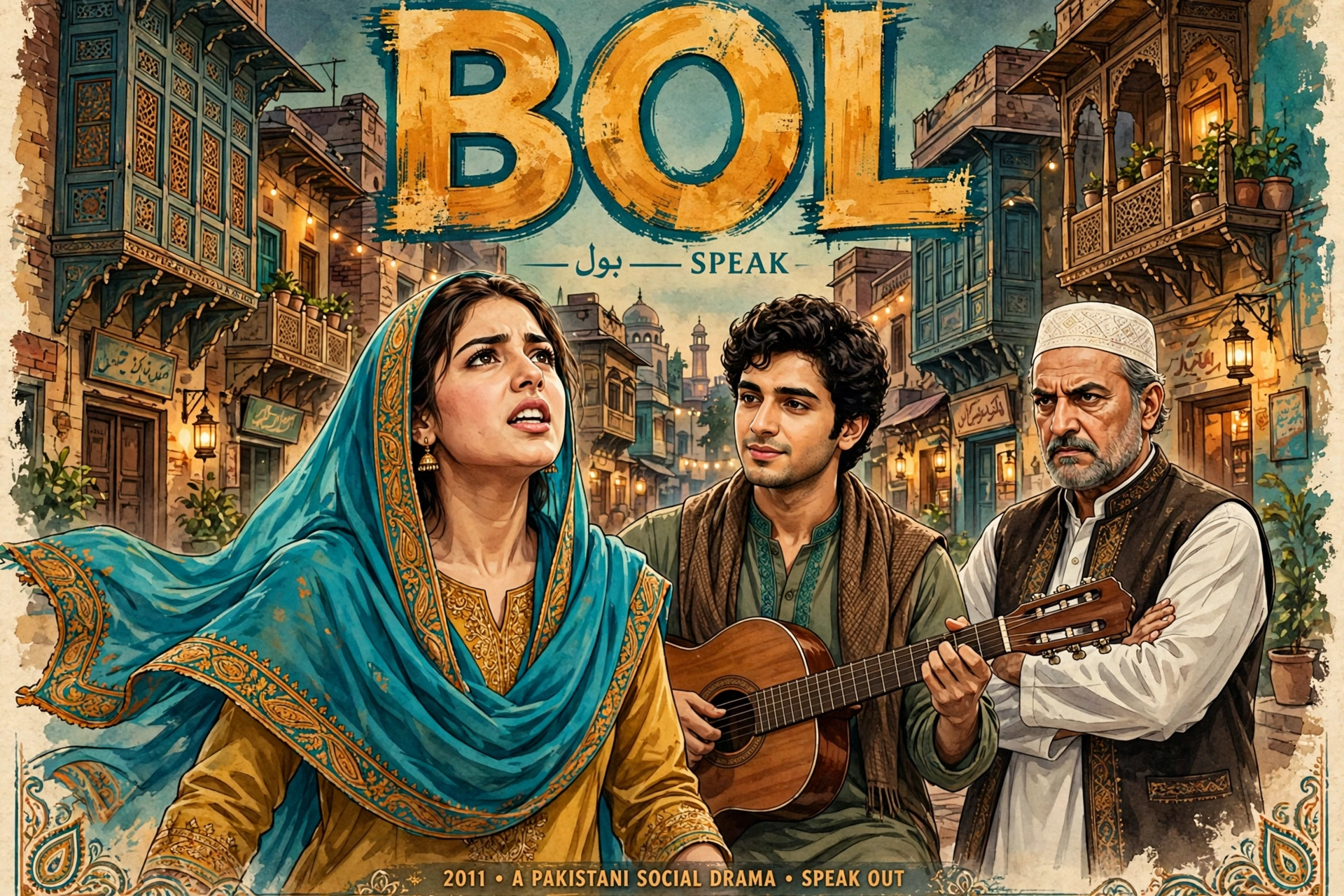
The title is an instruction: Bol means “speak.” Any serious Bol review has to begin with the fact that Shoaib Mansoor’s second film, released in Pakistan on 24 June 2011, was built as an act of speech — a film that wanted to say, in a mainstream cinema with stars and songs, the things polite conversation avoided: that daughters are not burdens, that a child born intersex is not a shame, that bringing children into the world without the means or intention to raise them is its own kind of cruelty. Coming four years after Khuda Kay Liye revived Pakistani cinema, Bol carried enormous expectations. It met many of them at the box office, won major awards, launched Mahira Khan’s film career and gave singer Atif Aslam his acting debut — and it remains the more divisive of Mansoor’s two landmarks, praised for its courage and criticised, fairly, for trying to say everything at once.
This review tries to hold both truths. Bol is brave, superbly acted at its centre, and genuinely moving in its best passages. It is also overstuffed, melodramatic in construction, and long. For the audience it was made for — families who filled Pakistani cinemas in 2011 and argued about it all the way home — the flaws plainly did not outweigh the force. Watching it now, the force is still what you remember.
| Detail | Information |
| Release date | 24 June 2011 |
| Director | Shoaib Mansoor |
| Writers | Shoaib Mansoor |
| Genre | Social Drama |
| Language | Urdu |
| Runtime | 165 minutes |
| Lead cast | Humaima Malik, Atif Aslam, Mahira Khan, Iman Ali, Shafqat Cheema, Manzar Sehbai |
| Our rating | 8/10 |
The film opens at the end. Zainab (Humaima Malik) is in prison, condemned to hang, and she has made an extraordinary last request: if her appeal for mercy fails, she wants to tell her story to the press before the sentence is carried out. The request travels to the highest office in the country, and the frame is set — microphones, cameras, a deadline — before the film steps back into the Lahore household where everything began.
Zainab grew up as the eldest daughter of Hakim Sahib (Manzar Sehbai), a devout, impoverished practitioner of traditional medicine who runs a small dispensary and serves as treasurer for his mosque. Hakim’s household is large and growing larger: daughter after daughter, a wife (Zaib Rehman) whose health is worn down by repeated pregnancies, and a fierce, unshakeable conviction in Hakim himself that what the family needs — what will redeem its poverty — is a son. The family’s most closely held secret is Saifi (Amr Kashmiri), a gentle, artistic child who is intersex, loved fiercely by his mother and sisters and regarded by his father as a disgrace to be hidden from the world.
Around this household, the film builds its web. There is Mustafa (Atif Aslam), the neighbour’s son, a young doctor whose affection for Zainab’s sister Ayesha (Mahira Khan) runs into the wall of sectarian difference and Hakim’s authority. There is the money Hakim holds in trust for the mosque, and the temptation it becomes when the family’s finances collapse. And there is Saqa (Shafqat Cheema), a brothel-keeper whose world of trafficked women — among them Meena (Iman Ali) — will intersect with Hakim’s desperation in a bargain that poisons everything it touches. How these threads tighten into the crime that put Zainab on the gallows is the film’s story to tell, not ours; we will say only that Bol is structured as a confession, and it makes you wait, as the press in the film must wait, to understand what exactly she is confessing to.
Humaima Malik as Zainab carries the film, and it is a star-making performance in the full sense. Zainab is the family’s conscience and its rebel — the daughter who arranges what her father forbids, argues what her mother cannot, and finally does what no one else will. Malik plays her without vanity: exhausted, funny in flashes, unbreakable in the frame sequences where she narrates her own condemnation with a calm that is more devastating than tears. She won Best Actress at the Lux Style Awards and at the London Asian Film Festival for this role, among other honours, and the performance holds up as one of the finest in modern Pakistani cinema.
Manzar Sehbai as Hakim Sahib won Best Actor at the Lux Style Awards and the SAARC Film Awards, and his work is the film’s most difficult achievement. Hakim is not written or played as a monster. He is pious, industrious, tender in his fashion — and the author of nearly every catastrophe in his house, through convictions he experiences as righteousness. Sehbai’s quiet, weathered performance lets the audience understand Hakim without ever being asked to excuse him, which is exactly the balance the film needs.
Shafqat Cheema as Saqa is superb and unsettling — a panderer played not as a cartoon villain but as a businessman of other people’s misery, courteous, practical and completely without shame; the performance won wide critical praise even from reviewers cool on the film. Amr Kashmiri as Saifi, in a debut that won Best New Talent at the London Asian Film Festival, gives the film its most delicate work: Saifi’s longing for an ordinary working life, and the world’s refusal to allow it, is Bol‘s moral heart.
The younger romantic thread is lighter. Atif Aslam as Mustafa, in his acting debut, is natural and likeable, leaning sensibly on his musical persona; he is a singer learning acting in public, and mostly getting away with it. Mahira Khan as Ayesha, in her own film debut, has less to do — the role is more symbol of the younger generation’s hopes than a full character — but she brings a freshness that hints clearly at the stardom that followed. Iman Ali as Meena does a great deal with limited screen time, giving a woman the world treats as merchandise a watchful, wounded dignity.
Bol was made under the banner of Shoaib Mansoor’s Shoman Productions, set in Lahore, and — a detail worth knowing — it grew out of a partnership with the PAIMAN maternal and child health initiative, supported through the Johns Hopkins University Center for Communication Programs, which worked with Mansoor to bring family-planning and gender questions before a mass audience. That origin explains the film’s strengths and its weaknesses in one stroke. Mansoor directs like a man who believes cinema should argue, and his staging is clear, patient and performance-led: long domestic scenes in the family’s cramped home, the old city’s lanes and rooftops used as a living backdrop, the gallows frame returning at intervals to remind us where every small decision is heading.
The weaknesses are structural. Mansoor loads the film with issues — patriarchy, family planning, sectarian prejudice, intersex rights, prostitution, corruption, capital punishment — and while each is connected to the household’s story, the accumulation means some are explored in a single emblematic scene rather than developed. Local reviewing at the time was divided for exactly this reason: some critics found the characters one-dimensional and the production values modest, while others, in Pakistan and India alike, praised a topical, thought-provoking film carried by bravura acting. Both readings identify real features of the same film. Mansoor’s dialogue, however, is a craft strength throughout — literate, idiomatic Urdu that gives even expository scenes a pulse — and his instinct for the telling detail (a trust fund counted at a kitchen table, a child’s paintings on truck panels) keeps the message-film machinery human.
For a film starring Atif Aslam, the music carries unusual weight, and the soundtrack is a multi-artist affair in the classic Pakistani manner: songs composed and performed by Aslam alongside Sajjad Ali, Hadiqa Kiani, Ahmed Jahanzeb, Shabnam Majeed, Sahir Ali Bagga, Bina Jawad, Faiza Mujahid and Shuja Haider, with a background score by Baqir Abbas that leans on flute and space rather than melodramatic strings.
The standout is “Hona Tha Pyar,” the romantic duet by Atif Aslam and Hadiqa Kiani — a gentle, hummable melody that became a major hit and was nominated for Song of the Year at the Lux Style Awards; it is also a nice piece of film history that the song was written and composed by Ali Javed, a sixteen-year-old schoolboy from Toba Tek Singh. Sajjad Ali’s “Din Pareshan Hay” supplies the film’s ache, Ahmed Jahanzeb and Shuja Haider’s “Mumkin Hay” its hope, and “Sayyan Bolain,” sung by Shabnam Majeed, Sahir Ali Bagga and Bina Jawad, roots the film in classical soil. Honesty requires noting that not every critic was persuaded — one prominent review called the soundtrack a surprising disappointment relative to Mansoor’s musical pedigree — but the album was commercially successful and “Hona Tha Pyar” in particular has had a long life beyond the film.
What we loved:
What could be better:
As with all Pakistani releases of its era, Bol‘s figures come from press and trade reporting rather than any official tracker, and they do not fully agree — so treat every number here as a reported range, not an audited fact. The film’s opening is the best-documented part of the story: contemporary reports record that it earned about Rs. 6.28 crore in its first six days in Pakistan, smashing the previous first-week record in that market held by the Bollywood hit My Name Is Khan. Reports of its domestic run then diverge — some accounts describe it finishing its Pakistani run at around Rs. 12 crore, while listings of worldwide totals for 2011 place the film at about Rs. 16.8 crore including its international release in India, the United States, Canada, Britain, the UAE and Australia. Reports differ, and this review does not pretend otherwise. What is solid is the standing: Bol was the highest-grossing Pakistani film of 2011 by a wide margin, one of the biggest Pakistani hits of all time to that date, and a commercial proof — after Khuda Kay Liye — that serious social drama could out-earn entertainment spectacles in its home market. Its awards matched the money, including Best Film at the Lux Style Awards and the London Asian Film Festival.
Yes — particularly if you believe popular cinema should occasionally aim at something more than diversion. Bol will frustrate tidy-minded viewers: it is long, it lectures through its structure even when its dialogue sparkles, and it asks a single Lahore family to carry the weight of a nation’s worth of questions. But its best performances are among the finest in Pakistani film, its central subject — the worth of daughters — is handled with fury and love in equal measure, and its closing question, delivered from the gallows, is one audiences have been repeating ever since. Few films earn their title. This one does: it speaks.
Our rating: 8/10 — an overstuffed, melodramatic, essential film, carried by two great central performances and a conscience that will not sit down.
Is Bol based on a true story?
No. It is an original screenplay by Shoaib Mansoor. It was developed in partnership with a maternal and child health initiative to raise family-planning and women’s-rights questions, but its Lahore family and their story are fictional.
Was Bol Mahira Khan’s first film?
Yes. Bol marked the film debut of both Mahira Khan, as Ayesha, and singer Atif Aslam, as Mustafa. Khan had appeared on television before; this was her first feature film.
What does Bol mean, and what is the film about?
Bol is Urdu for “speak.” The film tells the story of a large Lahore family ruled by a devout, impoverished father whose desperate wish for a son — and rejection of his intersex child — sets a chain of tragedies in motion, narrated by his eldest daughter from death row.
Is Bol suitable for family viewing?
It deals with prostitution, sexual violence, murder and capital punishment, though without graphic explicitness. It was widely seen by families in Pakistan and sparked household discussion, but it is best suited to older teens and adults.
Where can I watch Bol (2011)?
The film is available on video platforms and streams in various regions. Availability changes over time, so check your local services.