★ LATEST REVIEWS

Our Rating: ★★★★☆ 7.5/10
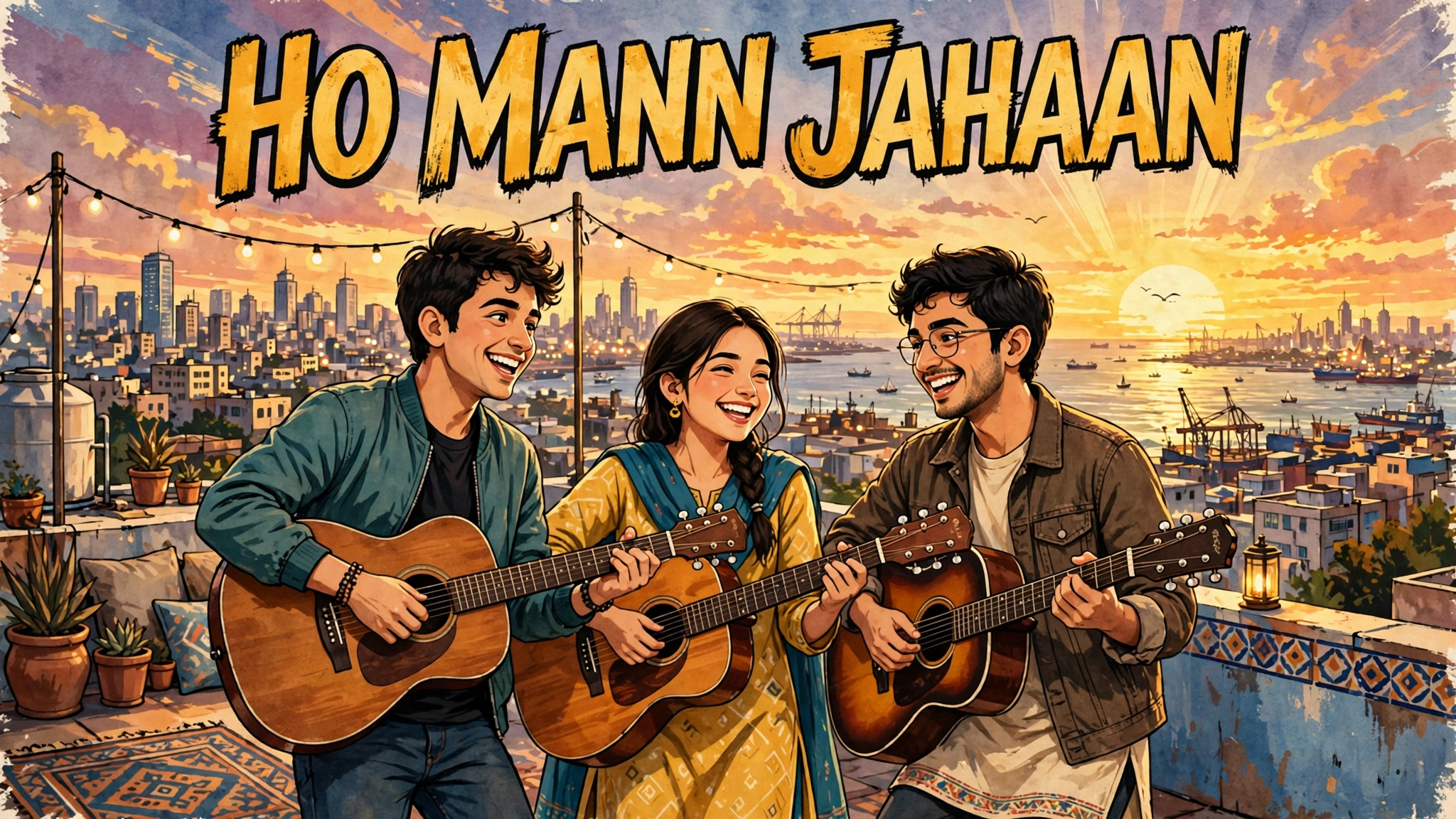
There is a particular kind of film that only a confident young film industry can make: a story about its own young people, set in its own biggest city, full of its own music, and unafraid to be sincere about the gap between what parents want and what children dream. Ho Mann Jahaan — the title translates roughly as “as the heart wills” — is that film for Pakistan. Directed by Asim Raza in his feature debut, released in Pakistan on 1 January 2016, and starring Mahira Khan, Sheheryar Munawar and Adeel Husain, it is a coming-of-age musical drama about three friends, one band, and the difficult business of growing up in Karachi.
It is not a perfect film. At 170 minutes it is too long, its final act loses its way, and its glossy world of beautiful young people with beautiful problems can feel remote from ordinary life. But it is also warm, good-looking, well-acted and full of good music, and it captures something real about a generation of urban Pakistanis negotiating between tradition and self-expression. For viewers who love musical dramas, or who want to see Karachi on screen as a living, breathing city rather than a news headline, it remains one of the most likeable Pakistani films of its decade.
| Detail | Information |
|---|---|
| Release date | 1 January 2016 (Pakistan; 31 December 2015 in the UAE) |
| Director | Asim Raza |
| Writers | Asim Raza, Rashna Abidi, Imtisal Abbasi |
| Genre | Coming-of-Age, Musical Drama |
| Language | Urdu |
| Runtime | 170 minutes |
| Lead cast | Mahira Khan, Sheheryar Munawar, Adeel Husain, Sonya Jehan, Bushra Ansari, Arshad Mahmud, Nimra Bucha |
| Our rating | 7.5/10 |
The film follows three young Karachiites who meet at college and form a band. Manizeh, played by Mahira Khan, is a spirited young woman from an artistic family, raised by a mother whose own marriage broke down and who is determined that her daughter should be free. Arhan, played by Sheheryar Munawar, is a passionate, less privileged young man for whom music is not a hobby but a lifeline. Nadir, played by Adeel Husain, is the privileged son of a wealthy, controlling mother, a young man who has everything except the freedom to choose his own life.
Their friendship is the film’s centre: rehearsals, performances, jokes, jealousies, and the slow realisation that adulthood is arriving whether they are ready or not. Around them are the adults who shape their choices — Sabina, played by Sonya Jehan, a powerful, independent woman who becomes a kind of mentor; Nadir’s formidable mother, played by Bushra Ansari; and Manizeh’s father, played by Jamal Shah. The film’s central tension is the one its title names: the struggle between doing what the heart wills and doing what family, class and society demand.
This review will not reveal how the triangle resolves or what happens to the band, but it is fair to say the film’s first two hours are stronger than its last half-hour. The early passages — the college scenes, the rehearsals, the concerts, the friendships — are joyful and confident. The final act, as several critics noted at the time, feels as if it loses the plot somewhat, with developments that do not quite add up and an ending that seems to have been reshaped late in the process. The journey, however, is charming enough that most viewers will forgive the destination.
Mahira Khan as Manizeh — Mahira Khan, already Pakistan’s biggest television star, gives a performance of warmth and natural charisma. Manizeh could easily have been a generic “free spirit”, but Khan plays her with a grounded emotional intelligence: her character’s independence is not a pose but a response to her family history, and her scenes with her mother and her friends have real feeling. Her screen presence carries the film’s romantic and musical passages, and she looks entirely at home in a big-screen leading role.
Sheheryar Munawar as Arhan — Munawar, who also co-produced the film, plays Arhan with earnest intensity. His character is the film’s emotional engine — the dreamer who cannot afford to fail — and Munawar gives him a sincerity that keeps the film from becoming merely glossy. His musical performances are committed, and his chemistry with Khan is one of the film’s strengths.
Adeel Husain as Nadir — Husain has the most difficult role: a privileged young man crushed by parental expectation, whose suffering could easily look like self-pity. He plays Nadir’s quiet misery with restraint, and his scenes with Bushra Ansari, as his domineering mother, are among the film’s most powerful. Nadir’s arc is the film’s most traditionally dramatic, and Husain handles it well.
The supporting cast and cameos — Bushra Ansari is superb as Nadir’s mother, a performance of controlled, maternal menace that many reviewers singled out. Sonya Jehan brings authority and mystery to Sabina, and Arshad Mahmud, Nimra Bucha and Jamal Shah all add depth. The film is also famous for its cameos — Fawad Khan, Hamza Ali Abbasi, Syra Yousuf and several Pakistani music stars appear in songs and small roles — and while these are fun for local audiences, they occasionally distract from the main story, turning scenes into celebrity spotting.
Asim Raza came to features from advertising and music videos, and it shows — in the best and worst ways. On the plus side, Ho Mann Jahaan is one of the best-looking Pakistani films of its era. Salman Razzaq Khan’s cinematography makes Karachi glow: the sea, the rooftops, the concerts, the cafes and the streets all look beautiful without looking like a tourism advertisement. The concert sequences are staged with real energy, and Raza’s experience with music videos pays off in the way songs are filmed — as performances with atmosphere, not as interruptions.
On the minus side, Raza’s direction occasionally favours gloss over grit. The film’s world is beautiful but sometimes hermetically so: everyone is attractive, well-dressed and articulate, and the film’s engagement with class — Arhan’s lack of privilege versus Nadir’s excess of it — is stated more than explored. The 170-minute runtime is the film’s biggest craft problem: a tighter edit, cutting perhaps twenty minutes, would have sharpened the story and hidden the final act’s wobbles. The film also carries noticeable product placement, including a prominent soft-drink brand, which some critics found distracting, though it is hardly unusual for commercial cinema.
Music is not decoration in Ho Mann Jahaan; it is the plot. The film’s soundtrack, featuring songs performed by the cast and by guest artists, is one of its great strengths. “Shakar Wandaan”, the film’s signature celebratory number, is a joyous, colourful set piece that became a hit, while the romantic and reflective songs — including numbers associated with the band’s journey — give the film’s emotional texture. The songs work because they are performed, not just played: the audience sees the band rehearsing, struggling, improving and performing, so the music feels earned.
The background score supports the drama without overwhelming it, and the sound design around the concerts — the crowd, the instruments, the acoustics — is convincing. For viewers who love Pakistani pop music, the soundtrack alone is a reason to watch; for others, it is the film’s most reliable pleasure, and the reason the film is remembered fondly even by critics who faulted its story.
What we loved:
What could be better:
Ho Mann Jahaan opened to a strong response and became one of the notable Pakistani hits of early 2016. It earned around PKR 3.25 crore in its first two days in Pakistan — about PKR 1.5 crore on day one and PKR 1.75 crore on day two, according to trade reporting at the time — and was on course for a PKR 5 crore opening weekend, an impressive result for a New Year release with little competition. Its total run is reported at around PKR 16.25 crore domestically and PKR 22.5 crore worldwide, figures that made it one of the highest-grossing Pakistani films of 2016 and confirmed Mahira Khan’s box-office drawing power.
A note on what we have omitted: no reliable, verifiable budget figure for Ho Mann Jahaan could be found in the sources consulted for this review, so the Quick Facts table carries no budget row rather than a guessed number. That omission does not affect the film’s story: commercially, it was a success, and critically it was received as a promising debut for Asim Raza and a sign that Pakistani cinema could make a glossy, musical, youth-focused film with confidence. In December 2016, it was showcased at the Pakistani Film Festival in New York, extending its reach beyond its home audience.
Yes — especially if you like musical dramas, coming-of-age stories, or Pakistani cinema. Ho Mann Jahaan is not a flawless film, and its last act will frustrate viewers who want a tightly plotted drama. But its pleasures are real: three likeable leads, a great soundtrack, a beautiful Karachi, and a story about young people trying to live honestly that remains relatable a decade later. Watch it for the music, stay for the friendship, and forgive the final half-hour its confusion.
Our rating: 7.5/10 — Warm, musical and beautifully shot; a likeable Karachi coming-of-age story that runs a little too long.
What does Ho Mann Jahaan mean?
The title is an Urdu phrase roughly meaning “as the heart wills” or “where the heart desires”, reflecting the film’s theme of choosing between duty and desire.
Who stars in Ho Mann Jahaan?
Mahira Khan, Sheheryar Munawar and Adeel Husain play the three friends, with Sonya Jehan, Bushra Ansari, Arshad Mahmud and Nimra Bucha in supporting roles, plus cameos from Fawad Khan, Hamza Ali Abbasi and others.
Is Ho Mann Jahaan a musical?
It is a musical drama: songs and performances are central to the story, since the three leads form a band, but it also works as a coming-of-age drama about family and growing up.
How long is Ho Mann Jahaan?
It runs 170 minutes, about two hours and fifty minutes, and is in Urdu.
Where can I watch Ho Mann Jahaan?
It has been available on streaming platforms including Prime Video in various regions, though availability changes over time, so check your local services.