
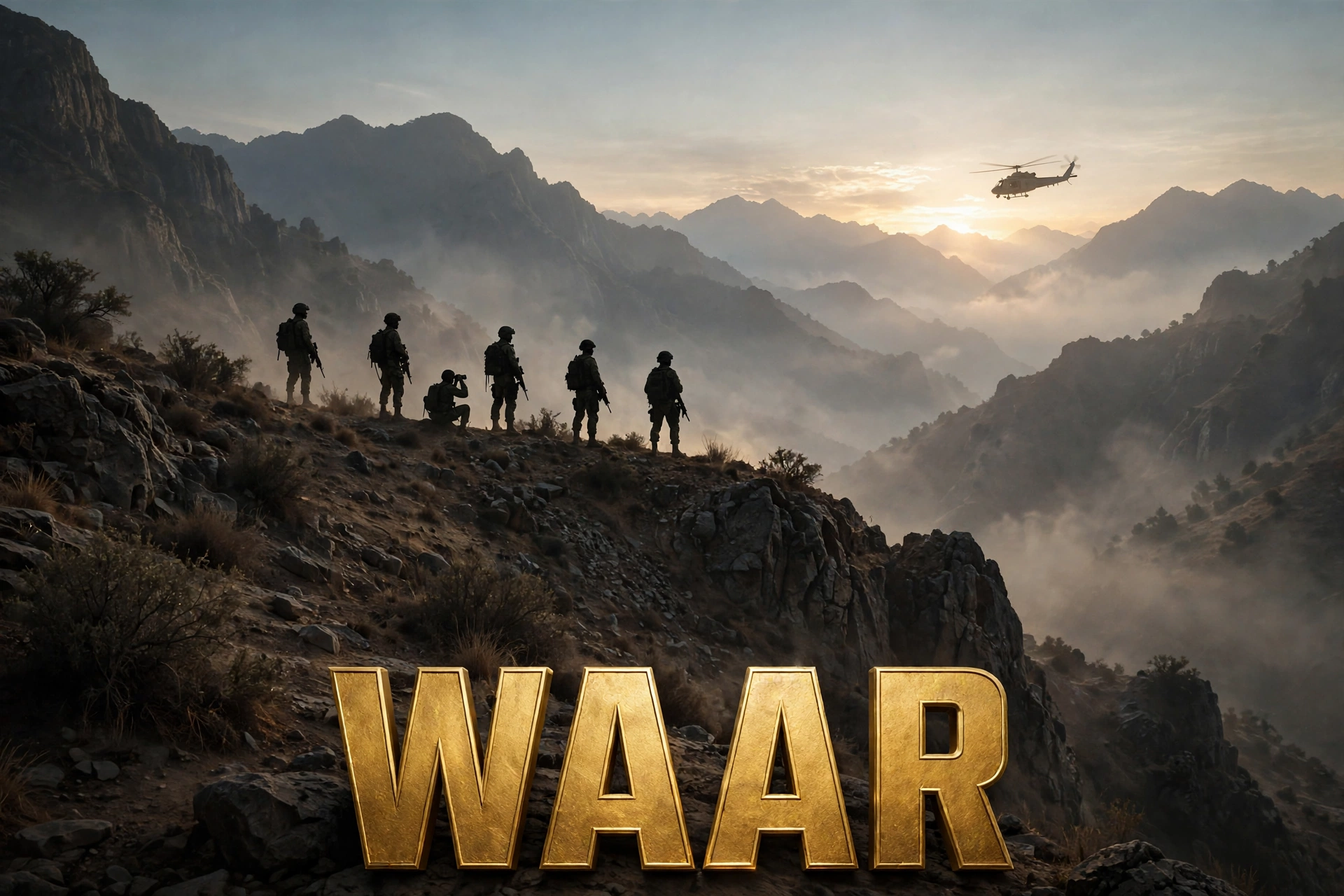

Waar (2013) Review – The Action Thriller That Restarted Pakistani Cinema
To understand Waar, you have to remember what Pakistani cinema looked like in 2013. The industry was on life support: a handful of releases a year, ageing infrastructure, and audiences who had long since given their money to Bollywood and Hollywood. Then, on Eid-ul-Adha, 16 October 2013, a young music-video director named Bilal Lashari released his first feature — an English-and-Urdu action thriller about the war on terror, made on a scale Pakistan had never attempted. Cinemas filled. Records fell. And an industry remembered what ambition felt like.
Waar did not just succeed; it changed expectations permanently. It became the highest-grossing Pakistani film of its time, proved that a local production could open like a blockbuster, and launched the career of the director who would later make The Legend of Maula Jatt. But a landmark is not automatically a masterpiece. Revisited today, Waar is both more impressive and more flawed than its reputation suggests — dazzling in craft, thin in places where it matters most.
In this review, we revisit the story, performances, direction, music and box office of Waar honestly, separating the history it made from the film it actually is.
Quick Facts: Waar at a Glance
| Detail | Information |
|---|---|
| Release date | 16 October 2013 |
| Director | Bilal Lashari |
| Writers | Hassan Rana |
| Genre | Action, Thriller |
| Language | English, Urdu |
| Runtime | 140 minutes |
| Budget | Rs. 17 crore (Rs. 170 million) |
| Lead cast | Shaan Shahid, Shamoon Abbasi, Meesha Shafi, Ali Azmat, Aisha Khan, Hamza Ali Abbasi |
| Our rating | 7.5/10 |
The Story: A Retired Major, A Coming Attack (Spoiler-Free)
Pakistan is bleeding from a campaign of terrorism, and its security agencies are fighting a war on several fronts at once — in the tribal north-west, in its cities, and in the shadows of foreign funding and local facilitation. In the north, a counter-terrorism operation is under way, led in the field by officer Ehtesham and coordinated by intelligence officer Javeria, who pieces together warnings of something far bigger than the attacks the country has already endured.
The signs point to a major planned strike, masterminded by a ruthless militant figure known as Ramal, whose network reaches from remote compounds to respectable drawing rooms. His assets include a glamorous, dangerous operative working under an alias, and protection that extends into politics itself, where a cynical politician named Ejaz Khan plays his own game with the men of violence.
The agencies conclude that stopping the attack will require a man who has walked away from the war: Major Mujtaba Rizvi, a decorated officer who took early retirement after personal tragedy and wants nothing more to do with the fight. Mujtaba is pulled back, reluctantly, into a hunt that is partly a military operation and partly a reckoning with his own past. The film builds its story in the manner of a stylised thriller — operations, surveillance, betrayals and set-piece attacks — and it draws openly on the atmosphere of real events of its era, including the 2009 attack on the police training school in Lahore, which it restages as one of its most intense sequences.
We will not reveal the target, the traitors, or the outcome. What you should know is the shape of the thing: this is a patriotic action thriller told largely from the perspective of the state and its soldiers, with a clear moral compass and a clear enemy. Whether that clarity is the film’s strength or its limitation is the argument at the heart of every serious discussion of Waar — and we will return to it in the verdict.
Performances: Presence Over Depth
Shaan Shahid as Major Mujtaba Rizvi carries the film the way only a true screen star can. Shaan was already a legend of Pakistani cinema when Waar arrived, and Lashari uses that legend intelligently: Mujtaba’s authority is never explained, it is simply present, in the stillness, the stare, the economy of movement. His English delivery gives the character an international-thriller polish, and his quieter scenes — a man hollowed out by loss, going through the motions of peace — are genuinely affecting. The limitation is the writing. Mujtaba is an icon more than a person, and Shaan, for all his presence, is rarely given a scene that tests him the way the film’s quieter moments promise.
Shamoon Abbasi as Ramal gives the film its most purely enjoyable performance. As the chief antagonist, Abbasi is cold, articulate and frighteningly calm — a villain who believes in his cause and says so in complete sentences. In a film that sometimes confuses loudness with intensity, his restraint stands out. Ramal deserved more screen time and a deeper exploration; as written, he is a compelling surface the film never quite cracks open.
Meesha Shafi as the operative known as Zoya brings glamour and ambiguity to the film’s espionage thread. Shafi has a natural screen magnetism, and her character — moving between worlds, loyal to money, ideology or herself, we are never quite sure — adds a layer of intrigue the military storyline lacks. The film, unfortunately, is more interested in how she looks moving through that world than in what she wants from it, and a promising character ends up underused.
Ali Azmat as Ejaz Khan is the surprise of the cast. The rock star plays the venal politician with a sleazy, smiling believability that provides the film’s sharpest commentary: whatever the ideology of the men with guns, it is men like this who profit. Aisha Khan as Javeria brings competence and urgency to the intelligence role, though the script keeps her largely at a desk of exposition, and Hamza Ali Abbasi as Ehtesham — in an early screen role, long before Maula Jatt made him a giant — shows the raw intensity that would define his career, even if the character is more function than person. Bilal Lashari himself appears briefly as a sniper, a director’s cameo that fans still enjoy spotting.
Direction and Technical Brilliance
Whatever criticisms follow, this section must begin with respect. Bilal Lashari, directing his first feature and also serving as his own cinematographer and editor, delivered images Pakistani audiences had simply never seen from a local film. The action is staged with scale and clarity: military operations in rugged northern terrain, coordinated assaults, aerial shots, explosions and gun battles that understand geography — you know where people are, what they are shooting at, and why it matters. The restaged police academy attack is harrowing, sustained filmmaking by any standard.
The visual language owes an obvious debt to Hollywood war thrillers, and Lashari does not hide it. What matters is execution. The colour palette — dusty golds, steel blues, harsh daylight — gives the film a unified, expensive look, and the sound design puts real weight behind every detonation. For 2013, on a budget that was large for Pakistan but small by international action standards, this was a technical leap of several generations at once.
The weaknesses live in the storytelling rather than the craft. The screenplay, by Hassan Rana, is built more from briefings and set pieces than from character, and its dialogue — a large share of it in English — sometimes sounds written to impress rather than to reveal. Subplots arrive with importance and leave without consequence. The pacing, brisk in the action passages, sags in the connective material, and at 140 minutes the film feels its length in the middle. Most debated of all is the film’s perspective: Waar presents the war on terror almost entirely through the state’s eyes, with foreign hands blamed and difficult domestic questions left largely unasked. As a piece of patriotic cinema that is a legitimate choice; as drama, it costs the film the moral complexity that separates a very good thriller from a great one. A viewer can admire the filmmaking and still wish the film trusted its audience with a harder story.
Music and Background Score
The score, composed by Amir Munawar, was reportedly years in the making, and it shows in the film’s biggest moments. This is muscular, modern action music — driving percussion, electronic pulses and orchestral weight — designed to make operations feel urgent and sacrifices feel enormous. It rarely lets up, which suits the film’s intentions, though a little more silence might have made the loud passages hit even harder.
The songs are woven into the film sparingly, as befits a thriller. Rock contributions, including work associated with the band Qayaas and singer Umair Jaswal, give the soundtrack an edge that matched the film’s youthful, urban marketing and helped it connect with an audience that had stopped expecting Pakistani films to sound current. “Inquilaab” in particular became associated with the film’s spirit of defiance. Judged as an album, the soundtrack is more functional than timeless; judged as part of the film’s machinery — selling scale, speed and national feeling — it does its job very effectively.
What Works and What Doesn’t
What we loved:
- Groundbreaking action direction and cinematography that permanently raised Pakistani standards
- Shaan Shahid’s commanding star presence and Shamoon Abbasi’s chilling villain
- A thrilling, large-scale restaging of real-era events that grips throughout
- The sheer ambition — a debut feature that behaved like a blockbuster event
What could be better:
- Characters are icons and functions rather than fully written people, so emotional stakes lag behind the spectacle
- The one-sided, state-first perspective avoids the harder questions its subject demands
- Dialogue, especially in English, can sound stiff, and the middle section sags at 140 minutes
Box Office: The Film That Broke the Records
The numbers rewrote the local record books. Made on a reported budget of around Rs. 17 crore — at the time the most expensive Pakistani production ever — Waar opened on Eid-ul-Adha 2013 on what was then the widest release in the country’s history, with packed houses reported across its screens. It set a new opening-day record for a film in Pakistan, overtaking the mark previously held by the Bollywood hit Chennai Express, raced through its first weeks, and finished with a reported worldwide gross of around Rs. 34.65 crore (Rs. 346.5 million) — making it the highest-grossing Pakistani film of its era. Just as importantly, it travelled: its release in the UAE and other overseas markets was treated as an event in itself, among the first times in years a Pakistani film had been positioned that way. Later films, including Lashari’s own Maula Jatt, would go far beyond these figures, but they were running on a track that Waar built.
Verdict: Should You Watch It?
Yes — both as entertainment and as history. As a thriller, Waar still delivers: the action holds up, the stars command the screen, and its best sequences remain among the finest set pieces Pakistani cinema has produced. As a complete drama, it is thinner than its reputation — more interested in honouring its heroes than in understanding anyone on screen, heroes included. Watch it, enjoy its scale, and then argue about its politics and its perspective, because that argument is part of what the film started. Few debut films get to say they restarted an industry. This one can.
Our rating: 7.5/10 — a technically thrilling, historically essential action film whose spectacle outruns its script.
Frequently Asked Questions
Is Waar based on a true story?
Not directly. It is a fictional story, but it is a stylised depiction of the atmosphere and events of Pakistan’s war on terror in that period, and it restages an attack inspired by the real 2009 assault on the police training school in Lahore.
Will there be a sequel to Waar?
A sequel, Waar 2, was announced in December 2013, shortly after the first film’s success. It stalled in development and has never been released, so as of now there is no sequel and no confirmed release date.
What languages is Waar in, and are subtitles available?
The film is bilingual, in English and Urdu, which was unusual for Pakistani cinema at the time and helped its international release. Subtitled versions have accompanied its overseas and home releases.
Where can I watch Waar?
Availability varies by country and changes over time. The film has circulated through international cinemas, television and digital platforms since 2013, so check your local streaming services and digital stores for current options.
How long is Waar, and is it suitable for children?
It runs about 140 minutes and contains sustained, realistic violence, including terrorist attacks and battle scenes. It is an adult action thriller and is not suitable for young children.