★ LATEST REVIEWS

★★★★☆ Our Rating: 8/10
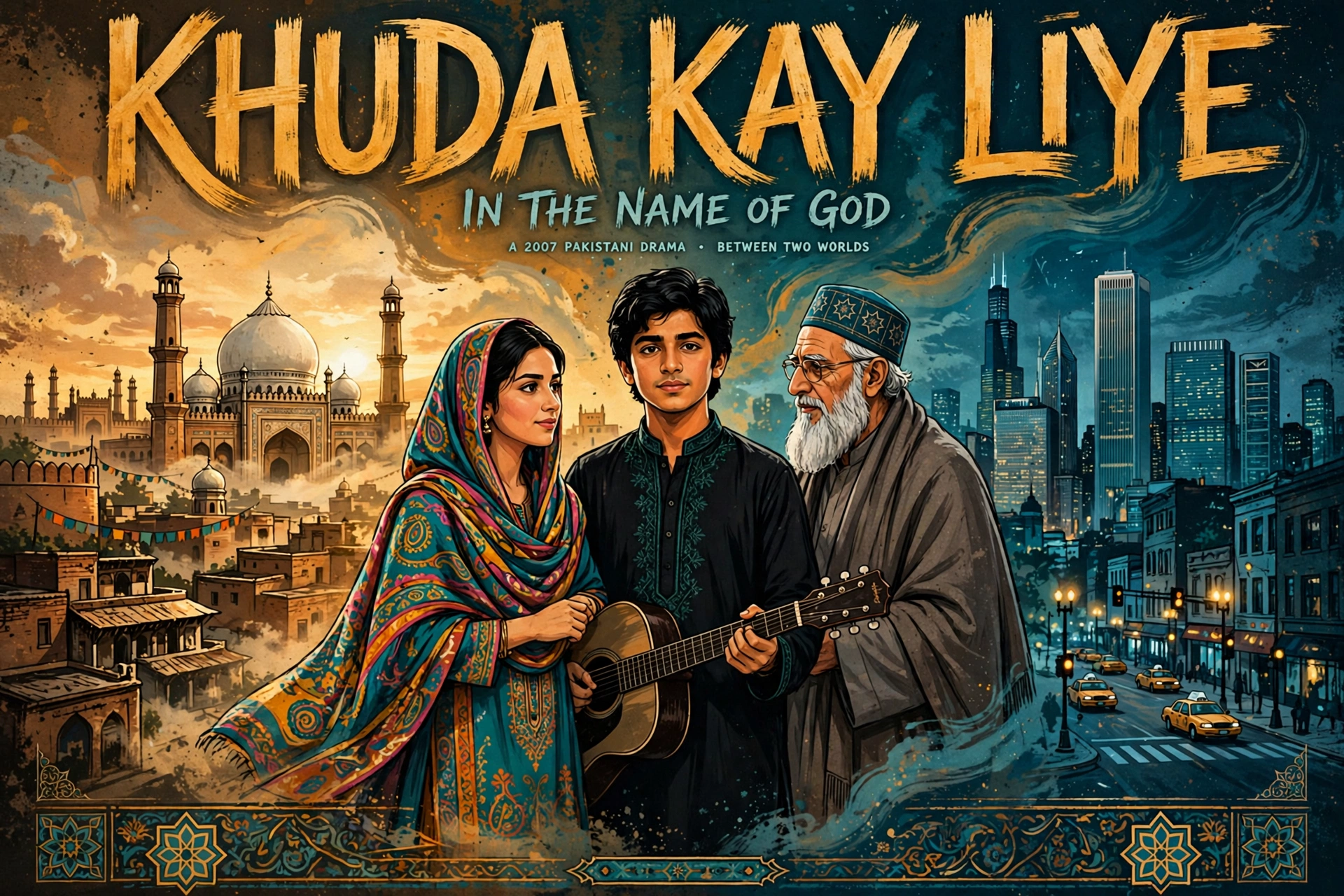
To write an honest Khuda Kay Liye review, you have to remember what Pakistani cinema looked like in 2007: an industry widely considered finished, its theatres closing, its audiences long gone to television and pirated DVDs. Into that silence stepped a television director, Shoaib Mansoor, with no conventional romance, no comedy track, no item songs — instead, a nearly three-hour argument about Islam, the West, and what the attacks of 11 September 2001 had done to ordinary Muslim lives. Released on 20 July 2007, Khuda Kay Liye — released internationally in English as In the Name of God — became a phenomenon: the film that brought families back to Pakistani cinemas, the first Pakistani film to receive a commercial release in India in over four decades, and the starting gun of the modern revival of Pakistani cinema.
It is also, watched today, a film that argues more than it dramatises, that runs long, and that delivers some of its most important ideas in a courtroom speech rather than in action. Both judgements belong in this review, because the film’s historical importance and its artistic limits come from the same source: Mansoor had things he urgently wanted to say, and he built a film sturdy enough to carry them, even when the carrying shows.
| Detail | Information |
| Release date | 20 July 2007 |
| Director | Shoaib Mansoor |
| Writers | Shoaib Mansoor |
| Genre | Drama |
| Language | Urdu, English |
| Runtime | 171 minutes |
| Budget | Rs. 6 crore |
| Lead cast | Shaan Shahid, Fawad Khan, Iman Ali, Rasheed Naz, Naseeruddin Shah |
| Our rating | 8/10 |
Mansoor (Shaan Shahid) and Sarmad (Fawad Khan) are brothers in Lahore, and together they are successful musicians — modern, popular, by every outward measure the confident face of urban Pakistan. The film’s engine is the slow divergence of their paths. Drawn to the sermons of the hardline cleric Maulana Tahiri (Rasheed Naz), Sarmad begins to remake his life: music, he is taught, is forbidden; the beard must grow; the old world must be renounced. Mansoor travels the opposite road, to Chicago, to study music — where his name, his faith and a marriage into an American family place him, after 9/11, in the path of an FBI that sees a suspect where he sees a student.
The third thread belongs to Maryam, called Mary (Iman Ali), a young British-Pakistani woman in London, happily in love and determined to choose her own life. Her father, outwardly liberal in his own arrangements, has other plans for her — plans that involve a trick, a journey to Pakistan, and a forced marriage in a remote tribal region from which escape seems impossible. Mary’s storyline is the film’s most harrowing, and the point where its three plots converge: in a Pakistani courtroom, where the case she brings becomes the stage for the film’s central question — not whether Islam is violent or peaceful in the abstract, but who gets to speak for it, and with what knowledge. Into that courtroom, late in the film, walks Maulana Wali (Naseeruddin Shah), a religious scholar whose testimony the whole film has been building towards. What he says, and what it costs each character to hear it, we will leave for the film to deliver.
Shaan Shahid as Mansoor was, in 2007, Lollywood’s biggest star, famous for a very different kind of film. His restraint here is the revelation: Mansoor’s warmth, ambition and later his brokenness are played without any of the mannerisms of his action-star persona, and the scenes of his detention and interrogation in America are gruelling precisely because Shaan lets the character be helpless. It remains one of the defining performances of his career, and it won him Best Actor honours, including at the Lux Style Awards.
Fawad Khan as Sarmad, in his film debut, has the harder arc: a good, sincere young man persuaded, sermon by sermon, into a version of faith that narrows his life and damages everyone near him. Khan plays the radicalisation without villainy — Sarmad believes, and his belief makes him dangerous and pitiable at once. The performance announced a major actor; within a few years Khan would be one of Pakistan’s biggest stars on both sides of the border.
Iman Ali as Mary, also making her film debut, carries the film’s suffering and its spine. Mary’s journey from London confidence to captivity to a courtroom is the emotional centre of the film, and Ali moves between English and Urdu, defiance and despair, with a rawness that more polish would have ruined. Rasheed Naz as Maulana Tahiri is chillingly calm — a radicaliser who never raises his voice — while Hameed Sheikh as Sher Shah and Naeem Tahir as the brothers’ father add grounded support.
And then there is Naseeruddin Shah as Maulana Wali. It is formally a special appearance, a single extended courtroom sequence, and it is the most remembered acting in the film: a scholar dismantling extremist argument with scripture, history and sorrow, delivered by one of the subcontinent’s greatest actors at full command. Skeptics may call it a lecture. It is — but it is a lecture performed like a thriller, and the film earns it by making us wait two hours to hear the other side argued at full strength.
Shoaib Mansoor came to cinema from a legendary television career — he had written and directed landmark serials and created era-defining music shows — and Khuda Kay Liye carries television’s virtues and limits into film. The virtues are clarity and courage. The film was shot across Lahore, Chicago, London and Khyber Pakhtunkhwa, and Mansoor orchestrates a genuinely multi-continental story, keeping three plotlines legible across 171 minutes without flashy technique. His camera, served by a multi-national cinematography team, observes rather than performs: Lahore’s music rooms, a Chicago campus, a stark tribal village and an American detention facility each have a distinct, unglamorous reality.
The limits are pacing and didacticism. At 171 minutes the film is long for its material; Sarmad’s transformation, though the point of the story, is charted in repetitive beats, and several scenes exist to state positions the audience has already understood. Mansoor the writer sometimes trusts dialogue where Mansoor the director should have trusted images. Yet the film’s boldest craft choice is tonal: it refuses to make its arguments through caricature. Tahiri is reasonable in manner; the FBI agents are bureaucratic rather than sadistic; the father who betrays Mary believes he is saving her. That fairness is what made the film discussable — and discussed it was, fiercely, including protests from religious groups in Pakistan who objected to its very existence. A film nobody argued with would not have mattered this much.
Music is not an ornament in this film; it is the argument’s home ground, since the question of whether music itself is forbidden runs through the brothers’ story. Rohail Hyatt, founding member of Vital Signs — the band Mansoor himself helped shape as a writer-producer in the 1980s — supervised the music, and the soundtrack blends pop craftsmanship with classical and Sufi material. Ahmed Jahanzeb and Shuja Haider produced and performed key tracks, and the singing roster runs from Saeen Zahoor to Hadiqa Kiani and Faiza Mujahid.
Two pieces define the album. “Allah Hoo,” built on Saeen Zahoor’s raw Sufi chant and reworked with electronic textures, is used at the film’s moments of greatest extremity and has outlived the film as a piece of music in its own right. “Bandeya” (in two versions, with vocals by Khawar Jawad alongside Farah Zala and, in the second, Faiza Mujahid) sets the words of Bulleh Shah into a rock-edged plea that states the film’s thesis in four minutes. The lighter title-side tracks, including “Hamaray Hain” and “Duniya Ho,” carry the brothers’ early, hopeful world. The soundtrack won Hyatt the Lux Style Award for Best Original Soundtrack, and it remains one of the essential Pakistani film albums.
What we loved:
What could be better:
Pakistani box-office figures from 2007 are unofficial press reports, and Khuda Kay Liye attracts especially inflated legends — claims of worldwide grosses as high as $10 million circulate in older material and should not be trusted. The most consistently cited figures are these: a production budget of about Rs. 6 crore (Rs. 60 million), a figure Mansoor himself quoted in interviews, and a total gross of about Rs. 15.06 crore reported in reference listings. Mansoor also noted at the time that the film earned roughly Rs. 7 crore in Pakistan alone from a release that began with only about ten prints — a remarkable result in a market with few functioning cinemas. Reports and recollections differ on the details; what no source disputes is the outcome. The film was Pakistan’s biggest commercial success of its era, ran for months, drew audiences who had not entered a cinema in decades, and then travelled: festival selection at the International Film Festival of India — the first Pakistani film in its official selection — a Silver Pyramid Award at the Cairo International Film Festival, three Lux Style Awards, and that historic Indian theatrical release in April 2008. Its real box office was the industry it revived behind it.
Yes — as cinema, and as a document of a moment when a country argued with itself on screen. Viewers coming fresh to Khuda Kay Liye should expect a drama of ideas rather than a thriller: long conversations, positions tested, lives bent by forces far larger than any villain. Its length and its lecturing streak are real flaws, and its production polish is of its modest time. But its performances endure, its central questions have not dated, and very few films anywhere can honestly claim to have changed what their national cinema believed was possible. This one can.
Our rating: 8/10 — a landmark of Pakistani cinema: imperfect, overlong, and absolutely essential.
Is Khuda Kay Liye based on a true story?
No. It is an original screenplay by Shoaib Mansoor. Its situations — post-9/11 detention of Muslim travellers, forced marriage, radical preaching — reflect widely reported realities of the period, but the characters and events are fictional.
What does the title Khuda Kay Liye mean?
It is Urdu for “For God’s Sake,” or, as the film’s English release title renders it, In the Name of God. The title is pointed: nearly every character acts claiming God’s name, and the film asks which of them has the right.
Was Khuda Kay Liye really the first Pakistani film released in India for decades?
Yes. Its April 2008 Indian release was widely reported as the first commercial Indian release of a Pakistani film in roughly 43 years, and it was also the first Pakistani film selected for the official programme of the International Film Festival of India.
Is Khuda Kay Liye suitable for family viewing?
It deals with detention, torture, forced marriage and religious extremism, and contains intense sequences. It is best suited to older teens and adults, and it rewards discussion afterwards.
Where can I watch Khuda Kay Liye (2007)?
The film is available on video platforms and streams in various regions, sometimes under its English title In the Name of God. Availability changes over time, so check your local services.