★ LATEST REVIEWS

★★★★☆ Our Rating: 8/10
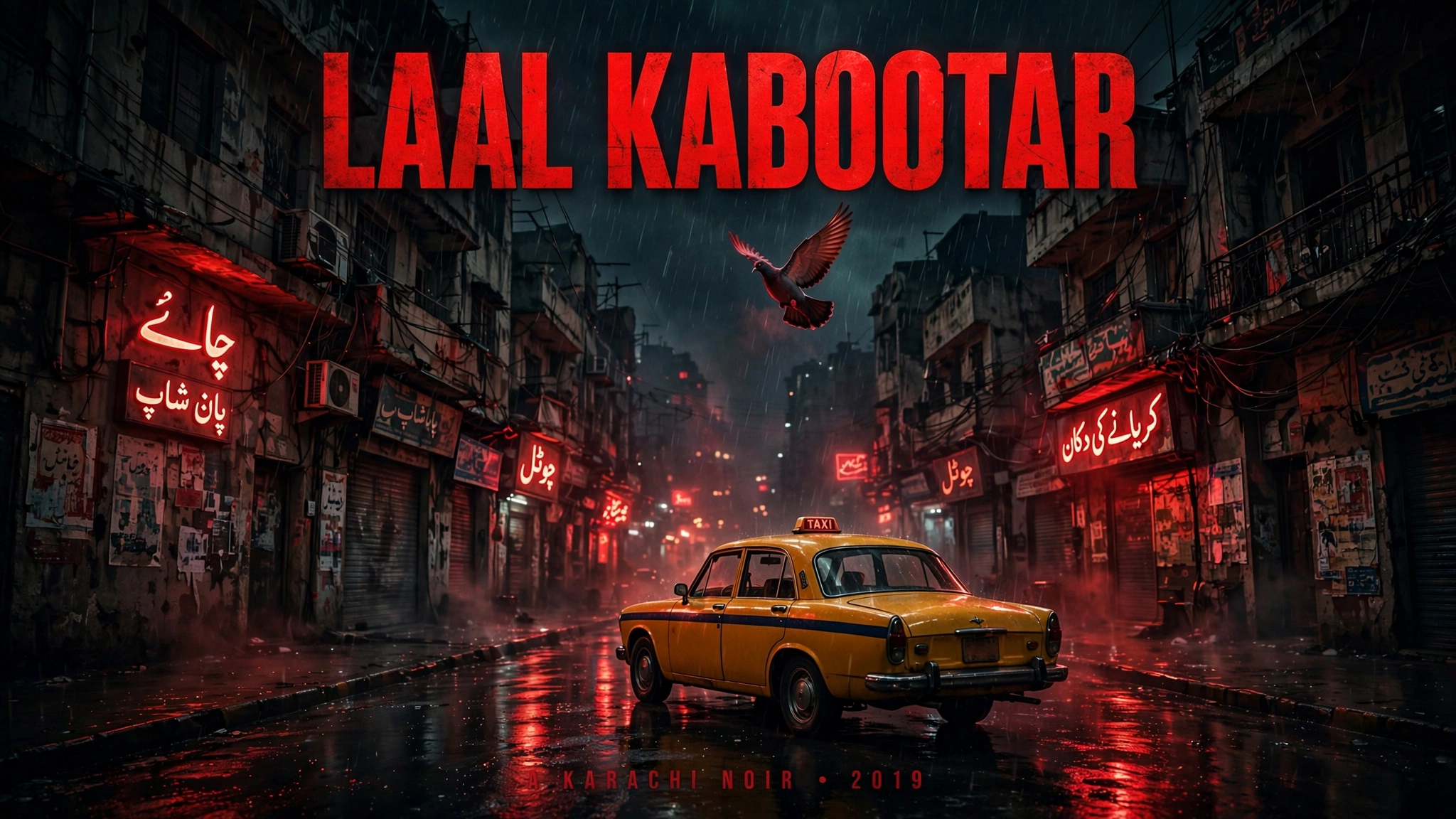
Pakistani cinema in 2019 knew how to do a wedding, a romance and a patriotic spectacle. What it almost never did was this: a tight, mean, 102-minute crime thriller set in the Karachi of target killings, stolen phones, land grabbers and taxi ranks, with no songs to hide behind and no hero to applaud. Laal Kabootar, meaning Red Pigeon, released on 22 March 2019, was director Kamal Khan’s feature debut, and it remains one of the most exciting Pakistani films of its decade precisely because it refused every comfort its industry usually insists on.
The film’s afterlife tells its own story. It was chosen as Pakistan’s official submission for Best International Feature Film at the 92nd Academy Awards. It did not secure a nomination, and nobody sensible expected it to, but the selection was a statement: this small, street-level thriller, made by a first-time feature director best known for music videos, was the film Pakistan’s own industry jury considered its finest of the year. At the Lux Style Awards it backed that judgement up, winning major honours including Best Film Director for Khan and Best Actor for its lead.
It is not flawless. The middle section circles once or twice, a supporting thread or two are thinner than the central pairing deserves, and viewers raised on polished, star-driven crime films will need a few minutes to adjust to its deliberately rough grain. Adjusted, they will find the most alive Pakistani genre film of its year.
| Detail | Information |
|---|---|
| Release date | 22 March 2019 |
| Director | Kamal Khan |
| Writers | Ali Abbas Naqvi |
| Genre | Crime, Thriller, Action |
| Language | Urdu |
| Runtime | 102 minutes |
| Lead cast | Ahmed Ali Akbar, Mansha Pasha, Rashid Farooqui, Ali Kazmi, Saleem Mairaj, Syed Mohammad Ahmed |
| Our rating | 8.0/10 |
Note on budget: no reliable production budget for Laal Kabootar has been published by its makers or by credible trade sources, so we omit the figure rather than repeat an unsourced number, as we do for many Pakistani films.
Karachi, in this film, is not a backdrop. It is the mechanism that grinds everyone. Aliya Malik (Mansha Pasha) had a life with shape to it: a home, a husband, a future being built. That ends with a killing, the kind Karachi residents know from news tickers, a man shot by unknown assailants, a case that will go nowhere. Aliya refuses the role written for her, the grieving widow who waits for a system that is not coming. She wants the men responsible found, and she is prepared to pay for help the law will not give her.
Adeel Nawaz (Ahmed Ali Akbar) belongs to the city’s other economy. A taxi driver and small-time hustler who snatches what he can and dreams, with total sincerity, of one thing: a visa, a ticket, Dubai, out. When Aliya’s search and Adeel’s schemes collide, the film settles into its real shape, an uneasy partnership between a woman with money, grief and a target, and a man with street knowledge, no money and a talent for trouble. Around them moves a supporting cast of fixers, relatives, policemen and predators, each representing one more way the city eats its own.
Where the partnership leads, whom it endangers, and what justice can even mean in a place where every door has a price, we will leave for your viewing. The film earns its reveals, and its final movement is stronger for knowing less in advance.
Ahmed Ali Akbar as Adeel Nawaz: This is the performance that announced Akbar as a film actor of the first rank, and it won him the Lux Style Award for Best Actor. Adeel is a chancer, and Akbar plays him fast, funny and faintly desperate, a man whose mouth runs ahead of his judgement because silence would mean admitting how trapped he is. The genius of the work is in the slow leak of conscience into the performance. Akbar never asks for our sympathy, which is exactly why the character’s late choices land.
Mansha Pasha as Aliya Malik: Pasha has the harder assignment. Aliya must be grieving and steely at once, and the film gives her none of the big breakdown scenes a lesser drama would rely on. She plays control as a form of pain: precise speech, direct eyes, a woman holding herself together by deciding, every day, to pursue the people who broke her life. Her scenes with Akbar crackle because their energies are perfect opposites, his noise against her stillness, his improvisation against her plan.
Rashid Farooqui brings lived-in authority to his supporting role and was honoured with the Lux Style Award for Best Supporting Actor, a reminder that this film’s world feels real because even its smallest inhabitants are cast and played with care. Ali Kazmi as Noman Malik, Saleem Mairaj and veteran Syed Mohammad Ahmed fill out a Karachi of relatives, threats and compromised decency, each sketched in a few scenes and each believable. There is no star turn in this film that breaks its reality, and that discipline starts with its two leads.
Kamal Khan came to features from music videos, and he brings a video director’s gifts, rhythm, compression and an instinct for the telling image, without the usual video director’s curse of empty flash. His Karachi is shot by cinematographer Mo Azmi, who had shot Asim Abbasi’s Cake, and the two find a visual language for the city that Pakistani screens had rarely used: handheld urgency in the streets, sodium light and shadow, affluent interiors that feel colder than the slums look warm. The camera does not tour Karachi. It runs errands in it, and the difference is the film’s whole aesthetic.
Ali Abbas Naqvi’s screenplay deserves equal credit. At 102 minutes this is, by local standards, a radically economical film, and its structure, two storylines braided until they tighten into one, shows a confidence in the audience that Pakistani mainstream writing often lacks. Dialogue is street-true, mixing Urdu with the city’s everyday slang, and the film trusts viewers to keep up rather than pausing to explain itself. The sound design is a particular triumph: traffic, generators, distant sirens and sudden, ugly bursts of violence create a Karachi you hear as much as see, and the film’s quieter moments feel genuinely dangerous because the city never stops muttering behind them.
Reservations, honestly stated: the pacing dips in the second act, where the partnership’s mechanics are established at slightly repetitive length, and one or two figures at the edges of the conspiracy remain functions rather than people. The film’s low-budget roughness also occasionally shows in night exteriors. None of it overturns the achievement. This is a debut that knows exactly what film it is.
Music in Laal Kabootar works in two distinct layers, and both serve the thriller rather than interrupting it. Taha Malik, credited as music director, gives the film its street pulse, including the title-associated track performed with Zoe Viccaji, and the soundtrack draws on voices rooted in Pakistan’s own musical soil, with contributions associated with the film including Sanam Marvi and Mai Dhai, alongside rap and urban textures that fit a Karachi of taxi radios and phone speakers. Crucially, there are no picturised song-and-dance numbers. Music exists inside the world, or underneath it.
The background score, by Danial Hyatt, is the subtler weapon. Hyatt builds tension from low, restless electronics and sparse percussion rather than orchestral alarm, so that scenes of ordinary driving or waiting carry a hum of risk. When violence comes, the score’s restraint makes it feel more sudden and more real. Together, Malik’s songs and Hyatt’s score gave the film a sonic identity critics singled out at release, and they remain a model for how a Pakistani thriller can sound contemporary without borrowing another industry’s voice.
What we loved:
What could be better:
Pakistani box-office reporting is inconsistent, and this film is a good example of why caution matters. The most widely cited reference figure for Laal Kabootar is a total of about Rs. 3.40 crore. By commercial standards that is a modest result, and the film was not a box-office juggernaut in a year when big romances and comedies took the large totals. Its opening was limited, its genre was untested locally, and it had no conventional star draw.
Measured differently, it outperformed almost everything released alongside it. Its television premiere followed on Geo Entertainment on 31 August 2019, its festival and critical profile travelled, the Academy submission gave it a permanent place in Pakistani film history, and its Lux Style Awards haul confirmed the industry’s own verdict. The honest summary is that Laal Kabootar was a critical and reputational hit whose theatrical earnings were small. Its real return has been influence: proof, still cited by younger Pakistani filmmakers, that a lean local thriller could be made, celebrated and remembered.
Yes, especially if you believe Pakistani cinema can be more than weddings and war cries. Laal Kabootar is lean, tense and acted with absolute conviction, and its Karachi will stay with you longer than many bigger films’ entire worlds. It asks for your attention for 102 minutes and repays it with the rarest thing in local genre cinema: an ending that feels like it happened, rather than one that was arranged.
Our rating: 8.0/10 — A gritty, gripping Karachi thriller that pointed Pakistani cinema down a new street.
Is Laal Kabootar based on a true story?
No. Its characters are fictional, written by Ali Abbas Naqvi, but its world of street crime, land grabbing and unsolved killings is drawn from the documented realities of life in Karachi.
Why was Laal Kabootar chosen as Pakistan’s Oscar entry?
It was selected as Pakistan’s official submission for Best International Feature Film at the 92nd Academy Awards in 2019, recognising its critical acclaim and craft. It was not ultimately nominated by the Academy.
What does Laal Kabootar mean?
It translates from Urdu as “Red Pigeon.” The title is used as a symbolic motif for the city and its hunted, restless inhabitants rather than as a literal plot element.
How long is Laal Kabootar and what language is it in?
The film runs 102 minutes and is in Urdu, with Karachi’s everyday street slang woven through the dialogue. Subtitled versions circulated with its festival and international exposure.
Is Laal Kabootar suitable for family viewing?
It is an adult crime thriller dealing with murder, street violence and strong street language, presented realistically rather than graphically for effect. It is best suited to adult viewers, not young children.