★ LATEST REVIEWS

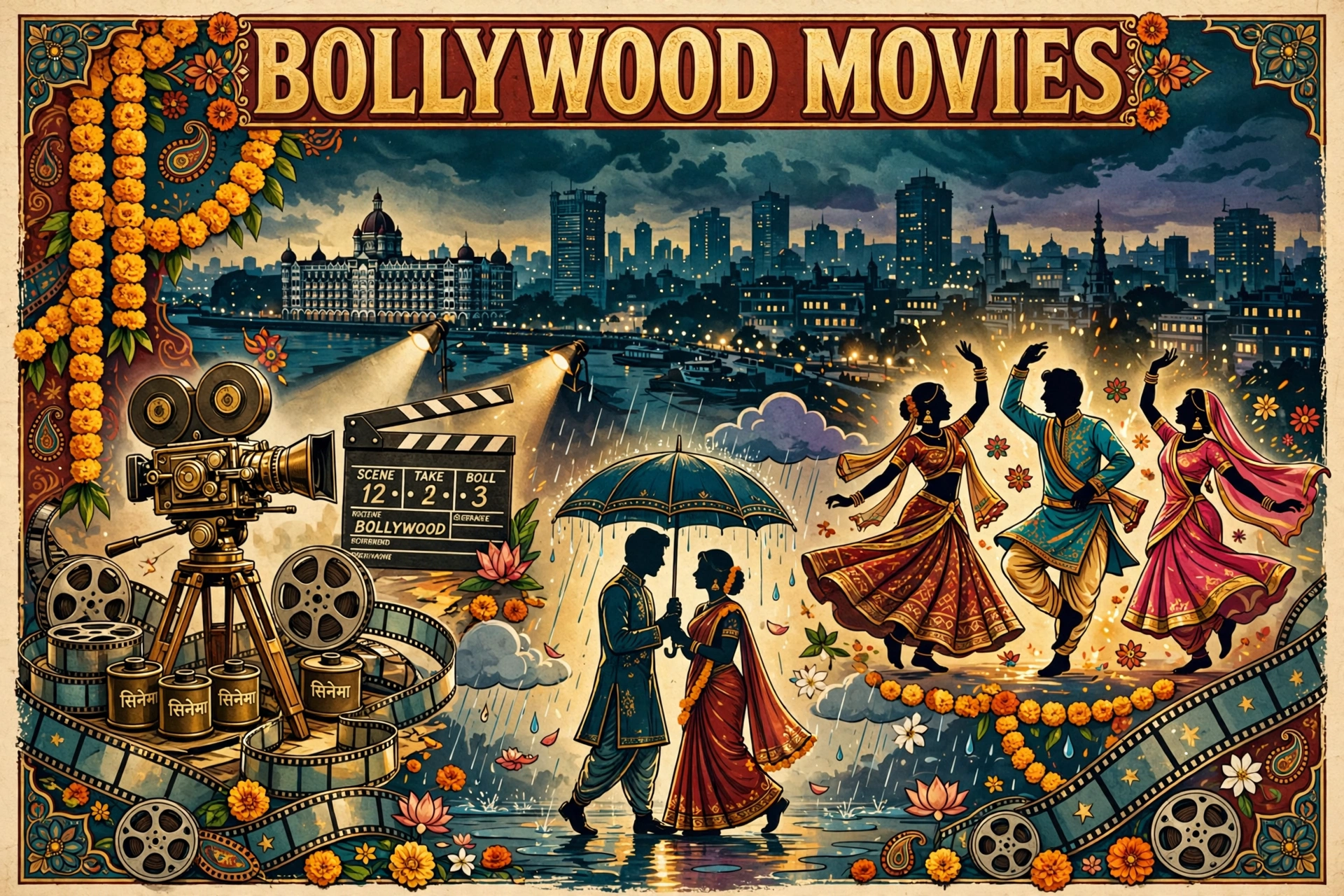
Ask a film lover anywhere in the world to picture Indian cinema, and one image arrives before all others: a hero and heroine in brilliant colour, music swelling, a hundred dancers moving as one, and a story big enough to hold love, family, comedy and heartbreak in a single evening. That image is Bollywood — the Hindi-language film industry of Mumbai — and it is one of the most beloved storytelling traditions on Earth.
Yet Bollywood is also one of the most misunderstood. Outsiders often reduce it to song-and-dance spectacle, while casual viewers at home sometimes take its depth for granted. The truth is far richer. Bollywood movies carry more than a century of history, from silent mythologicals to the angry-young-man epics of the seventies, from the globe-conquering romances of the nineties to the lean, daring films of the streaming age. This guide walks you through all of it: where Bollywood came from, what makes its films unmistakably themselves, and the classics and modern essentials you should watch first — whether you are a complete beginner or a lifelong fan filling in the gaps.
Bollywood is the informal name for the Hindi-language film industry based in Mumbai, India’s financial and entertainment capital. The word itself is a playful blend of “Bombay” — Mumbai’s former name — and “Hollywood,” and while some industry veterans dislike the nickname, it has stuck around the world as shorthand for a very specific kind of cinema.
Two clarifications matter. First, Bollywood is not all of Indian cinema. India is a multilingual giant, and its Telugu, Tamil, Malayalam, Bengali, Kannada, Marathi and other industries each have their own stars, styles and proud histories — several of which we cover in their own FlickZada categories. Bollywood is the Hindi-language branch of that enormous family, historically the most widely distributed across India and the diaspora.
Second, Bollywood is not a genre. Within it you will find crime sagas, courtroom dramas, gentle comedies, historical epics, horror films and quiet independent works. What unites them is less a subject than an emotional grammar: heightened feeling worn openly, music treated as the story’s bloodstream rather than decoration, and a deep belief that a film should give its audience everything — laughter, tears, romance, action and moral weight — in one sitting. Once you learn to read that grammar, Bollywood movies stop seeming “over the top” and start seeming generous.
Indian cinema begins with Dadasaheb Phalke, whose Raja Harishchandra (1913) is celebrated as India’s first full-length feature film. Phalke drew on the country’s great epics and stage traditions, and the silent era that followed built a thriving industry of mythologicals, devotionals and social dramas. In 1931, Ardeshir Irani’s Alam Ara gave Indian audiences their first talkie — and, significantly, its songs. Sound arrived in Indian cinema holding music by the hand, and the two have never been separated since. Playback singing, in which professional singers lend their voices to actors on screen, soon became the industry standard and created a parallel pantheon of beloved vocalists whose fame rivalled the stars themselves.
The decades after independence in 1947 are remembered as Bollywood’s golden age, and the label is earned. A newly free nation was asking hard questions about poverty, tradition, corruption and hope, and its filmmakers answered on screen. Raj Kapoor played the beloved tramp, a Chaplin-inspired everyman whose films mixed sentiment with social conscience. Guru Dutt made aching, luminous masterpieces about artists crushed by a material world. Bimal Roy brought literary depth and rural realism, while Mehboob Khan’s Mother India (1957) — the story of a village mother holding her family and her dignity together against impossible odds — became a national epic and earned India an Academy Award nomination for Best Foreign Language Film.
The golden age also perfected the industry’s musical soul. Composers and lyricists were stars in their own right, and a film’s album could carry it to glory. The era’s black-and-white classics remain the foundation everything later was built on: romantic, idealistic, and convinced that cinema should comfort and challenge in equal measure.
The 1970s tore up the gentle template. Urban frustration, unemployment and disillusion with authority produced a new hero: the angry young man, embodied by Amitabh Bachchan in a run of films written by the legendary duo Salim–Javed. These were stories of dock workers, smugglers and vigilantes — men failed by the system who decided to settle accounts themselves. Alongside them flourished the “masala” film, a deliberate mixture of action, romance, comedy, melodrama and music designed to give every member of the family something to cheer.
The decade’s towering achievement is our review of Sholay (1975) — Ramesh Sippy’s dacoit Western about two small-time crooks hired to defend a village from the sadistic bandit Gabbar Singh. Dismissed by many critics on release, it ran for five continuous years at a single Mumbai theatre and became woven into the language itself — its dialogue is still quoted daily by people born decades later. If one film explains what popular Hindi cinema can do at its best, it is this one.
By the late 1980s, video piracy and formula fatigue had battered the industry. The 1990s answered with gloss, melody and romance. A new generation of stars — Shah Rukh Khan, Salman Khan, Aamir Khan, Kajol, Madhuri Dixit and their peers — headlined family-centred love stories shot in Switzerland, London and other dream locations, aimed squarely at both Indian audiences and the vast diaspora abroad.
The emblem of the era is Dilwale Dulhania Le Jayenge (1995), Aditya Chopra’s romance about two young Indians raised in London who fall in love on a European trip and then must win over a traditional father. Its run at Mumbai’s Maratha Mandir theatre became the stuff of legend, continuing for decades and turning the film into a rite of passage for generations of couples. Our Dilwale Dulhania Le Jayenge review explores why this seemingly simple love story permanently changed what a Bollywood blockbuster looked and sounded like.
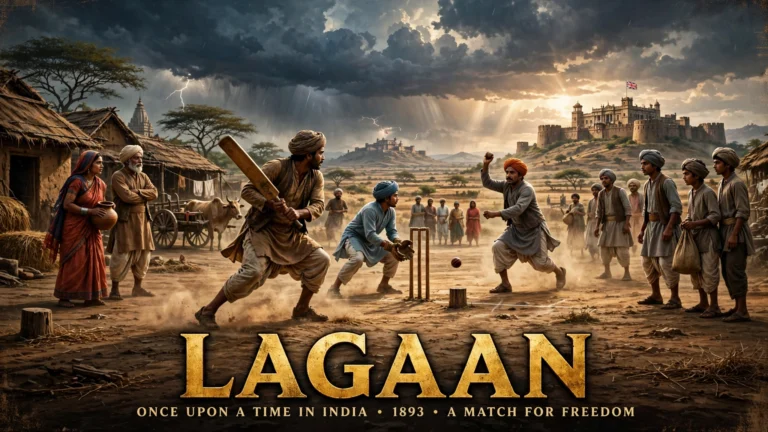
The new century split Bollywood in two productive directions. Multiplex cinemas in the cities rewarded smaller, smarter films: stories about dyslexia and childhood, college friendship, small-town dreamers and moral dilemmas, told without the old formulas. Lagaan (2001), a period drama about a village cricket match played against British colonial officers, carried Hindi cinema to an Academy Award nomination and proved a three-hour epic about tax and cricket could thrill the whole world. Rajkumar Hirani’s 3 Idiots (2009) turned a comedy about engineering college into a national argument about education and success, while his PK (2014) used an innocent alien’s questions to gently interrogate organised religion — and audiences rewarded the courage.
At the same time, a darker, more rooted cinema emerged from the heartland: sprawling crime epics set in coal country, twisted small-town thrillers, and gritty stories that owed nothing to Switzerland. Bollywood was growing up in public, and its audience was growing with it.
The last decade has reshaped the industry again. Streaming platforms created a second home for mid-budget dramas and bold experiments, while the big screen answered with scale. After the pandemic years shook theatrical business everywhere, the 2023 one-two punch of Pathaan and Jawan — both fronted by Shah Rukh Khan — reminded everyone what a true event film feels like in a packed Indian cinema. Meanwhile, the lines between India’s industries have blurred: dubbed releases, shared stars and nationwide openings have created a “pan-India” era in which a Telugu or Kannada spectacle and a Hindi blockbuster compete in the same weekend. Bollywood today is at once more global, more competitive and more varied than at any point in its history.
Spend enough time with Hindi cinema and certain signatures become unmistakable pleasures rather than quirks.
Music as storytelling. In most of world cinema, a song stops the story. In Bollywood, the song is the story — it says what the characters cannot say aloud: first love, separation, celebration, grief. A great Bollywood album is a parallel film told in melody, which is why composers and playback singers enjoy a fame here that they enjoy almost nowhere else.
The interval. Indian cinemas traditionally pause mid-film, and classic Bollywood scripts are engineered around that break — a twist, a revelation or a cliffhanger placed exactly at the halfway mark. Even today, many films are secretly two films: the one before the interval and the one after.
Emotional maximalism. Bollywood has never believed that restraint is automatically superior. Feelings are declared, families are sacred, mothers are revered, villains are hissable and coincidences are fate wearing a disguise. Judged by the standards of minimalist European cinema this looks excessive; judged on its own terms, it is an operatic style with its own discipline and rewards.
The masala mix. Action, comedy, romance, drama and song are combined in a single film the way a thali combines flavours on one plate. The modern industry has drifted toward single-genre films, but the masala instinct — never let the audience get only one thing — remains the industry’s DNA.
The star system. For most of its history, Bollywood has been star-driven to a degree even Hollywood rarely matches: films are conceived as vehicles, openings are events, and a handful of surnames have dominated for decades. The healthiest modern trend is the audience’s growing willingness to reward content over casting — but a true star entrance, held a beat too long while the theatre erupts, remains one of cinema’s great live experiences.
Every list invites argument, and Bollywood fans argue gloriously. This one is built as a journey: begin with the foundational classics, then move through the modern landmarks that show what the industry can do now. Each title links to our full FlickZada review.
If the runtimes and unfamiliar style worry you, start where the doorway is widest. 3 Idiots is the friendliest first Bollywood film ever made — funny, warm and not a frame wasted. Follow it with Andhadhun for proof of the industry’s modern thriller craft, then Dangal for the big emotional epic experience. Only then go back to Sholay: watching the foundation after you know the house makes every scene land harder. Save Gangs of Wasseypur for a weekend — it is really two films and rewards total immersion — and keep Dilwale Dulhania Le Jayenge for when you are ready to simply surrender to romance the way a billion people have before you.
Wherever you start, watch with subtitles, watch in the original Hindi, and give the songs a chance to work on you. By the third film, most newcomers stop noticing the style and start feeling it.
A final piece of orientation: Bollywood is one great industry among several. The Telugu industry (Tollywood) currently produces India’s biggest spectacles, Tamil cinema (Kollywood) blends star power with social fire, and Malayalam cinema (Mollywood) is revered by critics for the finest writing in the country. Films now routinely cross these borders through dubbing and simultaneous nationwide releases, and many of today’s Hindi stars share screens and release weekends with their southern counterparts. If this guide is your first step into Indian cinema, treat it as the front door of a very large house — our World Cinema beginner’s guide maps the rest of the rooms.
No. Bollywood is the Hindi-language industry based in Mumbai. India has many major film industries — Telugu, Tamil, Malayalam, Kannada, Bengali and others — each with its own language, stars and traditions. Bollywood is the largest and most widely known internationally, but it is one branch of a much bigger tree.
Music entered Indian cinema with its very first talkie in 1931 and never left. In the Bollywood grammar, songs carry emotion and story rather than interrupting them — they express love, grief and celebration that dialogue alone cannot hold. Many viewers consider a great soundtrack half the film.
Classic Bollywood films often ran close to three hours, built around a mid-film interval. Modern releases are usually shorter and tighter, and many recent hits run a little over two hours. The twelve films in our must-watch list above include both the grand old epics and lean modern works, so you can choose by your appetite.
We suggest 3 Idiots for pure enjoyment and easy entry, Andhadhun if you prefer thrillers, and Dangal if you want the full big-hearted epic experience. All three are reviewed in depth on FlickZada, with honest ratings and no spoilers.
Not at all. Those genres built the industry’s fame, but modern Bollywood produces acclaimed crime sagas like Gangs of Wasseypur, courtroom and social dramas, biopics, horror-comedies and psychological thrillers. The industry’s range is the biggest surprise waiting for new viewers.
Bollywood movies are not a guilty pleasure, a curiosity or a stepping stone to “serious” cinema. They are one of the world’s great popular art forms — a century of craft in how to make an audience laugh, cry, gasp and sing inside a single story. Start with the twelve films above, argue with our ratings, and then keep going: the industry releases more stories every year than any viewer could finish, and somewhere in that flood is the film that will make you a lifelong fan. When you find it, you will know exactly why the world fell in love with Bollywood — and FlickZada will be here, reviewing it all honestly, one film at a time.