
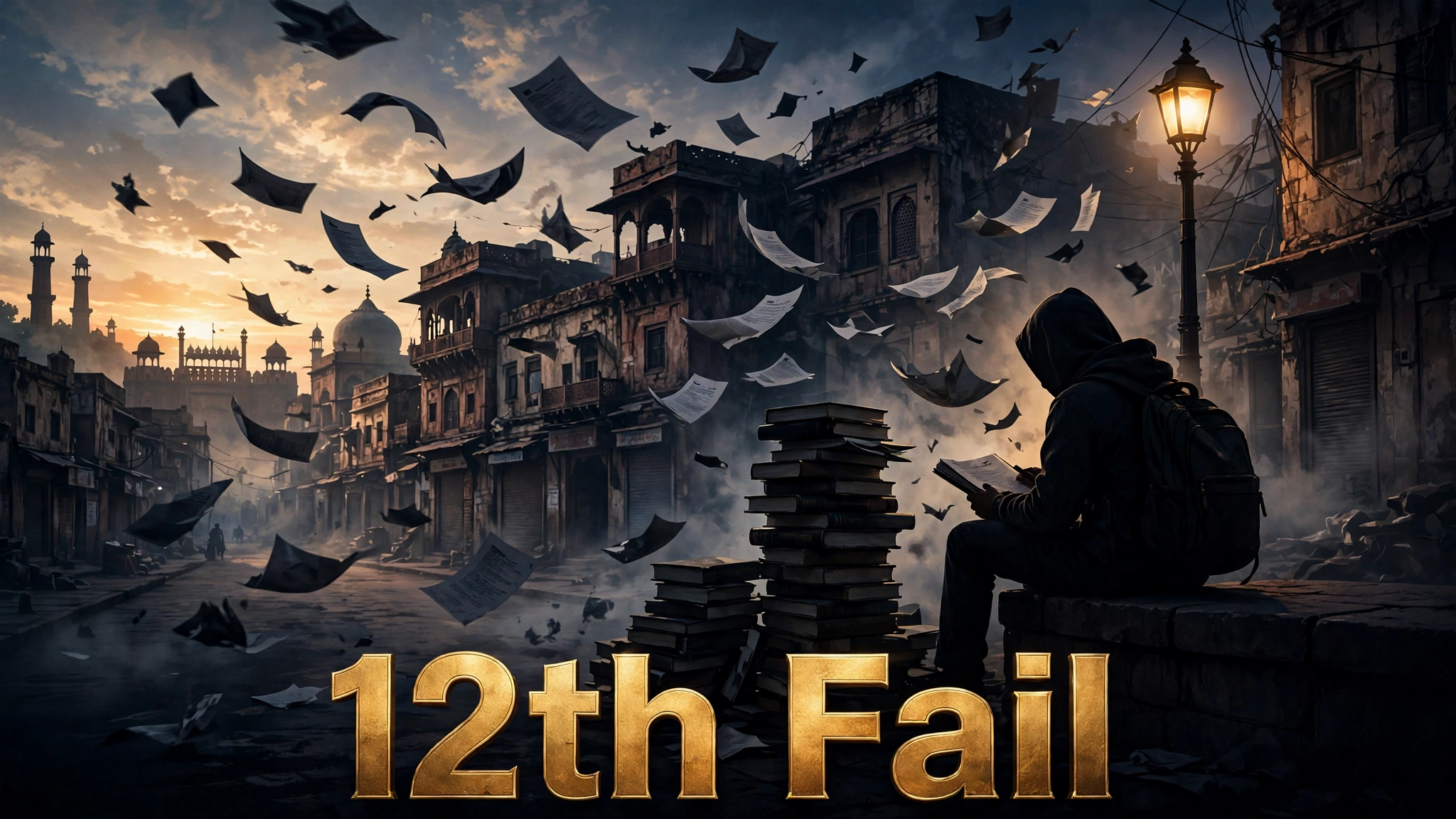

12th Fail (2023) Review – Restart, and Mean It
Some films arrive with noise. Others arrive quietly and then refuse to leave your head for weeks. 12th Fail belongs firmly to the second group. Released without the usual carpet of hoardings and dance-number promotions, this small Hindi drama built its entire journey on viewers telling other viewers: you have to see this one. That kind of word of mouth cannot be bought, and it cannot be faked for long either. A film has to actually move people for strangers to become its publicity team.
At its heart, this is not really a film about an examination. The Union Public Service Commission test is the mountain in the distance, yes, but the real subject is much closer to everyday life: what happens after you fail in public, in a system where a mark sheet is treated like a character certificate. Anyone who has ever been called average, written off by a teacher, or quietly pitied by relatives will recognise something in Manoj Kumar Sharma’s story. You do not need to have attempted the civil services to feel the sting of those early scenes, or the lift of the later ones.
What makes the film special is its refusal to turn struggle into a glossy montage. Poverty here is not a backdrop for inspiration posters. It is power cuts, borrowed money, flour-mill shifts, and rooms so crowded that privacy is a rumour. Yet the film is never miserable for the sake of it. There is warmth, humour, and a stubborn kind of hope running through it from start to finish.
In this review, we will give you an honest breakdown of the story, the performances, the craft, the music, and the box office journey — and tell you plainly whether 12th Fail deserves your time.
Quick Facts: 12th Fail at a Glance
| Detail | Information |
|---|---|
| Release date | 27 October 2023 |
| Director | Vidhu Vinod Chopra |
| Writers | Vidhu Vinod Chopra (based on the book by Anurag Pathak) |
| Genre | Biographical drama |
| Language | Hindi |
| Runtime | 147 minutes |
| Budget | ₹20 crore |
| Lead cast | Vikrant Massey, Medha Shankar, Anant V Joshi, Anshumaan Pushkar, Priyanshu Chatterjee |
| Our rating | 8.7/10 |
The Story: From a Village Classroom to Delhi’s Exam Maze (Spoiler-Free)
Manoj grows up in a village in the Chambal region, in a family where honesty is valued but money is painfully scarce. His father holds on to his principles even when those principles cost the household dearly. At school, Manoj’s academic life takes a humiliating turn when a crackdown on cheating — led by a principled police officer whose integrity leaves a deep mark on the boy — wipes out the shortcut he and his classmates had been relying on. He fails his Class 12 examinations, and that failure becomes the title and the turning point of his life.
Instead of shrinking into the future others have planned for him, Manoj decides to aim at one of the toughest goals available to a young Indian: the civil services. The road first takes him to Gwalior and then to Delhi, where thousands of hopefuls live in tiny rooms, attend coaching classes, work odd jobs, and try to keep their self-respect intact while the years slip past. Along the way he meets fellow aspirants who become his support system, a mentor figure who tells him uncomfortable truths, and Shraddha, a fellow student whose own ambitions are just as serious as his.
The film follows the grind honestly: the attempts, the near-misses, the self-doubt, and the small decisions that separate giving up from starting again. We will not reveal how his final attempts unfold or where his journey lands. What we can say is that the last stretch earns its emotion because everything before it has been shown without shortcuts.
Performances: Quiet Work That Hits Hard
Vikrant Massey as Manoj Kumar Sharma: This is a performance built from small things — a hopeful smile that fades half a second too late, shoulders that carry exhaustion before the dialogue admits it. Massey never plays Manoj as a hero in waiting. He plays him as an ordinary, sometimes naive young man whose one extraordinary quality is that he keeps getting up. That ordinariness is exactly why the big moments land. When success or failure finally arrives on his face, you feel you have lived the years with him.
Medha Shankar as Shraddha Joshi: Shankar brings a calm steadiness that balances Massey’s intensity. Shraddha is not written as a prize for the hero or a shoulder kept ready for crying scenes. She has her own examination, her own family pressures, and her own spine. Shankar plays her with warmth but never softness for its own sake, and the romance grows out of mutual respect, which makes it far more believable than the usual filmy love track.
Anant V Joshi as Pritam Pandey: As Manoj’s friend and fellow aspirant, Joshi supplies both comic relief and one of the film’s most human arcs. Ambition in a crowded race does strange things to friendships, and his track quietly asks how much generosity survives when everyone is competing for the same few seats.
Anshumaan Pushkar and Priyanshu Chatterjee: Pushkar is affecting as the friend whose own dreams keep slipping away, representing the many aspirants whose stories do not end in selection lists. Chatterjee, as the honest officer who unknowingly changes Manoj’s life early on, makes a lasting impression in limited screen time. His integrity is the spark for the whole story, and he plays it without a trace of self-importance.
Direction and Technical Craft
Vidhu Vinod Chopra directs with a restraint that suits the material. This is a filmmaker who could easily have underlined every emotional beat with swelling music and slow motion, and he mostly chooses not to. Scenes are allowed to play out in real spaces, with real clutter. The camera observes the coaching-hub lanes of Delhi, the cramped rooms, the libraries and tea stalls, and lets you absorb how an entire economy runs on the hopes of young people who have left home with one bag and one dream.
The cinematography by Rangarajan Ramabadran favours natural light and honest framing over beauty shots. Village sequences feel sun-baked and dusty; Delhi feels grey, crowded, and tiring, which is precisely the point. There is a visual honesty here that matches the story’s theme: no filters, no cheating, in life or in the frame.
Editing by Jaskunwar Kohli keeps a long, episodic journey moving. Covering years of preparation in 147 minutes without making the film feel like a summary is a genuine achievement. A few transitions are abrupt, and one or two subplots resolve a little neatly, but the overall rhythm works — the film breathes where it should and tightens where the pressure needs to rise.
There are no visual effects to speak of, and none are needed. The production design does the heavy lifting instead: examination halls, bookshops stacked with guides, and hostel rooms that tell you everything about their occupants before anyone speaks.
Music and Background Score
Shantanu Moitra’s music is used the way good film music should be used — sparingly, and in service of the scene. The songs do not stop the story to perform for you. Instead, they slip in as part of the aspirants’ world: a melody overheard during a low phase, a tune that carries the feeling of a fresh start. The theme of beginning again, captured in the film’s now-famous “restart” spirit, is woven through the score rather than hammered home in a single anthem.
The background score deserves particular credit for knowing when to stay silent. Some of the most powerful moments — a result being read, a long walk home, a quiet conversation between friends — play with little more than ambient sound. When the music does rise, it rises because the character has earned the moment, not because the audience needs to be instructed to feel something. In an era of loud, wall-to-wall scoring, that discipline stands out.
If there is a criticism, it is that the album, heard separately from the film, feels modest. These are not tracks designed to top wedding playlists. But judged by what film music is actually for, the score does its job beautifully.
What Works and What Doesn’t
What we loved:
- A lead performance from Vikrant Massey that is honest, layered, and completely free of hero-posturing
- Writing that treats failure, poverty, and the coaching industry with respect instead of melodrama
- A romance built on equality and shared ambition rather than filmy clichés
- An ending stretch that earns genuine tears because the struggle before it was never glossed over
What could be better:
- The middle section slightly repeats the cycle of attempt and setback, and a few minutes could have been trimmed
- A couple of supporting characters, especially in the village portion, get less depth than their early scenes promise
- Viewers expecting a fast-paced thriller structure may find the deliberate pacing slow in the first half
Box Office: The Little Film That Refused to Slow Down
Made on a modest budget of around ₹20 crore and released on a limited number of screens on 27 October 2023, 12th Fail was never expected to be a box office story. It opened small, collecting just over ₹1 crore on its first day in India. Then something rare happened: audiences became its marketing department. Weekend after weekend, the film held on, grew in several circuits, and eventually finished its theatrical run with a worldwide gross of over ₹69 crore — more than three times its production budget.
That figure needs context to be appreciated. This was a film with no established box office star in the lead, no chartbuster album driving pre-release buzz, and a subject — examination failure — that most producers would call uncommercial. Its success was a clear verdict from the audience: sincerity sells, provided you give it time. The film’s second life on streaming only widened its reach, turning it into one of the most talked-about Hindi films of its year and a regular recommendation in conversations about meaningful cinema.
Verdict: Should You Watch It?
Yes — and not just if you are preparing for an examination. 12th Fail works because it understands something universal: the gap between who you are told you are and who you might still become. It respects the intelligence of its audience, trusts quiet performances over loud speeches, and treats honesty not as a slogan but as a daily, costly practice. It is not flawless — the pacing dips in the middle and a few threads tie up quickly — but its heart and craft place it among the finest Hindi dramas of recent years. Students will see themselves in it. Parents, we suspect, will see themselves too.
Our rating: 8.7/10 — A sincere, beautifully acted drama that turns one man’s restart into everyone’s reminder.
Frequently Asked Questions
Is 12th Fail based on a true story?
Yes. The film is based on Anurag Pathak’s book about the real-life journey of Manoj Kumar Sharma, who overcame academic failure and poverty to join the Indian Police Service, and Shraddha Joshi, who became an Indian Revenue Service officer.
Is there a sequel to 12th Fail?
No sequel has been announced. The film tells a complete, self-contained story, and its ending leaves Manoj’s journey at a natural resting point.
What language is 12th Fail in, and are subtitles available?
The film is in Hindi, with some English used naturally in examination and interview settings. Subtitled versions are widely available, so non-Hindi speakers can follow it comfortably.
Where can I watch 12th Fail?
Availability changes by region and over time. Check the major streaming services and rental platforms in your country, as the film has had a wide digital release following its theatrical run.
What is the runtime and age rating of 12th Fail?
The film runs for 147 minutes and carries a U certificate in India, meaning it is suitable for general audiences, including family viewing.