★ LATEST REVIEWS

Our Rating: ★★★★★ 9/10
A quick clarification before anything else, because it shapes this entire Gangs of Wasseypur review: this is a review of Gangs of Wasseypur as the single film it was made to be. Anurag Kashyap shot one enormous crime epic running over five hours, screened it that way at the Cannes Directors’ Fortnight in May 2012, and only split it into two parts — released in India on 22 June and 8 August 2012 — because no exhibitor would programme a film of that length. Judging Part 1 alone is like judging half a novel. Judged whole, it is one of the most consequential Hindi films of its generation: the movie that proved a regional, profane, star-free crime saga, rooted in the coal belt of Dhanbad, could command national attention and lasting cult devotion.
It is also, honestly, a demanding watch. It spans roughly seven decades, introduces dozens of significant characters, kills many of them without ceremony, and assumes the viewer is keeping up. Its violence is abrupt and ugly rather than stylish, its humour is pitch black, and its second half changes protagonist, tone and pace so completely that some viewers admire Part 1 and merely respect Part 2. This review will argue the whole is greater than either half — while naming exactly where the sprawl costs it.
Below: the story kept spoiler-free, the performances that launched careers, the folk-soaked music that became a phenomenon of its own, and box-office figures handled carefully, because Indian trade numbers from 2012 deserve exactly that caution.
| Detail | Information |
|---|---|
| Release date | 22 June 2012 (Part 1) and 8 August 2012 (Part 2), India; premiered May 2012 at Cannes |
| Director | Anurag Kashyap |
| Writers | Zeishan Quadri (story); Akhilesh Jaiswal, Anurag Kashyap, Sachin K. Ladia, Zeishan Quadri (screenplay) |
| Genre | Crime, Drama, Action |
| Language | Hindi |
| Runtime | 319 minutes combined (Part 1: 160 minutes; Part 2: 159 minutes) |
| Budget | Approx. ₹18.5 crore combined (reported as approx. ₹9.2 crore per part) |
| Lead cast | Manoj Bajpayee, Nawazuddin Siddiqui, Richa Chadha, Tigmanshu Dhulia, Pankaj Tripathi, Huma Qureshi, Reema Sen, Piyush Mishra |
| Our rating | 9/10 |
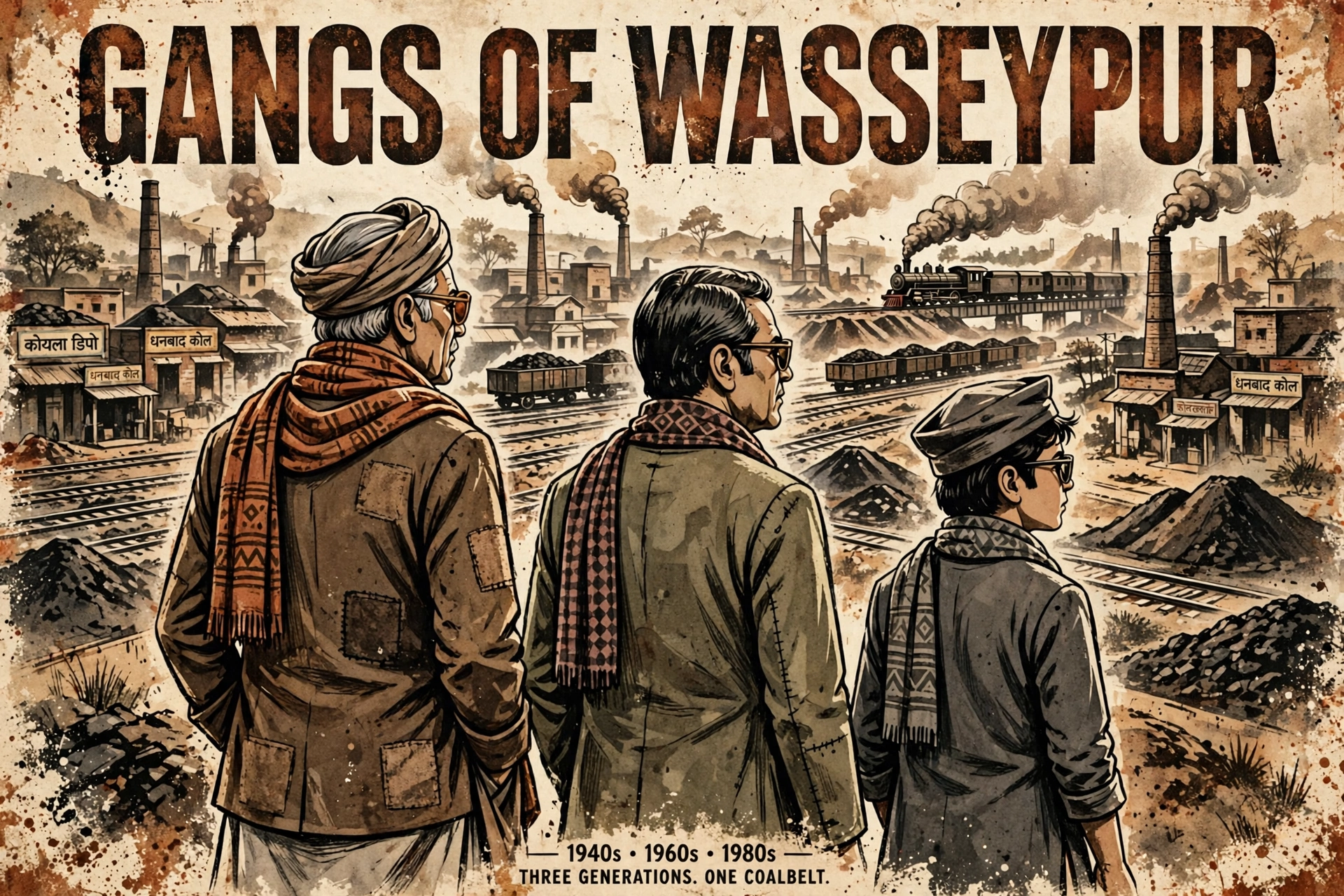
Wasseypur, a Muslim-majority area of Dhanbad in what is now Jharkhand, runs on coal — and on who controls it. The saga opens in the 1940s with Shahid Khan, a worker who robs trains by impersonating a legendary dacoit and is exiled for it, falling into the orbit of Ramadhir Singh, the rising strongman of the region’s mines and politics. A betrayal there plants the seed of everything that follows: a feud between the Khan family and Ramadhir Singh that will outlive the men who started it.
The bulk of Part 1 belongs to Shahid’s son, Sardar Khan, who grows up consumed by a single vow — to restore his father’s honour by destroying Ramadhir Singh, not quickly but completely. Sardar builds a gang, a family and a reign of fear, marrying the fiery Nagma and later taking a second wife, Durga, in decisions that fracture his own household as surely as any gunfight. Around the central feud, Kashyap layers the other powers of Wasseypur: the Qureshi family, butchers turned enforcers, whose rivalry with the Khans carries its own generational hatred, and a shifting world of politicians, police officers and coal contractors for whom gang war is simply business weather.
Part 2 jumps forward. Sardar’s sons inherit a war they did not start and temperaments that do not match his. Danish, the eldest, tries to hold the empire together. Faizal, the second son — a quiet, perpetually stoned young man who seems, to his own mother included, the least likely successor imaginable — is pushed toward the centre of the feud as the body count rises and new players, including the flamboyant Sultan Qureshi and the unpredictable Definite, redraw the map. The story runs all the way to 2009, and its governing idea never changes: in Wasseypur, revenge is not an event. It is an inheritance, and every generation pays interest on it. Where that inheritance finally leads, this review will not say.
Manoj Bajpayee as Sardar Khan gives one of the great Hindi film performances of the century. Sardar is charismatic, funny, lecherous, terrifying and oddly principled — a man whose code is real and whose appetites keep breaking it. Bajpayee, narrating little and dominating everything, makes the character’s magnetism believable, which is essential: the film needs you to understand why men follow Sardar and why women stay, even as it shows you the wreckage. His controlled fury in quiet scenes is scarier than any of the film’s shootouts.
Nawazuddin Siddiqui as Faizal Khan is the saga’s second engine, and his arc is the boldest gamble in the film. Introduced as a mumbling, ganja-dazed bystander in his own family’s war, Faizal must become credible as its most dangerous man without ever turning into a different person. Siddiqui does it through stillness — a soft voice, an unhurried walk, eyes that stop apologising. The performance made him a star after a decade of small roles, and the combined film won him a Special Mention at the National Film Awards. Richa Chadha as Nagma matches Bajpayee scene for scene: her abuse-hurling, heartbroken, unbreakable matriarch ages across decades without losing her spine, and she won the Filmfare Critics Award for Best Actress. She is the film’s conscience, insofar as it permits one.
The depth of the bench is the real story. Director Tigmanshu Dhulia, acting as Ramadhir Singh, is superb — a villain played not as a monster but as a patient politician who understands that survival beats glory, which makes him more frightening than any of the gunmen. Pankaj Tripathi as Sultan Qureshi, in Part 2 especially, brings a smiling, unhurried menace that has since become his signature. Huma Qureshi as Mohsina, Faizal’s film-loving wife, gives the second half warmth and one of Hindi cinema’s most charming courtships, built on a conversation about movie stars and permission. Piyush Mishra, who also narrates as Nasir, Sardar’s loyal uncle, ties the generations together with weary authority. Almost nobody in this cast was a conventional star in 2012. That is the point, and the triumph.
Kashyap directs the saga as anti-glamour. Rajeev Ravi’s camera does not aestheticise Wasseypur; it sits in its dust, its crowded lanes, its wedding halls and slaughterhouses, and lets geography explain power — who owns the mine, who controls the road, whose house has a second floor. Violence arrives the way it does in the world the film depicts: suddenly, clumsily, often in daylight, and frequently over in seconds. The famous long takes and tracking shots exist, but they serve immersion rather than showing off.
The structure is the achievement and the risk. Kashyap and his writers compress decades using narration, musical montages and abrupt time jumps, trusting pattern recognition — a face, a song, a repeated insult — to keep the audience oriented. Mostly it works, and the density is exhilarating: this is a film that respects your attention. But the honesty this review owes you is that Part 2, in particular, accumulates subplots — new gangs, new romances, new betrayals — faster than it can deepen them, and a middle stretch sags under the weight of characters introduced mainly to be killed. Shweta Venkat’s editing keeps the whole comprehensible, which is itself a minor miracle, yet at 319 minutes the saga’s sprawl is a feature you must consent to, not a flaw you can ignore. Come to it as a season of television in film form, in two sittings if needed, and it rewards you. Demand a tight three-hour arc and it will fight you.
The soundtrack, by Sneha Khanwalkar with songs also involving Piyush Mishra, and a background score by G. V. Prakash Kumar, is not decoration on this film — it is one of its narrators. Khanwalkar travelled through the region collecting folk forms, wedding songs and street idioms, then rebuilt them with modern production, so the music sounds like Wasseypur itself: rooted, crude, funny and mournful at once. Songs comment on the action like a chorus, undercutting machismo at the very moments the characters are performing it.
Two tracks became cultural fixtures. “Hunter,” with its brazen double meanings, announced that this would not be a polite film. In Part 2, “Keh Ke Lunga” distilled the saga’s entire revenge philosophy into a catchphrase audiences carried out of the cinema. Elsewhere, wedding and folk numbers root the violence in ordinary community life, which is precisely why the violence disturbs. Khanwalkar was nominated for Best Music Director at the Filmfare Awards for the combined work — rare recognition for a soundtrack built from folk research rather than star playback formulas — and the album’s afterlife, endlessly quoted and streamed, has arguably outgrown the films’ theatrical run.
What we loved:
What could be better:
Handle these numbers with the caution all 2012 Indian trade figures require: they come from press and trade reporting, not audited statements, and trackers differ on whether they are quoting net or gross collections. The combined budget is consistently reported at roughly ₹18.5 crore — about ₹9.2 crore attributed to each part — which is remarkably small for a period crime epic of this scale. Against that cost, the two parts together earned net domestic collections commonly cited at about ₹50.81 crore, making the venture clearly profitable despite neither part being a conventional blockbuster. Individual published estimates vary — Part 1 figures appear between roughly ₹27.85 crore and ₹35.13 crore depending on source and measure, and Part 2 at roughly ₹22 crore — and some compilations put the combined gross at up to around ₹70 crore. We present the range rather than pretend one figure is exact.
The honours were substantial for a film of its budget and rating: the combined work won at the National Film Awards, including Best Audiography and the acting Special Mention for Siddiqui, and collected four Filmfare Awards including Best Film (Critics) and Best Actress (Critics) for Chadha. Its true commercial story, though, is its afterlife — satellite, home video, streaming and quotation turned a modest theatrical performer into a permanent piece of Indian popular culture.
Yes, if you have any interest in where modern Hindi cinema changed direction. Watch both parts, close together, and treat them as the single film Kashyap shot. Gangs of Wasseypur is messy in the way living places are messy, and its best passages — Sardar’s rise, Faizal’s transformation, Nagma’s fury, that soundtrack — are as good as anything Indian popular cinema produced in the 2010s. Its length and density are genuine costs, and this review has not hidden them. They are also the price of the film’s richness. Very few sagas earn their sprawl. This one mostly does.
Our rating: 9/10 — a sprawling, profane, unforgettable crime epic that changed Hindi filmmaking, best experienced whole.
Should I watch Gangs of Wasseypur Part 1 and Part 2 together?
Yes. They were shot as one film of about 319 minutes and screened that way at Cannes in 2012 before being split for Indian theatres. Part 2 continues directly from Part 1, and the story only completes across both.
Is Gangs of Wasseypur based on a true story?
It is inspired by real coal-mafia conflicts and crime families of the Dhanbad region, and some characters draw on real figures, but names, events and timelines are fictionalised and dramatised. Treat it as historical fiction, not documentary.
Why is the film rated A (adults only)?
The Indian censor board gave it an A certificate for its strong language, violence and mature themes. The profanity is integral to the world depicted, but parents should take the rating seriously.
How long will it take to watch the whole saga?
About five hours and twenty minutes combined — 160 minutes for Part 1 and 159 for Part 2. Many viewers watch one part per evening, which works well since the split point is a natural break.
Where can I watch Gangs of Wasseypur?
Both parts are available on major streaming platforms and on home video in most regions. Availability changes over time and varies by country, so check your local services for the current listing.