★ LATEST REVIEWS

Our Rating: ★★★☆☆ 5.5/10
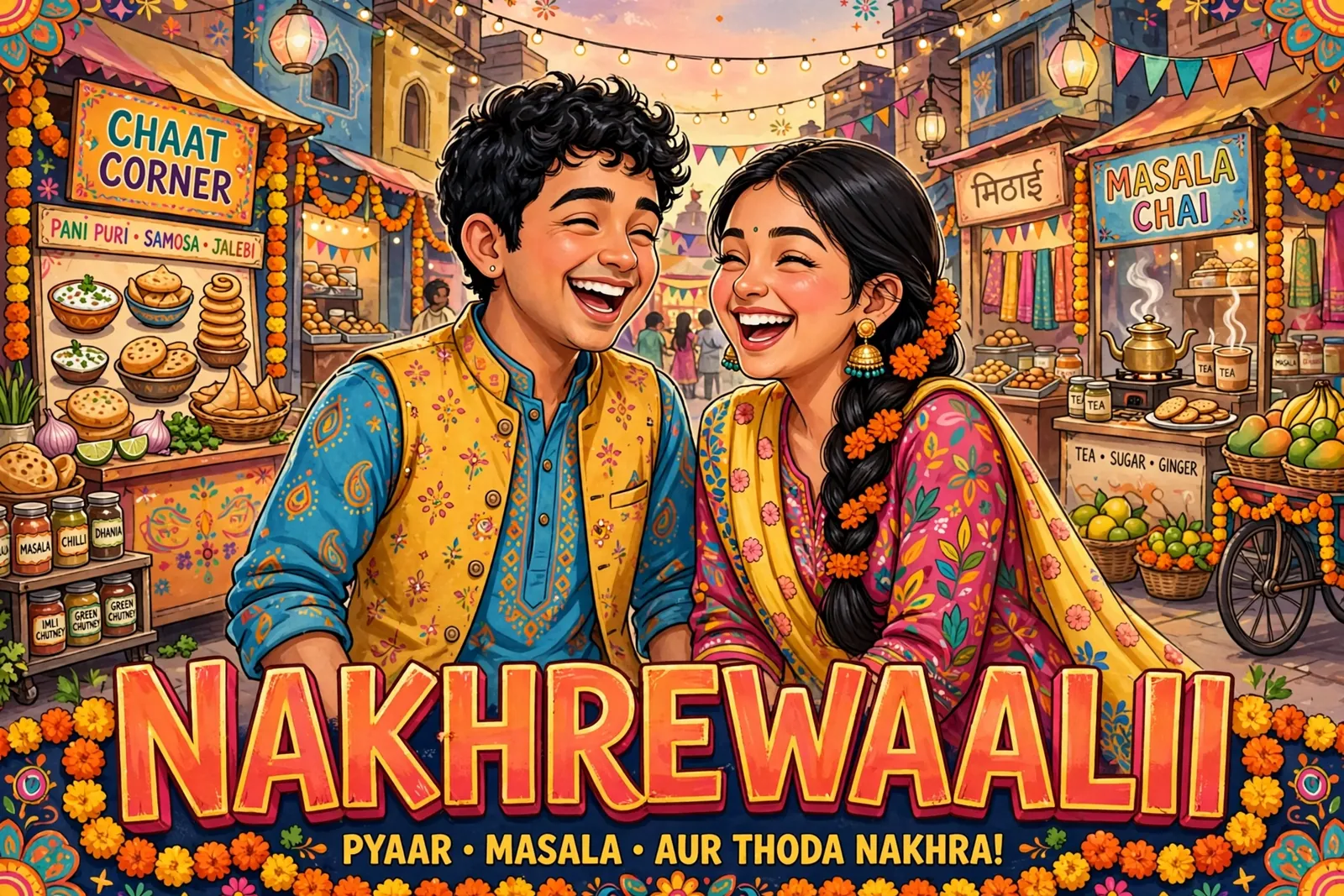
Nakhrewaalii arrives with the warmest of pedigrees — an Aanand L. Rai production, a small-town hero, a heroine with spark, and a premise borrowed from a beloved old Kishore Kumar song — and then, somewhere in its second half, it forgets what made that premise charming. The film is a romantic comedy about a young man who disguises himself as a woman, and about what he learns by stepping, literally, into a woman’s shoes. That is a good idea, and the film’s first half treats it with genuine warmth. But the writing never develops the idea into a story, the jokes thin out, and by the climax the film is leaning on twists it has not earned. Critics split down the middle — News18 gave it 3 out of 5 and praised its heart, Movie Talkies gave it 1.5 out of 5 and told readers to skip it — and both responses are visible in the finished film.
This review is spoiler-free on the film’s climax. The disguise’s unraveling is the film’s last real surprise, and it is better met fresh.
| Release date | 30 October 2026 (some listings give 29 October) |
| Director | Rahul Shanklya |
| Writer | Divy Nidhi Sharma, based on Satya Vyas’s novel “Dilli Darbar” |
| Genre | Romantic comedy, drama |
| Language | Hindi |
| Runtime | About 2 hours 9 minutes (some listings give 2 hours 30 minutes) |
| Lead cast | Ansh Duggal, Pragati Srivastava, Kumud Mishra, Gopal Datt, Akash Makhija, Aayushi Verma |
| Music | Tanishk Bagchi, Vayu, Gaurav Chatterji, Vaibhav Pani; song “Betuka” by Jasleen Royal |
| Our rating | 5.5/10 |
Sumit Mishra (Ansh Duggal) is a good-for-nothing young man from Hardoi who believes, with the confidence of youth, that being a woman only has advantages. His girlfriend Sweety dumps him and marries an engineer, and Sumit — heartbroken, angry and foolish in the way only a young man can be — moves to Delhi for higher studies, with romance and reinvention on his mind. There he meets Paridhi (Pragati Srivastava), the landlord’s daughter, and the two fall into the film’s central conversation: how difficult it is to be a boy in this society, and how much more difficult it is to be a girl. To win his love, and to understand the other side of that argument, Sumit takes the film’s great leap: he disguises himself as a woman, Sumita, and steps into a life he has only ever judged from outside.
The first half works because it trusts its premise. Duggal and Srivastava have a warm, easy chemistry — reviewers compared them to Bittu and Shruti from Band Baaja Baaraat — and the film’s small-town-meets-Delhi world, with its nosy landlords and university corridors, feels lived-in rather than assembled. The film’s best idea is also its most serious one: that a man who thinks womanhood is easy will learn otherwise only by living it, and that the lesson is funny precisely because it is true.
The second half is where the film loses its way. The writing, as Bollywood Bubble put it, is “weak and vague”: the premise never develops into an engaging story, the humour turns predictable, and the climax leans on contrivance. Rediff’s review was blunter, calling the humour outdated and the characters deliberately foolish, and noting that the film recycles the cross-dressing comedy trope of Chachi 420 without adding much to it. There is a comparison, too, that the film cannot quite escape: its second half, as one reviewer noted, looks “too similar to Dream Girl.” The film’s heart is in the right place — its message about equality, seen from both sides, is genuinely worth hearing — but its screenplay is not strong enough to carry that heart to the finish line.
Ansh Duggal as Sumit / Sumita — Duggal, making his rom-com debut, is the film’s most pleasant surprise. He plays Sumit with sincerity and comic timing, and his work as Sumita — the disguise, the voice, the body language — is committed rather than caricatured. The writing lets him down in the second half, as several reviewers noted, but the performance itself suggests a leading man worth following. Akshay Kumar’s public encouragement after watching the trailer — wishing Duggal stardom — now reads as a fair judgment of the actor, if not of the film.
Pragati Srivastava as Paridhi — Srivastava, also debuting, makes a confident first impression. She is warm, funny and convincing, and her chemistry with Duggal is the film’s most reliable pleasure. The fair criticism is that the script does not give her enough material to make Paridhi memorable beyond the romance — she is the film’s conscience more than its co-lead, and she deserved more scenes of her own.
Kumud Mishra, Gopal Datt, Akash Makhija and Aayushi Verma — The supporting cast is dependable throughout: Mishra and Datt bring veteran comic steadiness, Makhija is solid as Sumit’s friend Jagat Singh, and Verma, as Mihika, is lovely in a supporting role that gives the love triangle its complication. Nobody here is bad. The film’s problem was never its actors.
Rahul Shanklya directs with warmth but without the discipline the material needed. The film has the recognisable temperament of an Aanand L. Rai production — small-town eccentricity, earthy romance, characters who feel like people rather than types — but it lacks the tightness of Rai’s best work. The camerawork and editing are below average by most accounts, and the film feels longer than its roughly two-hour runtime in the second half. The production design and locations are decent to good, and the Delhi setting is used well, but the technical package never quite lifts the writing.
One production note worth recording: the film’s title song recreates Kishore Kumar’s classic 1956 track, and the CBFC required changes before release — muting and replacing certain words, including replacing “UP” with “village” in one line. That history is part of the film’s release story, and it hints at the film’s old-fashioned heart: this is a comedy that wants to be naughty and nice at the same time, and sometimes trips over the line between them.
The music is a mixed bag. “Betuka,” sung by Jasleen Royal with music by Vayu and Sharan Rawat, is the film’s most effective song, and the title track’s recreation of the Kishore Kumar classic carries genuine warmth and mischief. But the background score fails to make much impact, and the soundtrack as a whole underwhelms — a disappointment for a rom-com, where music should be doing half the emotional work. The songs are pleasant; they are not the film’s salvation.
What we loved:
What could be better:
Nakhrewaalii opened quietly on 30 October in a crowded weekend, and verified opening-weekend gross figures were still consolidating at the time of writing — this review therefore reports no single box-office number for the film rather than risk a wrong one. What is clear is that the film did not arrive as an event: it arrived as a small rom-com in a big weekend, and its commercial fate will depend on word of mouth among family audiences rather than on its opening. Given the split critical response, that word of mouth is likely to be as divided as the reviews.
If you like gentle Bollywood rom-coms and you are curious about two promising debutants, yes — for the first half, and for the idea at its centre. Nakhrewaalii has a sweet premise, likeable leads and a message worth hearing. But go in knowing that the second half wastes much of what the first half builds, and that the film’s humour and plotting feel older than its stars. It is a film you will half-love and half-forgive, which is perhaps the most honest thing that can be said about it.
Our rating: 5.5/10 — A warm idea and two sparkling debuts, let down by weak writing and a tired second half.
What is Nakhrewaalii about?
A heartbroken young man from Hardoi moves to Delhi, falls in love, and disguises himself as a woman to win his love — learning, in the process, how much harder life is for women than he assumed.
Who stars in Nakhrewaalii?
Ansh Duggal stars as Sumit/Sumita and Pragati Srivastava as Paridhi, in both actors’ rom-com debuts, with Kumud Mishra, Gopal Datt, Akash Makhija and Aayushi Verma in support.
Who directed Nakhrewaalii?
Rahul Shanklya, from a script by Divy Nidhi Sharma based on Satya Vyas’s novel “Dilli Darbar.” It is produced by Aanand L. Rai’s Colour Yellow Productions.
When was Nakhrewaalii released?
It released in cinemas on 30 October 2026 (some listings give 29 October).
How long is Nakhrewaalii?
About 2 hours and 9 minutes, though some listings give 2 hours and 30 minutes.
What did critics think of Nakhrewaalii?
Critics split: News18 gave it 3 out of 5 and praised its heart, while other reviewers gave it 1.5 out of 5 and criticised its weak second half and outdated humour.
Is Nakhrewaalii based on a true story?
No — it is a fictional romantic comedy based on Satya Vyas’s novel “Dilli Darbar.”
Where can I watch Nakhrewaalii?
It is currently in theatres; streaming details will be announced after its theatrical run.