★ LATEST REVIEWS

Our Rating: ★★★★☆ 8.5/10
Every child is special. That is not a slogan in Taare Zameen Par — it is an argument, made with unusual patience and feeling. Aamir Khan’s directorial debut, released in December 2007, tells the story of Ishaan Awasthi, an eight-year-old boy who cannot read, cannot keep up at school, and is slowly losing his sparkle in a world that measures children by marks. It is one of the most beloved Hindi films of its generation, and it earned that love honestly: it is funny, painful and deeply humane, and it changed how many Indian families talked about learning difficulties.
The film’s subject is dyslexia, a condition in which a bright child struggles to read and write because letters and words do not behave the way they should on the page. In 2007, that word was barely known to most Indian parents. Taare Zameen Par did not just tell a story about it; it taught a country what it was. That is a rare achievement for a mainstream film, and it is why the film still matters long after its songs have become nostalgic.
| Detail | Information |
|---|---|
| Release date | 21 December 2007 (India) |
| Director | Aamir Khan |
| Writer | Amole Gupte |
| Genre | Drama, Family |
| Language | Hindi |
| Runtime | 164 minutes |
| Budget | ₹12 crore |
| Lead cast | Darsheel Safary, Aamir Khan, Tisca Chopra, Vipin Sharma, Tanay Chheda, Sachet Engineer |
| Our rating | 8.5/10 |
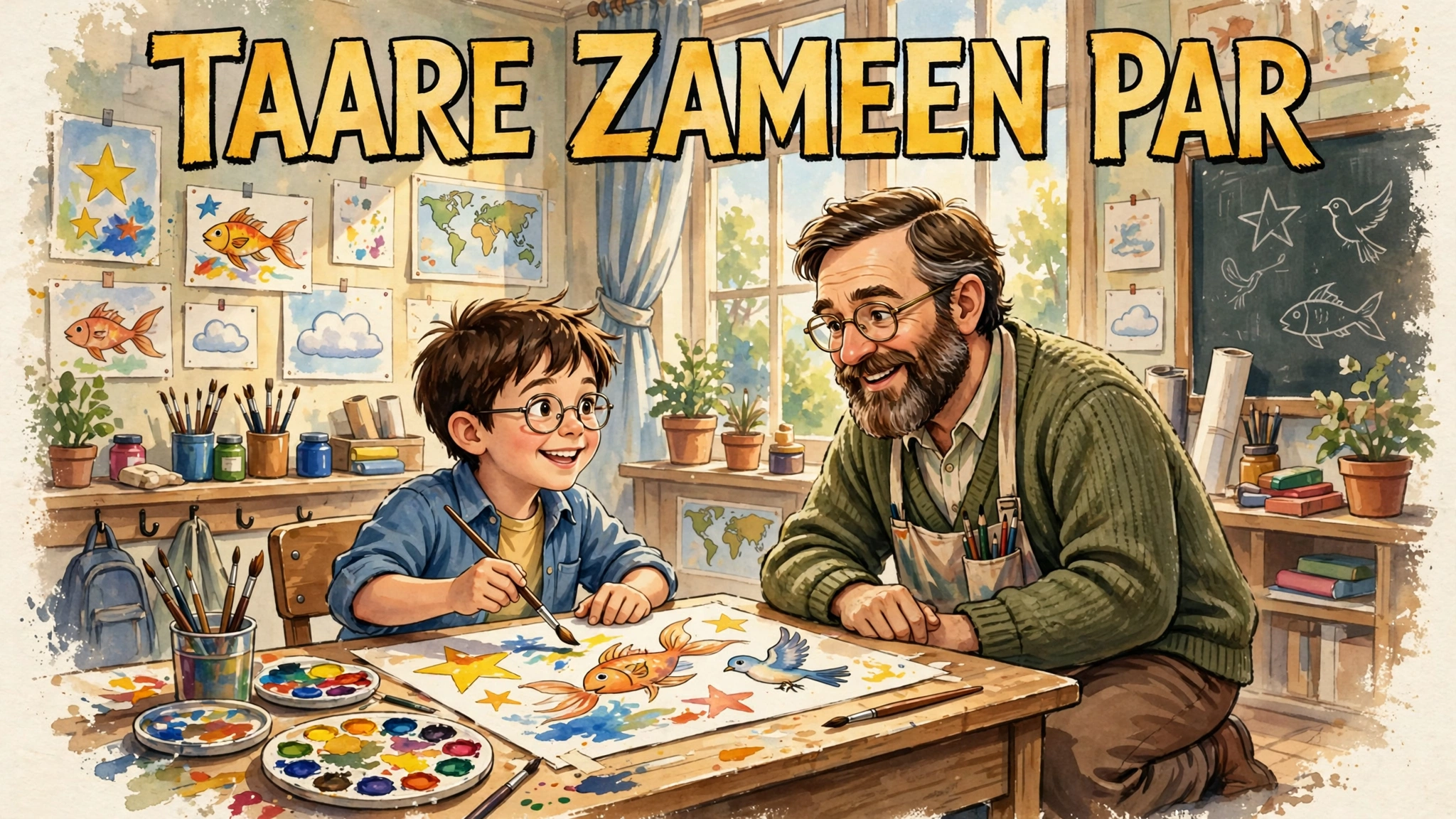
Ishaan Awasthi is eight years old, and he is failing at almost everything school asks of him. His notebooks are full of reversed letters, his homework is a disaster, and his teachers treat him as lazy or careless. What they do not see is what Ishaan sees: a world alive with colour, with dogs and fish and planets and stories, a imagination so vivid that his paintings are extraordinary. His elder brother Yohaan, by contrast, is a topper, and the comparison at home is constant and crushing.
When Ishaan’s failures become too much for his exasperated parents, they send him to a strict boarding school, hoping discipline will fix him. Instead, the separation breaks something in him. The boy who painted the world in colour stops painting altogether. Then a new art teacher arrives at the school — Ram Shankar Nikumbh, a joyful, unconventional man who teaches through play and imagination — and he notices something the other adults missed. This review will not reveal how Nikumbh reaches Ishaan or what happens at the school’s art competition, because those scenes land hardest when they are fresh. What can be said is that the film’s second half is about a teacher doing the simplest and hardest thing: looking at a child properly, and believing what he sees.
Darsheel Safary as Ishaan Awasthi — Safary’s performance is the film. He was nine years old when he played Ishaan, and he gives a performance of astonishing naturalness: mischievous, dreamy, frightened and heartbroken by turns, without ever seeming to act. His face in the boarding-school scenes — the light going out of a child who has been told too often that he is a problem — is genuinely hard to watch, and it is why the film works. Child performances this good are rare, and Safary’s remains one of the finest in Hindi cinema.
Aamir Khan as Ram Shankar Nikumbh — Khan, directing himself, is wise enough to hold himself back. Nikumbh arrives late in the film, and Khan plays him with warmth, humour and a teacher’s patience, never stealing focus from Ishaan. His best scenes are quiet ones: watching Ishaan, talking to his parents, and in one memorable sequence, showing Ishaan’s father what it feels like to read a language you cannot decode. Khan’s restraint is a mark of a director who knows whose story this is.
Tisca Chopra as Maya Awasthi and Vipin Sharma as Nandkishore Awasthi — Chopra is heartbreaking as Ishaan’s mother, a woman who loves her son fiercely but does not yet understand him, and whose guilt, once she does, is palpable. Sharma is equally good as the father, a man whose love expresses itself as pressure and discipline because that is all he knows. The film is fair to both parents: it does not make them villains, only people who have not yet learned to see their child. That fairness is one of its great strengths.
Aamir Khan’s direction, in his debut, is remarkably assured. He shoots Ishaan’s world through Ishaan’s eyes: the camera lingers on colours, on a puppy, on rain on a window, on the small wonders that adults walk past. The early scenes of Ishaan’s imagination — animated sequences in which his paintings come alive — are charming without being cute, and they make the later greying of his world, at boarding school, genuinely painful. Cinematographer Satyajit Pande (credited as Setu) gives the film a warm, lived-in look, and editor Deepa Bhatia handles the film’s emotional rhythm with care.
The film’s one structural weakness is its length and its occasional sentimentality. At 164 minutes, some stretches — particularly the repeated scenes of Ishaan’s school failures — could have been tighter, and the climax leans hard on emotion in a way that some viewers will find manipulative. But the emotion is earned, because the film has done the work of making Ishaan real. A film that makes an audience cry for a child is not necessarily sentimental; sometimes it is simply honest.
Shankar–Ehsaan–Loy’s soundtrack, with lyrics by Prasoon Joshi, is one of the finest in Hindi cinema. “Maa” is the film’s emotional core, a song about a mother’s love and a child’s longing that has become an anthem for parents everywhere. “Taare Zameen Par” itself is joyful and full of wonder, “Bum Bum Bole” captures childhood mischief, and “Kholo Kholo” celebrates the opening of a child’s mind. The songs are not interruptions to the story; they are the story, told in the language of a child’s feelings. The background score, too, knows when to be silent: the boarding-school scenes are often quiet, and that quiet hurts more than any music could.
What we loved:
What could be better:
Taare Zameen Par was made on a budget of ₹12 crore, a modest figure that is consistently reported across sources. Its worldwide gross is most commonly given as about ₹98.48 crore, though some trade listings put it slightly lower, around ₹88–89 crore, reflecting differences in how overseas and later re-release earnings are counted. On any of those figures, it was a major commercial success, many times over its budget, and it went on to win the Filmfare Award for Best Film and Best Director, and the National Film Award for Best Film on Family Welfare. It was also India’s official entry for the Academy Award for Best Foreign Language Film, though it did not make the shortlist. Its real success, though, is harder to count: the number of parents and teachers who recognised a child in Ishaan, and changed how they treated that child.
Yes — with your family, and with tissues nearby. Taare Zameen Par is not a perfect film, but it is a necessary one, and it remains moving on a rewatch because its subject is timeless: every generation has children who do not fit the mould, and every generation needs reminding that the mould is not the measure of the child. It is funny, it is painful, and it ends with one of the most satisfying scenes in Hindi cinema. If you have ever been a child who struggled, or a parent who worried, this film will speak to you directly.
Our rating: 8.5/10 — A warm, humane classic that changed how a country saw its children.
Is Taare Zameen Par based on a true story?
No. It is a fictional story written by Amole Gupte, though it is grounded in real understanding of dyslexia and childhood.
What is dyslexia?
Dyslexia is a learning difficulty that affects reading and writing. Children with dyslexia are often bright and creative, but letters and words appear jumbled or reversed to them. With the right teaching, they can thrive.
Is Taare Zameen Par suitable for children?
Yes. It is a family film, and it is especially valuable for children, parents and teachers to watch together and discuss.
How long is Taare Zameen Par?
It runs 164 minutes, about two hours and forty-four minutes.
Where can I watch Taare Zameen Par?
It is available on major streaming and digital platforms in many regions, though availability changes by country and over time, so check your local services.