★ LATEST REVIEWS

★★★★★ Our Rating: 9/10
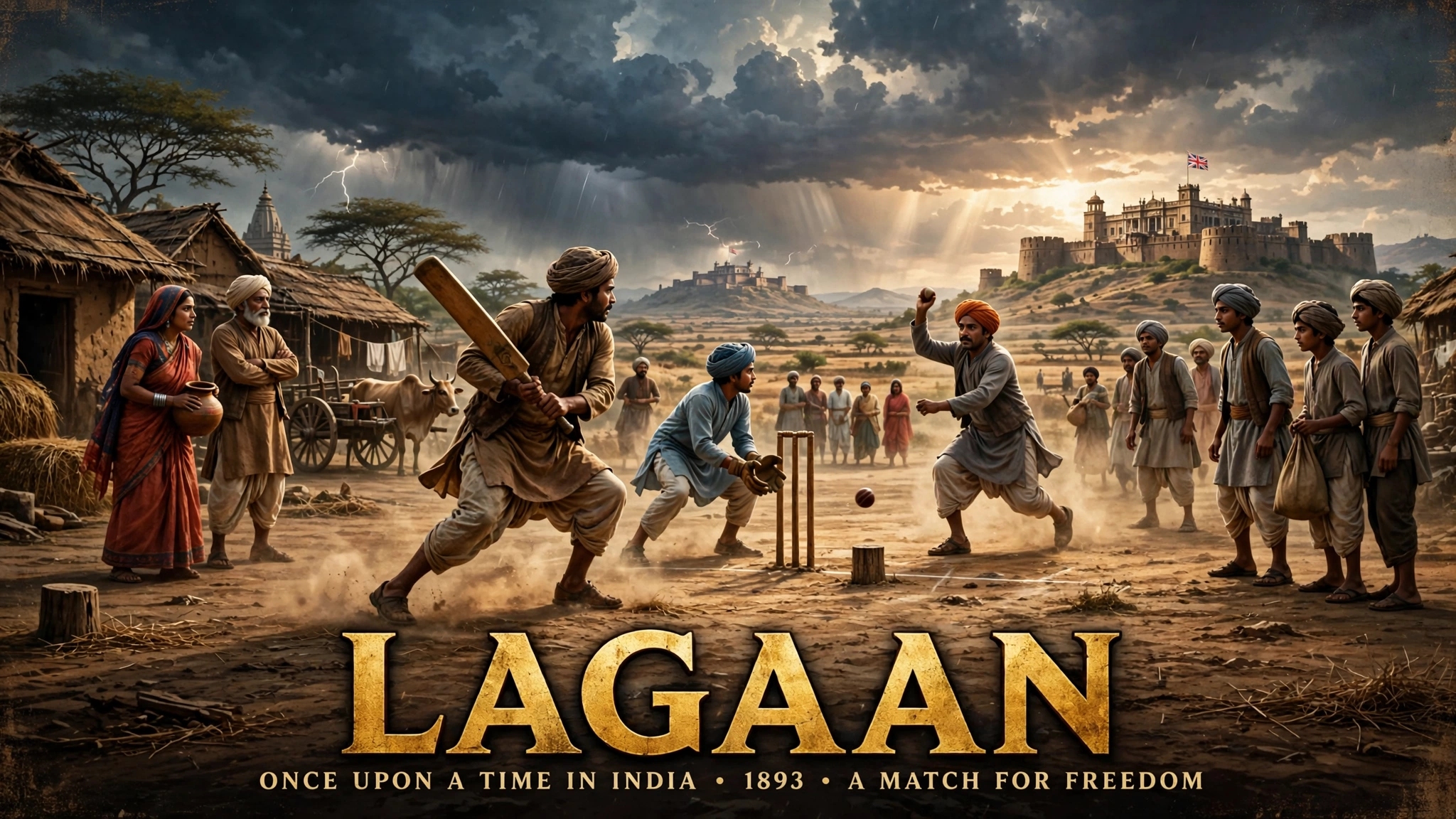
Every national cinema has a handful of films that changed what its filmmakers believed was possible. For modern Hindi cinema, Lagaan is one of them. A period sports musical, nearly four hours long, made by a director coming off two failures, produced by its star through a brand-new company, shot in punishing heat with a huge cast and a cricket match as its climax — on paper, almost every decision looked like a risk. In practice, it became a blockbuster at home, conquered festivals abroad and carried India to an Academy Award nomination for Best Foreign Language Film, only the third Indian film ever to get there.
Part of its achievement is how confidently it fuses things that are not supposed to sit together. It is a story about colonial taxation and a story about learning to play cricket. It is a rousing underdog sports film and a full-scale musical with songs by A. R. Rahman and Javed Akhtar. It asks a mainstream audience to invest in villagers, dialect, drought and a tax system — and rewards that investment with one of the most purely pleasurable final acts in Indian cinema.
It is not beyond criticism. Its length is a real commitment, its British characters divide into the sympathetic and the sneering with limited middle ground, and its final match, for all its brilliance, plays loose with the laws of cricket when drama demands it. In this review we look at the spoiler-free story, the performances, Gowariker’s direction and craft, Rahman’s landmark score and the box-office and awards journey, and we try to judge the film as a film, not just as a monument.
| Detail | Information |
|---|---|
| Release date | 15 June 2001 (India) |
| Director | Ashutosh Gowariker |
| Writers | Ashutosh Gowariker; dialogues by K. P. Saxena (Hindi) |
| Genre | Sports, Drama, Musical |
| Language | Hindi (with English and Awadhi dialect) |
| Runtime | 224 minutes |
| Budget | ₹25 crore |
| Lead cast | Aamir Khan, Gracy Singh, Rachel Shelley, Paul Blackthorne, Raghubir Yadav, Yashpal Sharma |
| Our rating | 9/10 |
The year is 1893. In the small central Indian village of Champaner, the rains have failed, the harvest is poor, and the farmers owe lagaan — the agricultural tax demanded by their British rulers, collected through the local raja. When the villagers plead for relief, they receive the opposite: the arrogant commanding officer of the nearby cantonment, Captain Andrew Russell, has doubled the tax out of spite after a perceived insult. Then, half in mockery and half in cruelty, Russell offers a wager. If the villagers can beat his officers at cricket — a game none of them has ever played — the tax for the whole province will be cancelled for three years. If they lose, they will pay triple.
Bhuvan, a young farmer with more spirit than caution, accepts the challenge over the horror of many of his fellow villagers, who reasonably point out that he has gambled with their survival. What follows is the heart of the film: months of preparation in which a team must be assembled from a divided village. There are men too proud, too frightened, too bound by caste prejudice or too sceptical to join. There is Elizabeth Russell, the captain’s sister, who is appalled by her brother’s cruelty and secretly teaches the villagers the rules of the game, and whose growing closeness to Bhuvan quietly complicates his bond with Gauri, the village girl who loves him. And there is the slow transformation of a group of farmers, woodcutters, barbers and outcasts into something that resembles a team — and of a tax dispute into a question of dignity.
The match itself occupies a huge final stretch, played across three days with the whole village watching, and this review will not reveal a single innings of how it unfolds. It is enough to say the film earns its length at the crease: every player recruited earlier matters, every grudge and kindness is cashed in, and the cricket is staged so that even a viewer who knows nothing about the sport understands exactly what each ball means.
Aamir Khan as Bhuvan — Khan, who also produced the film as the first project of Aamir Khan Productions, gives one of the defining performances of his career. His Bhuvan is not a superhero in peasant dress. He is stubborn, occasionally reckless, and his great quality is not talent but refusal: he will not accept that the villagers are beaten before they begin. Khan plays that conviction without bombast, letting it show in patience with frightened teammates and in the famous steadiness he brings to the match. It is star acting in service of an ensemble, and the film depends on exactly that balance.
Gracy Singh as Gauri — In her film debut, Singh has the most conventionally written role — the loving village girl — and plays it with a directness that keeps Gauri from becoming decoration. Her warmth anchors Bhuvan’s home life, and her scenes of quiet jealousy and hurt as Elizabeth enters their world give the love triangle genuine feeling rather than melodrama. She also holds her own in the song sequences, which is no small requirement in a Rahman musical.
Paul Blackthorne as Captain Andrew Russell and Rachel Shelley as Elizabeth — Blackthorne commits fully to Russell’s arrogance: clipped, contemptuous and convinced of his own superiority in a way that makes him an effective villain, if a deliberately one-note one. Shelley has the subtler task. Her Elizabeth could easily have been a device, but she plays her decency and divided loyalty with sincerity, and her Hindi-learning scenes with the villagers are among the film’s most charming. Between them, the two performances show the film’s approach to its British characters: drawn broadly, but with at least one figure of conscience on the other side.
The village eleven and supporting cast — The true triumph of casting is the team itself. Raghubir Yadav brings humour and pathos as the former seer turned player, Yashpal Sharma gives real menace-free dignity to a proud villager wrestling with prejudice, and performers including Rajesh Vivek, Rajendra Gupta, Shrivallabh Vyas, Suhasini Mulay and Kulbhushan Kharbanda build a village that feels like a society rather than a backdrop. Most memorably, the inclusion of Kachra, a Dalit villager whose selection forces the team to confront its own caste cruelty, gives the film a moral argument inside its sporting one — the villagers cannot ask for justice from the British while denying it at home. That thread is the film at its bravest.
Ashutosh Gowariker’s direction is the story of a filmmaker refusing to simplify. He shoots Champaner — built near Bhuj in Kutch, Gujarat — as a real, parched place: Anil Mehta’s cinematography bakes the early film in dust, white light and cracked earth, so that the audience feels the drought in its skin, and understands why rain in this story is not weather but life itself. When colour and movement arrive — in festivals, songs and finally the match — the contrast is emotional as much as visual. Nitin Chandrakant Desai’s production design and Bhanu Athaiya’s costumes build a period world that is detailed without ever turning into a museum display.
The craft decision that defines the film is its structure. Gowariker spends real time on recruitment, training and village politics before a competitive ball is bowled, which is precisely why the match works: the audience knows every player’s limitation and story, so tension needs no artificial inflation. The match direction itself is a lesson in clarity — geography, score and stakes are always legible — even if purists will note deliveries, field placings and match situations bent cheerfully in drama’s favour. Ballu Saluja’s editing sustains a 224-minute film with far less sag than most films half its length, though the middle portions, particularly around the romantic triangle, do move at a pace modern audiences may find stately.
Synchronised sound recording, still not standard in Hindi films of the era, gives the performances a naturalism that supports the whole enterprise. This was an ambitious production by the standards of its industry and year — at ₹25 crore, among the most expensive Indian films made up to that point — and the money is on the screen in scale, locations and sheer logistical control.
A. R. Rahman’s soundtrack for Lagaan, with lyrics by Javed Akhtar, is routinely and justly ranked among the finest in Hindi film history. What is remarkable is its range within a single, recognisably Indian folk-rooted idiom. “Ghanan Ghanan” builds a whole sequence out of a village watching clouds that may or may not bring rain — hope and dread in the same chorus. “Mitwa” is the film’s call to courage, the song Bhuvan uses to hold his frightened team together, and it has lost none of its lift. “Radha Kaise Na Jale” stages the romantic tension through a playful Radha-Krishna performance at a village festival, doing narrative work that dialogue would have handled clumsily, while “O Ri Chhori” lets the love story breathe in two languages, and “Chale Chalo” turns training into an anthem.
Rahman’s background score is equally considered, swelling the match without drowning it and using silence and crowd sound where a lesser score would have pasted emotion over every ball. The music is not decoration on this film; it is one of the load-bearing walls, carrying exposition, prayer, flirtation and resolve in turn.
What we loved:
What could be better:
Lagaan was made on a budget of ₹25 crore — a reliable, widely documented figure, and at the time an unusually large one for a Hindi film — which is why the budget row appears in our Quick Facts. Released on 15 June 2001, it opened in a famous head-on clash with another period blockbuster, Gadar: Ek Prem Katha, and the remarkable outcome is that both films became major hits with different audiences. Lagaan earned about ₹65.97 crore during its original theatrical run and finished as the third highest-grossing Hindi film of 2001 — a strong commercial result for a film of its length and subject, even before its long international and home-video life is counted.
Its honours matched its earnings. The film won eight National Film Awards, including Best Popular Film Providing Wholesome Entertainment, and eight Filmfare Awards, including Best Film, Best Director for Gowariker and Best Actor for Khan. Above all, it was nominated for Best Foreign Language Film at the 74th Academy Awards, following only Mother India and Salaam Bombay! among Indian films — and, as of 2025, no Indian film has received that nomination since. The Oscar went elsewhere, but the nomination itself permanently changed what Indian producers believed a Hindi film could attempt abroad.
Yes — ideally in one sitting, on the best screen available, with the time set aside to give it what it asks. Lagaan is a big-hearted, superbly crafted popular film that treats a mainstream audience as intelligent, patient and capable of caring about a tax dispute in 1893 — and mainstream audiences, in India and far beyond it, proved it right. Its flaws are the flaws of its ambitions: it is long because it builds, broad because it wants everyone in the theatre to feel the same thing at the same moment.
For viewers who know it only by reputation, it is more playful, funnier and more moving than the word “classic” suggests. For those returning to it, it holds up as the rare epic whose climax still tightens the chest even when you know every ball.
Our rating: 9/10 — A landmark sports epic whose heart, music and construction have not dated at all.
Did Lagaan really get nominated for an Oscar?
Yes. It was nominated for Best Foreign Language Film at the 74th Academy Awards in 2002, only the third Indian film to be nominated in that category. It lost to the Bosnian film No Man’s Land.
Is Lagaan based on a true story?
No. The village, the wager and the match are fictional, though the film is grounded in the real history of the lagaan tax, drought and British rule in nineteenth-century India.
How long is Lagaan, and does it have an interval?
It runs 224 minutes — about three hours and forty-four minutes. Indian theatrical screenings traditionally included an interval; home versions are presented as a single long film.
What language is Lagaan in?
Primarily Hindi, in a dialect based on Awadhi that was softened for modern audiences, with English spoken by the British characters and in parts of one song. Subtitled prints are widely available.
Where can I watch Lagaan?
It is available on major streaming and digital purchase services in many regions, though availability changes by country and over time, so check your local platforms.