★ LATEST REVIEWS

★★★★☆ Our Rating: 7/10
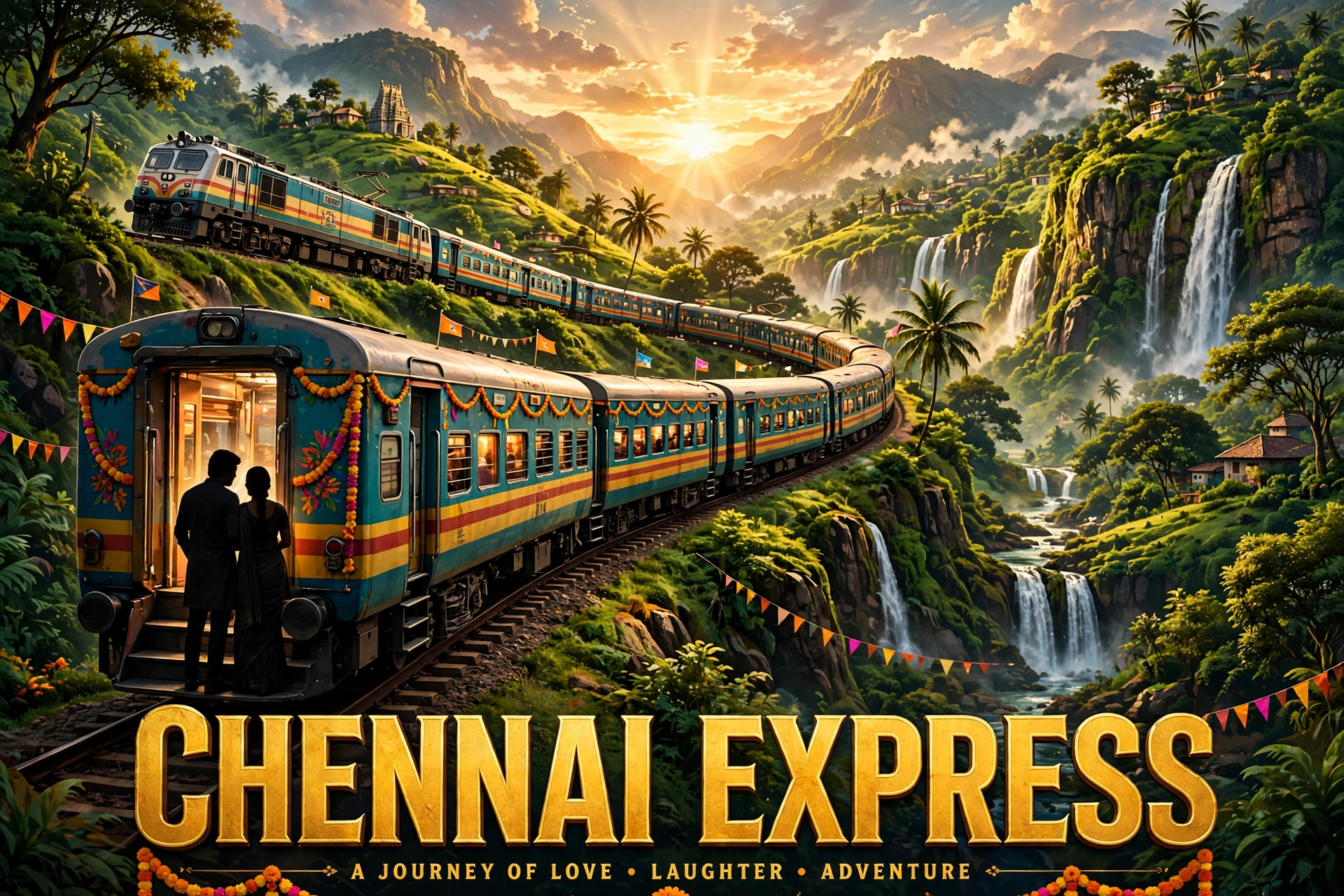
Chennai Express was never designed to be subtle, and judging it as if it were misses the point of the thing. This is director Rohit Shetty joining forces with Shah Rukh Khan at full commercial throttle: a North-meets-South romance, a fish-out-of-water comedy, a full-scale action film and a travel postcard for Tamil Nadu, all loaded onto one train and sent downhill at speed. Some of it is inspired nonsense. Some of it is just nonsense. The fun of the film — and there is plenty — is in how often the first kind wins.
The pairing is the engine. Shah Rukh Khan, then nearly two decades into superstardom, plays the city boy completely out of his depth, while Deepika Padukone, in the role that arguably completed her rise to the top tier, plays the woman who is smarter, braver and funnier than him in almost every scene. Their chemistry carries long stretches where the plot is really just an excuse to move from one comic set piece or song location to the next.
Revisiting it now, the film holds up as exactly what it set out to be: a big, bright, crowd-pleasing entertainer with a genuine star performance from Padukone, a soundtrack that still gets played, and jokes that land at a better rate than most star vehicles of its era — alongside stretches of forced comedy, casual stereotyping and action that goes beyond cartoonish into weightless. In this review we cover the spoiler-free story, performances, craft, music and its record-breaking box-office run, honestly, strengths and flaws together.
| Detail | Information |
|---|---|
| Release date | 9 August 2013 (India) |
| Director | Rohit Shetty |
| Writers | Story by K. Subash; screenplay by Yunus Sajawal; dialogues by Farhad-Sajid |
| Genre | Action, Comedy, Romance |
| Language | Hindi (with Tamil dialogue) |
| Runtime | 141 minutes |
| Budget | ₹70–115 crore (reported figures conflict — see Box Office) |
| Lead cast | Shah Rukh Khan, Deepika Padukone, Sathyaraj, Nikitin Dheer, Kamini Kaushal |
| Our rating | 7/10 |
Rahul Mithaiwala is a forty-year-old Mumbai sweet-shop owner who has spent his life doing what his strict grandfather expects. When the old man dies, his last wish is that his ashes be immersed at Rameswaram in the far south. Rahul’s real plan is far less dutiful: he intends to pretend to take the long train journey, slip away with his friends to Goa instead, and enjoy the freedom he has never allowed himself. Fate, in the form of the Chennai Express, has other ideas.
On board, Rahul helps a young woman, Meena — full name Meenalochni Azhagusundaram — and several men chasing her board the moving train, in a sequence that knowingly plays with one of the most famous train moments in Hindi cinema. What Rahul does not know is that Meena is fleeing an arranged marriage, and that her father, Durgeshwara Azhagusundaram, is a powerful and feared figure in her home region whose authority nobody questions lightly. The men Rahul helped are her father’s men. His impulsive act of chivalry lands him, very much against his will, in the middle of a world whose language he cannot speak and whose rules he cannot begin to guess.
From there the film runs on a classic engine: captivity turning into escape attempts, escape attempts turning into reluctant partnership, and partnership quietly turning into affection. Rahul wants only to get home safely; Meena wants a life she has chosen herself, which makes her the braver and more determined of the two from the start. Whether the two of them can face down her father, the fiancé chosen for her, and a culture clash played for both comedy and occasional sincerity, is the journey this review will not spoil. What can be said is that the emotional spine — a man who has avoided every real decision in his life finally having to stand somewhere and mean it — is simple, clear and just strong enough to hold the noise around it.
Deepika Padukone as Meena — This is the performance the film is remembered for, and rightly. Padukone commits completely to Meena’s accented Hindi, and what could have been a one-joke caricature becomes a fully played comic creation: quick, imperious, vulnerable in flashes, and consistently funnier than everyone around her. Crucially, Meena is never the damsel of this story. She rescues Rahul as often as he rescues her, she drives most of the escapes, and Padukone plays her intelligence without softening her comedy. It remains one of the defining star turns of her career.
Shah Rukh Khan as Rahul Mithaiwala — Khan does what very few superstars willingly do: he plays the fool. Rahul is cowardly, scheming, physically outmatched and frequently wrong, and Khan leans into that with the self-deprecating energy of his early comic roles, while sprinkling in playful references to his own famous films for the fans. The performance is broad — sometimes broader than it needs to be — but his timing with Padukone is excellent, and he gives the film’s few sincere scenes a warmth that keeps Rahul likeable even when the character is at his most useless.
Sathyaraj as Durgeshwara Azhagusundaram — The veteran Tamil star brings real gravity to a part that a lesser performance would have turned into pure shouting. His Durgeshwara is intimidating because he is composed: a man so certain of his authority that he rarely needs to raise his voice. That weight matters, because the film’s climax needs the father’s world to feel genuinely difficult to defy, and Sathyaraj supplies that in every scene.
Nikitin Dheer as Tangaballi and the supporting cast — Dheer is physically imposing and appropriately menacing as the chosen groom, though the role asks little of him beyond presence. Kamini Kaushal brings gentle warmth to Rahul’s grandmother in the framing portions, and the wider ensemble of character actors fills out the village world energetically, even when individual comic tracks are hit-and-miss.
Rohit Shetty’s direction is built on momentum. Scenes are short, colours are saturated, the camera keeps moving, and any pause threatens to be filled by a punchline, a song or a flying vehicle. His action style here is the familiar one from his Golmaal and Singham films — slow-motion hero entries, cars and jeeps somersaulting in cheerful defiance of physics, and villains launched improbable distances by single blows. Judged as realism it is absurd, and it is not trying to be realism. Judged as rhythm and spectacle, the set pieces are cleanly staged, easy to follow and pitched exactly at the gallery the film was made for, though the climactic action does eventually tip from exuberant into exhausting.
The more pleasant surprise is how well the film is shot. Cinematographer Dudley gives the southern locations a lush, postcard richness — green hills, waterfalls, temple towns and backwaters — and the production design makes Meena’s village feel festive and lived-in rather than a generic set. The film’s visual idea of the South is romanticised, certainly, but it is genuinely beautiful to look at for long stretches. Editing keeps the 141 minutes brisk by the standards of its era; the sag comes not from length but from repetition, as a few comic routines — language misunderstandings above all — are returned to one time too many.
Craft-wise, the film’s weak point is tone management. Shetty will cut from a genuinely tender exchange to a broad gag to flying bodies within a minute, and viewers who want any one of those registers sustained will be frustrated. Viewers who accept the masala contract — everything, in quantity, in rotation — will find the machinery working exactly as intended.
Vishal–Shekhar’s songs were central to this film’s success and remain its most durable element. “Titli” is the standout — a light, melodic romance number that gives the central pair their softest moments and shows off the locations beautifully. “Kashmir Main Tu Kanyakumari” is an infectious travel song built entirely on the North-South concept, “Tera Rastaa Chhodoon Naa” supplies the emotional ballad, and “1 2 3 4 Get on the Dance Floor” is pure high-energy filler of the enjoyable kind. Then there is “Lungi Dance”, the tribute track performed by Yo Yo Honey Singh, which became a phenomenon in its own right and still turns up wherever this era of Bollywood is played.
Amar Mohile’s background score keeps the comedy and action legible, punching up entrances and chases in the house style of Shetty’s films. It is functional rather than distinctive, but the songs carry the musical identity so completely that it hardly matters. A fair test of a commercial soundtrack is whether it outlives its marketing window, and this one clearly has.
What we loved:
What could be better:
Commercially, there is no argument: Chennai Express was a juggernaut. It grossed about ₹423 crore worldwide, broke a string of opening records in India and overseas, became at the time the fastest Hindi film to cross ₹100 crore net domestically, and briefly stood as the highest-grossing Bollywood film worldwide, overtaking 3 Idiots. Released over the Eid period, it demonstrated the ceiling of the Khan–Shetty combination and remained among the biggest Hindi hits of the decade.
On budget, the sources genuinely conflict, which is why our Quick Facts gives a range instead of a single figure. Some widely used references list the production budget at ₹115 crore, while many trade reports and news accounts put it at around ₹70–75 crore. We cannot reconcile those figures from reliable primary documentation, so we state the range honestly rather than pretend precision. Either way, against a ₹423 crore worldwide gross, the film was an emphatic commercial success many times over, and its satellite, music and home-video value only added to that.
If you enjoy the classic Hindi masala entertainer — songs, stars, comedy, action and romance in generous rotation — Chennai Express is one of the better-made examples of its period, lifted well above its script by Padukone’s performance and a soundtrack that has not aged a day. It is an ideal group watch: undemanding, colourful and funny in its best stretches.
If you need tight plotting, grounded action or comedy that never reaches for the easy stereotype, this will try your patience, and its flaws are real rather than nitpicks. Our rating reflects that balance: a flawed film, but an effective and frequently delightful one.
Our rating: 7/10 — Star power, songs and one superb comic performance carry a loud, uneven but very likeable entertainer.
Is Chennai Express a remake of any film?
No. It is an original story by K. Subash, though it playfully references earlier Hindi films, including Shah Rukh Khan’s own Dilwale Dulhania Le Jayenge in its famous train sequence.
What language is Chennai Express in?
Primarily Hindi, with a significant amount of Tamil dialogue, especially from Meena’s family and in the village portions. Subtitled versions are widely available.
Who sang Lungi Dance, and is it in the film?
“Lungi Dance” is performed by Yo Yo Honey Singh as a tribute to Rajinikanth. It appears with the film’s closing portions and became one of the biggest Hindi film songs of 2013.
Is Chennai Express suitable for children?
It is rated U/A in India. The action is cartoonish rather than graphic and the comedy is broad, but younger children may miss much of the humour; it is best suited to family viewing with older children.
Where can I watch Chennai Express, and how long is it?
It runs 141 minutes and is available on major streaming and digital stores in many regions, including Netflix in several territories, though availability varies by country, so check your local services.