★ LATEST REVIEWS

Our Rating: ★★★★☆ 7.5/10
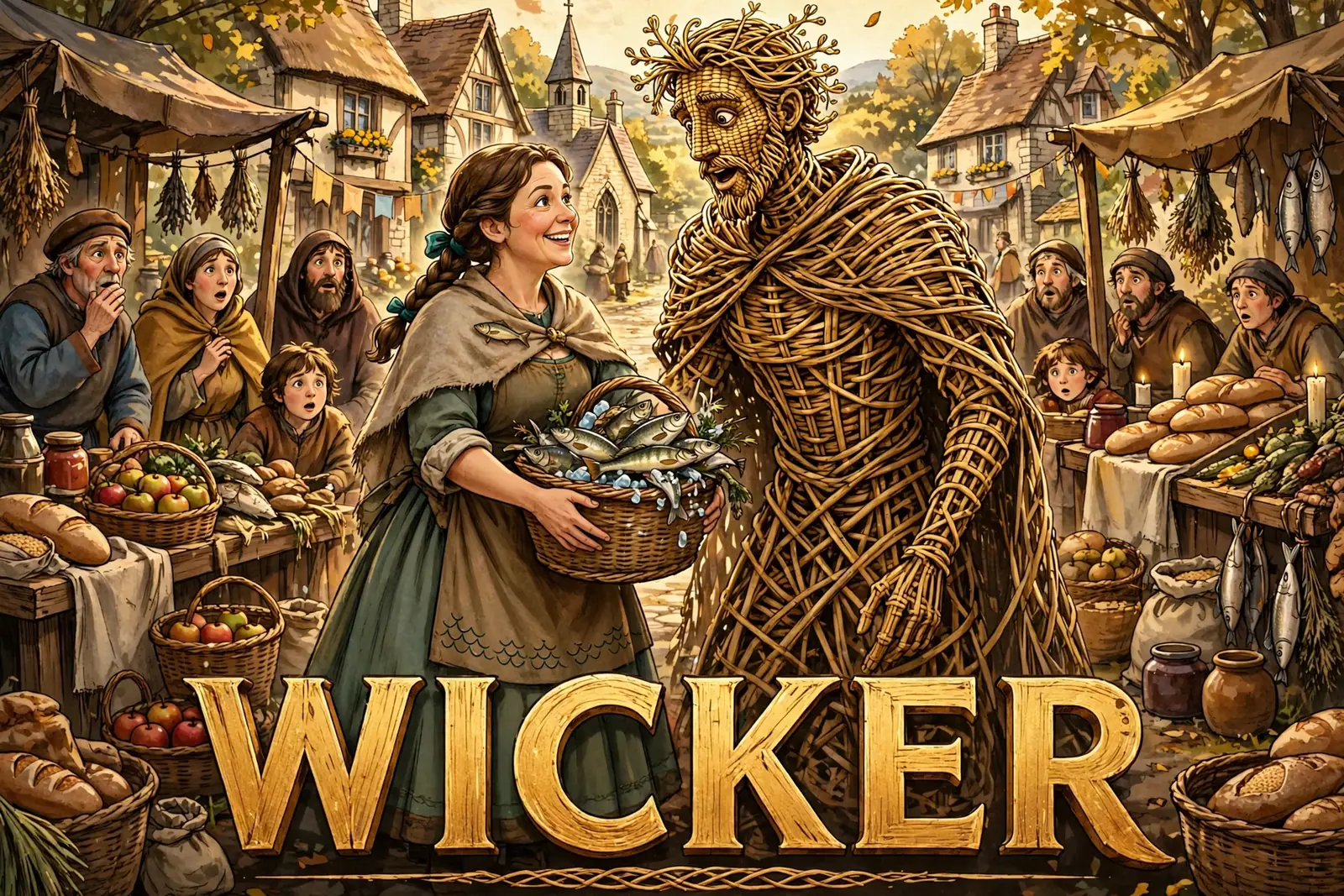
Every year produces one film that makes you wonder how it got made, and in 2026 that film is Wicker. A lonely fisherwoman in a medieval village, shunned for smelling of fish and for being unmarried, commissions the local basket weaver to build her a husband out of wicker. He does. The husband — played by Alexander Skarsgård, woven by the effects artists at Wētā Workshop — is devoted, well-spoken, handsome in the way only a six-foot-four man made of willow can be, and considerably better at marriage than any of the flesh-and-blood husbands in town. What follows is a saucy, bawdy, surprisingly tender fable about marriage, gossip and belonging, and one of the strangest love stories ever put on screen. It is also, by the numbers, a genuine hit of its weekend: about $4.1 million in its US opening frame for a domestic total around $13.3 million.
This review is spoiler-free on the film’s final act. The fable’s ending is its best joke, and it deserves to land unspoiled.
| Release date | 30 October 2026 (United States); 23 October 2026 (United Kingdom cinemas) |
| Directors | Alex Huston Fischer and Eleanor Wilson |
| Writers | Alex Huston Fischer and Eleanor Wilson, based on Ursula Wills-Jones’s short story “The Wicker Husband” (2008) |
| Genre | Fantasy romantic comedy-drama, fairy-tale fable |
| Language | English |
| Runtime | About 105 minutes |
| Lead cast | Olivia Colman, Alexander Skarsgård, Peter Dinklage, Elizabeth Debicki, Richard E. Grant |
| Our rating | 7.5/10 |
The village in Wicker is a place out of a storybook and a sociology essay at once. Nobody is known by their name; everyone is known by their lot in life — the Fisherwoman, the Basket Weaver, the Tailor’s Wife, the Doctor. The Fisherwoman (Olivia Colman) catches the fish, sells them at market, and lives at the forest’s edge because of the pungent aroma that clings to her. She is content as a singleton, until a village wedding ritual marks her out as the next to marry and the town greets the idea with mean-spirited laughter. Stung, she does something gloriously perverse: she asks the Basket Weaver (Peter Dinklage) to make her a husband.
A month later, the Wicker Husband arrives at the altar, and the film becomes something nobody quite expects. He listens. He notices. He is kind without being told to be kind. He handles the household without a chore chart. The village, full of miserable marriages, does not know what to do with a happy one — and that, more than any magic, is the film’s engine. The Tailor’s Wife (Elizabeth Debicki), the town’s self-appointed social queen, leads the backlash, and the comedy sharpens into commentary: on tradition, on who gets to be happy, and on what marriage is actually for.
The film’s tone is its tightrope. It is, as one reviewer put it, “a saucy, bawdy romp with lots of nudge-nudge jokes” — the villagers discuss the couple’s married life with frank, graphic curiosity, and the film plays the erotic angle for laughs without ever becoming crude for its own sake. Underneath the jokes sits a real question, one the film is brave enough to ask: if a husband is created for the sole purpose of marrying you, does he have agency of his own? Wicker does not fully answer that question, and its third act runs out of steam in places, but the fact that it asks it at all lifts the film above its own quirkiness.
Olivia Colman as the Fisherwoman — Colman is handed one of her best roles since her Oscar-winning Queen Anne in The Favourite, and she seizes it. Her Fisherwoman is feisty, foul-mouthed, funny and heartbreakingly used to being overlooked. Colman plays the character’s rough exterior without ever sanding down her dignity, and the film’s most moving moments come when that dignity cracks — when a woman who learned to survive without affection discovers what it feels like to be chosen.
Alexander Skarsgård as the Wicker Husband — Skarsgård’s résumé already includes a vampire, a Viking prince and assorted oddities; a husband made of rattan is somehow the logical next step. His performance is a marvel of restraint: the Wicker Husband is gentle, attentive and funny precisely because he does not perform husbandhood the way the village men do. The physical chemistry with Colman is real, and it is played for tenderness as much as for comedy. That a man woven from willow becomes the film’s most human character is the joke, and also the point.
Peter Dinklage as the Basket Weaver and Elizabeth Debicki as the Tailor’s Wife — Dinklage, who makes the husband and then watches his creation outgrow him, gets the film’s best final moment, and plays the Weaver’s pride and unease beautifully. Debicki is magnificent as the social order’s enforcer, a woman who has made herself head of the hierarchy and intends to stay there. Richard E. Grant, as the Doctor, rounds out a supporting cast that understands exactly what kind of film it is in.
Directors Alex Huston Fischer and Eleanor Wilson, adapting Ursula Wills-Jones’s 2008 short story “The Wicker Husband,” have made a film that feels, in tone and texture, centuries old — like a Grimms’ fairy tale retold by people who have read a great deal of feminist theory. The craft is the film’s quiet triumph: Wētā Workshop built the Wicker Husband almost entirely with practical effects, prosthetics and innovative 3D printing, so that Skarsgård remains free to perform underneath the weave. The costume and production design sell the village as a real, muddy, lived-in place rather than a theme-park medievalism, and that groundedness is what lets the absurd premise work.
Where the film falters is momentum. The premise is so strong that the middle hour sometimes coasts on it, and the third act, as several reviewers noted, runs out of steam before its excellent final beat. The story does not quite contain enough plot to push beyond its fable structure, and a few of the village subplots blur together. At 105 minutes it never becomes a slog, but you can feel the film searching for its ending in the last twenty minutes.
The score is folk-flavoured and light on its feet, matching a film that wants to feel like a tale told by a fire. The sound design keeps the village tactile — market noise, creaking wicker, the rustle of willow — and the Wicker Husband’s movements carry a soft, woody music of their own. It is unobtrusive work, and it suits the film.
What we loved:
What could be better:
Wicker took about $4.1 million in the 30 October–1 November weekend in North America, a drop of about 28% from its opening, for a domestic total of about $13.3 million — good enough for fourth place in a crowded weekend, ahead of the much bigger-budgeted Street Fighter. For a film this strange, that is a genuine success, and it suggests what the reviews suggested: word of mouth is doing the work. Audiences who go in expecting a weird fairy tale come out recommending a weird fairy tale, and that is the best marketing a film like this can have.
One dating note for readers: sources differ on the release date, with UK cinemas listing 23 October and US listings giving 30 October. This review uses the US theatrical date of 30 October as its primary date and notes the earlier UK opening.
Yes — especially if you are tired of films that feel assembled from other films. Wicker is bizarre, bawdy, tender and genuinely original, carried by two wonderful performances and a premise that earns its strangeness. It is not perfect; its ending arrives later than it should. But it is the rare film that leaves you arguing about marriage, happiness and what we owe the people we make — all because a woman ordered a husband made of wicker and got a better one than anyone in town.
Our rating: 7.5/10 — The year’s most bizarre film, and one of its most lovable — a fable with bite, heart and a woven leading man.
What is Wicker about?
A shunned fisherwoman in a medieval village commissions the basket weaver to build her a husband out of wicker, and the happy marriage that follows scandalises a town full of miserable ones.
Who stars in Wicker?
Olivia Colman stars as the Fisherwoman, Alexander Skarsgård as the Wicker Husband, Peter Dinklage as the Basket Weaver, and Elizabeth Debicki as the Tailor’s Wife.
Who directed Wicker?
Alex Huston Fischer and Eleanor Wilson, who also wrote it, based on Ursula Wills-Jones’s 2008 short story “The Wicker Husband.”
When was Wicker released?
It opened in UK cinemas on 23 October 2026 and in the United States on 30 October 2026.
How long is Wicker?
About 105 minutes.
Is Wicker related to The Wicker Man?
No — despite the similar name, it has nothing to do with the classic folk-horror film; it is a romantic fairy-tale fable.
How much has Wicker earned at the box office?
About $13.3 million domestically after the 30 October–1 November weekend, when it placed fourth.
Is Wicker suitable for children?
No — it is a grown-up fable with bawdy humour and frank discussion of married life; it suits adults better than children.