★ LATEST REVIEWS

★★★★☆ Our Rating: 8.3/10
Salman Khan has built much of his stardom on playing men who solve problems with their fists and their swagger. Bajrangi Bhaijaan asks something different of him, and that is a large part of why it worked on audiences so deeply. Here, his character’s strength is not that he can fight a crowd — it is that he will not lie, will not give up a child who is not his, and will walk into a hostile border situation armed with nothing except stubborn goodness. In a career of larger-than-life roles, this may be the one where less did the most.
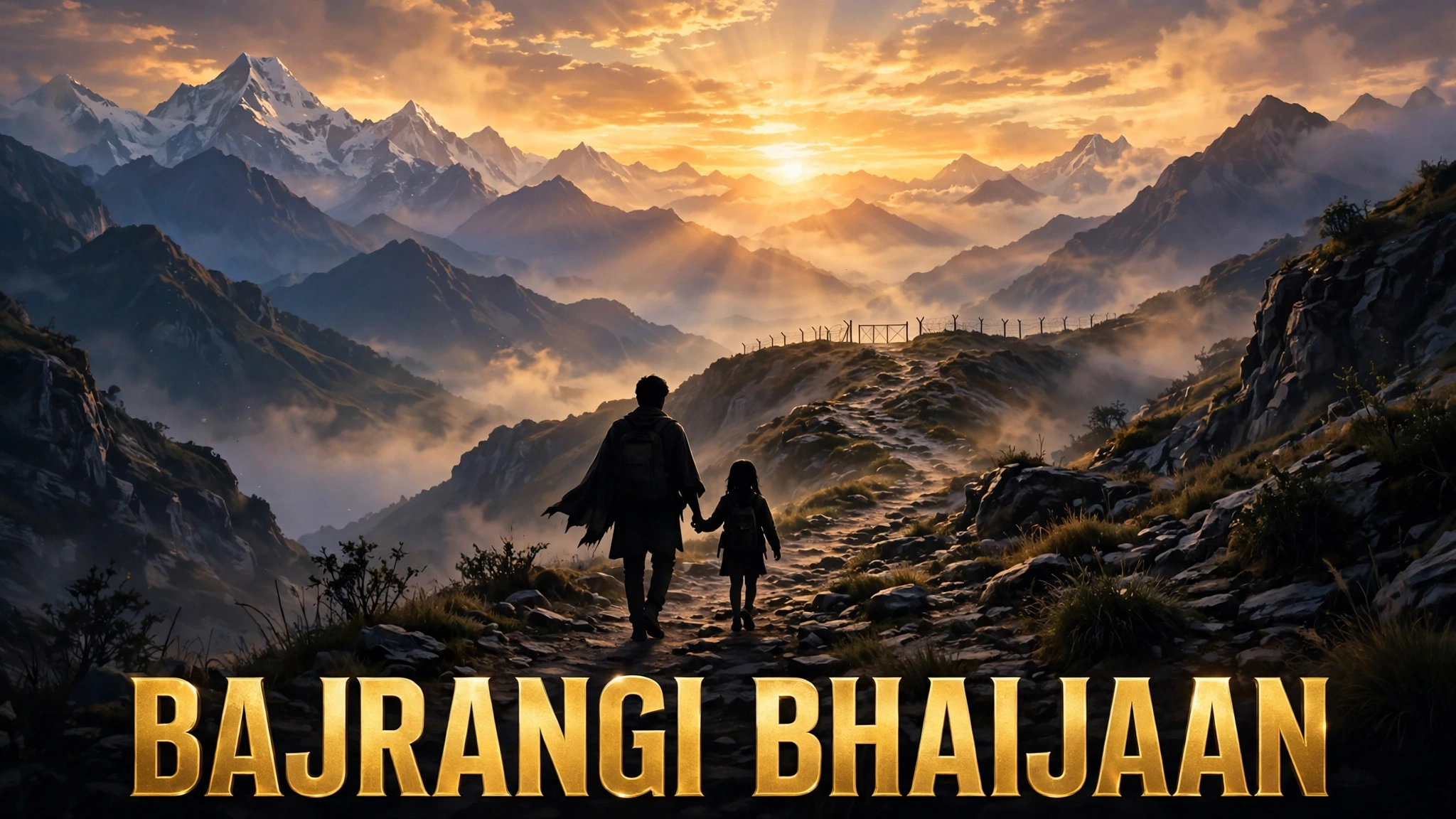
The film takes one of the most sensitive subjects available to a Hindi filmmaker — the India-Pakistan divide — and approaches it through the smallest possible story: a lost little girl who cannot speak, and a man who decides her home is his responsibility. There are no war rooms, no speeches about nations. There is a child, a journey, and the discovery, repeated at every stop, that ordinary people on both sides of a fence are more alike than the politics suggests.
It is not a flawless film. It is long, it leans hard on sentiment in places, and its final stretch asks for a great deal of goodwill. But its heart is in exactly the right place, and when a film with this scale of stardom chooses kindness as its spectacle, the effect on a mass audience is worth taking seriously.
In this review, we will give you an honest breakdown of the story, the performances, the craft, the music, and the huge box office journey — including where the film’s sentiment tips into excess.
| Detail | Information |
|---|---|
| Release date | 17 July 2015 |
| Director | Kabir Khan |
| Writers | Kabir Khan, Parveez Sheikh, V. Vijayendra Prasad (story by V. Vijayendra Prasad) |
| Genre | Comedy drama |
| Language | Hindi |
| Runtime | 159 minutes |
| Budget | ₹75 crore |
| Lead cast | Salman Khan, Harshaali Malhotra, Kareena Kapoor Khan, Nawazuddin Siddiqui |
| Our rating | 8.3/10 |
Shahida is a young girl from a village in Pakistan who has been unable to speak since birth. Her mother brings her to India on a pilgrimage, hoping a visit to a revered shrine in Delhi might change her daughter’s fortune. On the journey home, fate intervenes cruelly: the little girl slips away from a halted train at night and is left behind as it pulls out, stranded in a country where she knows nobody and cannot even say her own name.
In India, she crosses paths with Pawan Kumar Chaturvedi, a kind-hearted, deeply devout follower of Lord Hanuman who lives by a simple rule — he does not lie, whatever it costs him. Pawan, whom people call Bajrangi, takes the child under his protection, names her Munni, and tries to find her family. Every attempt fails, because the one person who knows where she belongs cannot tell him. When Pawan finally understands that her home is across the border in Pakistan, he makes a decision everyone around him calls madness: he will take her home himself.
What follows is a road journey in the truest sense — buses, borders, deserts, officials, smugglers’ routes, and the constant problem that Pawan has no passport, no visa, and no plan beyond honesty. Along the way he is helped by Rasika, the woman he loves, back home in Delhi, and later by Chand Nawab, a small-time Pakistani journalist who first sees Pawan as a story and gradually sees him as something more.
We will not reveal how the crossing ends, what happens to Pawan in Pakistan, or whether mother and daughter meet again. Those moments are the film’s emotional payload, and they deserve to arrive unspoiled.
Salman Khan as Pawan Kumar Chaturvedi: This is among the most liked performances of Khan’s career, and the reason is restraint. Pawan is not a quip machine or an action figure; he is a simple, slightly bumbling devotee whose heroism is entirely moral. Khan plays him with an open face and a soft voice, letting the humour come from Pawan’s innocence rather than from star attitude. When the film needs him to cry, he cries like a man unembarrassed by it, and audiences responded to that vulnerability. There are moments where the star takes over — a couple of crowd-pleasing beats feel inserted for the gallery — but they are fewer than usual.
Harshaali Malhotra as Shahida / Munni: Child performances can make or break a film like this, and Malhotra, in her debut, carries an astonishing share of the story without a single line of dialogue. Everything she communicates — fear, mischief, trust, longing for her mother — comes through her eyes and expressions, and she never once feels coached or cute for the camera’s benefit. Her bond with Khan is the film; if you do not believe it, nothing else matters, and you believe it within minutes.
Kareena Kapoor Khan as Rasika: Kapoor brings warmth and modern common sense to Rasika, the schoolteacher who loves Pawan and becomes Munni’s fiercest advocate at home. The role is smaller than the film’s first act suggests — she largely exits the journey once it crosses the border — but her scenes establish the emotional world Pawan is risking, and she plays them with easy charm.
Nawazuddin Siddiqui as Chand Nawab: Siddiqui arrives in the second half and promptly lifts the film’s energy. His journalist is funny, opportunistic, and recognisably human — a man chasing a story who finds his conscience on the way. His partnership with Khan is the film’s second great relationship, and some of its most quoted scenes belong to him. Late in the film, a short piece-to-camera by Chand Nawab became one of the most shared sequences of its year, and Siddiqui’s delivery is a large part of why.
Kabir Khan, who came to feature films from documentary, directs scale well. The journey structure suits him: India and Pakistan are shot as places people actually live in, not as sets of symbols, and Aseem Mishra’s cinematography makes the most of the variety — Delhi’s bustle, the stark beauty of the desert and mountain regions, and village life on both sides of the border that looks, pointedly, much the same.
Rameshwar S. Bhagat’s editing keeps a 159-minute film moving by treating the journey as a series of episodes, each with its own small climax. The approach mostly works, though the middle stretch — a run of obstacles at and around the border — could have lost one episode without weakening the story. Some viewers will also find the final act’s reliance on crowds, media, and collective goodwill a touch fanciful. The film is making an argument about people power, and it makes it with its heart on its sleeve; whether that moves you or strikes you as naive will decide how you rate the last half hour.
Where Khan the director is at his best is in the small scenes: a shared meal, a mosque visit handled with genuine respect, a child teaching a grown man how much can be said without words. The film’s much-praised handling of religion — devotion shown as a source of compassion rather than conflict — comes through in these quiet choices, not in any speech.
Technically the film is polished throughout, with its action kept modest and its large crowd sequences staged cleanly. This is a star vehicle that mostly remembers it is a story first.
Pritam’s songs gave the film several lasting hits, and the most beloved of them, “Tu Jo Mila,” became the emotional signature of Pawan and Munni’s bond — a gentle song about finding family where you least expect it, used in the film with real tenderness. The devotional energy of “Bhar Do Jholi Meri,” performed as a qawwali in the film, is another high point, staged as a plea for the child rather than a performance piece, and it lands accordingly.
The album also has its party numbers — “Selfie Le Le Re” opens the film with Salman Khan’s Hanuman-devotee energy at full brightness, and “Chicken Kuk-Doo-Koo” adds playful colour. These tracks do their commercial job, though in story terms the loud openers sit a little oddly against the gentle film that follows. Julius Packiam’s background score bridges the gap, carrying the journey’s emotion in the long dialogue-light stretches, particularly once the story crosses into Pakistan and Munni’s silence becomes the film’s central sound.
Overall, the music serves the film’s double nature: a mass entertainer on the surface, a fable about compassion underneath. The softer songs are the ones that have lasted.
What we loved:
What could be better:
Released worldwide on 17 July 2015, during the Eid period long associated with Salman Khan releases, Bajrangi Bhaijaan opened strongly and then did something his action films rarely needed to do — it grew on family audiences and repeat viewing. Made on a reported budget of ₹75 crore, it finished with a worldwide gross of about ₹918 crore, becoming the highest-grossing Indian film of its year and one of the biggest Hindi films of all time up to that point.
Those numbers matter because of what the film is. There is no conventional villain, no big action climax, and the second lead is a six-year-old who never speaks. Its success demonstrated that a star of Khan’s magnitude could carry a gentle, message-driven drama to blockbuster numbers, and its extraordinary television premiere ratings afterwards confirmed how deeply it had settled into family viewing habits.
Internationally, the film also found warm receptions in markets that respond to emotional family stories, and it won the National Film Award for Best Popular Film Providing Wholesome Entertainment — an honour that, for once, describes its box office appeal exactly.
Yes — especially with family. Bajrangi Bhaijaan is a big, open-hearted film that uses one of Bollywood’s biggest stars to argue for gentleness, honesty, and the idea that a border is a line on a map, not a line between people. Its length and its sentimental final act are fair criticisms, and viewers allergic to earnestness should be warned. But its central relationship is genuinely touching, its message has only grown more welcome with time, and its best scenes — the silent child, the truthful man, the journalist finding his voice — are as good as popular Hindi cinema gets.
Our rating: 8.3/10 — A warm, big-hearted journey that proves kindness can be a blockbuster.
Is Bajrangi Bhaijaan based on a true story?
No. It is an original fictional story by V. Vijayendra Prasad. While it is not based on one specific real case, stories of people separated across the India-Pakistan border give its premise a real-world resonance.
Is there a sequel to Bajrangi Bhaijaan?
A sequel has been discussed publicly by its makers over the years, but as of now no released sequel exists, and the original film tells a complete story with a full ending.
What language is Bajrangi Bhaijaan in, and are subtitles available?
The film is primarily in Hindi, with some Urdu in the Pakistan portions. Subtitled versions are widely available for international audiences.
Where can I watch Bajrangi Bhaijaan?
Streaming and rental availability varies by country and changes over time. Check the major platforms in your region, where it is a frequently listed catalogue favourite.
What is the runtime and age rating of Bajrangi Bhaijaan?
The film runs for 159 minutes and was certified U/A in India. It is suitable for family viewing, though its length may test the patience of very young children.