
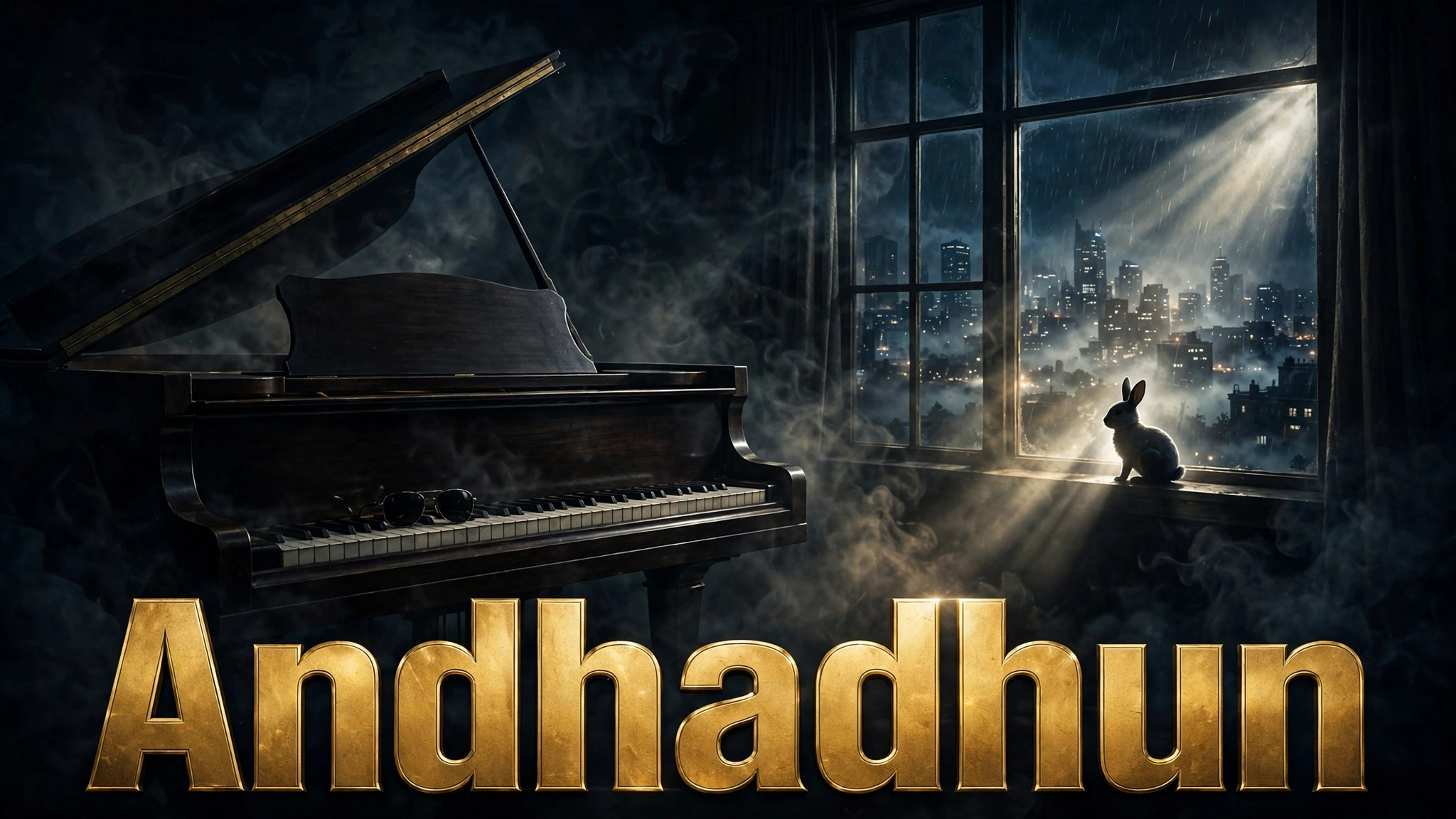

Andhadhun (2018) Review – The Pianist Who Saw Too Much
There is a particular pleasure in watching a thriller that trusts you. It shows you something, lets you draw the obvious conclusion, and then quietly reveals that your conclusion was a trap — not by cheating, but by playing fair in a way you did not notice. Andhadhun does this again and again, for over two hours, and still has one card left to play in its final minutes. It is the most fun you can have being fooled.
Directed by Sriram Raghavan, Hindi cinema’s most patient builder of suspense, the film takes a delicious premise — a pianist pretending to be blind becomes entangled in a murder he was never supposed to witness — and spins it into a blackly comic game of lies, greed, and survival. Nobody in this film is innocent. Almost everybody is lying about something. And the audience, delightfully, is in no position to feel superior, because the film lies to us too, with a straight face and perfect manners.
What elevates Andhadhun above the standard twist thriller is that the twists are not the point. The point is character: how ordinary selfishness escalates, step by reasonable step, into chaos. Each new disaster grows out of a small, understandable decision, which is why the film stays gripping even when its plot is at its most outrageous.
In this review, we will break down the spoiler-free story, the performances, the craft, the music, and the remarkable box office story — and yes, we will talk about that ending, without ruining it for those who have not seen the film.
Quick Facts: Andhadhun at a Glance
| Detail | Information |
|---|---|
| Release date | 5 October 2018 |
| Director | Sriram Raghavan |
| Writers | Sriram Raghavan, Hemanth M. Rao, Pooja Ladha Surti, Arijit Biswas, Yogesh Chandekar |
| Genre | Black comedy crime thriller |
| Language | Hindi |
| Runtime | 138 minutes |
| Budget | ₹32 crore |
| Lead cast | Tabu, Ayushmann Khurrana, Radhika Apte, Anil Dhawan |
| Our rating | 9.1/10 |
The Story: A Blind Act, a Dead Actor, and No Way Out (Spoiler-Free)
Akash is a talented young pianist in Pune who presents himself to the world as blind. Whether this is an artistic experiment, a way to sharpen his music, or simply a comfortable lie that brings sympathy and opportunities, the film leaves pleasingly ambiguous at first. What matters is that the act works — until the day it works too well. Invited to play a private concert at the home of Pramod Sinha, a retired film actor preparing a surprise for his wife Simi, Akash arrives at the flat and finds himself in the middle of a situation no blind man should be able to witness, and no sighted man would survive admitting to.
From that moment, Akash is trapped inside his own performance. To report what happened would expose his lie; to stay silent makes him part of the crime. Around him, other characters begin their own calculations — Simi, who has the most to lose; the police officer whose personal life complicates the investigation; and a cast of opportunists who smell money in somebody else’s tragedy. Akash’s girlfriend Sophie, who runs a restaurant and knows nothing of the pretence’s consequences, drifts closer to a truth that could endanger her too.
The film then moves through a series of escalating traps, double-crosses, and reversals involving ransom, organ traders, and one very memorable auto-rickshaw driver. To describe more would be theft — the surprises are the film’s currency, and they are best spent first-hand. We will say only that the closing minutes reframe everything you have just watched, and that viewers are still arguing about them years later.
Performances: Everyone Is Hiding Something
Ayushmann Khurrana as Akash: This was the performance that confirmed Khurrana as far more than the reliable face of small-town comedies. His Akash has to act within the acting — maintaining blindness convincingly while his eyes, for the audience, register panic, calculation, and guilt. It is a physically precise performance: the careful hands, the hesitations at doorways, the moments where the mask slips for half a second. He also plays the piano portions with enough conviction to sell a professional musician, and he lets Akash be selfish and foolish, not just victimised, which keeps the character interesting.
Tabu as Simi: Tabu is magnificent. Her Simi is one of the great modern Hindi film characters — glamorous, funny, terrifying, and oddly understandable, often within the same scene. She plays a woman improvising her way through a catastrophe of her own making, and the brilliance of the performance is its calm: Simi never panics the way a normal thriller character would, and that composure makes her far more frightening. Whole stretches of the film run on her face alone, as she recalculates in real time.
Radhika Apte as Sophie: Apte brings a natural, unforced warmth to Sophie, the closest thing the film has to an innocent — though even Sophie gets her moments of sharp instinct. She is the audience’s emotional anchor in a story full of schemers, and her scenes with Khurrana have an easy, lived-in quality that makes the later complications hurt.
Anil Dhawan as Pramod Sinha and the supporting cast: Dhawan is used sparingly and cleverly as the cheerful retired actor whose love of his own old films sets the plot in motion. Around the leads, the ensemble is uniformly strong: Manav Vij as the blustering inspector with secrets of his own, Ashwini Kalsekar as his formidable wife, and Zakir Hussain as a doctor whose helpfulness has a price. Nobody is wasted; almost everybody gets a scene that flips your reading of them.
Direction and Technical Craft
Sriram Raghavan directs thrillers the way chess players move — quietly, several steps ahead, and with visible enjoyment. His great gift is staging: scenes in Andhadhun are choreographed so that the audience often knows where every person in a room is, what they can and cannot see, and why a single glance would be fatal. The long, coolly observed sequence at the Sinha apartment, where the film’s central situation unfolds, is a masterclass in tension built from stillness rather than cutting.
K. U. Mohanan’s cinematography keeps Pune bright and ordinary on the surface — this is a sunlit nightmare, not a rain-soaked noir — which makes the darkness underneath funnier and more shocking. The camera’s occasional habit of adopting a watchful position, as if the film itself were peeking, suits a story entirely about who sees what.
Pooja Ladha Surti’s editing is essential to the trickery. Information is withheld and released with jeweller’s precision, and several jokes and shocks land purely because a cut arrives a beat earlier or later than expected. The pace is remarkable: at 138 minutes, with this much plot, the film never once feels rushed or padded, and its mid-film set pieces — including a sequence involving a hospital and a bag that should not be opened — keep topping themselves.
If there is a flaw, it is that the final act piles reversal upon reversal so quickly that a couple of them rest on coincidence. The film earns most of its luck through character, but once or twice the machinery shows. It is a minor complaint in a film this controlled.
Music and Background Score
Music is not decoration in Andhadhun; it is part of the plot machinery. Akash is a pianist, so the piano runs through the film’s bloodstream — classical flourishes, half-finished compositions, and a haunting recurring tune that the story itself keeps returning to. Daniel B. George’s background score understands the assignment perfectly: playful when the film is playing, icy when it is not, and always in conversation with the piano on screen.
Amit Trivedi’s songs slot in without breaking the thriller’s spell. “Naina Da Kya Kasoor” carries the romance with a light step, and “Laila Laila” adds colour without stopping the story. The title track, with guest composers Raftaar and Girish Nakod, brings a contemporary swagger that the film uses in flashes rather than full song-and-dance form — a wise choice, because every time Andhadhun leaves its plot for too long, you can feel the audience lean forward, impatient to get back to the game.
That restraint is the soundtrack’s defining virtue. In most Hindi thrillers, songs are where tension goes to die. Here, the musical moments either advance character or sharpen mood, and the film’s most suspenseful stretches are often its quietest.
What Works and What Doesn’t
What we loved:
- A screenplay that plants, pays off, and re-plants its surprises with rare discipline — almost every scene matters later
- Tabu and Ayushmann Khurrana at career-best level, playing two liars circling each other
- Direction that builds tension from staging and stillness instead of noise and jump cuts
- Dark humour woven through genuine danger, so the laughs tighten the suspense instead of releasing it
What could be better:
- The last act leans on coincidence once or twice, asking the audience’s goodwill to stretch
- A couple of supporting tracks resolve very abruptly amid the rush of final reversals
- Viewers who need a tidy, fully explained ending may find the closing ambiguity frustrating — though many of us consider it the film’s finest joke
Box Office: A Modest Thriller That Ate the World
Made for around ₹32 crore and released on 5 October 2018, Andhadhun opened respectably in India rather than spectacularly. What happened next is the interesting part. Strong reviews and fierce word of mouth turned it into a long-running hit at home, and then, in 2019, its release in China transformed its commercial story entirely. Chinese audiences embraced the film in enormous numbers, and its worldwide total climbed to an estimated ₹456.89 crore — more than fourteen times its budget.
For a dialogue-driven thriller with no conventional action set pieces and a morally slippery hero, that is an astonishing result. It also travelled critically: the film won major honours at home, including National Film Awards for Best Feature Film in Hindi, Best Actor for Khurrana, and Best Screenplay, alongside Filmfare recognition including Best Film (Critics) and Best Actor (Critics).
The film’s success sent a clear signal to the industry — a well-written thriller, released patiently, could outperform far more expensive star vehicles. Producers have been chasing that lesson ever since, with mixed results, because the real secret was never the genre. It was the writing.
Verdict: Should You Watch It?
Without hesitation. Andhadhun is one of the finest Hindi thrillers ever made — a film that respects your intelligence, rewards your attention, and still finds time to be funny, romantic, and genuinely shocking. Go in knowing as little as possible, resist spoilers with your life, and prepare to spend the journey home arguing about the ending with whoever watched it with you. That argument, by the way, has no correct resolution. That is rather the point.
Our rating: 9.1/10 — A wickedly smart, endlessly rewatchable thriller with two towering performances.
Frequently Asked Questions
Is Andhadhun based on a true story?
No. It is a work of fiction, though its makers have acknowledged taking initial inspiration from a French short film about a piano tuner who pretends to be blind. The story built on that idea is entirely its own.
Is there a sequel to Andhadhun?
No sequel has been released or officially confirmed. The film’s open ending continues to fuel speculation, but it works perfectly as a standalone story.
What language is Andhadhun in, and are subtitles available?
The film is in Hindi. Subtitled versions are widely available, and the film’s strong international release means translations are easy to find in most regions.
Where can I watch Andhadhun?
Availability varies by country and changes over time. Check the major streaming and rental platforms in your region, where the film is a regular and popular catalogue title.
What is the runtime and age rating of Andhadhun?
The film runs for 138 minutes and was certified U/A in India. It contains crime, violence, and mature themes, so it is best suited to adults and older teenagers.