★ LATEST REVIEWS

Our Rating: ★★★☆☆ 6.5/10
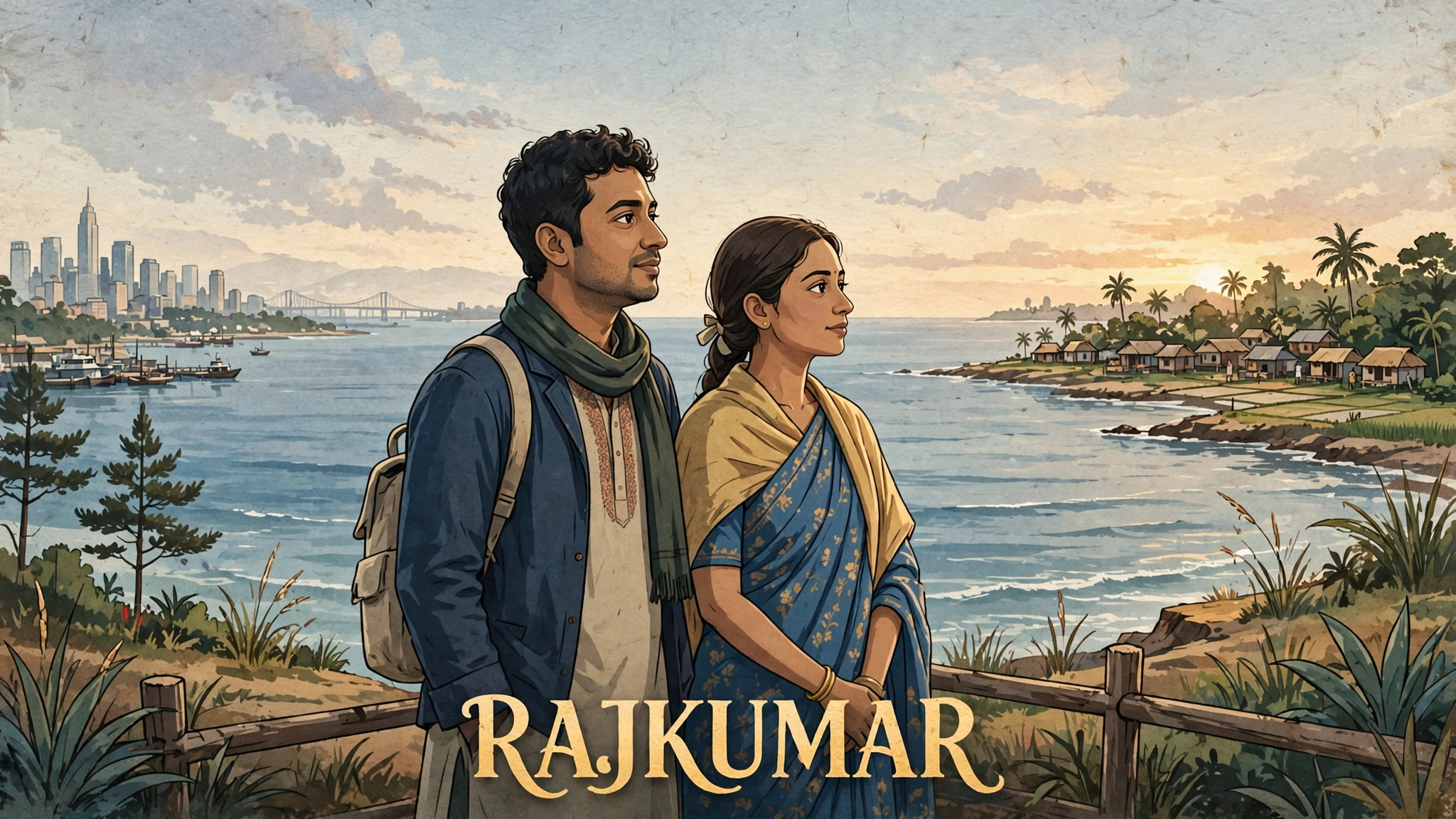
Few stars in South Asia command an audience quite like Shakib Khan does in Bangladesh. His films open big, his fans turn out in force, and his commercial power can carry a film a long way. Rajkumar, directed by Himel Ashraf and released on Eid in April 2024, is an attempt to use that power for something more ambitious than a standard star vehicle: a cross-continental drama about a man separated from his mother during the Liberation War of 1971, who travels to the United States as an adult in search of her.
That ambition is real, and it deserves credit. The film was shot on a significant budget for Dhallywood, it played in a record number of Bangladeshi cinemas, and it became one of the highest-grossing Bangladeshi films of 2024. But ambition is not the same as achievement, and Rajkumar is, frankly, an uneven film. Its central performance is committed, its premise is moving, and its commercial success is undeniable, but its storytelling is baggy, its emotional beats are often underlined rather than earned, and its second half struggles to sustain the promise of its first.
This is an honest review, and honesty requires saying that Rajkumar works best as a star showcase and a cultural event, and less well as a drama. Fans of Shakib Khan will find much to enjoy. Viewers looking for a tightly constructed film about loss and reunion may find themselves admiring the intention more than the result.
| Detail | Information |
|---|---|
| Release date | 11 April 2024 (Bangladesh) |
| Director | Himel Ashraf |
| Writers | Himel Ashraf |
| Genre | Drama, Romance, Action |
| Language | Bengali |
| Runtime | 145 minutes (some listings give 142 minutes) |
| Budget | Approximately ৳6 crore (estimated) |
| Lead cast | Shakib Khan, Courtney Coffey, Tariq Anam Khan, Mahiya Mahi, Dilara Zaman |
| Our rating | 6.5/10 |
The film’s emotional core is established early. During the upheaval of 1971, a child is separated from his mother, and that separation shapes everything that follows. As an adult, the man — Shamsul Haque, known as Sam — lives with the wound of that loss, and he eventually travels to the United States, where he believes the trail of his mother may lead. The film follows his life in America, his work, his relationships, and his continuing search, intercut with memories of the Bangladesh he left behind.
In the United States, Sam meets Julie, played by Courtney Coffey, and their relationship becomes the film’s second strand: a romance between a Bangladeshi immigrant carrying a lifetime of grief and an American woman who must learn what that grief means. Around them are family figures, including Sam’s mother and grandmother in memory and flashback, and a cast of supporting characters who represent both the Bangladeshi diaspora and the American world Sam must navigate.
This review will not reveal whether Sam finds his mother, or what that discovery costs him, because the film treats that question as its central mystery and its emotional payoff. It is fair to say, without spoiling anything, that the film’s structure — moving between Bangladesh and America, between past and present — is both its greatest opportunity and its greatest problem. When the transitions work, the film feels expansive and genuinely moving. When they do not, it feels like two films competing for the same running time.
Shakib Khan as Shamsul “Sam” Haque — Khan gives a committed, physically and emotionally engaged performance, and it is clear that he believed in this project. He plays Sam’s grief without irony and his determination without swagger, and in the film’s best scenes — quiet moments of memory, or of confrontation with his own past — he is genuinely affecting. Where the performance strains is in the film’s broader passages, where the script asks him to carry exposition and melodrama at the same time, and where his star presence occasionally overwhelms the character’s vulnerability. It is a performance to admire, even when the film around it falters.
Courtney Coffey as Julie — Coffey, an American actor cast opposite Bangladesh’s biggest star, has a difficult task: to make a cross-cultural romance believable while also serving as the audience’s entry point into Sam’s American life. She is warm and natural in her early scenes, and her chemistry with Khan is better than many cross-industry pairings manage. As the film’s melodrama intensifies, however, her character is given less to do than she deserves, and she sometimes feels like a function of Sam’s journey rather than a person in her own right.
Tariq Anam Khan, Mahiya Mahi and Dilara Zaman — The supporting cast is a mixture of strength and unevenness. Tariq Anam Khan brings gravitas to his role, Mahiya Mahi makes a strong impression in her scenes as Sam’s mother figure, and Dilara Zaman, as Sam’s grandmother, provides some of the film’s most affecting moments with relatively little screen time. Other supporting performances, particularly in the American sequences, are less consistent, and the film’s large cast sometimes works against its intimacy: too many characters compete for attention in a story that needed fewer, deeper relationships.
Himel Ashraf directs Rajkumar with visible ambition. The film moves between Bangladesh and the United States, between 1971 and the present, and Ashraf clearly wanted a film that felt international in scope while remaining rooted in Bangladeshi emotion. The cinematography by Sheikh Rajibul Islam is handsome, particularly in the Bangladeshi sequences, where village and river landscapes are filmed with warmth and care, and the production design makes a genuine effort to distinguish the two worlds Sam inhabits.
The problem is not ambition but control. At 145 minutes — some listings give 142 minutes, a small discrepancy that reflects different cuts and listings rather than a major version difference — the film has too much story for its structure. Subplots are introduced and then abandoned, emotional turning points are repeated rather than deepened, and the pacing sags in the middle, when the film should be tightening toward its climax. Ashraf’s previous collaboration with Khan, Priyotoma (2023), was a more disciplined film, and the comparison is not flattering to Rajkumar: this is a bigger film that feels less sure of itself.
The action elements, which the film’s marketing emphasised, are serviceable but unremarkable, and they sit uneasily alongside the drama. When Rajkumar trusts its central relationship — a son and a lost mother — it is moving. When it reaches for spectacle, it dilutes that power.
The music of Rajkumar, by Emon Chowdhury, Akassh, Prince Mahmud, Sajid Sarkar and Joel Van Dijk, is one of its more consistent strengths. The songs are melodic and emotionally direct, in the tradition of Bangladeshi commercial cinema, and they work best when they are allowed to carry a scene of memory or longing without dialogue competing with them. Several songs became popular on their own terms, which is no small achievement for a film whose dramatic reputation is mixed.
The background score is less restrained. It tends to underline every emotional beat, swelling whenever the film wants the audience to feel something, and that insistence can have the opposite effect, making genuine moments feel manufactured. A lighter touch in the score would have served Khan’s performance better, and it is a reminder that in melodrama, what is withheld often matters more than what is emphasised.
What we loved:
What could be better:
Whatever its artistic unevenness, Rajkumar was a major commercial success. Made for an estimated ৳6 crore, it grossed a reported ৳26 crore, making it one of the highest-grossing Bangladeshi films of 2024 and one of the highest-grossing Bangladeshi films of all time at the point of its release. Both figures should be read with the usual caution that applies to Bangladeshi box-office reporting, which is less systematically audited than in larger industries, but the scale of the success is not in doubt: the film played in a record 125 cinemas out of roughly 210 in Bangladesh, and its advance bookings were reported as unprecedented for a Bangladeshi film.
That commercial performance tells its own story about the Bangladeshi audience in 2024. Shakib Khan’s stardom, an Eid release, a story rooted in 1971, and a US-shot production were a powerful combination, and the film’s success helped confirm the new commercial scale that Dhallywood had reached with Priyotoma and Toofan. It also illustrates a familiar truth of star cinema: a film can be a hit, and can matter to its audience, without being a fully realised drama. Rajkumar mattered to a great many people, and that matters, even when a review must be honest about its flaws.
If you are a Shakib Khan fan, yes, without question — this is a film made for you, and its central performance and its scale will reward your loyalty. If you are a general viewer curious about Bangladeshi cinema, it is worth a watch with tempered expectations: come for the premise, the songs and Khan’s commitment, and be prepared for a long, uneven journey to get there. Rajkumar is not the great film its subject deserved, but it is a sincere one, and sincerity counts for something.
Our rating: 6.5/10 — An ambitious star drama whose heart is bigger than its storytelling.
What is Rajkumar about?
A Bangladeshi man separated from his mother during the 1971 Liberation War travels to the United States as an adult to search for her, in a drama of loss, romance and reunion.
Who directed Rajkumar?
Himel Ashraf, who also wrote the film. It stars Shakib Khan as Sam, with Courtney Coffey as Julie.
How long is Rajkumar?
145 minutes according to most listings, though some give 142 minutes, reflecting different cuts and listings.
Was Rajkumar a box-office hit?
Yes. It grossed a reported ৳26 crore against an estimated ৳6 crore budget, making it one of the highest-grossing Bangladeshi films of 2024.
Where can I watch Rajkumar?
It has been available on streaming and digital platforms in various regions, though availability changes over time, so check your local platforms.